


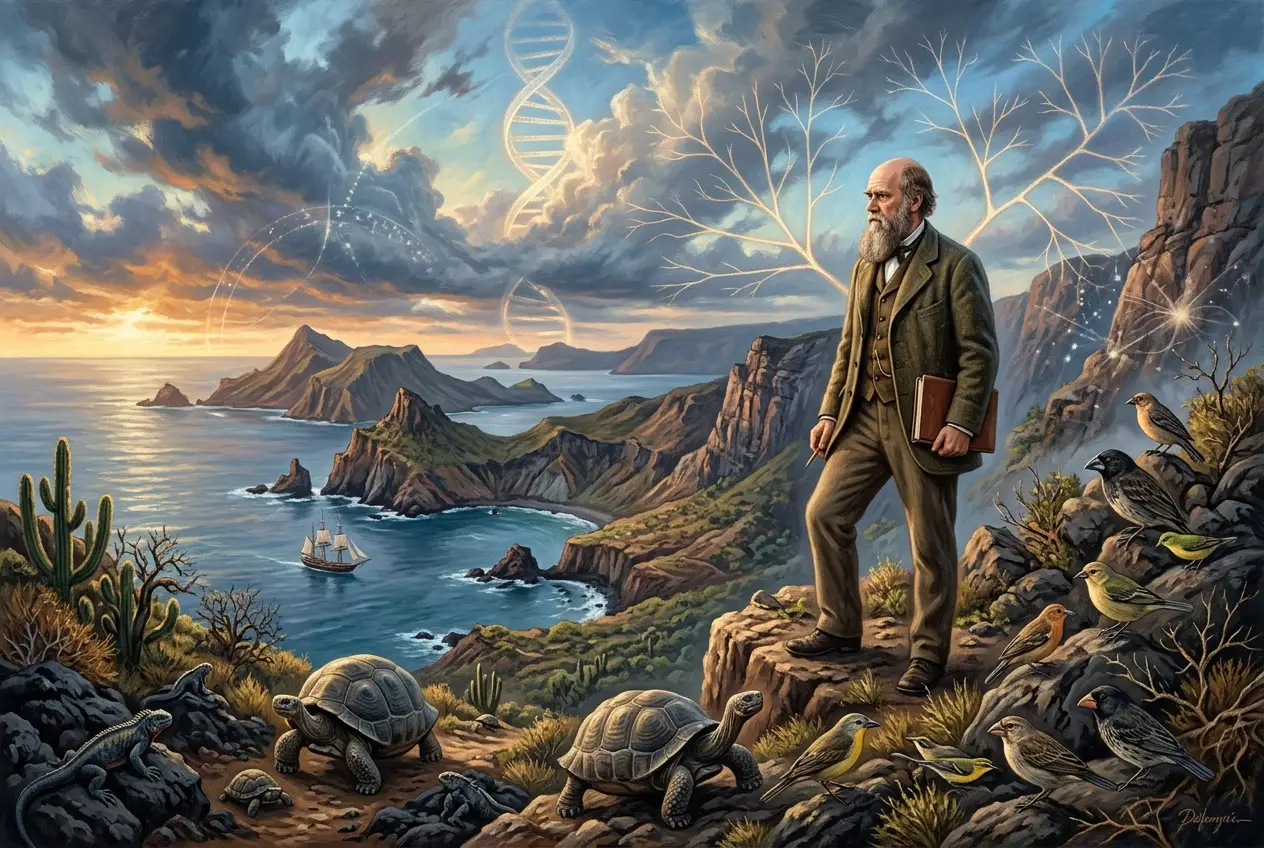
I’ve always been fascinated by moments in history where a single individual’s insights irrevocably alter humanity’s understanding of itself and the cosmos. Few figures embody this more profoundly than Charles Darwin. His name, almost synonymous with "evolution," conjures images of the HMS Beagle, the Galapagos Islands, and a revolutionary idea that shook the very foundations of scientific and religious thought. This is going to be a very long blog, delving deeply into the extraordinary life of a man whose meticulous observations, relentless curiosity, and sheer intellectual courage reshaped our perception of life on Earth. I want to take you on a journey through his formative years, his groundbreaking expedition, the decades of painstaking research that followed, and the eventual publication of a book that would change everything.
The Formative Years: A Budding Naturalist in a Traditional World
Charles Robert Darwin was born on February 12, 1809, in Shrewsbury, Shropshire, England, into a family already steeped in intellectual curiosity and scientific leaning. His paternal grandfather was the eminent physician, naturalist, and poet Erasmus Darwin, a proponent of evolutionary ideas long before Charles. His maternal grandfather was Josiah Wedgwood, the renowned potter and abolitionist. This was not a lineage destined for quiet conformity.
From an early age, I sense that Darwin was drawn not to the conventional paths laid out for him, but to the natural world. He was the fifth of six children born to Robert Waring Darwin, a wealthy and respected physician, and Susannah Wedgwood. His childhood home, The Mount, was a comfortable Georgian estate that allowed young Charles ample opportunity to indulge his burgeoning interest in collecting specimens – beetles, shells, minerals – and observing nature. This early passion for collecting was more than a hobby; it was a nascent expression of the meticulous observation that would define his life's work.
His early education at Shrewsbury School, a boarding school, was, by his own admission, largely uninspiring. He later recalled, "Nothing could have been worse for the development of my mind than Shrewsbury School." He found the classical curriculum – Greek, Latin, and ancient history – tedious, preferring to read widely on his own, particularly on natural history and geology. His father, a pragmatic man, viewed Charles's scientific interests as idle pursuits and urged him towards more respectable professions.
Disillusionment in Medicine: Edinburgh and the Call of Nature
At sixteen, following in his father's and grandfather's footsteps, Charles was sent to the University of Edinburgh to study medicine. Edinburgh was then a leading center for medical education, but Darwin quickly found himself repulsed by the brutality of 19th-century surgery, performed without anesthesia. I can only imagine the visceral discomfort he felt during operations. He largely neglected his medical studies, though he did learn taxidermy from John Edmonstone, a freed black slave from Guyana, which proved to be a practical skill he would later employ.
Instead of anatomy lectures, Darwin gravitated towards the vibrant intellectual circles of Edinburgh’s natural history scene. He became a keen member of student societies, particularly the Plinian Society, where he presented his first scientific discovery: that the black spores often found in oyster shells were the eggs of a mollusc leech. Here, I believe, he truly began to find his intellectual footing. He studied marine invertebrates with Robert Grant, a radical evolutionist and former student of Lamarck, who openly discussed evolutionary theories. While Darwin found these ideas intriguing, they didn't immediately captivate him, perhaps due to his lingering adherence to creationist views prevalent at the time. Yet, these early exposures planted seeds of doubt and inquiry.
Cambridge and Clerical Plans: A Naturalist's Detour
Seeing his son's lack of enthusiasm for medicine, Dr. Darwin next suggested a career in the Anglican clergy. In 1828, Charles matriculated at Christ's College, Cambridge, to pursue a Bachelor of Arts degree, a prerequisite for becoming a clergyman. Though his ultimate career path would diverge dramatically, I see this period as crucial for forging connections that would directly lead to his greatest adventure.
At Cambridge, Darwin was still far from a diligent theological student. He spent more time riding, shooting, and collecting beetles, a passion that consumed him. He formed close friendships with fellow naturalists and, more importantly, found mentors who recognized his potential. John Stevens Henslow, professor of botany, became a pivotal figure. Henslow encouraged Darwin's scientific pursuits, taught him systematic observation, and introduced him to other leading scientists. Henslow's courses ignited Darwin’s enthusiasm for natural science. He also read extensively, particularly works by Alexander von Humboldt and John Herschel, which inspired a dream of exploring tropical lands.
Another significant influence was Adam Sedgwick, a prominent geologist, who took Darwin on a geological field trip to Wales. This experience taught Darwin the fundamentals of geological mapping and observation, skills that would be indispensable. By the time he graduated in 1831, Darwin had abandoned any serious thought of becoming a clergyman. His true calling was becoming undeniably clear.
The Voyage of the HMS Beagle: A Five-Year Odyssey of Discovery
The pivotal moment in Charles Darwin’s life, the experience that would crystallize his observations and set him on the path to revolutionary thought, was his voyage aboard the HMS Beagle. This was an opportunity born from a confluence of luck, networking, and a deep-seated desire for exploration.
In August 1831, Professor Henslow recommended Darwin for an unpaid position as a naturalist on a two-year surveying expedition to chart the coast of South America. Captain Robert FitzRoy, the Beagle's commander, sought a well-educated gentleman companion to alleviate the solitude of command, and Darwin, with his scientific training and social standing, was an ideal candidate. Initially, Dr. Darwin objected, fearing it would be a waste of time, but he was persuaded by his brother-in-law, Josiah Wedgwood II.
I can only imagine the mixture of excitement and trepidation Darwin must have felt embarking on such a momentous journey. What began as a proposed two-year trip extended into an almost five-year odyssey, from December 1831 to October 1836. The Beagle’s mission was to survey the coast of South America, improve charts, and establish chronometric longitudes around the world. For Darwin, it was an unparalleled opportunity to explore the natural world firsthand.
South America: Unveiling a Continent's Secrets
The majority of the Beagle voyage was spent along the coast of South America, where Darwin disembarked frequently for extended overland excursions. I often reflect on the sheer physical endurance and intellectual rigor this must have required. He collected thousands of specimens – plants, animals, fossils – and meticulously recorded his geological and biological observations in notebooks. These detailed records would form the bedrock of his later theories.
In Patagonia, Darwin unearthed fossils of gigantic extinct mammals, including a Megatherium (giant sloth) and Glyptodon (armored mammal), alongside modern species. The striking similarity between these extinct forms and extant South American mammals puzzled him. Why would God create similar but distinct creatures across geological epochs? This question would nag at him. He also observed geological phenomena, like earthquakes uplifting the land, and found marine fossils high in the Andes, providing powerful evidence for Charles Lyell's uniformitarianism, a geological theory suggesting that Earth’s features were formed by slow, continuous processes over vast spans of time, rather than sudden catastrophic events. This directly challenged the prevailing catastrophist view that interpreted Earth's history through biblical accounts. Darwin carried Lyell's "Principles of Geology" with him and found its arguments compelling, gradually shifting his worldview.
While in South America, Darwin encountered a bewildering array of biodiversity. He noted regional variations in species, even within similar environments. He observed the habits of various birds, mammals, and insects, and often reflected on the struggle for existence he witnessed in nature. He sent back crates of specimens to Henslow in Cambridge, already building a reputation as a promising naturalist.
The Galapagos Islands: The Crucible of Evolution
Of all the places the Beagle visited, none proved as crucial to Darwin’s developing ideas as the Galapagos Archipelago. In September 1835, the Beagle spent five weeks exploring these isolated volcanic islands off the coast of Ecuador. I often think of this brief period as the scientific equivalent of an epiphany.
Darwin was struck by the unique fauna of the Galapagos: giant tortoises, marine iguanas, and, most famously, the finches. What truly puzzled him was that while the species on each island were distinct, they were also remarkably similar to one another and to species found on the South American mainland. He initially didn’t realize the significance of the finches, mistaking some for wrens and others for gross-beaks. It was only later, upon reviewing his specimens with ornithologists, that he understood that these were all variations of finches, each adapted to different food sources and environments on specific islands.
He observed that certain islands had different varieties of tortoises, identifiable by the shape of their shells. The local residents could even tell which island a tortoise came from just by looking at it. This pattern of variation, with subtle differences linked to geographical isolation and environmental conditions, screamed a powerful message: species were not immutable. They changed. They adapted. And this adaptation seemed to be driven by their environment.
Beyond the Galapagos: Australia, Africa, and the Return Home
After the Galapagos, the Beagle continued its circumnavigation, stopping at Tahiti, New Zealand, Australia, and various islands in the Indian Ocean, including Cocos (Keeling) Islands. In Australia, Darwin was bewildered by the marsupial fauna, so different from placental mammals he knew. He pondered how such distinct forms could arise in similar environmental niches.
The voyage concluded in October 1836, when the Beagle returned to England. Darwin, though often seasick and exhausted, disembarked a changed man. He had amassed an enormous collection of specimens, notebooks filled with observations, and, most importantly, a mind teeming with unanswered questions and nascent ideas about the origins of life's diversity. He was no longer just a collector; he was a scientist grappling with one of nature’s most profound mysteries.
The initial reception of Darwin's specimens and geological findings was enthusiastic. Henslow had already circulated some of Darwin's letters, making him somewhat famous among scientific circles. Lyell was particularly impressed. Darwin immediately set about organizing his collections, writing up his journal, and beginning the arduous process of interpreting his vast amount of data. This homecoming marked the end of an unparalleled adventure and the beginning of an even greater intellectual quest.
The Decades of Deliberation: Crafting the Theory
The period following the Beagle voyage was one of intense intellectual activity, meticulous research, and, for many years, private struggle for Darwin. He had gathered an unprecedented amount of data, but connecting the dots, formulating a coherent theory, and preparing it for public scrutiny would take over two decades.
Early Formulations: Transmutation and Species Change
Upon his return, Darwin was already leaning towards the idea of "transmutation of species" – the concept that species change over time, rather than being fixed. This was a radical departure from the prevailing view of special creation, which held that each species was individually created by God and remained unchanged. He began a series of "Transmutation Notebooks" in 1837, privately exploring these revolutionary ideas.
I think about the immense pressure he must have felt. Not only was he challenging deeply held religious beliefs, but also the scientific orthodoxy. Many respected scientists, including Lyell, believed in the fixity of species. Darwin knew he needed overwhelming evidence and an unassailable mechanism for change to convince the scientific community.
The Influence of Malthus: The Struggle for Existence
A critical turning point came in September 1838, when Darwin read Thomas Malthus's "An Essay on the Principle of Population." Malthus argued that human population tends to increase exponentially, while food supply increases arithmetically, leading to a "struggle for existence." Darwin immediately saw the application of this principle to the natural world. If more organisms are born than can survive, then there must be a struggle for resources, and only the fittest will prevail. This was the spark.
"It at once struck me that under these circumstances favourable variations would tend to be preserved, and unfavourable ones to be destroyed," Darwin later wrote in his autobiography. "The result of this would be the formation of new species." This was the core concept of natural selection. He recognized that individuals within a population exhibit variation, some of which might confer an advantage in the struggle for survival and reproduction. These advantageous traits would be passed on to offspring, gradually accumulating over generations, leading to the formation of new species.
A Secret Theory: Fear of Controversy and Meticulous Accumulation
Darwin understood the explosive nature of his ideas. The concept of humans descending from earlier life forms was particularly scandalous. His own family was religious, and he sought to avoid upsetting them or tarnishing his reputation. Therefore, he kept his theory largely secret, sharing it only with a few trusted scientific colleagues, notably Lyell and the botanist Joseph Dalton Hooker.
For years, Darwin methodically gathered evidence, cross-referencing observations from his Beagle voyage with extensive studies in selective breeding of pigeons, observations of plant and animal variations, and detailed anatomical research. He corresponded with breeders, naturalists, and scientists worldwide. He meticulously documented variations, adaptations, and geographical distributions. I picture him in his study, surrounded by specimens, books, and notebooks, painstakingly constructing his argument brick by brick. His personal life also evolved during this period; he married his cousin, Emma Wedgwood, in 1839, and they settled at Down House in Kent, where he would live and work for the rest of his life. His health was often poor, plagued by various mysterious ailments, but his intellectual drive remained undiminished.
Table: Key Influences on Darwin's Theory
| Influence | Description | Impact on Darwin's Thinking |
|---|---|---|
| HMS Beagle Voyage | Observation of diverse species, geological formations, fossils, and island biogeography. | Provided raw data for species variation, adaptation, and the realization of immense geological time. Questioned species immutability. |
| Charles Lyell | Author of "Principles of Geology," advocating uniformitarianism (gradual geological change over long periods). | Convinced Darwin of "deep time," providing the necessary timescale for natural selection to act. |
| Thomas Malthus | Essay on population growth outstripping resources, leading to a "struggle for existence." | Provided the mechanism for natural selection: competition for survival and reproduction driving the preservation of advantageous traits. |
| Artificial Selection | Observations of plant and animal breeders creating new varieties by selecting desirable traits. | Gave a direct analogy for natural selection, showing how selection pressure could lead to significant changes over generations. |
| Comparative Anatomy | Studies of homologous structures (e.g., bone structures in limbs of different mammals) suggesting common ancestry. | Provided evidence for shared ancestry and modifications of basic body plans. |
| Embryology | Similarities in early embryonic development across diverse species. | Further supported common descent, showing developmental pathways conserved across different taxa. |
| Fossil Record | Discovery of extinct forms resembling extant ones, and transitional fossils. | Demonstrated species change over geological time, illustrating extinction and the emergence of new forms. |
The Threat of Co-Discovery: Alfred Russel Wallace
Despite having formulated the core of his theory by the late 1830s, Darwin procrastinated on publication. He wanted to be exhaustive, to leave no stone unturned in his evidence. This extensive delay almost cost him sole credit for his groundbreaking idea.
In June 1858, Darwin received a package from Alfred Russel Wallace, a young British naturalist working in the Malay Archipelago. Wallace had independently conceived of a theory of evolution by natural selection, almost identical to Darwin's, and sought Darwin’s opinion on his manuscript. I can only imagine Darwin’s shock and dismay. His "life's work" was about to be scooped.
Fortunately, Darwin's friends – Lyell and Hooker – intervened. They arranged for a joint presentation of Wallace's essay and excerpts from Darwin’s unpublished writings to the Linnean Society of London on July 1, 1858. While the presentation initially drew little attention, it ensured that Darwin's priority in developing the theory was acknowledged. This event spurred Darwin into action. He immediately began compressing his extensive manuscript into an "abstract," a book he expected to be much shorter than his planned magnum opus.
On the Origin of Species: A Paradigm Shift
The publication of "On the Origin of Species by Means of Natural Selection, or the Preservation of Favoured Races in the Struggle for Life" on November 24, 1859, was an event that reverberated through the scientific, religious, and social spheres of the Victorian era, and indeed, through all subsequent human thought.
The Book's Central Arguments
Darwin's book was a masterpiece of scientific argumentation. It laid out a comprehensive, evidence-based case for evolution by natural selection. I find its structure profoundly logical and persuasive, even today.
- Variation: Individuals within any species show variation. Darwin meticulously demonstrated this through examples from domesticated animals and plants, as well as wild populations.
- Inheritance: Some of these variations are heritable, meaning they can be passed from parents to offspring. (Though Darwin didn't know the mechanism of heredity – genetics would come later – he observed its effects).
- Overproduction: More offspring are produced than can possibly survive and reproduce. This leads to a struggle for existence.
- Natural Selection: Individuals with advantageous variations are more likely to survive, reproduce, and pass on those traits to the next generation. This process "selects" for certain traits, leading to gradual change in populations over vast stretches of time.
- Descent with Modification: Over many generations, the accumulation of these changes leads to the divergence of populations, ultimately resulting in the formation of new species from common ancestors. This concept elegantly explained the branching pattern of life, often visualized as a "tree of life."
Crucially, Darwin avoided directly addressing human evolution in Origin, only hinting at it with the famous line: "Light will be thrown on the origin of man and his history." He knew this would be the most contentious point, and he wisely chose to establish the general principle of natural selection first.
Immediate Reception and Controversy
The first edition of 1,250 copies sold out on the first day. The book was a sensation, sparking intense debate and immediate controversy. Scientifically, it presented a cohesive theory with overwhelming evidence, but its implications were profound and unsettling for many.
Religious objections were perhaps the most vocal. The idea that life had evolved through natural processes, without direct divine intervention for each species, directly challenged the literal interpretation of biblical creation. The thought of humans sharing a common ancestor with apes was particularly offensive, seen as an affront to human dignity and a rejection of humanity's special place in creation.
Philosophically, Origin challenged teleological views of nature, which held that nature had a predetermined purpose or design. Darwin's mechanism of natural selection was blind, undirected, and mechanistic, operating on random variations. This removed the need for a divine designer to explain the intricate adaptations of living beings.
However, the book also found strong support among a growing number of scientists and intellectuals. Thomas Henry Huxley, a brilliant anatomist, became "Darwin's Bulldog," fiercely advocating for the theory in public debates. Joseph Dalton Hooker also championed the work. Charles Lyell, while initially hesitant to fully accept natural selection, eventually came around. The debates were often fierce and public, epitomized by the famous 1860 Oxford debate between Huxley and Bishop Samuel Wilberforce, where Huxley famously quipped about preferring an ape for an ancestor than a man who used his gifts to obscure the truth.
The Evolution of His Own Thought: Expanding on the Theory
After the monumental achievement of On the Origin of Species, Darwin continued to develop and refine his theory, addressing its implications and expanding on specific areas. He published several more significant works that further solidified the foundations of evolutionary biology.
The Descent of Man: Confronting Human Evolution
Though he had deliberately skirted the topic of human evolution in Origin, Darwin knew it was an inevitable extension of his theory. In 1871, he published "The Descent of Man, and Selection in Relation to Sex." This book directly addressed the origin of humanity, arguing that humans, like all other species, had evolved from earlier forms through natural selection.
I imagine the courage it took him to finally publish this. In Descent, he presented evidence for human ancestry from Old World monkeys, pointed out similarities in anatomy, embryology, and rudimentary organs. He also introduced the concept of sexual selection, a crucial addition to natural selection, explaining the evolution of traits that enhance an individual's ability to attract a mate, even if those traits might be detrimental to survival (e.g., a peacock's tail). This explained features that natural selection alone couldn't fully account for, such as elaborate plumage or ritualized combat.
Darwin also explored the evolution of human moral and intellectual faculties, arguing that altruism, sympathy, and intelligence could also arise through natural selection and group selection, benefiting the survival of the community. This was a direct counter-argument to those who claimed human morality was purely divine.
The Expression of the Emotions in Man and Animals: Bridging the Divide
Another fascinating work, published in 1872, was "The Expression of the Emotions in Man and Animals." This book further broke down the perceived barrier between humans and other animals. Darwin argued that many human emotional expressions (like smiling, frowning, blushing) have homologous origins in animal behaviors, serving adaptive purposes and demonstrating a continuity of emotional experience across species.
I find this work particularly insightful because it prefigures modern ethology and psychology, showing Darwin's remarkable breadth of vision. He conducted extensive observations, using photographs and questionnaires, to document how emotions were expressed across different cultures and species, demonstrating shared evolutionary roots.
Other Works: Botany and Ecology
Darwin's later career saw him delve deeply into specific areas of botany and ecology, which reinforced his evolutionary framework.
- Orchids (1862): "On the Various Contrivances by which Orchids are Fertilised by Insects" explored the intricate co-evolutionary relationships between plants and their pollinators, demonstrating how natural selection shaped these complex adaptations.
- Climbing Plants (1865): "On the Movements and Habits of Climbing Plants" was a detailed study of plant movements, showcasing his meticulous experimental approach.
- Insectivorous Plants (1875): In "Insectivorous Plants," he studied carnivorous plants, demonstrating their adaptations for trapping and digesting insects.
- The Power of Movement in Plants (1880): Co-authored with his son Francis, this work further explored plant tropisms and movements.
- Earthworms (1881): His final book, "The Formation of Vegetable Mould, through the Action of Worms, with Observations on their Habits," published just before his death, was a study of the often-overlooked role of earthworms in soil formation. It encapsulated his lifelong dedication to understanding even the humblest aspects of nature.
These later works, though less revolutionary than Origin, consistently provided further evidence and intricate examples of natural selection and adaptation in action. They showed Darwin's persistent commitment to empirical research and his ability to draw profound conclusions from seemingly minor observations.
The Man Behind the Theory: Character, Health, and Family Life
While his scientific achievements are monumental, Charles Darwin was also a complex individual with a rich personal life, marked by deep affection for his family, persistent health struggles, and a profoundly thoughtful character.
Darwin at Down House: A Secluded but Productive Life
After his marriage to Emma Wedgwood in 1839, the Darwins moved to Down House in Kent in 1842, where Charles lived for the remainder of his life. This rural retreat provided the perfect environment for his intellectual pursuits. He often referred to it as his "thinking shop." Here, he conducted countless experiments, observed nature in his garden, and wrote his most important works. His daily routine was highly structured, blending work, family time, and rest, a necessity given his chronic ill health.
His work ethic was legendary. Despite his wealth, he remained dedicated to scientific inquiry, meticulously recording observations, analyzing data, and corresponding with a vast network of naturalists and breeders. He transformed his home into a living laboratory, experimenting with plants, insects, and even pigeons.
Health Battles: A Lifelong Enigma
Darwin suffered from chronic ill health throughout his adult life, experiencing bouts of nausea, vomiting, stomach pains, severe fatigue, and headaches. The exact nature of his illness remains a subject of debate among historians and medical professionals. Theories range from Chagas disease (contracted during the Beagle voyage) to Crohn's disease, lactose intolerance, or even psychological factors exacerbated by the stress of his revolutionary ideas.
I believe these persistent ailments significantly shaped his working habits, forcing him into a disciplined routine of short work periods and long rest breaks. His ill health also meant he largely avoided public debates, leaving the vigorous defense of his theory to allies like Huxley. This seclusion, however, also allowed him to focus intensely on his research, free from the distractions of urban life and constant social engagements.
Family Life: Love, Loss, and Shared Inquiry
Darwin's marriage to Emma was a deep and enduring partnership. They had ten children, though three died in childhood. The death of his beloved daughter Annie in 1851, at the age of ten, was a particularly devastating blow that profoundly affected his faith and hardened his scientific resolve. He noted that suffering and death were an inevitable part of nature, a stark reality that aligned with his developing theory of natural selection.
Emma, deeply religious, worried about the implications of Charles's work for his soul, and their differing views on religion caused some tension. However, her unwavering love and support were crucial to his productivity. She was his confidante, his nurse, and a steadying presence. His children also became involved in his scientific endeavors, assisting with experiments and observations, reflecting a home environment permeated by intellectual curiosity. Several of his sons, including George, Francis, and Horace, went on to become distinguished scientists themselves.
The Legacy of Darwin: A Unifying Theory
Charles Darwin died on April 19, 1882, at Down House, at the age of 73. Contrary to his wish to be buried in the local churchyard, he was interred in Westminster Abbey, close to Sir Isaac Newton and Sir John Herschel, a testament to the profound impact of his contributions to science and human thought.
The Triumph of Evolution
Darwin's theory of evolution by natural selection fundamentally transformed biology. Before Darwin, biology was largely descriptive, focusing on classification and anatomical description. After Origin, biology gained a unifying explanatory framework. The bewildering diversity of life, the intricate adaptations of organisms, the patterns in the fossil record, and the similarities in embryology all made sense under the umbrella of evolution.
I often reflect on how complete his revolution was. He not only proposed that evolution occurred but also a compelling mechanism for it. While subsequent discoveries, particularly in genetics (the modern synthesis), have refined and expanded upon his ideas, the core tenets of Darwinian evolution remain central to our understanding of life. Genetics provided the missing piece: the mechanism of heredity and the source of variation (mutations).
Beyond Biology: Impact on Science and Society
Darwin’s influence extends far beyond biology. His work profoundly impacted geology, anthropology, psychology, philosophy, and even economics.
- Geology: His acceptance of Lyell's deep time solidified the concept of an ancient Earth, essential for the slow action of natural selection.
- Anthropology: The Descent of Man laid the groundwork for the scientific study of human origins, paving the way for paleontology and primatology.
- Psychology: The Expression of the Emotions inspired the study of comparative psychology and the evolutionary basis of human behavior.
- Philosophy: Darwin's ideas challenged teleology, promoting a mechanistic, undirected view of nature that influenced logical positivism and pragmatism. It forced a re-evaluation of humanity's place in the universe.
- Society and Religion: The "Darwinian Revolution" sparked intense social and religious debates that continue to this day. While many religious denominations have reconciled faith with evolution, others continue to reject it. The concept of "survival of the fittest" was, unfortunately, co-opted and misused in social Darwinism to justify colonialism, racism, and unregulated capitalism, a distortion of Darwin's original intent.
Modern Relevance: From Medicine to AI
Today, the principles of evolution are indispensable.
- Medicine: Understanding the evolution of pathogens is crucial for developing vaccines and antibiotics. The rise of antibiotic-resistant bacteria is a stark example of natural selection in action. We can trace the evolution of viruses like SARS-CoV-2 (COVID-19) to understand mutations and variants. You can read more about how understanding life's building blocks helps us with modern innovations in our blog about Can Living Cells Store Quantum Data?.
- Conservation Biology: Evolutionary principles guide efforts to protect biodiversity and manage endangered species.
- Agriculture: Breeders use evolutionary understanding to develop more resilient and productive crops and livestock.
- Computer Science and AI: Evolutionary algorithms are used in artificial intelligence and machine learning to optimize solutions to complex problems, mimicking the process of natural selection. The idea of systems adapting and "learning" through selection is deeply rooted in Darwin's insights. It's fascinating how core biological principles can be applied to digital intelligence, much like exploring if the universe is a giant neural network.
- Space Exploration: The search for extraterrestrial life is fundamentally guided by evolutionary principles, anticipating that life elsewhere might also have evolved through similar adaptive processes. This connects to questions like Could Spacetime Store Quantum Data?, as we consider how fundamental laws apply across the cosmos.
"It is not the strongest of the species that survives, nor the most intelligent that survives. It is the one that is most adaptable to change." — Although often misattributed to Darwin, this sentiment perfectly captures the essence of his theory: adaptability is key to survival.
His ideas continue to inspire new avenues of research, from epigenetics to the complex interplay of genes and environment. The tree of life that Darwin envisioned is continually being refined and expanded with new genomic data, revealing ever more intricate relationships among all living things.
Conclusion: An Enduring Legacy of Curiosity
Charles Darwin, the shy, often sickly gentleman naturalist, gave the world one of its most powerful and elegant scientific theories. His life was a testament to the power of observation, meticulous data collection, and intellectual courage. He took a perilous journey around the world, spent decades in quiet contemplation and experimentation, and finally published a book that fundamentally reshaped our understanding of life, challenging dogma and opening new horizons for scientific inquiry.
I believe Darwin's greatest legacy is not just the theory of evolution itself, but the scientific method he embodied: a relentless pursuit of truth through evidence, critical thinking, and a willingness to challenge established beliefs. He taught us that the intricate beauty and diversity of life are not the result of static perfection, but of a dynamic, ever-changing process, driven by the subtle yet powerful forces of natural selection. His work encourages us to look deeper, question more profoundly, and always remain curious about the incredible world around us. His story is a powerful reminder that the greatest revolutions often begin with a single, profound question.
&meta_title; Charles Darwin: Life, Theory, and Impact of Evolution by Natural Selection &meta_title; &meta_description; Dive deep into the extraordinary life of Charles Darwin, from his formative years and the transformative HMS Beagle voyage to the groundbreaking publication of "On the Origin of Species." Explore the meticulous research, profound insights, and enduring legacy of the man who revolutionized our understanding of life on Earth through his theory of evolution by natural selection. &meta_description;
&faqs;{"faqs":[{"id":1,"question":"What was the primary observation that led Darwin to his theory?","answer":"The variation in species across different islands of the Galapagos Archipelago, particularly the finches and tortoises, was a key observation. Darwin noted that species adapted to their specific environments, suggesting that they were not immutable but changed over time."},{"id":2,"question":"How did Thomas Malthus's work influence Darwin?","answer":"Malthus's essay on population, which posited that populations grow faster than resources, leading to a 'struggle for existence,' provided Darwin with the critical mechanism for natural selection: that individuals with advantageous traits would be more likely to survive and reproduce in a competitive environment."},{"id":3,"question":"Why did Darwin delay publishing his theory for so long?","answer":"Darwin delayed publication for over two decades due to the controversial nature of his ideas, which challenged religious and scientific orthodoxy. He wanted to gather overwhelming evidence and refine his arguments to make them unassailable, and also feared the social repercussions."},{"id":4,"question":"What is 'sexual selection,' and how does it differ from natural selection?","answer":"Sexual selection is a mode of natural selection where members of one biological sex choose mates of the other sex to a greater extent, or compete with members of the same sex for access to mates. Unlike natural selection, which focuses on survival traits, sexual selection often explains traits that improve mating success, even if they might increase survival risks (e.g., a peacock's elaborate tail)."},{"id":5,"question":"Beyond biology, what was Darwin's broader impact on scientific thought?","answer":"Darwin's work shifted scientific thought towards a mechanistic, undirected view of natural processes, challenging teleological (purpose-driven) explanations of nature. It solidified the concept of 'deep time' for Earth's history and laid foundations for modern fields like anthropology and psychology, fundamentally changing humanity's perception of its place in the natural world."},{"id":6,"question":"Are there any modern scientific fields where Darwin's theories are still applied?","answer":"Yes, Darwin's theories are fundamental to modern medicine (understanding pathogen evolution), conservation biology, agriculture, and even computer science (evolutionary algorithms in AI). His framework remains essential for understanding and addressing contemporary challenges related to life on Earth."},{"id":7,"question":"What was the 'modern synthesis' in evolutionary biology?","answer":"The modern synthesis, developed in the early 20th century, integrated Darwin's theory of natural selection with Mendelian genetics. It provided the mechanism for heredity (genes) and the source of variation (mutations) that Darwin lacked, solidifying evolution by natural selection as the central paradigm of biology."}]}&faqs; &external_links;
- Charles Darwin on Wikipedia (opens in a new tab)
- HMS Beagle on Wikipedia (opens in a new tab)
- On the Origin of Species on Wikipedia (opens in a new tab)
- Alfred Russel Wallace on Wikipedia (opens in a new tab) &external_links; &internal_links;
- Can Living Cells Store Quantum Data?
- Is the Universe a Giant Neural Network?
- Could Spacetime Store Quantum Data? &internal_links;




Conversation0
No comments yet. Be the first to share a thought — the best questions often become new stories.