


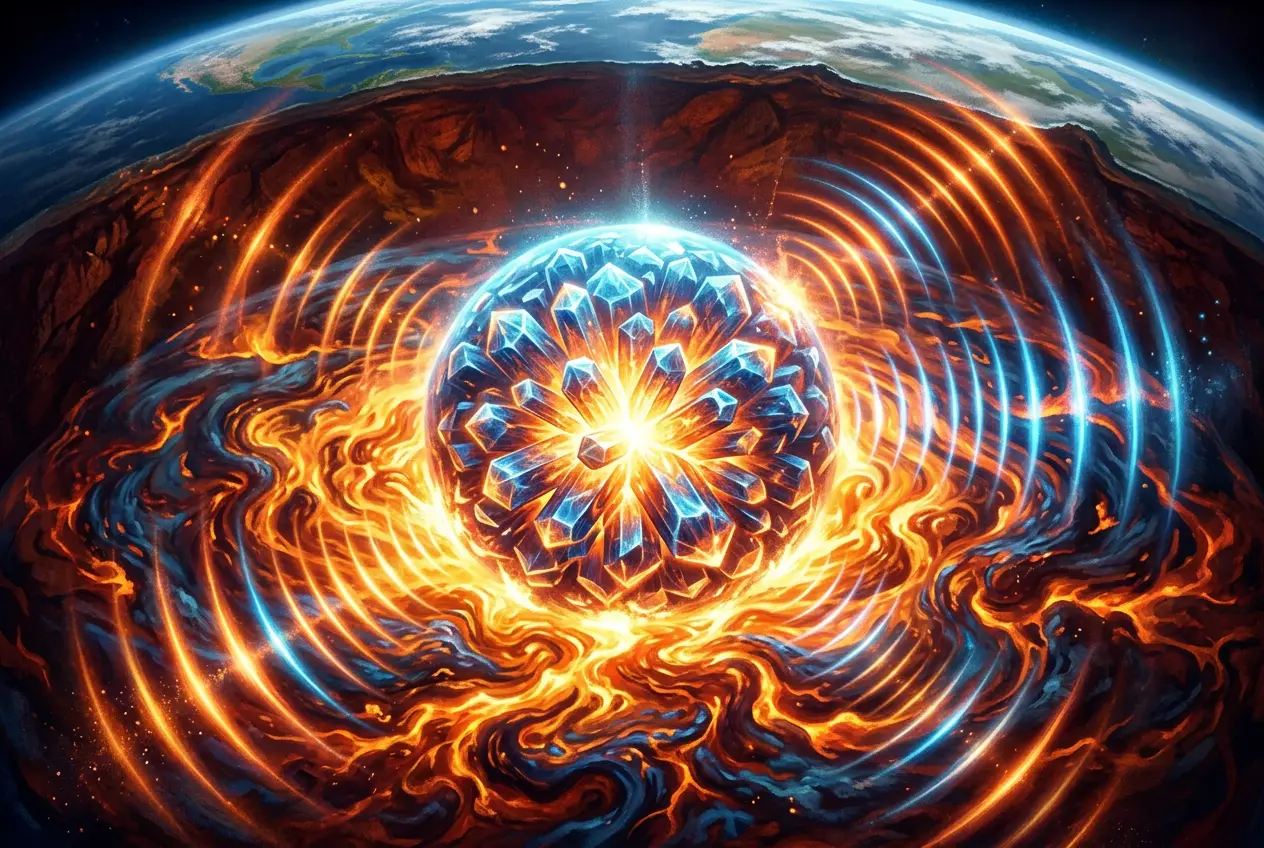
I’ve always been fascinated by what lies beneath our feet. We explore distant galaxies, probe the mysteries of black holes, and send rovers to Mars, yet the very heart of our own planet remains a profound enigma. For decades, scientists have grappled with the composition and behavior of Earth’s inner core, a realm of unfathomable pressure and scorching temperatures. Recently, a wave of new research, relying heavily on the subtle whispers of seismic waves, has suggested something truly astonishing: our planet's fiery heart might actually be a giant, slow-growing crystal.
Imagine a world within a world, a solid metallic sphere roughly the size of the Moon, spinning independently, constantly evolving. This is the Earth’s inner core, a place where iron atoms are packed together under pressures millions of times greater than at the surface, and temperatures rivaling the Sun’s surface. It’s a harsh environment, almost impossible to comprehend, let alone observe directly. So, how do we even begin to understand its secrets?
The Unseen Depths: How We 'See' the Core
Since we can't drill down to the center of the Earth – the deepest human-made boreholes only scratch the crust – our primary tool for understanding the planet's interior is seismology. When an earthquake strikes, it sends vibrations, or seismic waves, rippling through the Earth. These waves behave differently as they encounter various materials and layers within the planet. By meticulously analyzing how these waves travel, reflect, refract, and change speed, scientists can create a detailed "sonogram" of Earth’s internal structure. It's like using echoes to map the inside of a cave you can't enter.
For instance, P-waves (primary waves) and S-waves (secondary waves) have distinct characteristics. P-waves can travel through solids and liquids, while S-waves can only propagate through solids. This fundamental difference allowed Inge Lehmann, a Danish seismologist, to deduce the existence of a solid inner core surrounded by a liquid outer core back in 1936. Her groundbreaking work was a triumph of indirect observation, painting a picture of what seemed impossible to see. You can read more about her contributions on Wikipedia (opens in a new tab).
The Anisotropy Enigma: A Clue to Crystallization
The plot thickens when we look closer at how seismic waves travel through the inner core itself. Scientists have long observed a puzzling phenomenon: seismic anisotropy. This means that seismic waves travel at different speeds depending on the direction they’re moving through the inner core. Waves traveling parallel to the Earth's rotational axis (from pole to pole) move faster than those traveling perpendicular (along the equator).
What could cause such directional dependence in wave speed? In materials science, anisotropy is a hallmark of crystalline structures. In a perfectly isotropic (uniform) material, waves would travel at the same speed in all directions. But if the material is made of organized crystals aligned in a certain way, the waves will encounter different atomic arrangements depending on their path, leading to variations in speed. This led many to theorize that the inner core isn't just solid iron, but that its iron crystals are aligned in a specific, preferential orientation.
The "Giant Crystal" Hypothesis
The idea of the inner core being a giant crystal isn't new, but recent advancements in seismic imaging and computational modeling have allowed scientists to propose more detailed and compelling models for its structure. Different research teams have put forward various arrangements, from a single, enormous crystal to a mosaic of smaller, tightly aligned crystals.
One prominent theory, supported by seismic data analysis, suggests that the inner core is dominated by a specific type of iron crystal structure, possibly hexagonal close-packed (HCP) iron, aligned along the Earth's rotational axis. Imagine billions of tiny iron crystals, all slowly growing and orienting themselves in the same direction, much like ice crystals forming in a block of ice, but on a planetary scale and under unimaginable conditions. This alignment would explain the observed anisotropy, with waves passing along the preferred crystal orientation traveling faster.
A study published in Nature Geoscience in 2021, for example, proposed a new model where the inner core's innermost region, a "ball within a ball," shows a different kind of anisotropy, suggesting a complex, multi-stage crystallization process. This further indicates that the inner core is not a simple, uniform sphere, but a dynamic, structured entity. This continuous research into Earth's deepest secrets often reveals layers of complexity we never anticipated, echoing the ongoing discoveries in fields like astrophysics, where we constantly re-evaluate our understanding of cosmic phenomena. For more insights into the inner core's layers, you can check out this Wikipedia article on the inner core (opens in a new tab).
How Does a Crystal Grow Under Such Conditions?
The conditions at the Earth’s core are extreme: temperatures estimated to be between 5,200 and 6,200 Kelvin (about 9,000 to 10,700 degrees Fahrenheit) and pressures exceeding 3.6 million atmospheres. At these pressures, iron behaves very differently than it does on the surface. It undergoes phase transitions, changing its atomic arrangement.
The inner core is believed to be growing slowly, solidifying from the molten iron of the outer core at a rate of about one millimeter per year. As the Earth gradually cools over billions of years, liquid iron at the boundary between the inner and outer core freezes onto the solid inner core. This slow, continuous crystallization process, influenced by the intense pressure and the Earth's magnetic field, could lead to the preferential alignment of iron crystals over geological timescales. This process also has profound implications for the Earth's magnetic field, which is generated by the convection currents in the liquid outer core as it cools and solidifies around the growing inner core. For a deeper dive into the complexities of geomagnetism, you might find our blog on is earths magnetic field flipping unpacking geologic reversals 8076 intriguing.
Implications for Planetary Science and Beyond
The revelation that Earth's inner core might be a giant crystal has far-reaching implications:
- Understanding Earth's Formation and Evolution: The structure of the core tells us about the conditions present when Earth formed and how it has changed over billions of years. It helps constrain models of planetary differentiation.
- Magnetic Field Generation: The inner core’s growth and interaction with the liquid outer core are crucial for generating Earth’s geomagnetic field, which protects us from harmful solar radiation. Changes in crystallization patterns could influence the magnetic field's strength and stability. You can learn more about this interplay on Wikipedia (opens in a new tab).
- Seismic Wave Propagation: A better understanding of the inner core's anisotropy improves our ability to model seismic wave paths, which in turn enhances our capacity for earthquake detection and even predicting their potential impact. This is similar to how we try to understand other subtle planetary signals, like the Earth's faint hum discussed in earths-hidden-pulse-does-our-planet-hum-a-secret-song-3124.
- Comparative Planetology: If Earth's core has a specific crystalline structure, it raises questions about the cores of other rocky planets like Mars or Venus. Do they also have anisotropic inner cores? What does this tell us about their formation and geological activity?
While the direct observation of the inner core remains beyond our current technological capabilities, I find it truly astounding how much we can infer from the subtle echoes reaching us from over 6,000 kilometers beneath the surface. It’s a testament to human ingenuity and the power of scientific inquiry.
As scientists continue to refine their models and gather more seismic data, the picture of our planet's heart will become even clearer. Perhaps one day, we will have a definitive answer to whether our Earth truly harbors a planetary-scale crystal, silently humming at its core. It's a reminder that even in our own backyard, incredible mysteries still await discovery, challenging us to look deeper and listen more closely to the whispers of our world. Just as we try to decipher if animals can sense quakes decoding earths alarms 5752, we are constantly refining our methods to understand the planet's internal signals.
The pursuit of these deep Earth mysteries reminds me that the world is filled with phenomena that push the boundaries of our imagination, much like the idea of did earths crust hold natural superconductors 7175 or other scientific anomalies. It's not just about what we can see, but what we can deduce from the subtle evidence presented by nature itself.



Conversation0
No comments yet. Be the first to share a thought — the best questions often become new stories.