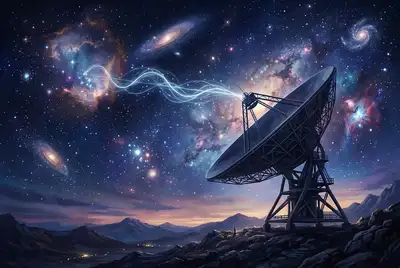
I often find myself gazing up at the night sky, a vast, silent canvas painted with countless stars and galaxies. It’s a profound experience, prompting questions about what truly lies beyond our visual grasp. We’ve sent probes, built powerful telescopes, and developed sophisticated algorithms, yet the universe continues to throw us curveballs—anomalies that defy our current understanding. Recently, I've been fascinated by a growing question: could Artificial Intelligence be the key to unlocking these hidden cosmic anomalies, patterns, and secrets that elude even our sharpest human minds?
For centuries, astronomers have meticulously cataloged the cosmos, charting everything from the rhythmic dance of binary stars to the breathtaking expanse of galaxy clusters. But what about the things that don't fit neatly into our models? The flickering signals, the inexplicable gravitational pulls, the objects that appear and disappear without a trace? These are the cosmic anomalies, and they represent the frontier of our understanding. Traditional methods, while powerful, are increasingly overwhelmed by the sheer volume and complexity of data streaming in from new-generation telescopes. This is where AI steps onto the stage, not as a replacement for human ingenuity, but as an indispensable partner in the ultimate cosmic detective story.
## The Data Deluge: Why AI is Our New Telescope
The universe is a master of big data. Observatories like the Vera C. Rubin Observatory (which will soon begin operations) and the Square Kilometre Array are set to generate petabytes of data daily. This isn't just a lot of information; it's a torrent of raw numbers, images, and spectra that no human team could possibly sift through in its entirety. This astronomical data deluge presents both an incredible opportunity and a daunting challenge.
Imagine trying to find a needle in a haystack, but the haystack is the size of a continent, and it’s growing by the second. That’s the task facing astrophysicists today. Traditional analysis often relies on human-defined parameters and assumptions, which means we might inadvertently filter out the very anomalies we’re looking for because they don't conform to our preconceived notions. This is a critical limitation when searching for the truly unexpected.
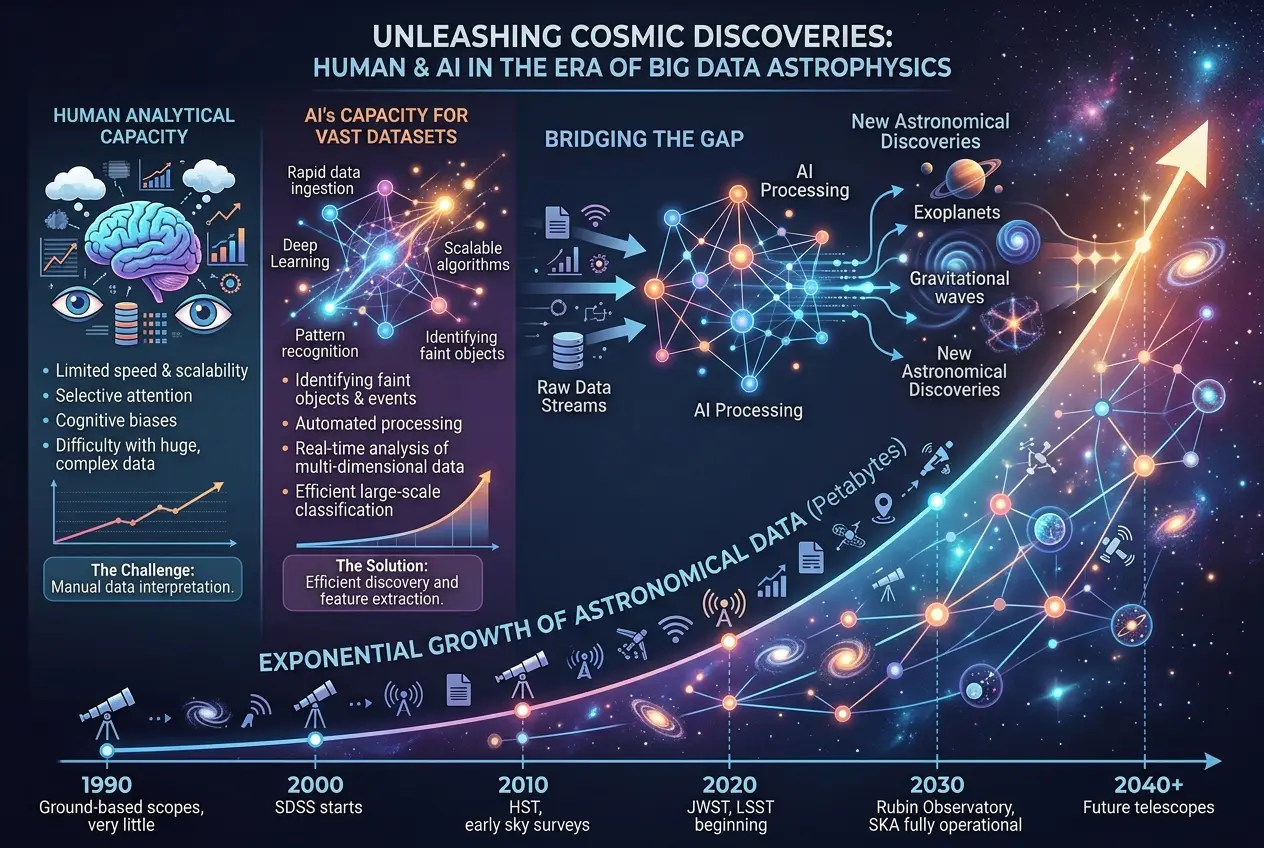
Artificial Intelligence, particularly through machine learning and deep learning techniques, offers a powerful solution. These algorithms are designed to process colossal amounts of information, identify subtle patterns, and flag deviations from established norms—all without human bias. They can learn from existing datasets of known celestial objects and then scan new data for anything that doesn't match, or for patterns that are simply too intricate for the human eye to discern. This ability to perform rapid, unbiased, and exhaustive analysis is what makes AI an almost perfect tool for cosmic anomaly detection.
## Whispers in the Cosmic Static: How AI Hears the Unheard
AI's power in uncovering anomalies stems from several key capabilities:
### Pattern Recognition Beyond Human Perception
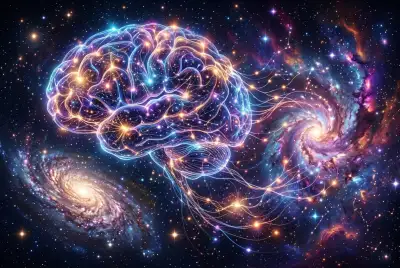
Our brains are excellent at pattern recognition, but they are limited by what they've been trained on and by sheer processing speed. AI algorithms, especially neural networks, can be trained on vast libraries of astronomical images and data. They can then identify subtle irregularities that might escape human observers, perhaps a tiny fluctuation in light that signals a unique event or an unusual clustering of distant galaxies. For instance, detecting rare gravitational lensing events, which hint at the presence of dark matter, can be significantly augmented by AI. You can read more about how AI leverages these networks on Wikipedia's page about [Artificial Neural Networks](https://en.wikipedia.org/wiki/Artificial_neural_network).
### Hunting for Transient Events
The universe is far from static. From supernovae explosions to fast radio bursts (FRBs), transient events are fleeting phenomena that often appear and disappear rapidly. Catching these "blink-and-you-miss-it" moments requires constant vigilance and rapid analysis. AI-powered telescopes can continuously monitor the sky, immediately flagging any unusual bursts of energy or light for further investigation. This real-time detection significantly increases our chances of studying these elusive cosmic occurrences.
### Decoding the Enigma of Dark Matter and Dark Energy
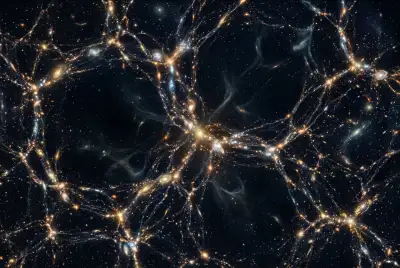
The biggest cosmic anomalies of all are dark matter and dark energy. We know they exist because of their gravitational effects and the expansion of the universe, but we cannot directly observe them. AI could play a pivotal role in mapping their distribution and understanding their properties. By analyzing subtle distortions in light from distant galaxies (gravitational lensing) or peculiar movements of celestial bodies, AI models can infer the presence of unseen matter or energy with greater precision than ever before. This connects directly to the ongoing quest to understand the universe's hidden dimensions, a topic we touched upon in our blog about [decoding reality: does the universe hide extra dimensions](blogs/decoding-reality-does-the-universe-hide-extra-dimensions-5269).
## AI in Action: Real-World Cosmic Discoveries
The application of AI in astrophysics is no longer a theoretical concept; it's actively leading to groundbreaking discoveries.
### Exoplanet Detection and Characterization
Finding exoplanets, especially small, rocky ones, is like searching for a firefly next to a lighthouse. AI algorithms are proving incredibly effective at sifting through stellar light curves from missions like Kepler and TESS, identifying the tiny dips that indicate a planet transiting its star. Beyond detection, AI is also helping to characterize these worlds, estimating their size, mass, and even potential atmospheric compositions based on subtle spectroscopic data. The sheer scale of exoplanet data makes AI indispensable for future discoveries. You can explore the fascinating methods on the [Exoplanet Wikipedia page](https://en.wikipedia.org/wiki/Exoplanet).
### Unmasking Gravitational Wave Sources
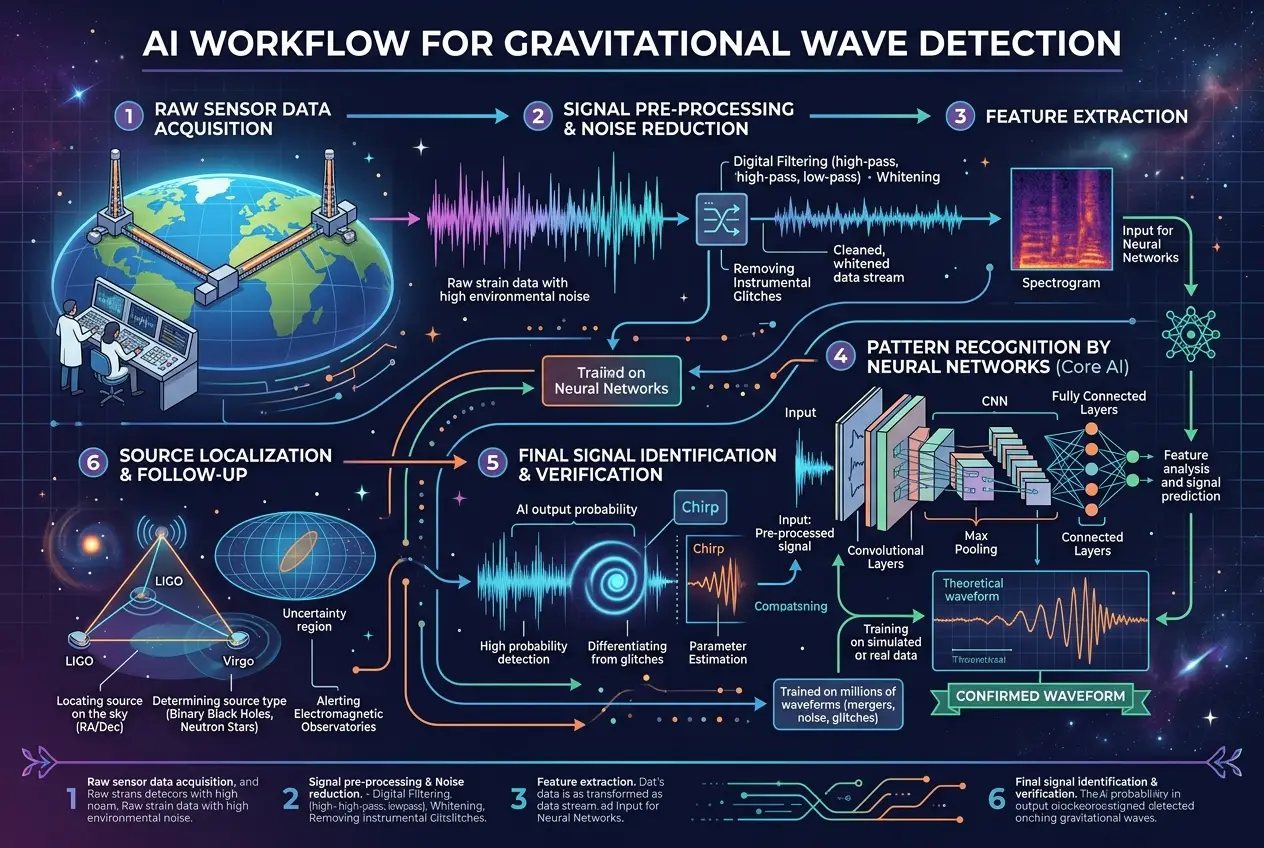
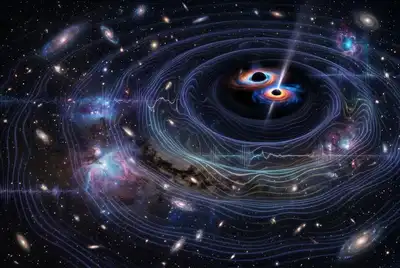
The groundbreaking detection of gravitational waves by LIGO opened a new window to the universe. These ripples in spacetime are extremely faint, and extracting their signals from noisy detector data is a monumental task. AI, particularly deep learning models, is being used to rapidly identify and classify gravitational wave events, differentiating them from instrumental noise and helping pinpoint the cosmic collisions of black holes or neutron stars that cause them. This has dramatically accelerated the rate at which we confirm these events.
### Cataloging Galaxies and Quasars
Astronomical surveys produce images of billions of galaxies. Classifying these by morphology (spiral, elliptical, irregular) or by spectral characteristics is crucial for understanding galactic evolution. AI models can perform this classification with remarkable speed and accuracy, far outperforming human efforts. They can also identify rare objects like quasars, which are incredibly luminous active galactic nuclei, distinguishing them from ordinary stars or galaxies. This enhanced cataloging helps astronomers identify outliers that might represent new, exciting phenomena.
## The Future of Cosmic Anomaly Hunting: Beyond Our Wildest Dreams
As AI technology continues to advance, its role in uncovering cosmic anomalies will only grow. I anticipate a future where AI-powered telescopes autonomously scan the skies, immediately notifying human researchers of unprecedented events. We might see:
* **Autonomous Observatories:** Telescopes that make their own observation decisions, optimize data collection, and filter out noise, constantly hunting for the anomalous.
* **Predictive Astrophysics:** AI models that not only identify anomalies but also begin to predict where and when certain rare events might occur, based on complex simulations and observational data.
* **A New Understanding of Physics:** By identifying phenomena that defy our current physical laws, AI could push the boundaries of theoretical physics, leading to entirely new paradigms. Perhaps it will even help us understand if "rogue black holes" are more common than we think, a fascinating topic explored in our article [Do Rogue Black Holes Threaten Our Galaxy?](blogs/do-rogue-black-holes-threaten-our-galaxy-6767).
### Ethical Considerations and the Human Element
While the promise of AI is immense, it's crucial to remember that AI is a tool. The interpretations, the hypotheses, and the ultimate understanding still require human insight and critical thinking. There's also the challenge of "explainable AI"—understanding *why* an AI flags something as anomalous, rather than simply accepting its output. The collaboration between human scientists and intelligent machines will be the true driving force behind future discoveries. As the scientific community delves deeper into applying AI, discussions around bias in data and model transparency are becoming increasingly important. A comprehensive overview of these considerations can be found on Wikipedia's page on [Ethics of Artificial Intelligence](https://en.wikipedia.org/wiki/Ethics_of_artificial_intelligence).
The journey to understand the universe is an endless one. As we grapple with the vastness of space and the intricacies of cosmic phenomena, AI offers a new lens through which to view reality. It provides us with the processing power to handle unprecedented scales of data and the unbiased analytical capabilities to spot the tiny deviations that might signify something truly extraordinary. The universe is whispering its secrets, and with AI, we might finally be ready to listen.
Could AI help us unravel the mystery of the Fermi Paradox, a topic we explored in [Why Is The Universe So Quiet? Decoding The Fermi Paradox](blogs/why-is-the-universe-so-quiet-decoding-the-fermi-paradox-5418)? Only time, and advanced algorithms, will tell.
Frequently Asked Questions
AI can help uncover a wide range of cosmic anomalies, including transient events like Fast Radio Bursts (FRBs), unusual gravitational lensing patterns indicative of dark matter, unexpected exoplanet behaviors, peculiar galactic formations, and subtle signatures of gravitational waves. Its strength lies in identifying patterns too subtle or complex for human observation.
AI, particularly deep learning models like neural networks, can process astronomical data on a massive scale and learn intricate correlations and features without explicit programming for each specific anomaly. This allows it to identify deviations from expected norms, recognize subtle statistical fluctuations, or find new types of patterns in multi-dimensional datasets that human eyes or traditional algorithms might overlook due to volume or complexity.
No, AI is not replacing human astronomers; rather, it's augmenting their capabilities. AI acts as a powerful tool for initial data processing, pattern recognition, and flagging potential anomalies, freeing up human scientists to focus on hypothesis generation, in-depth analysis of flagged events, and designing new experiments. It's a collaborative partnership that enhances discovery.
Key challenges include ensuring data quality and consistency, the need for 'explainable AI' (understanding why an AI flags an anomaly), avoiding biases in training data that might lead to missed discoveries, and the computational resources required for processing vast astronomical datasets. Distinguishing genuine anomalies from data noise or instrumental errors is also an ongoing challenge.
AI helps in understanding dark matter and dark energy by analyzing subtle gravitational lensing effects, peculiar galaxy movements, and large-scale structure formation in the universe. By processing vast amounts of observational data, AI can infer the distribution and properties of these invisible cosmic components with greater precision, helping refine our theoretical models.
Verified Expert
Alex Rivers
A professional researcher since age twelve, I delve into mysteries and ignite curiosity by presenting an array of compelling possibilities. I will heighten your curiosity, but by the end, you will possess profound knowledge.
Leave a Reply
Comments (0)
No approved comments yet. Be the first to share your thoughts!
 Join Us
 Unknown Author










Leave a Reply
Comments (0)