


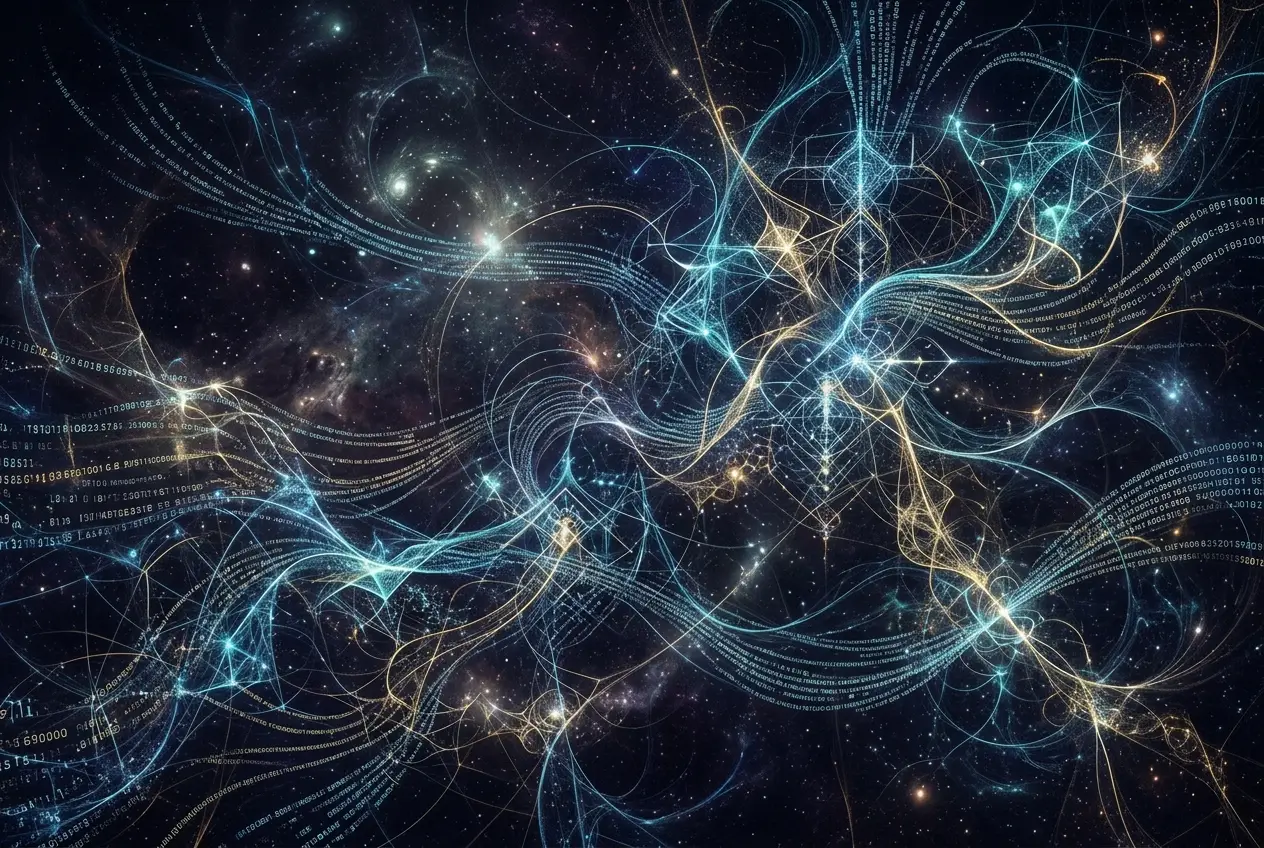
I’ve always been fascinated by the idea of lost information. Think about it: a forgotten diary, a corrupted hard drive, or ancient texts wiped from history. The thought of valuable data vanishing is a poignant one, reflecting our human struggle to preserve knowledge. But what if the greatest repository of lost information isn't a crumbling library or an old server farm, but the very fabric of the universe itself? What if the "empty" space between stars and galaxies isn't truly empty, but a vast, silent archive, holding echoes of everything that has ever been?
It sounds like science fiction, I know. But modern physics, peering into the deepest mysteries of the cosmos, is beginning to hint at a reality far stranger and more profound than we ever imagined. The concept of space as a blank canvas is, increasingly, an outdated one.
The Quantum Foam: Is Nothing Truly Empty?
When we picture empty space, we often envision a void – a perfect vacuum devoid of matter, energy, or even light. However, quantum mechanics paints a radically different picture. What we perceive as "nothingness" is, in fact, a bustling, seething ocean of activity known as the quantum vacuum.
Imagine this: even in the darkest, coldest reaches of space, elementary particles are constantly winking into and out of existence. These "virtual particles" live for an infinitesimally brief moment, appearing in particle-antiparticle pairs, only to annihilate each other almost immediately. This continuous dance of creation and destruction forms a kind of energetic "foam" that pervades all of reality. This is not just theoretical conjecture; experiments like the Casimir effect provide compelling evidence for the reality of these vacuum fluctuations (see more on the Quantum Vacuum on Wikipedia (opens in a new tab)).
If this "nothing" is constantly in motion, fluctuating with energy, could it also be a medium for information? Could the subtle ripples within this quantum foam encode details about past events, forgotten civilizations, or even the fundamental blueprint of the cosmos?
Information as a Fundamental Cosmic Currency
In physics, information isn't just data on a computer chip; it’s a fundamental property of matter and energy. It describes the state of a system. When something happens in the universe – a star is born, a black hole swallows matter, a thought crosses your mind – information is involved. The laws of physics dictate that information, much like energy, cannot be truly destroyed. It can be transformed, scrambled, or diffused, but it doesn't simply vanish. This principle is at the heart of the information paradox that arises with black holes.
One of the most mind-bending ideas in this realm is the Bekenstein bound. Proposed by physicist Jacob Bekenstein, it suggests that there's a finite maximum amount of information that can be contained within a given region of space, and this maximum is proportional to the area of its boundary, not its volume. This is counter-intuitive. We usually think of information scaling with volume. Think of a hard drive: the more volume, the more data. But Bekenstein's work hinted that the universe might store information differently. This concept leads us to some truly profound ideas.
Black Holes: Cosmic Incinerators or Information Archives?
Black holes are often considered the ultimate cosmic shredders, crushing everything that falls into them into an infinitely dense singularity. For decades, physicists like Stephen Hawking wrestled with the implications of this. If matter falls into a black hole, and then the black hole eventually evaporates via Hawking radiation, where does the information about the original matter go? Is it truly lost? If so, it would violate the fundamental principle of information conservation.
The prevailing view now, primarily driven by the holographic principle, suggests that information is not lost. Instead, it's somehow "encoded" onto the two-dimensional surface of the black hole's event horizon, much like a hologram stores a 3D image on a 2D surface. This doesn't mean the information is easy to retrieve, but it implies it's not destroyed. You can read more about this fascinating concept on Wikipedia's Black Hole Information Paradox page (opens in a new tab).
This idea of information being stored on a boundary, rather than within a volume, isn't limited to black holes. It suggests a much grander possibility for the entire cosmos.
The Holographic Universe: A Cosmic Projection?
What if the entire universe operates on a similar principle? The holographic principle (learn more about it on Wikipedia (opens in a new tab)) proposes that all the information describing our three-dimensional universe could be encoded on a distant, two-dimensional boundary – a sort of cosmic horizon. Our perceived 3D reality would then be a projection, a grand illusion emerging from this flattened informational surface.
If this is true, then the seemingly "empty" space around us isn't empty at all. It's a manifestation of information projected from an unimaginable distant source. Every particle, every field, every interaction, every historical event could be meticulously recorded and replayed, not just within the volume of space, but as a subtle imprint on its boundaries. This aligns with ideas explored in our previous discussion on whether Is Empty Space a Quantum Computer?, where we considered how fundamental processes could act as computational mechanisms.
Could the "lost data" of the universe be etched into this holographic boundary, waiting for an advanced civilization – perhaps even ourselves in the distant future – to find a way to "read" it?
Deciphering the Cosmic Archive
The implications of empty space holding the universe's lost data are staggering. Imagine a cosmic hard drive, not made of silicon or magnetic fields, but of spacetime itself, or the quantum vacuum. If we could tap into this, what would we discover?
- The Big Bang's first moments: A direct recording of cosmic genesis.
- Lost civilizations: Proof of life across the cosmos, their histories and technologies.
- Fundamental laws: A deeper understanding of physics, perhaps even the ability to "rewind" universal processes.
The challenge, of course, is monumental. How do you even begin to "read" information encoded in the quantum foam or on a cosmic horizon? It would require technologies far beyond our current grasp, perhaps involving manipulating spacetime itself or understanding quantum gravity on a scale we can only dream of. However, if our reality is indeed a holographic projection, then the "data" is already intrinsically linked to our existence. The question becomes one of decryption.
The journey to understanding this hidden cosmic archive will likely involve breakthroughs in quantum information theory, gravity, and our understanding of the very fabric of reality. It might even connect to the idea of whether Do Quantum Fluctuations Code Our Reality?, suggesting that the "code" is embedded in the vacuum itself. The data might not be "stored" in the way we store files on a disk, but rather as emergent properties of the underlying quantum fields.
Towards a Future of Cosmic Information Retrieval?
While current technology is light-years away from such capabilities, the conceptual framework is being laid. Scientists are exploring ways to manipulate quantum states and entanglement, which are the building blocks of information at the smallest scales. Perhaps the ability to extract data from the vacuum isn't about building a giant cosmic scanner, but about understanding and interacting with the fundamental informational structure of reality.
We're already probing the idea that Could Spacetime Store Quantum Data?, and the vacuum is an intrinsic part of spacetime. If the universe truly maintains a perfect record of all information, then the search for lost knowledge isn't limited to dusty archaeological digs or forgotten digital archives. It extends to the very "emptiness" of space, which might hold the greatest secrets of all time.
The universe, in this view, is not just a stage for events but also the ultimate record-keeper. It's a thought that humbles and excites me simultaneously, pushing the boundaries of what we consider possible. If we can ever learn to read its ancient script, the "empty" void might reveal the most incredible stories ever told.
Conclusion
The notion that empty space might be a cosmic library, an archive of all universal data, is one of the most intriguing propositions to emerge from modern physics. From the bustling quantum vacuum to the profound implications of black holes and the holographic principle, science increasingly suggests that information is never truly lost – it’s merely re-encoded into the fabric of existence. While the methods for deciphering this cosmic script remain firmly in the realm of future technology, the very idea compels us to rethink our understanding of reality, reminding us that the deepest mysteries often lie in the places we least expect: within the silent, seemingly empty spaces that define our universe.



Conversation0
No comments yet. Be the first to share a thought — the best questions often become new stories.