



The notion that ancient civilizations, equipped with rudimentary tools and a profound connection to the natural world, might have built devices or structures capable of processing cosmic information on a scale we consider "computational" often seems like something plucked from science fiction. Yet, as I delve deeper into the mysteries surrounding megalithic structures and sophisticated ancient alignments, a fascinating question emerges: could some ancient sites have functioned as cosmic supercomputers? I’m not talking about silicon chips or electrical circuits, but rather intricate systems designed to model, predict, and perhaps even interact with celestial mechanics and cosmic phenomena, built from stone, earth, and a deep understanding of the universe.
For centuries, many ancient monuments were seen merely as ceremonial spaces or simple observatories. We admired their astronomical alignments, noting how certain stones or openings perfectly framed the sunrise on the solstice or the setting of a particular star. But what if this understanding barely scratches the surface? What if these vast, deliberately constructed sites were far more complex, representing an advanced form of data processing – a cosmic computation engine built into the very landscape?
Think about it. We define a computer as a device that performs calculations, stores information, and processes data. While ancient societies lacked our digital infrastructure, they certainly possessed immense capabilities for observation, measurement, and the systematic recording of patterns. When we look at sites like Stonehenge, the pyramids of Giza, or the intricate structures of Chichen Itza, we see not just stones, but precisely engineered systems that encode astronomical knowledge with astounding accuracy. Could this encoding and predictive capability be interpreted as a form of ancient, analog "cosmic computing"?
The Antikythera Precedent: A Glimpse of Ancient Sophistication
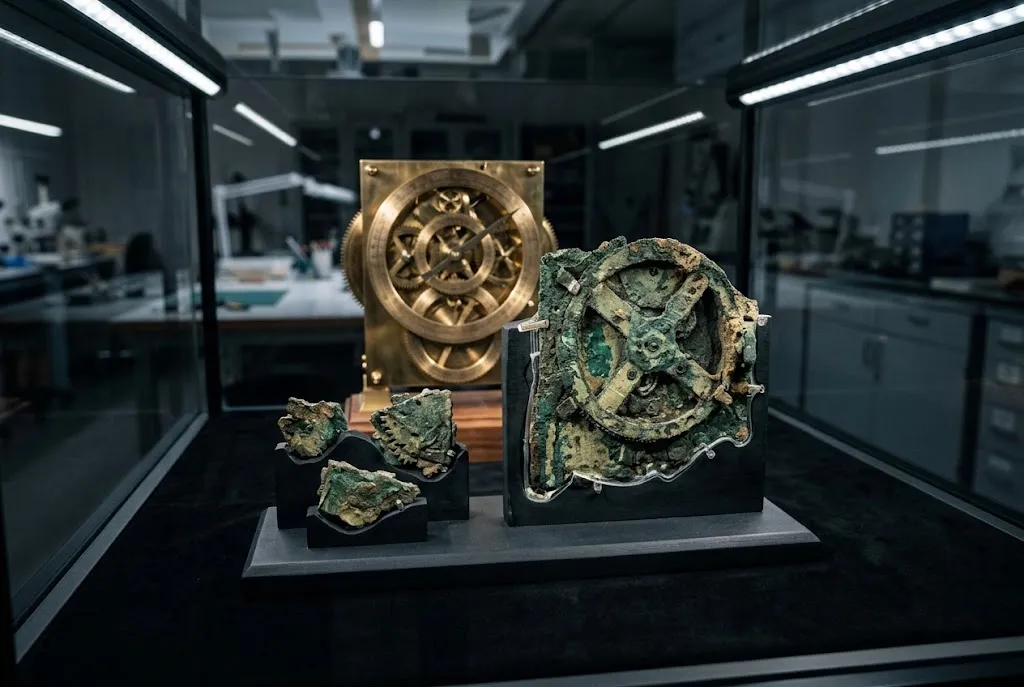
Before diving into megalithic structures, I must acknowledge the remarkable Antikythera Mechanism. Discovered in a shipwreck off the coast of Greece, this intricate device, dating back to the 2nd century BCE, is widely regarded as the world's first analog computer. Its complex gears and dials were designed to predict astronomical positions and eclipses decades in advance. You can read more about its complexities in our earlier blog, Antikythera: Was it Our First Analog Computer?.
The Antikythera Mechanism undeniably proves that ancient minds were capable of constructing sophisticated machines for cosmic computation. This single artifact shatters the perception of antiquity as technologically primitive. If such a device could exist, what other forms of "cosmic computing" might have been developed, perhaps on a grander, architectural scale, across different cultures and continents?
Megalithic Observatories: More Than Just Stargazing?
Many ancient structures exhibit extraordinary precision in their astronomical alignments. Stonehenge in England, for instance, aligns perfectly with the summer solstice sunrise and the winter solstice sunset. The Carnac stones in Brittany, France, comprise thousands of megaliths arranged in complex patterns that some researchers believe track lunar cycles and other celestial events with astonishing accuracy.
But simple observation isn't computation. The "supercomputer" theory posits that these sites didn't just observe the cosmos; they actively modeled it. Imagine a system where the position of stones, their size, their distance from each other, or even their geological properties, represented variables in a vast, open-air equation.
For example, some theories suggest that the multiple rings and stones at Stonehenge were not merely symbolic but could have been used to track complex cycles, such as the 19-year Metonic cycle (the approximate common multiple of the solar year and the synodic month) or the more complex 56-year Aubrey Hole cycle, which could predict eclipses. British astronomer Gerald Hawkins proposed that Stonehenge functioned as a sophisticated astronomical observatory and a calculator for predicting eclipses in his 1960s research. His work, though debated, opened the door to viewing these sites as more than just temples. You can find more on archeoastronomy here: Archaeoastronomy - Wikipedia (opens in a new tab).
Earth's Frequencies and Cosmic Data Processing
Another intriguing angle is the idea that some ancient sites might have been designed to interact with Earth's natural energies or even cosmic radiation. We’ve explored similar concepts in blogs like Megalithic Tech: Did Ancients Sense Cosmic Rays?.
Certain types of stone, such as quartz-rich granite, generate piezoelectric charges when subjected to mechanical stress. Could the massive forces involved in moving and placing megaliths, combined with the subtle seismic activity of the Earth, have created resonant frequencies or energy fields within these structures? What if these energies were then used to "process" information from the cosmos?
Some researchers, like Dr. Robert Schoch, have explored how natural geological processes and the Earth's electromagnetic field might have influenced or been utilized by ancient builders. While highly speculative, the concept aligns with the recurring theme in ancient cultures of seeking harmony with natural forces. Imagine a vast network of sites, each acting as a node, collecting and transmitting data through geomantic energies.
The Mayan Astronomical Complex: Predicting the Unpredictable
The Maya civilization, renowned for its sophisticated calendar system and astronomical prowess, built entire cities aligned with celestial events. Chichen Itza, in Mexico, features El Castillo, a pyramid designed so that on the spring and autumn equinoxes, the sunlight creates the illusion of a serpent ascending or descending its staircase.
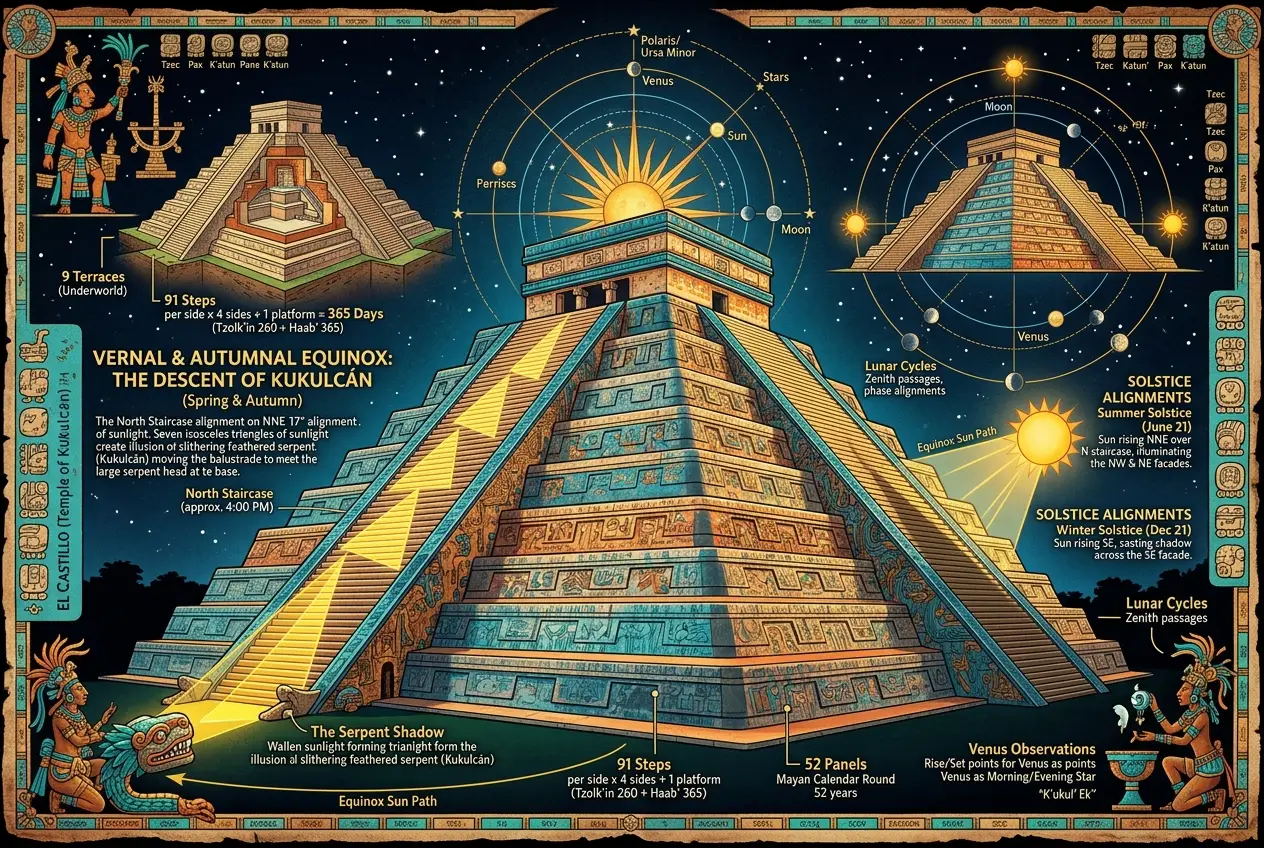
Beyond such visual spectacles, the Mayan Long Count calendar was incredibly precise, tracking cycles that spanned thousands of years. Their astronomical tables, recorded in codices like the Dresden Codex, predict solar and lunar eclipses with remarkable accuracy, along with the cycles of Venus and Mars. The level of mathematical and astronomical understanding required for this is staggering.
Could these intricate calendars and architectural alignments be considered a form of "cosmic computing"? They took raw data (celestial observations) and processed it through complex mathematical models to produce predictions and maintain an accurate temporal framework. This wasn't just observing a single star; it was understanding and predicting the complex interplay of multiple celestial bodies over vast timescales. This level of predictive modeling is a core function of a computer. More details on Mayan astronomy can be found on Maya astronomy - Wikipedia (opens in a new tab).
The Giza Plateau: A Terrestrial Map of the Heavens?
The pyramids of Giza have long fascinated researchers, not just for their monumental scale but for their precise orientation. The three main pyramids align with the stars in Orion's Belt. This "Orion Correlation Theory," popularized by Robert Bauval, suggests that the Giza pyramids were built to mirror the constellation Orion as it appeared around 10,500 BCE.
While the theory itself is subject to debate, it highlights a profound engagement with celestial mapping. If the Giza plateau was indeed intended as a terrestrial projection of the heavens, it represents a complex system for encoding and referencing cosmic information. This would be akin to a massive, three-dimensional database, where locations on Earth correspond to specific cosmic coordinates. Such a system would require sophisticated surveying, astronomical knowledge, and an overarching computational design.
The Digital Divide: Redefining "Computer"
The challenge in labeling ancient sites as "cosmic supercomputers" lies in our modern definition of a computer—an electronic device with processors and memory. However, if we expand our understanding to include any system capable of complex information processing, storage, and retrieval, especially for predictive modeling, then the case becomes more compelling.
Ancient "cosmic computers" might not have whirred and blinked like ours, but they likely utilized different principles:
| Feature | Modern Digital Computer | Ancient "Cosmic Computer" (Hypothetical) |
|---|---|---|
| Input | Digital data, sensor readings | Celestial observations, Earth energies |
| Processing | Silicon microprocessors | Astronomical alignments, geometric forms |
| Storage | Hard drives, RAM | Stone monuments, oral traditions, codices |
| Output | Data displays, simulations | Calendar predictions, ceremonial events |
| Energy Source | Electricity | Solar energy, Earth's natural fields |
| Programming | Code, algorithms | Archeoastronomical knowledge, sacred geometry |
This table illustrates how, conceptually, ancient sites could fulfill the fundamental roles of a computer, albeit through entirely different mechanisms. The "programming" would have been the accumulated knowledge of generations of astronomer-priests and architects, encoded in the very fabric of their constructions.
The Future of Research: Unlocking Ancient Algorithms
The idea of ancient sites as cosmic supercomputers remains largely theoretical, but it encourages us to look at our past with new eyes. It pushes us beyond a purely functional interpretation of structures and into considering their potential for complex information processing.
Modern archaeoastronomy, coupled with digital modeling and AI analysis of ancient patterns, could potentially unlock hidden "algorithms" within these sites. By simulating celestial movements over millennia and overlaying them with the precise dimensions and alignments of ancient structures, we might uncover previously unseen predictive functions or information storage capabilities. We've seen similar approaches in topics like Did Ancient Astronomers Decode Cosmic Time Algorithms?.
The concept challenges us to reconsider the intellectual capabilities of our ancestors and to appreciate the ingenuity with which they sought to understand and interact with the vast, mysterious cosmos. Perhaps, in their monumental stone structures, they left us not just temples and tombs, but the silent, enduring remnants of humanity's first cosmic computation engines. It's a humbling thought, and one that sparks endless curiosity about the hidden depths of ancient intelligence.
Ultimately, whether we call them "computers" or "advanced observatories," these sites stand as testaments to humanity's enduring quest to decode the universe. And who knows, the more we learn, the more we might find that the ancients were not just looking at the stars, but computing with them.




Conversation0
No comments yet. Be the first to share a thought — the best questions often become new stories.