


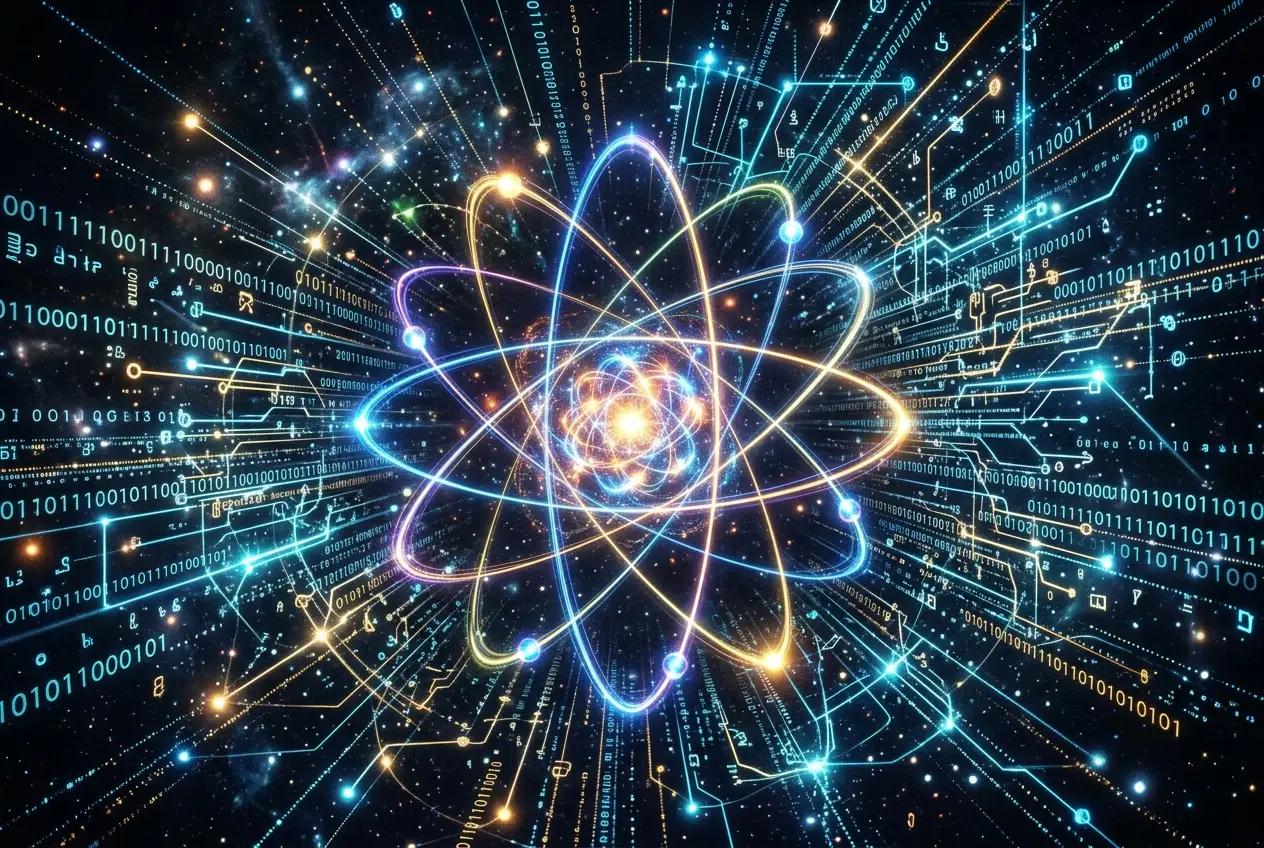
I often find myself marveling at how far we’ve come in the digital age. Just a few decades ago, a single computer filled an entire room, its storage capacity measured in mere kilobytes. Today, my smartphone, no bigger than my palm, holds terabytes of data – photos, videos, apps, and an entire digital life. It's an incredible leap in miniaturization and density. But what if I told you that this journey is far from over? What if the next frontier isn't just smaller chips or denser hard drives, but rather, the ultimate limit of information storage: a single atom?
The idea sounds like something straight out of science fiction. How could something so incredibly small, the fundamental building block of matter, possibly hold the vast oceans of data we generate every second? Yet, scientists and engineers around the world are not only asking this question but actively pursuing it. This isn't just about shrinking our devices; it's about fundamentally rethinking how information is stored, processed, and ultimately, how it could reshape our technological future.
The Ever-Shrinking Digital Universe
To understand the audacious goal of atomic data storage, let's first appreciate the current landscape. Modern data storage relies primarily on two principles: magnetic domains (like in hard disk drives) and electrical charges (like in solid-state drives). In HDDs, tiny magnetic regions are flipped to represent bits (0s and 1s). In SSDs, electrons are trapped or released in tiny gates. Both methods have pushed the boundaries of miniaturization, cramming billions of bits into astonishingly small spaces.
I remember thinking the first time I heard about Moore's Law, that it couldn't possibly continue indefinitely. Gordon Moore’s observation from 1965, predicting that the number of transistors on a microchip would double approximately every two years, has driven the semiconductor industry for decades. However, as we approach the physical limits of silicon, where individual transistors are now measured in a handful of atoms, conventional methods are hitting a wall. Quantum effects, often seen as a problem at this scale, suddenly become our biggest opportunity.
The Atomic Bit: A New Paradigm for Data
Imagine if each bit of information, a 0 or a 1, wasn't represented by a million atoms, or even a thousand, but by just one. This is the promise of atomic data storage. The concept isn't about using the atom's internal structure in a complex way (like manipulating quarks, for example), but rather leveraging its state or position.
One of the most promising avenues involves using the spin of an electron within an atom. Electrons possess a quantum property called "spin," which can be thought of as an intrinsic angular momentum, much like a tiny top spinning on its axis. This spin can be "up" or "down," providing a perfect binary system for encoding a bit of information. This is the basis of a field known as spintronics, and it's particularly exciting because electron spin is less susceptible to environmental interference than charge, making it potentially more stable for data storage. Researchers have successfully stored information in the spin of individual atoms, such as holmium atoms, demonstrating the feasibility of this approach. For more on the quantum properties of atoms, you can refer to the Wikipedia article on Atomic orbital (opens in a new tab).
Another approach focuses on the physical position of atoms. Scientists have used Scanning Tunneling Microscopes (STMs) to meticulously arrange individual atoms on a surface, forming patterns that represent information. In 2017, IBM researchers managed to store a single bit of data using just one atom of holmium, and then read it back reliably. This wasn't just theoretical; it was a tangible demonstration of atomic-scale memory. While manipulating individual atoms is currently a slow and delicate process, these breakthroughs prove the fundamental concept.
Why Go Atomic? The Mind-Boggling Potential
The immediate advantage of atomic storage is, of course, density. The amount of information we could cram into a minuscule space would be truly staggering. If we could reliably store one bit per atom, a single gram of a material like silicon could potentially hold more data than all the hard drives on Earth combined. Think about the implications:
- Vastly increased storage capacity: Imagine carrying the entire internet in your pocket, or a lifetime of every piece of digital content ever created on a chip the size of a grain of sand.
- Reduced energy consumption: Manipulating individual atomic states could require far less energy than current methods, leading to more efficient data centers and longer-lasting portable devices.
- New computing paradigms: Atomic-scale storage isn't just about capacity; it's a stepping stone to quantum computing. If we can control and read the quantum states of individual atoms for storage, we are well on our way to using those same quantum states for computation. This blurs the line between memory and processing in revolutionary ways.
I can't help but feel a sense of wonder contemplating a future where the physical world around us, down to its most basic constituents, becomes a canvas for information. This is not merely an incremental improvement; it's a paradigm shift.
Challenges on the Quantum Frontier
While the potential is electrifying, the path to widespread atomic data storage is fraught with formidable challenges.
- Stability at room temperature: Quantum states are notoriously fragile. They are easily disrupted by thermal fluctuations, vibrations, and electromagnetic noise. Most current experiments require extremely low temperatures (near absolute zero) and highly controlled environments to maintain the coherence of atomic spins. Achieving stable atomic storage at room temperature is a monumental hurdle.
- Read/Write Speed: Manipulating individual atoms or reading their quantum states is currently a slow process. To be practical, atomic memory needs to achieve speeds comparable to, or ideally, far exceeding, current storage technologies. This demands entirely new methods of interaction, possibly leveraging exotic quantum phenomena.
- Scalability: Moving from storing a few bits with individual atoms to storing trillions of bits requires manufacturing and control techniques on an unprecedented scale. Developing reliable and cost-effective methods for fabricating and accessing atomic-scale arrays is a massive engineering challenge.
- Error Correction: At the quantum level, errors are inherent. Developing robust error correction codes that can deal with the unique types of errors in quantum and atomic systems is crucial for reliable data storage.
Despite these challenges, progress is being made. For instance, the development of new materials with specific properties, like topological insulators or two-dimensional materials, offers environments where quantum states might be more stable. The continuous refinement of tools like STMs and the advent of quantum logic gates are slowly paving the way. You can learn more about the challenges and advancements in quantum information science on Wikipedia's page for Quantum information (opens in a new tab).
The Road Ahead: From Lab to Reality
The journey from a single atom storing a single bit to a usable, commercial atomic memory device is long and complex. It requires not just breakthroughs in physics, but also in materials science, engineering, and manufacturing. However, the foundational research is laying the groundwork.
Consider the early days of transistors. They were clunky, unreliable, and expensive. Few could have predicted the microchip revolution they would spawn. Similarly, the initial demonstrations of atomic storage are just the first flickerings of a potentially world-changing technology. Researchers are exploring various materials and methods, from manipulating atoms on surfaces to exploiting the inherent quantum properties of certain molecular structures.
This field often intersects with the broader quest for quantum computing, where the goal is to use quantum mechanical phenomena (like superposition and entanglement) to perform calculations far beyond the reach of classical computers. If we can master atomic data storage, we might be building the ultimate memory for future quantum computers, enabling unprecedented processing power and problem-solving capabilities. For more insights into quantum computing and its future, you might want to read our blog on whether Can Quantum Entanglement Power FTL Communication? or Black Holes: Are They Nature's Ultimate Quantum Computers?
The implications extend far beyond just storing more movies. Imagine medical diagnostics that can analyze vast genomic data in an instant, AI systems with truly human-like memory and learning capabilities, or simulations of complex scientific phenomena with unparalleled accuracy. Atomic data storage could be a cornerstone technology enabling these, and many other currently unimaginable, innovations.
Conclusion: The Ultimate Data Frontier
The question, "Can a single atom store all our data?" is ambitious, and the immediate answer is no, not yet. But the journey toward using individual atoms as the fundamental units of information storage is undeniably underway. It represents the ultimate pursuit of information density, pushing the boundaries of what's physically possible. We're witnessing the very early stages of a technological revolution that promises to redefine our relationship with data, memory, and computation itself. As I reflect on this potential, I can’t help but feel a profound sense of excitement for the future. The universe, in its smallest forms, holds the keys to our greatest technological leaps.





Conversation0
No comments yet. Be the first to share a thought — the best questions often become new stories.