


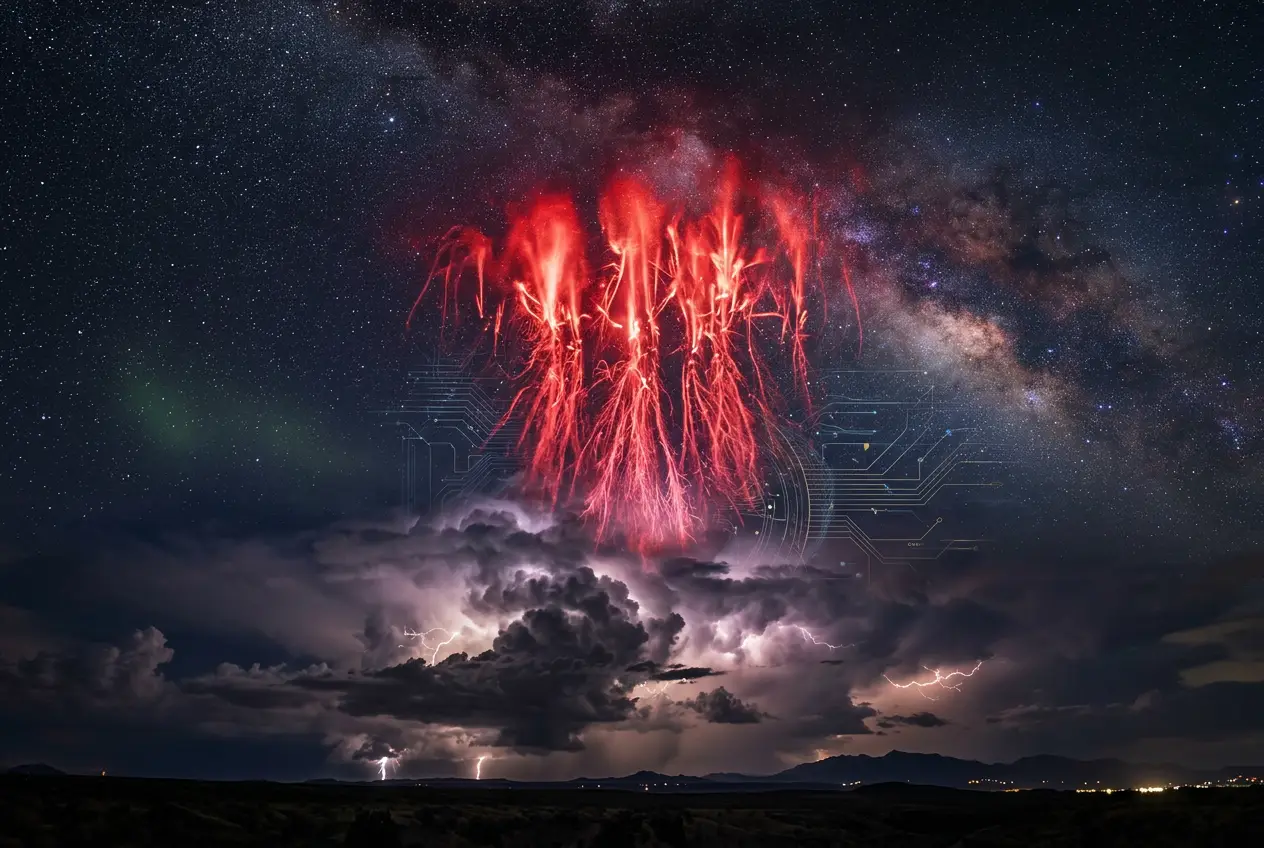
I still remember the first time I saw a picture of a sprite. It wasn't in a textbook or a science documentary; it was a grainy image shared online, claiming to be "lightning reaching space." My initial thought was, "That can't be real." It looked like something out of a sci-fi movie – massive, ethereal crimson tendrils reaching dozens of miles above thunderclouds, far higher than any conventional lightning strike. Yet, as I dug deeper, I discovered these spectacular phenomena are not only real but are a crucial, though largely unseen, part of Earth's atmospheric electrical system. They’re called Transient Luminous Events (TLEs), and they're one of the planet's most dramatic, yet elusive, natural spectacles.
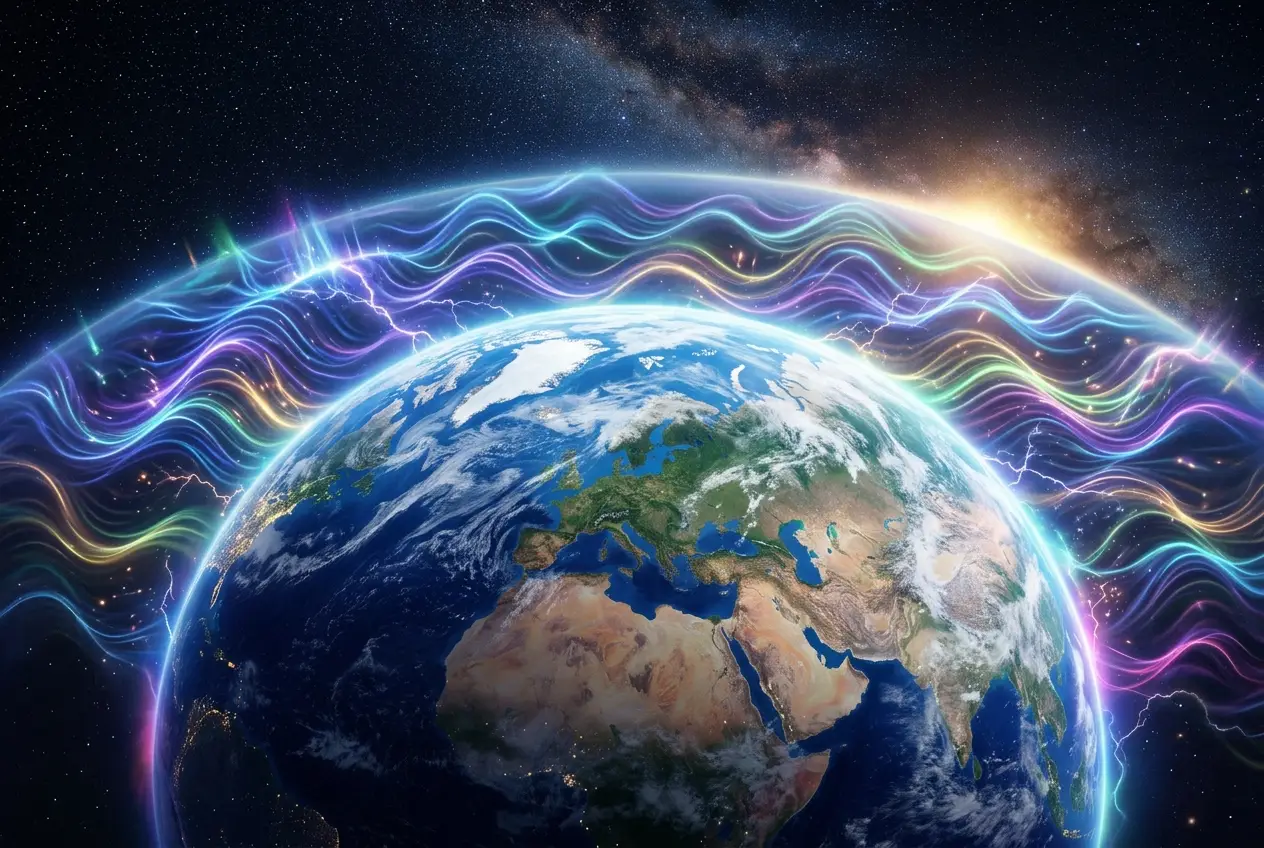
Imagine our planet not just as a rock orbiting the sun, but as a vast, complex electrical circuit. We're familiar with lightning crashing down from storm clouds, but what if there's an equally powerful, upward-reaching "counter-lightning" that connects our stormy lower atmosphere to the edge of space? This isn’t a conspiracy theory; it’s a reality we're only just beginning to comprehend, and it makes me wonder if these colossal electrical discharges could hold secrets to harnessing atmospheric energy or even influence technological systems in ways we don't yet fully understand. Could these "sprites" be part of Earth's own hidden power grid?
The Elusive Giants: What Exactly Are Sprites?
For centuries, sailors and aviators reported fleeting flashes of light high above storms, dismissing them often as hallucinations or optical illusions. It wasn’t until 1989 that scientists at the University of Minnesota accidentally captured the first unambiguous video evidence of a sprite. This discovery opened a new window into a previously unknown realm of atmospheric physics.
Sprites are not lightning in the traditional sense. They don’t originate from thunderclouds and don’t directly connect to the ground. Instead, they occur above large thunderstorms, typically at altitudes between 50 and 90 kilometers (30 to 55 miles), in the mesosphere and lower ionosphere. They are often triggered by powerful positive cloud-to-ground lightning strokes that occur below them. These positive strikes leave a deficit of charge in the cloud top, creating a massive electric field that extends upwards, sometimes sparking a plasma discharge that propagates into the upper atmosphere.
The visual appearance of sprites is mesmerizing. They typically manifest as brief, diffuse red flashes that can stretch horizontally for tens of kilometers and vertically for more than 20 kilometers. Often described as "jellyfish" or "carrot" shapes, they have a luminous core and faint tendrils extending downward, resembling giant celestial lightning bolts. Their reddish hue comes from the excitation of nitrogen molecules in the upper atmosphere, which then emit light as they de-excite, much like the gas in a neon sign.
More Than Just a Light Show: The Science Behind Sprites
To truly appreciate sprites, we need to delve a bit into the physics of our atmosphere. Below 15 km, we have the troposphere, where most weather happens. Above that is the stratosphere, and then the mesosphere (from about 50 to 85 km), where temperatures plummet. Beyond the mesosphere lies the thermosphere, which includes the ionosphere, a region of Earth's upper atmosphere where atoms and molecules are ionized by solar radiation. This ionization creates a layer of plasma that can conduct electricity.
When a powerful positive lightning discharge occurs from a thundercloud, it effectively "launches" an electromagnetic pulse upwards. This pulse, combined with the lingering strong electric field, can cause a breakdown in the relatively thin air of the mesosphere and ionosphere. Electrons accelerate, collide with neutral air molecules, and ionize them, creating a cascade of free electrons – a plasma. This rapid ionization process is what we see as a sprite. It’s a spectacular instance of plasma physics playing out on a grand scale, linking different layers of Earth's atmosphere. You can learn more about sprites on Wikipedia (opens in a new tab).
The energy involved in these events is immense. While conventional lightning releases gigawatts of power, sprites distribute their energy over a much larger volume and for a shorter duration, typically just a few milliseconds. Yet, the sheer scale and the upward direction of these discharges suggest a significant role in the global atmospheric electrical circuit. Some researchers propose that sprites, along with other TLEs like blue jets and elves, help to balance the electrical charge between the ground, the thunderclouds, and the ionosphere.
Connecting the Dots: Are Sprites Earth's Hidden Power Grid?
The concept of a "hidden power grid" might sound fantastical, but it’s a way to conceptualize the intricate exchange of energy happening constantly in our atmosphere. While sprites don't directly power our homes, their existence highlights a massive, dynamic electrical system operating above us.
Consider the potential implications:
- Atmospheric Energy Exchange: Sprites act as a conduit, transferring energy from the lower atmosphere up to the ionosphere. This upward energy flow helps maintain the Earth's global electric circuit, which is crucial for various atmospheric processes and even influences space weather.
- Influence on Technology: Could these massive electrical discharges affect satellites, GPS signals, or even long-range radio communications? While specific direct impacts are still under research, high-energy atmospheric events are known to perturb the ionosphere. Disruptions in the ionosphere can indeed interfere with radio waves and satellite signals, which rely on stable atmospheric conditions. This is a fascinating area where the interplay of natural phenomena and our technology becomes apparent, much like the potential influence of cosmic rays on Earth's tech anomalies, a topic we've explored before in Cosmic Rays: Do They Spark Earth's Tech Anomalies?.
- Plasma Research: Sprites are natural plasma laboratories. Understanding how plasma forms and behaves in the low-pressure, high-altitude environment of the mesosphere could have applications in fusion energy research, plasma propulsion, or even novel material science.
- Geomagnetic Field Interaction: Earth's magnetic field plays a role in shielding us from solar winds and cosmic radiation. Changes in the ionosphere, potentially influenced by sprite activity, could subtly interact with the geomagnetic field. While not a direct cause, these interactions contribute to the complex dynamics of our planet's protective layers, a topic related to how our Earth's Magnetic Field is Flipping.
I find myself thinking about other anomalous light phenomena, like the mysterious Will O' the Wisps, and how they, too, raise questions about overlooked natural energy sources or plasma events. Sprites represent a far grander scale, but the underlying curiosity about natural energy and its potential remains.
The Challenge of Observation and Future Research
Observing sprites is no easy feat. They are incredibly brief, occur high above active thunderstorms (which are often obscured by clouds), and are most visible from specialized ground-based observatories or from aircraft and spacecraft looking down on the storm tops. This difficulty in observation is partly why they remained a scientific mystery for so long.
However, advancements in high-speed cameras, low-light sensors, and dedicated research missions (like the European Space Agency's ASIM instrument on the International Space Station) are beginning to unveil their secrets. Scientists are now collecting unprecedented amounts of data, allowing for detailed modeling of sprite formation and their effects on the upper atmosphere.
The implications of this research extend beyond just understanding dramatic light shows. By studying sprites, we gain deeper insights into fundamental atmospheric processes, the global electrical circuit, and the complex interactions between our planet's lower weather systems and the near-space environment. Understanding the mesosphere and ionosphere, which sprites illuminate, is crucial for improving our climate models and even for predicting space weather phenomena that can impact our technology. More information on the mesosphere can be found on Wikipedia (opens in a new tab).
Conclusion: Earth's Unseen Electrical Tapestry
The existence of sprites challenges our conventional understanding of Earth's atmosphere. They remind us that even in our technologically advanced age, there are still vast, energetic phenomena happening above our heads that we're only just beginning to map. The idea of Earth's atmosphere as a dynamic, electrically charged system, with spectacular, colossal discharges connecting its layers, is nothing short of awe-inspiring.
While sprites may not be directly powering our homes tomorrow, their role in the global electrical circuit and their potential influence on our technologically dependent world cannot be understated. As we continue to gaze upwards, observing and analyzing these elusive giants, I can't help but feel a profound sense of wonder, knowing that our planet holds even more electrical marvels than we ever imagined. Perhaps, in these fleeting flashes of red, lies a deeper understanding of the very energy that courses through our world. The more we learn, the more I believe the universe is constantly challenging our perception of what's possible, right here on Earth.


Conversation0
No comments yet. Be the first to share a thought — the best questions often become new stories.