There’s a certain thrill in peering back through the mists of time, isn't there? I often find myself lost in thought about the ancient world, particularly the phenomena that baffled and inspired people for millennia. Among these, the enigmatic **oracles of antiquity** stand out. Imagine a place where mere mortals sought divine guidance, where priestesses spoke words believed to come directly from the gods, shaping empires and guiding personal destinies. For centuries, we’ve attributed their prophecies to pure spiritual connection or, perhaps, clever deception. But what if there was something more? What if, beneath the ceremonial robes and sacred smoke, ancient oracles were, in fact, leveraging nascent forms of **technology** or a sophisticated understanding of their environment to achieve their profound effects?
It’s a bold thought, I know, challenging our traditional view of ancient mysticism. Yet, when we examine the most famous oracle of them all—the **Oracle of Delphi**—the lines between the divine and the decidedly earthly begin to blur. For over a thousand years, the Pythia, Apollo’s priestess, delivered prophecies from a chasm in the temple floor. Her utterances were often vague, sometimes ecstatic, leading many to believe she was in a trance-like state. Ancient texts describe her prophecies as being fueled by "pneuma," a divine vapor emanating from the earth. But what was this "pneuma" really?
The Geological Hypothesis: Vapors of Prophecy
For a long time, the idea of intoxicating vapors at Delphi was dismissed as myth, primarily because early geological surveys found no evidence of fault lines or gas emissions at the site. However, I recall reading about a fascinating re-evaluation in the late 20th and early 21st centuries. Geologists, archaeologists, and even chemists revisited the site with modern instruments. What they found was truly compelling.
They discovered that the Temple of Apollo at Delphi was built directly over the intersection of two major geological fault lines: the Kerna fault and the Delphi fault. More crucially, they identified traces of **ethylene gas** seeping from fissures in the limestone. Ethylene is a sweet-smelling hydrocarbon known to produce a narcotic effect, leading to a trance-like state, feelings of euphoria, and out-of-body experiences—precisely the symptoms described of the Pythia.
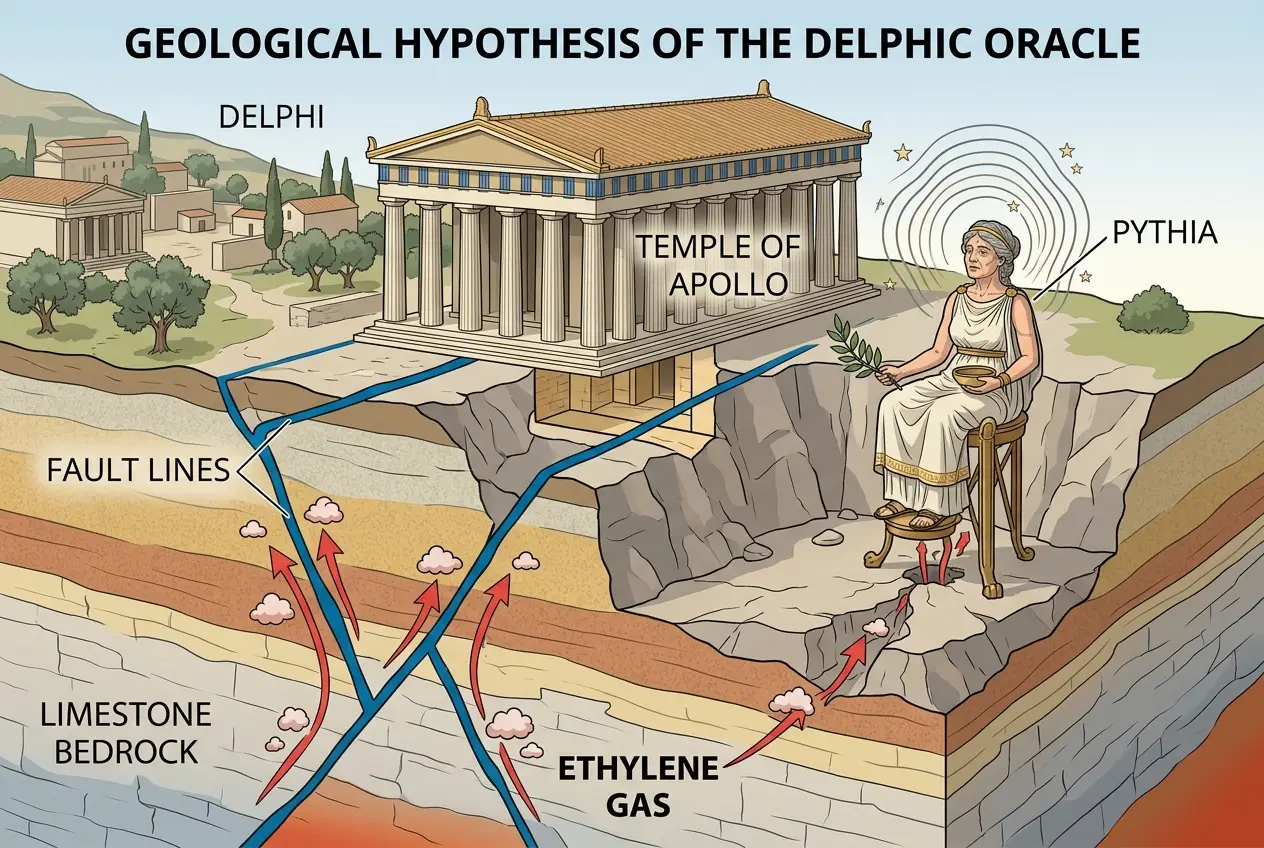
"The geological data, when combined with historical accounts, provides a powerful argument for a natural, rather than purely supernatural, explanation for the Pythia’s altered state," notes John R. Hale in *Archaeology* magazine, discussing the research. The ancient Greeks, without fully understanding the chemical composition, might have instinctively known or discovered the effects of these vapors. They built their sacred sites over these very locations, attributing the sensations to divine influence. This isn't just speculation; you can read more about this on its dedicated Wikipedia page: [Delphi](https://en.wikipedia.org/wiki/Delphi).
This isn't to say the Pythia was a charlatan. On the contrary, her belief in Apollo's presence was likely genuine, reinforced by the potent physiological effects of the gas. The "technology" here wasn't mechanical, but an **environmental leverage**—a profound, albeit unconscious, understanding of the earth’s hidden properties. It’s a remarkable example of how ancient cultures, without modern science, could still discern and utilize natural phenomena for profound ritualistic purposes.
Acoustics and Sensory Manipulation
Beyond geological factors, I’ve often pondered the role of sensory manipulation in ancient rituals. Oracles weren't just about listening to a priestess; they were immersive experiences. Temples were designed to awe, to disorient, and to prepare the supplicant for a transformative encounter.
Consider the **acoustics of ancient temples**. Many structures, from the pyramids to Greek amphitheatres, demonstrate an astonishing grasp of sound manipulation. Could these principles have been applied to oracle chambers? Imagine reverberating echoes, chanting, and perhaps even specific frequencies designed to induce a heightened state of awareness or suggestibility. The architecture itself could act as a subtle "tech" to enhance the perceived divine connection. The way sound can be used to alter perception is something ancient cultures might have intuited, as we explored in a previous post about how some ancient cultures might have used [natures hidden sounds](blogs/did-ancient-cultures-decode-natures-hidden-sounds-8216).
Furthermore, the **visual environment** played a critical role. Dim lighting, sacred iconography, smoke from burning incense (which could also have psychoactive properties, depending on the herbs used), and the very architecture of the space could have created an atmosphere ripe for suggestion. The Pythia often spoke from a raised tripod, partially obscured, adding to her mystique and the perception of otherworldliness. These were not merely aesthetic choices; they were powerful tools for shaping human experience and belief.
The Cognitive "Computer": Interpreting Ambiguity
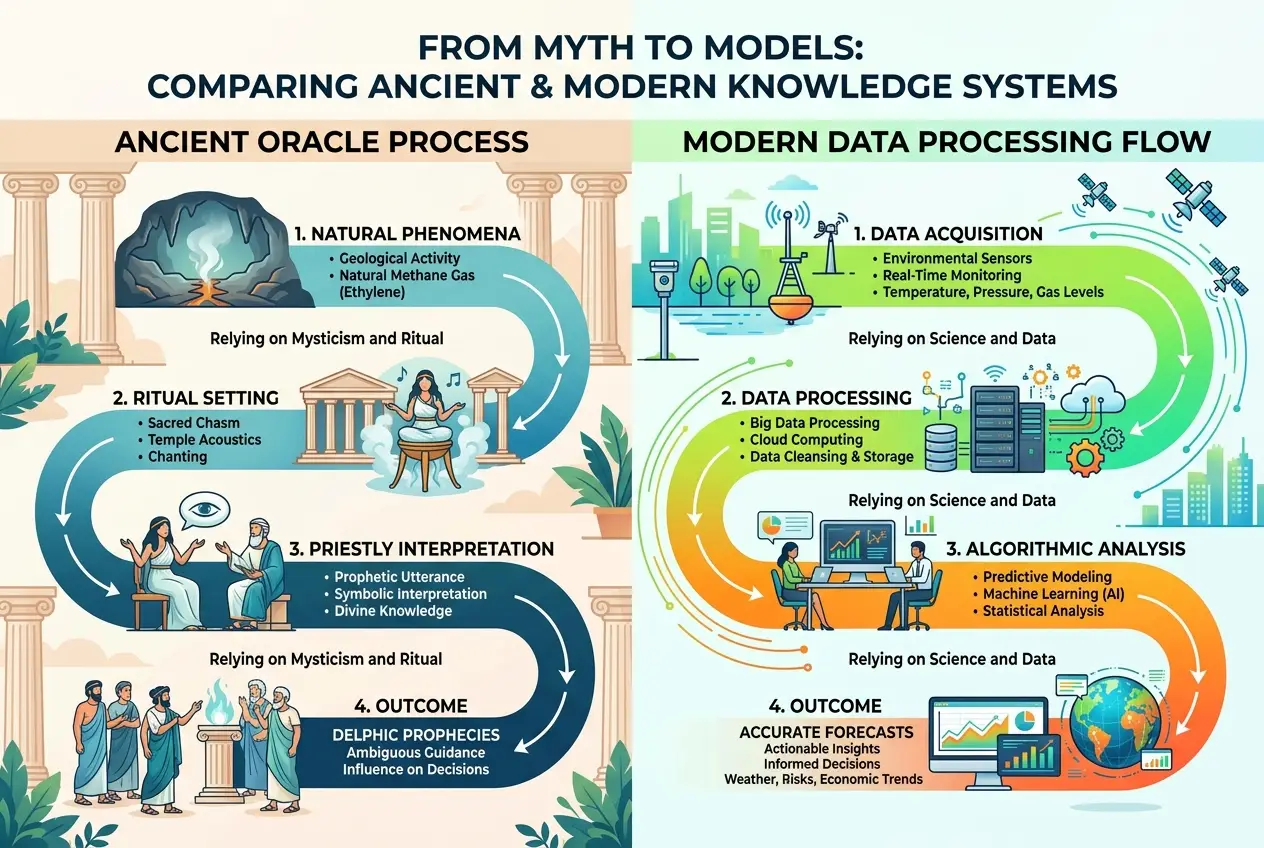
Even if the Pythia's trance was induced by natural gases, her prophecies still required interpretation. This is where the human element, the "cognitive computer" if you will, comes into play. The priests of Apollo, who served as intermediaries, often translated the Pythia's fragmented utterances into intelligible, albeit ambiguous, verses. This ambiguity was itself a form of **ingenious "programming."**
| Element of Oracle Experience |
Potential "Ancient Tech" or Method |
Effect on Prophecy Seeker |
| Ethylene Gas |
Geological Vapors |
Induced trance, euphoria, altered perception in Pythia. |
| Temple Acoustics |
Architectural Design |
Disorientation, heightened sensory experience, perceived solemnity. |
| Incense Smoke |
Controlled Combustion of Herbs |
Atmospheric effect, potential psychoactive influence, ritualistic symbolism. |
| Ambiguous Language |
Sophisticated Interpretation by Priests |
Allows for multiple meanings, self-fulfilling prophecy, reduced risk of error. |
| Ritual & Symbolism |
Psychological Conditioning |
Enhances suggestibility, fosters belief, creates an immersive "divine" experience. |
A prophecy like "A great empire will fall" is brilliant in its vagueness. It guarantees "accuracy" no matter which empire falls, allowing the oracle's reputation to remain intact. This strategic use of ambiguity, combined with keen observation of political and social trends, allowed the priests to offer advice that seemed divinely inspired, but was often deeply pragmatic. They were, in a way, processing complex human data—political currents, social anxieties, personal desires—and outputting probabilistic, influential statements. For more on how ancient societies handled complex information, consider reading about how [Quipu did Inca knots encode cosmic data](blogs/quipu-did-inca-knots-encode-cosmic-data-5089).
Modern Parallels and Unexplained Phenomena
The idea that natural phenomena or human understanding of environmental factors could be misinterpreted as divine intervention isn't unique to ancient Greece. Throughout history, various cultures have attributed mysterious occurrences to supernatural forces. From inexplicable lights in the sky to strange sounds, the human mind often seeks a transcendent explanation when a scientific one is not immediately apparent. We’ve seen similar discussions about how ancient priests might have used [bio-electric scanners](blogs/did-ancient-priests-use-bio-electric-scanners-6550) for insights.
Today, with our advanced scientific tools, we can unravel many of these "mysteries." Yet, a part of me always wonders about the limits of our current understanding. Could there be other, more subtle energies or phenomena that ancient peoples were more attuned to, simply because they lacked the distractions of our modern world? Are there still "hidden technologies" of the earth waiting to be discovered, or perhaps rediscovered, that could explain other ancient anomalies?
For example, the phenomenon of **electromagnetic fields affecting human consciousness** is a topic of ongoing scientific research. While still largely inconclusive regarding direct prophetic ability, some studies suggest that specific frequencies or field strengths can induce altered states, affect mood, or even influence cognitive function. Could certain geological formations generate localized electromagnetic anomalies that ancient cultures, sensitive to their environment, learned to harness, albeit without knowing the underlying physics? This aligns with the broader theme of understanding how [our bodies sense unseen cosmic signals](blogs/can-our-bodies-sense-unseen-cosmic-signals-2639).
Conclusion: Bridging Mysticism and Early Science
Ultimately, the question of whether ancient oracles used "tech" for prophecy isn't about debunking spirituality. Instead, it offers a fascinating perspective on how our ancestors understood and interacted with their world. It suggests that what we perceive as purely mystical might often have had a foundation in natural phenomena, cleverly leveraged through observation, ritual, and a sophisticated understanding of human psychology.
The Oracle of Delphi, far from being a simple trick, might represent one of humanity’s earliest attempts at **empirical observation and environmental manipulation**, disguised within a profound religious framework. It was a powerful system where geological "tech" met human cognitive "computing," creating an experience that resonated deeply with the spiritual needs of an entire civilization. The prophecies were not merely random utterances but a blend of natural influence, priestly interpretation, and perhaps even early strategic intelligence gathering. It makes me wonder what other "divine" mysteries might one day be illuminated by the ever-advancing light of scientific inquiry, revealing the ingenious, albeit unrecognized, "tech" of our ancestors.
 Join Us




 Unknown Author






























Leave a Reply
Comments (0)