


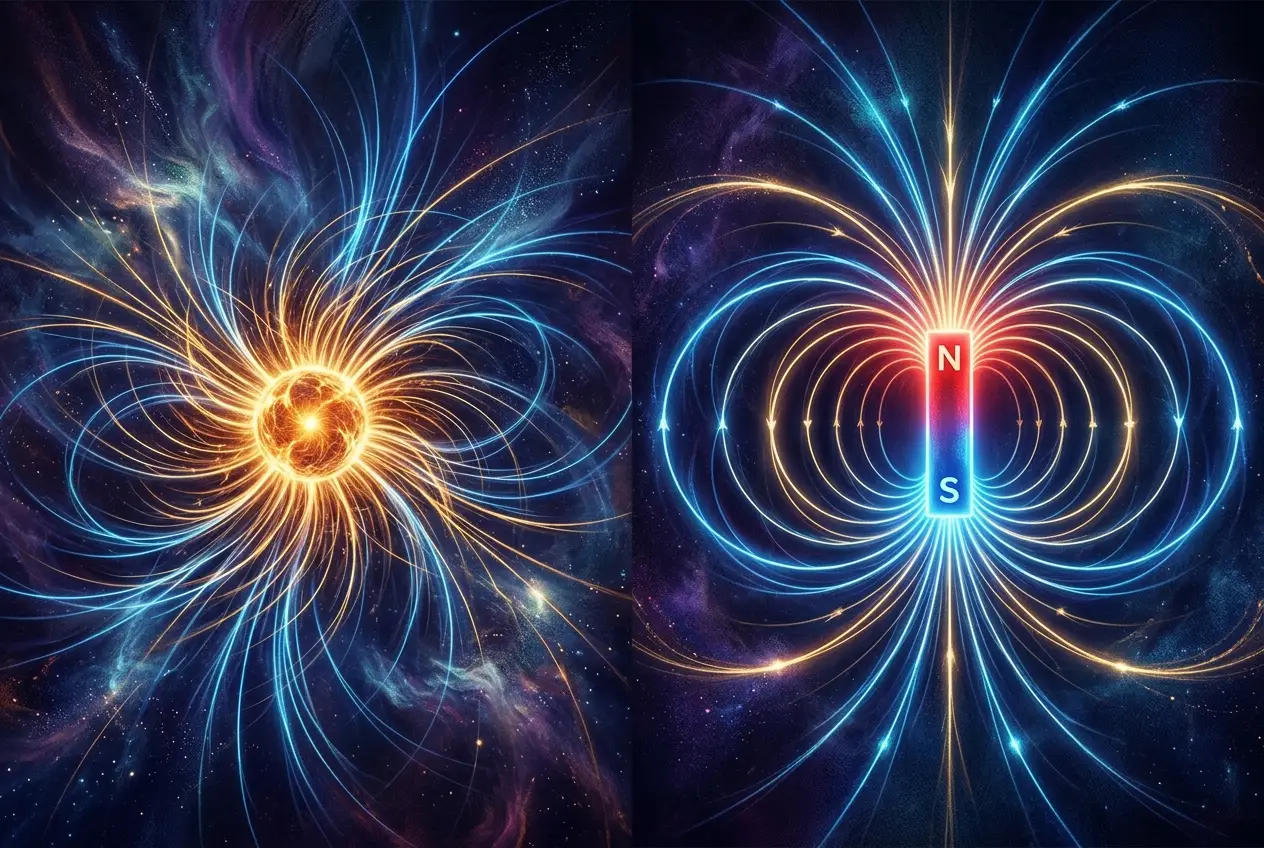
I remember the first time I held two magnets in my hands, feeling that invisible push and pull. It was magic, pure and simple. Every magnet I'd ever seen, from refrigerator decorations to industrial cranes, always had a north pole and a south pole. Break one in half, and you don't get a lonely north or south; you get two smaller magnets, each with its own pair of poles. This fundamental observation is drilled into us from childhood: magnetism comes in pairs, dipoles.
But what if it didn't? What if there existed a "magnetic monopole" – a particle with only a north pole, or only a south? The idea sounds like something out of science fiction, a fundamental asymmetry that would shake the very foundations of physics as we know it. And yet, for nearly a century, scientists have been on an intense, perplexing hunt for these elusive particles, believing that their discovery could unlock secrets about the universe, from the origins of the cosmos to the very nature of energy and technology.
The Missing Piece of the Cosmic Puzzle
To understand why magnetic monopoles are such a big deal, we need to talk about electromagnetism. This is one of the four fundamental forces of nature, responsible for everything from light to electricity, and indeed, magnetism. James Clerk Maxwell, in the 19th century, unified electricity and magnetism into a single, elegant theory with four brilliant equations. These Maxwell's equations are cornerstones of modern physics and engineering.
However, there's a striking asymmetry in these equations. They describe electric charges (like electrons and protons) existing as isolated entities—a single electron, a single proton. But for magnetism, they only describe dipoles. There's no term for an isolated magnetic charge, a monopole. If such a particle existed, it would introduce a beautiful symmetry into Maxwell's equations, making them perfectly symmetrical between electricity and magnetism.
Imagine if you could have an electron without its electric charge. That's how profound the concept of a magnetic monopole is. Its existence would mean that just as electric charges generate electric fields, magnetic charges would generate magnetic fields, radiating outwards or inwards from a single point, without needing a corresponding opposite pole.
This isn't just an aesthetic desire for symmetry. The implications run deep. In the early 20th century, physicist Paul Dirac theorized that if magnetic monopoles existed, they could explain why electric charge is quantized—meaning it only comes in discrete packets (like the charge of an electron), rather than continuous values. Dirac's argument, published in 1931, provided a compelling theoretical framework for these hypothetical particles, suggesting that if even one magnetic monopole existed anywhere in the universe, it would inherently quantize electric charge everywhere else. This link is so elegant that many physicists believe monopoles must exist. You can read more about the intricacies of this idea on Wikipedia's entry on magnetic monopoles (opens in a new tab).
Where Do We Look for the Unseen?
The quest for magnetic monopoles is a fascinating blend of theoretical brilliance and experimental ingenuity. If they exist, where would we find them? And what would they even look like?
1. The Big Bang's Leftovers: Many theories suggest that magnetic monopoles would have been created in the incredibly high-energy conditions of the early universe, just after the Big Bang. If so, they would be incredibly massive and incredibly rare. Modern cosmological models, particularly those involving inflation, actually predict that if monopoles were created, their numbers would have been diluted to near zero. However, some models still allow for a small, detectable population. This means searching for them as relic particles from the dawn of time.
2. High-Energy Collisions: Just as we recreate conditions similar to the early universe in particle accelerators like the Large Hadron Collider (LHC) at CERN, scientists have been trying to produce magnetic monopoles in these powerful machines. If monopoles are indeed very massive, it would take immense energy to create them. Experiments at the LHC, such as those by the MoEDAL (Monopole and Exotics Detector at the LHC) collaboration, are specifically designed to detect highly ionizing, massive, and long-lived particles like monopoles, should they be produced in proton-proton collisions. While no definitive monopoles have been found yet, the search continues, constantly pushing the boundaries of what these colliders can achieve.
3. Cosmic Rays and Earth's Orbit: If monopoles are stable and rare, some might be hurtling through space, remnants of cosmic events. Detectors like the AMS-02 (Alpha Magnetic Spectrometer) on the International Space Station scan cosmic rays for exotic particles, including monopoles. The idea is that a monopole would interact with a magnetic field differently than a charged particle, leaving a unique signature in the detectors. Terrestrial detectors buried deep underground, shielded from other cosmic ray "noise," also search for these potential cosmic visitors.
4. Exotic Materials: In recent years, the hunt has taken a fascinating turn into condensed matter physics. Scientists have discovered "emergent monopoles" in certain exotic materials, particularly spin ice. These aren't true elementary magnetic monopoles, but rather excitations within the material that behave as if they were monopoles. When you heat up or apply a magnetic field to spin ice, the arrangement of magnetic moments (spins) can create "defects" that act like isolated magnetic charges, moving through the material. While not the fundamental particles Dirac predicted, these emergent monopoles offer a tangible way to study monopole-like behavior and validate some of the theoretical predictions. This fascinating area of research blurs the lines between particle physics and material science, offering unexpected avenues for discovery. You can delve deeper into spin ice on Wikipedia (opens in a new tab).
The "Oh My God" Particle and Other Close Calls
The search for magnetic monopoles has been riddled with tantalizing near-misses and intriguing anomalies. One of the most famous came in 1982 when physicist Blas Cabrera reported what appeared to be a single magnetic monopole event in his detector. Dubbed the "Valentine's Day Monopole" because of the date, the signal was a perfect match for what a monopole should look like. The excitement was immense, but unfortunately, no further events were ever detected, leading many to conclude it was likely a fluke or an unexplainable background event.
More recently, the "Oh-My-God" particle, a cosmic ray detected in 1991 with an energy equivalent to a tennis ball traveling at 97% the speed of light, briefly reignited discussions about exotic particles. While not directly linked to monopoles, such ultra-high-energy cosmic rays push the boundaries of known physics and remind us that the universe still holds profound surprises. This kind of event makes me wonder if our current detectors are truly capable of capturing all cosmic phenomena. For more on the "Oh-My-God" particle, you can visit the Wikipedia page for Ultra-high-energy cosmic ray (opens in a new tab).
What If We Found One? The Revolutionary Impact
The discovery of a true, elementary magnetic monopole would be one of the most significant scientific breakthroughs in centuries, profoundly impacting several fields:
- Fundamental Physics: It would complete Maxwell's equations, confirming Dirac's quantization condition, and provide a huge boost to Grand Unified Theories (GUTs), which attempt to unify the strong, weak, and electromagnetic forces. It would imply a deeper, more symmetrical order to the universe than we currently perceive.
- Cosmology: It would offer invaluable insights into the earliest moments of the universe, helping us understand the Big Bang and the mechanisms of cosmic inflation.
- Technology: This is where things get really exciting. Imagine a future where we could manipulate magnetic fields with single magnetic charges, analogous to how we use electric charges today.
- Energy Storage and Transmission: Superconducting circuits could be designed with unprecedented efficiency.
- Magnetic Computing: New forms of data storage and processing based on magnetic monopole currents could emerge, potentially leading to computing architectures that dwarf current capabilities. Much like how quantum sensors are reshaping our reality perception, the precise manipulation of magnetic fields via monopoles could lead to incredibly sensitive new devices. Check out our blog on Do Quantum Sensors Reshape Our Reality Perception? for more on such advanced sensor tech.
- Propulsion: The ability to generate powerful, directed magnetic fields with monopoles could revolutionize space travel and propulsion systems, perhaps even pushing the boundaries of what is possible with exotic matter, similar to discussions around Do Tachyons Exist? Decoding Faster-Than-Light Travel.
The implications are truly staggering. Just as the discovery of the electron transformed our world with electricity and electronics, the discovery of the magnetic monopole could usher in a new era of "magnetronics." It might even give us a new lens through which to view the unseen parts of the universe, much like the ongoing quest to understand dark matter, a topic explored in Does Dark Matter Hide a Universe We Can't See?.
The Enduring Mystery
Despite decades of searching, spanning from deep space to the heart of particle accelerators and exotic materials, the elementary magnetic monopole remains elusive. This persistent absence is, in itself, a profound statement. It either means they are incredibly rare, fantastically heavy, or perhaps, our understanding of the universe still has a fundamental gap.
The hunt for magnetic monopoles is more than just a search for a particle; it's a testament to humanity's relentless curiosity and our unwavering belief that the universe holds deeper truths waiting to be uncovered. Whether they exist as relics of the Big Bang, products of high-energy collisions, or subtle manifestations in exotic materials, the magnetic monopole continues to be a profound mystery, a theoretical masterpiece that could one day shatter our perception of the magnetic world. And when that day comes, I believe it will change everything.




Conversation0
No comments yet. Be the first to share a thought — the best questions often become new stories.