


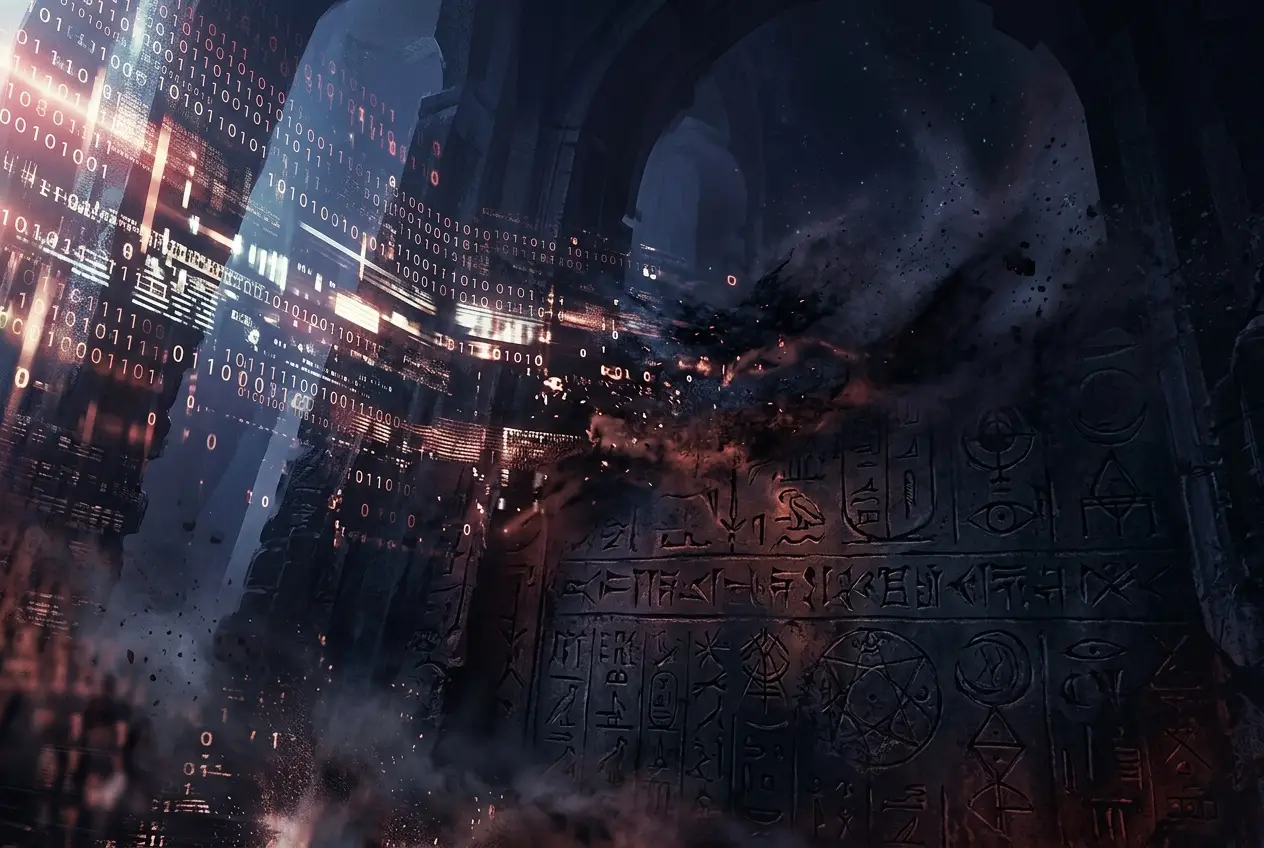
Recently, I was sifting through some old digital files – photos from the early 2000s, documents from college projects, even some music downloaded in formats that barely exist anymore. It got me thinking: what will happen to all this? Not just my personal archives, but the colossal mountain of data our civilization generates every single second. Will it last? Or are we, paradoxically, building a future where our greatest accomplishments and mundane memories alike are destined for an inevitable "Digital Dark Age"?
It’s a chilling thought, isn’t it? We live in an era of unprecedented information abundance. We create, share, and consume data at a rate unimaginable just a few decades ago. From personal photographs to groundbreaking scientific research, our collective knowledge is increasingly encoded in digital zeroes and ones. But what if this digital foundation is far more fragile than we imagine? What if, much like the burning of the Library of Alexandria or the decay of ancient scrolls, a vast portion of our digital heritage is poised to vanish, leaving future generations with tantalizing gaps in our story?
The Specter of Data Loss: What is the Digital Dark Age?
The term "Digital Dark Age" isn't just a dramatic turn of phrase; it's a very real concern for archivists, historians, and technologists alike. It refers to a future scenario where historical digital documents become inaccessible or unreadable due to the obsolescence of file formats, software, or hardware. Imagine a priceless historical text written in a language no one understands, or stored on a device that no longer exists. That’s the digital equivalent we face.
The core problem is multi-faceted:
- Media Decay: Hard drives fail, optical discs scratch, flash memory degrades. Physical storage media aren't eternal. Even robust magnetic tapes have a finite lifespan.
- Software Obsolescence: Files created in older software versions (think WordPerfect documents from the 90s, or even early CAD files) can become unreadable by modern applications. Software updates are relentless, and backward compatibility isn't guaranteed forever.
- Hardware Obsolescence: Try finding a working floppy disk drive today, let alone the specialized hardware needed to read ancient punch cards or early magnetic tapes. As technology advances, the machinery to access older data disappears.
- Format Migration Nightmares: Even if we preserve the hardware and software, actively migrating billions of files through countless formats to ensure readability is an immense, ongoing, and expensive task.
- Link Rot: The internet is a dynamic place. Websites change, pages are deleted, and hyperlinks break. What was once a definitive source can become a dead end overnight.
It’s a silent, insidious enemy that isn't a dramatic asteroid impact or a global EMP, but a gradual, technological erosion. We're not losing data because of catastrophic events, but because we're not actively fighting its disappearance.
The Ghost in the Machine: Bit Rot and Data Degradation
One of the most insidious forms of data loss is bit rot, also known as data decay or data degradation. It's not about a file being deliberately deleted or a hard drive crashing entirely; it's about subtle, almost imperceptible changes to the individual bits that make up a digital file. Over time, due to cosmic rays, electromagnetic interference, or even just random thermal fluctuations, a single '1' can flip to a '0' or vice versa. For a simple text document, this might manifest as a corrupted character. For an image, a strange pixel or distortion. For critical executable code, it could render an entire program useless.
While modern storage systems employ error correction codes to detect and often fix minor bit flips, this is a continuous battle. For truly long-term preservation, active management is key. This involves periodically refreshing data onto new media, checking integrity, and migrating formats. Without this vigilance, even data stored on seemingly robust systems can slowly, silently, become corrupted.
Lessons from History: The Original Dark Ages
The term "Dark Ages" traditionally refers to a period in European history (roughly 500-1000 AD) following the collapse of the Western Roman Empire. During this time, there was a significant decline in written records, urban life, and general intellectual activity. Much of the knowledge from classical antiquity was lost, either destroyed or simply forgotten as the infrastructure to preserve and transmit it crumbled. It took centuries for Europe to recover and rediscover much of its past.
This historical parallel isn't perfect, but it serves as a powerful metaphor. Just as the Roman Empire’s vast libraries and archives depended on specific materials, languages, and political structures, our digital archives depend on specific technologies and economic stability. If these fail, or simply evolve too rapidly without proper foresight, we risk losing access to our collective digital memory. You can read more about the historical context of the term "Dark Ages" on Wikipedia to understand the scale of knowledge loss involved.
Battling the Digital Abyss: Current Solutions and Future Visions
Thankfully, humanity isn't sitting idly by. A whole field of digital preservation has emerged, dedicated to ensuring our digital heritage survives.
- Active Migration: This is the most common strategy. Institutions regularly migrate their data to newer formats and storage media. This is a labor-intensive and costly process, but essential.
- Emulation & Virtualization: Instead of migrating data, this approach focuses on recreating the original computing environment. If you have an old program, you can run it on an emulator that mimics the vintage hardware and operating system. This is a complex but powerful method for preserving functionality, not just raw data.
- Cloud Storage & Redundancy: Storing data in multiple geographic locations across vast cloud infrastructures (often with many copies) significantly reduces the risk of physical media failure leading to total loss. However, it still doesn't solve software/hardware obsolescence and relies on the long-term viability of cloud providers.
- Long-term Archival Media: Researchers are exploring new, more durable storage solutions.
- M-DISC (Millennial Disc): An optical disc technology designed for greater longevity (estimated 1,000 years) by engraving data onto a rock-like inorganic layer. While promising, it still faces obsolescence issues for playback drives.
- DNA Storage: This is perhaps the most exciting frontier. DNA is incredibly dense, stable, and has an estimated half-life of 500+ years, potentially far longer if stored correctly. We are constantly developing biological systems, so the "reader" for DNA (living organisms) is unlikely to become obsolete. Imagine storing petabytes of data in a tiny vial! We've previously discussed related concepts in "Can DNA Store the World's Digital Data?" (/blogs/can-dna-store-the-worlds-digital-data-5328), highlighting its immense potential.
- Quartz Glass Storage: Companies like Microsoft are experimenting with storing data in quartz glass using femtosecond lasers. This method promises extreme longevity (thousands of years) and resilience to heat, water, and electromagnetic pulses.
- Standardization Efforts: Organizations like the International Organization for Standardization (ISO) are working on standards for digital preservation to ensure interoperability and long-term access. The more standardized formats and practices become, the easier it will be to migrate data in the future.
The Role of AI and Future Tech
Artificial intelligence might play a crucial role in preventing a Digital Dark Age. AI algorithms could be developed to:
- Automate Format Migration: Intelligently identify file formats, assess their risks of obsolescence, and automatically convert them to newer, more stable formats, reducing the massive manual effort required today.
- Metadata Generation & Enrichment: Automatically create rich metadata for files, describing their content, context, and origins, making them discoverable even centuries from now.
- Predictive Analytics for Media Failure: AI could monitor storage media for early signs of degradation, prompting preventative action before data is lost.
- Digital Archaeology: As we discussed in "Could Ancient Crystals Store Earth's Forgotten Histories?" (/blogs/did-ancient-crystals-store-earths-forgotten-histories-9595), the idea of extracting information from seemingly inert materials fascinates me. AI could become adept at "digital archaeology," recovering data from damaged or obscure formats, even from ancient, corrupted digital artifacts.
This isn't just about saving our vacation photos; it's about preserving humanity's collective intellect, our scientific breakthroughs, our cultural expressions, and our historical record. Without a concerted effort, future historians might find themselves staring at enigmatic hard drives, unable to unlock the stories within. The concept of "Memory Metals" (/blogs/memory-metals-do-alloys-store-hidden-information-1925) also hints at how materials themselves might become more robust forms of data storage, further blending technology and the fundamental properties of matter.
Conclusion: A Race Against Time
The Digital Dark Age isn't a guaranteed future, but it's a very real threat that demands our immediate attention. We're in a race against time, not against an external enemy, but against the relentless march of technological change and the inherent fragility of our digital mediums.
Ensuring our digital legacy survives requires a continuous, collaborative effort involving technologists, archivists, policymakers, and even everyday users. It means investing in robust infrastructure, developing innovative storage solutions, and embracing proactive preservation strategies. Our ability to understand our past, appreciate our present, and build our future depends on it. Otherwise, the digital age, for all its brilliance, might just be remembered as a vast, impenetrable void to those who come after us.


Conversation0
No comments yet. Be the first to share a thought — the best questions often become new stories.