


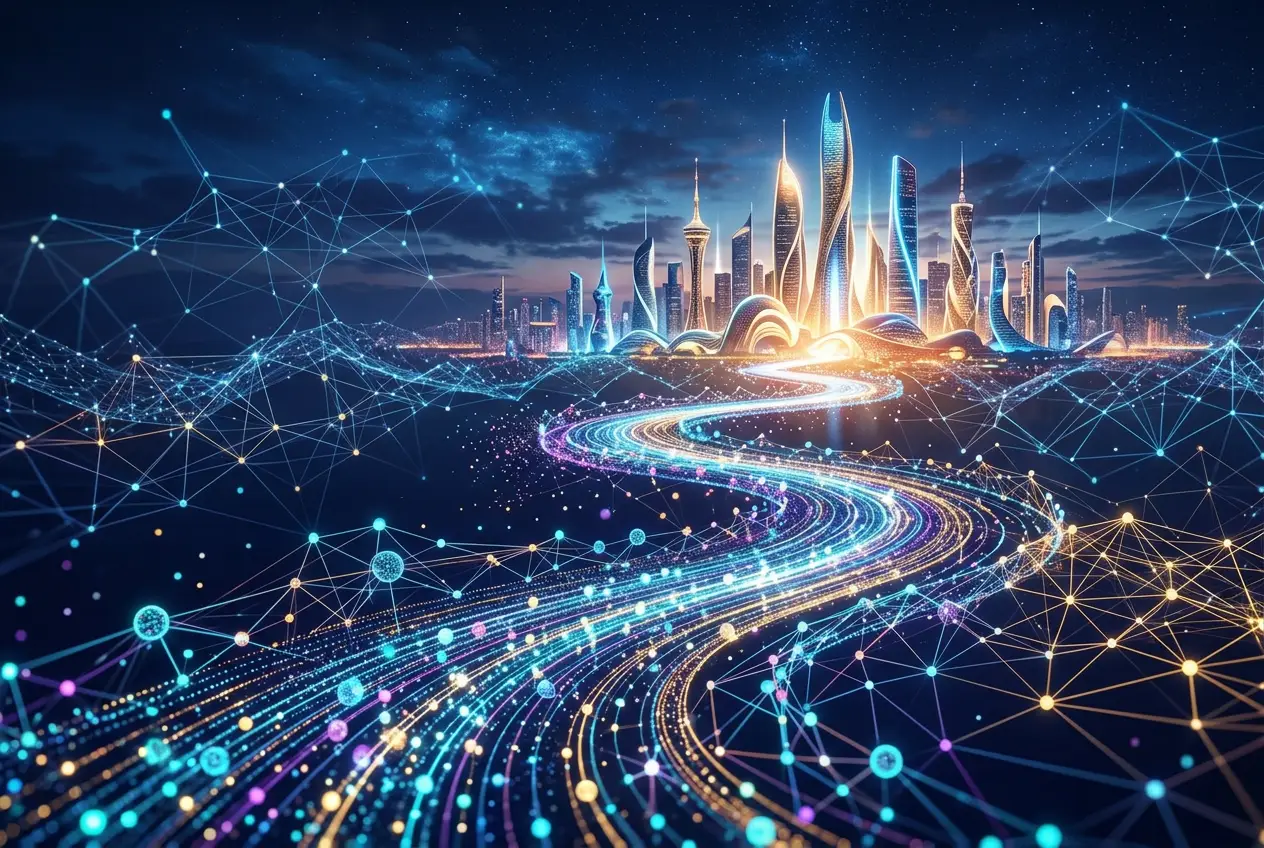
I’ve been watching the rapid evolution of Artificial Intelligence for years, and lately, something has captivated my thoughts more than ever: could AI become our ultimate oracle, capable of foreseeing humanity’s next monumental breakthroughs? It’s a question that feels ripped from science fiction, yet with every passing year, AI’s predictive power grows more sophisticated, making us wonder if the distant future might not be so distant after all.
From guiding self-driving cars to diagnosing diseases with uncanny accuracy, AI is already transforming our present. But can it do more? Can it sift through the colossal ocean of human data – scientific papers, economic trends, social media chatter, historical patterns – and pinpoint the exact moment or the precise idea that will spark the next industrial revolution, the next cure for a global pandemic, or even the next great philosophical shift? The prospect is both thrilling and a little unsettling.
How AI Learns to See the Future
At its core, AI's ability to predict stems from its unparalleled capacity to process and analyze Big Data. Unlike human analysts who can only juggle a limited set of variables, AI algorithms thrive on complexity. They can ingest petabytes of information, identifying subtle patterns, correlations, and anomalies that would be invisible to the human eye.
-
Big Data & Pattern Recognition: Imagine AI sifting through decades of scientific publications, patent filings, and research grants. It’s not just reading them; it’s mapping the connections between disparate fields, recognizing emerging research clusters, and even spotting the "weak signals" that precede a major discovery. This is akin to a super-powered version of what researchers call predictive analytics. "Predictive analytics encompasses a variety of statistical techniques from data mining, predictive modelling, and machine learning that analyze current and historical facts to make predictions about future or otherwise unknown events." - Wikipedia on Predictive Analytics (opens in a new tab)
-
Machine Learning Algorithms: These are the brains behind the operation. Algorithms like neural networks and deep learning models are trained on vast datasets to learn complex relationships. They don't just memorize; they learn to generalize, allowing them to make informed guesses about new, unseen data. For instance, by analyzing historical economic indicators, geopolitical events, and technological advancements, an AI could potentially forecast significant economic shifts or even the emergence of entirely new markets. This is where AI truly distinguishes itself; its capacity to learn and adapt makes its predictions increasingly nuanced. We've seen how AI can even learn from human intuition in complex tasks, hinting at a deeper understanding of decision-making processes, as discussed in our article, Can AI Truly Learn from Human Intuition?.
-
From Data to Foresight: The process isn't about clairvoyance; it's about probability and statistical inference on an unprecedented scale. By understanding how past innovations unfolded, what factors contributed to their success or failure, and how various societal elements interact, AI can construct sophisticated models of potential futures.
The "Leaps": What Can AI Predict?
The scope of AI's predictive potential extends far beyond mere trend spotting. We're talking about fundamental transformations across various domains:
Scientific Discoveries
Imagine an AI that, by analyzing every known chemical compound, every material property, and every theoretical physics paper, could propose the exact molecular structure for a room-temperature superconductor or a novel material that could revolutionize energy storage. It could accelerate drug discovery by simulating millions of molecular interactions, identifying potential cures years before traditional research methods.
Technological Breakthroughs
AI could foresee the convergence of multiple nascent technologies to create something entirely new. Perhaps it could predict the advent of commercially viable fusion power by tracking advances in plasma physics, material science, and computational modeling. Or the precise conditions under which quantum computing moves from theoretical promise to widespread application. This isn't just about incremental improvements; it's about anticipating the "singularity" moments where technology fundamentally shifts our capabilities. "The technological singularity—or simply the singularity—is a hypothetical future point in time at which technological growth becomes uncontrollable and irreversible, resulting in unforeseeable changes to human civilization." - Wikipedia on Technological Singularity (opens in a new tab)
Societal Transformations
This is perhaps the most profound and challenging area. Could AI predict shifts in global demographics, the rise of new political ideologies, or even major cultural movements that redefine human interaction? By analyzing massive datasets of human behavior, communication patterns, and historical precedents, AI might identify the tipping points that lead to societal revolutions, economic upheavals, or even global peace initiatives. Such insights could offer invaluable guidance for policymakers, educators, and leaders, helping them navigate complex challenges and seize opportunities.
Beyond the Horizon: Real-World Glimmers
While predicting "the next big leap" remains largely theoretical, the building blocks are already in place:
- Climate Modeling: AIs are already crucial in predicting complex climate patterns, forecasting extreme weather events, and modeling the impact of human activities on the environment.
- Disease Outbreaks: AI can analyze global health data, travel patterns, and genetic information to predict the spread of infectious diseases, aiding in early intervention and containment.
- Market Trends: Financial institutions use AI to predict market fluctuations, identify investment opportunities, and even anticipate consumer behavior with remarkable accuracy.
These are smaller "leaps" perhaps, but they demonstrate the underlying capabilities that, when scaled and refined, could extend to broader, more profound predictions. The journey from understanding complex data to predicting large-scale societal shifts is one of increasing sophistication in algorithm design and data integration.
The Limits and the Labyrinth of Ethics
The idea of an all-knowing AI is tempting, but it's crucial to acknowledge the significant limitations and ethical dilemmas.
- Data Bias: AI is only as good as the data it's trained on. If historical data is biased, the AI's predictions will reflect and even amplify those biases, potentially perpetuating inequalities or misrepresenting future realities.
- The "Black Box" Problem: Many advanced AI models, especially deep learning networks, operate as "black boxes." We can see their inputs and outputs, but understanding how they arrive at a particular prediction can be incredibly difficult. This lack of transparency can hinder trust and accountability, particularly when dealing with critical societal predictions.
- The Prediction Paradox: What if AI predicts a negative outcome? Knowing the future might prompt us to change our actions, thus rendering the prediction false. This "observer effect" means that a truly accurate prediction of a major societal shift might be inherently impossible if humanity retains its free will.
- Ethical Minefield: If AI can predict, who controls this power? Should such predictions be made public, or kept by governments or corporations? What are the implications for privacy, individual autonomy, and the very fabric of democratic societies if our futures are effectively "pre-written" by an algorithm? We've explored broader philosophical questions about reality and technology in Is Our Reality a Digital Simulation?, and the ability of AI to foresee could add another layer to such complex discussions.
The Human Element: Our Indispensable Role
Ultimately, even the most sophisticated AI will remain a tool. Humanity’s capacity for creativity, innovation, and unpredictable free will ensures that we remain the primary drivers of our own "next big leaps." AI can illuminate pathways, highlight potential pitfalls, and even suggest novel solutions, but it cannot replace the spark of human genius or the courage to venture into the unknown.
Think of AI not as a crystal ball, but as the most powerful telescope ever built, helping us see further into the cosmic patterns of human development. It offers a new lens through which to understand our collective journey, providing insights that can empower us to make better decisions, anticipate challenges, and perhaps, consciously shape our future for the better. This collaboration between human ingenuity and artificial intelligence promises a future where we are better equipped to tackle the grand challenges that lie ahead. Even in understanding our past, AI plays a pivotal role, as exemplified by its potential to Can AI Unlock Ancient Lost Languages?, showing its strength in decoding complex data, past or future.
In the realm of AI and society, the rise of robot companions also touches upon how we integrate AI into our social fabric, and the article Can AI Nurture Us? The Rise of Robot Companions provides an interesting perspective on how AI's predictive capabilities might extend to understanding and meeting our emotional needs in the future.
Conclusion
The question of whether AI can predict humanity's next big leap isn't just about technological capability; it's about our evolving relationship with intelligence itself. As AI continues to refine its predictive models, we are entering an era where foresight might become an actionable commodity. The future remains unwritten, but with AI as a co-pilot, we might just have a better roadmap to navigate its uncharted territories, making conscious choices about the directions we take. It's a fascinating, complex journey, and I, for one, am eager to see how it unfolds.



Conversation0
No comments yet. Be the first to share a thought — the best questions often become new stories.