


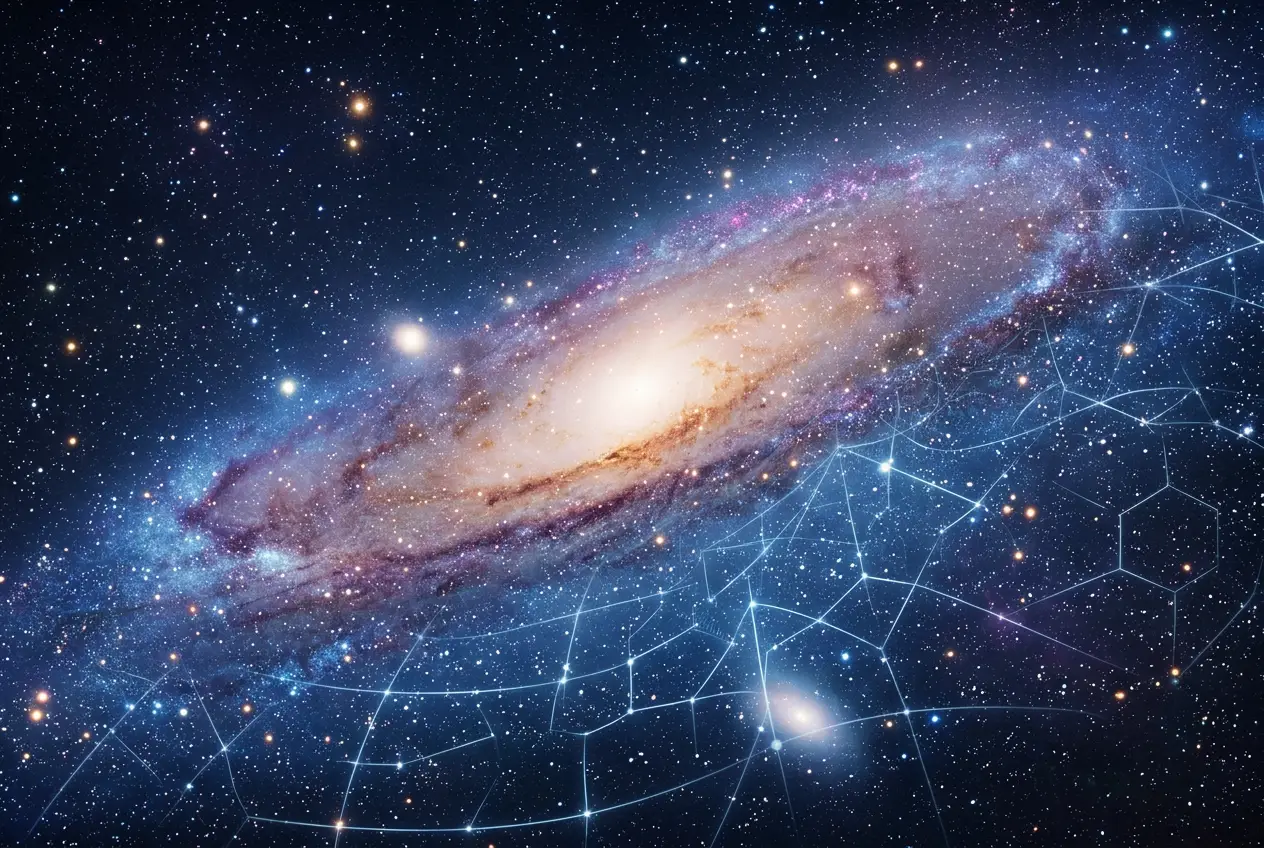
Sometimes, I find myself pausing mid-task, observing a strangely familiar pattern or experiencing an uncanny coincidence, and a fleeting thought crosses my mind: "Is this real? Or just a glitch?" It's a question many of us have secretly entertained, perhaps after a vivid dream or a moment of profound déjà vu. The concept isn't new to science fiction, but what if the idea that our universe is a sophisticated computer simulation isn't just a fantasy, but a plausible scientific hypothesis?
This isn't about wild conspiracy theories; it’s a serious proposition explored by physicists, philosophers, and even tech moguls. The Simulation Hypothesis asks a question that strikes at the very core of our existence: could everything we perceive—our planet, the stars, our consciousness, the laws of physics themselves—be part of an incredibly intricate program running on a colossal, alien computer? I’ve found this idea utterly captivating, and it pushes the boundaries of what we understand about reality, technology, and what it truly means to exist.
The Genesis of a Mind-Bending Idea
The notion of a simulated reality has roots in ancient philosophy, with Plato's Allegory of the Cave being an early, albeit metaphorical, exploration. However, the modern scientific and technological articulation of the Simulation Hypothesis truly gained traction in 2003 when philosopher Nick Bostrom published his seminal paper, "Are You Living in a Computer Simulation?" Bostrom, a professor at the University of Oxford, laid out a probabilistic argument that has since ignited widespread debate and research.
His argument, in essence, states that at least one of three propositions must be true:
- The vast majority of civilizations at our level of technological development go extinct before becoming "posthuman" (meaning they never reach a stage where they possess massive computing power).
- Any posthuman civilization that does emerge has little to no interest in running ancestor simulations.
- We are almost certainly living in a computer simulation.
Bostrom posits that if a civilization reaches a posthuman stage, its computational power would be so immense that it could run an astronomical number of detailed ancestor simulations – simulations of their historical predecessors' lives. Given the sheer scale of potential simulations, the probability that we are among the few "base" realities, rather than one of the countless simulated ones, becomes incredibly small. It's a provocative thought experiment, forcing us to confront the limits of our perception.
Glimpses of the Code: Arguments for a Simulated Universe
While direct proof remains elusive, several intriguing phenomena and observations in our universe offer tantalizing, albeit circumstantial, "clues" that some interpret as hints of a simulated reality.
The Fine-Tuning of the Universe
One of the most compelling arguments comes from the inexplicable fine-tuning of our universe. The fundamental constants of physics—like the strength of gravity, the mass of an electron, or the ratio of the electromagnetic force to the strong nuclear force—appear to be perfectly calibrated for the existence of life. Even a tiny deviation in any of these values would result in a universe incapable of forming stars, planets, or even complex atoms.
For me, this often feels like staring at a complex piece of software where all the parameters are set just right, not by accident, but by design. Is this evidence of a divine creator, or simply the optimized settings of a simulated environment? As physicists like Max Tegmark have pointed out, if these constants were truly random, the probability of them landing in the life-permitting "sweet spot" is infinitesimally small. This cosmic precision could be a feature of a simulation designed to produce intelligent observers. You can learn more about the scientific discussion around this phenomenon on Wikipedia's page on Fine-tuned Universe (opens in a new tab).
The "Pixelated" Nature of Reality
At the smallest scales, our universe doesn't appear infinitely smooth. Quantum mechanics suggests that space and time might be quantized, meaning they exist in discrete, indivisible units, much like pixels on a screen or data points in a computer program. The Planck length (approximately 1.6 x 10^-35 meters) and Planck time (approximately 5.4 x 10^-44 seconds) represent the theoretical minimum possible units of length and time.
Could these fundamental limits be the "resolution" of our simulated reality? If you've ever zoomed in too far on a digital image, you'll see the pixels that make up the picture. Similarly, some theories propose that if we could probe reality at these extreme scales, we might hit the "edge" of the simulation's resolution. This concept also raises questions about the behavior of particles, like in quantum entanglement, where particles appear to instantaneously influence each other across vast distances, seemingly defying classical notions of space and time – a phenomenon that some theorists playfully suggest could be "data compression" or "shortcuts" in the simulation's code. To dive deeper into such mind-bending concepts, consider exploring our previous discussion on how quantum mechanics challenges our perception in /blogs/how-does-quantum-entanglement-defy-space-time-5424.
Universal Speed Limit: The Speed of Light
The cosmic speed limit, the speed of light in a vacuum (c), is another curious constant. Nothing with mass can accelerate to or exceed this speed. In a simulation, a universal speed limit could be a practical constraint, perhaps similar to the refresh rate or processing speed of the simulation's underlying hardware. It's a hard limit that shapes our entire understanding of causality and interaction within the universe, much like a frame rate limits the speed of events in a video game.
Information and Consciousness
Many modern physicists suggest that information is fundamental to reality, not just an emergent property. If information is the bedrock, then a universe that processes and stores information—much like a computer—becomes a more intuitive concept. Furthermore, the nature of consciousness itself presents a profound puzzle. If our reality is simulated, then our minds might also be digital constructs. This raises fascinating questions about free will and the possibility of uploading consciousness, a topic we touched upon in /blogs/can-brain-interfaces-upload-our-memories-9476. The question of whether our brains operate as complex quantum machines also adds another layer to this mystery, as explored in articles like /blogs/is-our-brain-a-quantum-machine-3312.
Cracks in the Code? Counterarguments and Challenges
Of course, the Simulation Hypothesis is far from universally accepted, and many scientists and philosophers offer robust counterarguments.
The Problem of Empirical Evidence
The most significant challenge is the lack of empirical evidence. How would one actually test if we are in a simulation? While theorists have proposed some experiments—such as looking for computational limits in cosmic ray energies or subtle grid-like anisotropies in the cosmic microwave background—none have yielded conclusive results. It's incredibly difficult to find evidence of the "system" while operating within the system itself.
The "Boltzmann Brain" Problem
One philosophical challenge is the Boltzmann Brain argument. If the universe is a simulation, and it runs for an immense amount of time, it becomes statistically more probable for a single, disembodied brain to spontaneously fluctuate into existence (a Boltzmann Brain) and experience a conscious moment than for an entire complex, ordered universe like ours to arise and sustain itself. This suggests that if we are simulated, the simulators would need to specifically design for a stable, ordered reality, not just random fluctuations, which complicates the "why" of the simulation. For more, see Wikipedia's Boltzmann brain entry (opens in a new tab).
The Infinite Regress
Another common critique is the problem of infinite regress: if our universe is a simulation, then the universe running our simulation must also be real, or it too could be a simulation. This leads to an endless chain of simulations, which doesn't resolve the question of what constitutes "base reality."
If It's a Simulation, Then What? The Profound Implications
Should the Simulation Hypothesis ever be proven true, its implications would be nothing short of revolutionary, impacting everything from physics and philosophy to our understanding of technology and purpose.
For science, it could fundamentally alter our search for the ultimate laws of the universe. If there’s a "code," perhaps we can find exploits or hidden parameters. It might even offer new avenues for understanding phenomena like dark matter and dark energy as features or background processes of the simulation.
Philosophically, questions of free will, morality, and the meaning of life would take on entirely new dimensions. Are we merely sophisticated programs, or do we possess genuine agency? And if there are "simulators," what are their intentions? Are they benevolent, indifferent, or simply running an experiment?
From a technological standpoint, the concept is awe-inspiring. If we ourselves are living in a simulation, it implies that the technology required to create such a reality is not just possible but has already been achieved by a civilization far more advanced than our own. This thought alone pushes the boundaries of our own aspirations for AI and virtual reality. Could advanced AI, capable of self-replication and evolving beyond our comprehension, eventually become our own 'simulators' in the future? This intriguing idea is discussed in /blogs/can-ai-build-itself-the-dawn-of-self-replicating-tech-1610. The implications extend to the very idea of multiverses—if our reality is one simulation, could there be countless others, each with its own set of rules and inhabitants? This concept finds parallel in discussions like those found on Wikipedia's Multiverse page (opens in a new tab).
The Quest for Proof: A Journey into the Unknown
Currently, the Simulation Hypothesis remains a powerful thought experiment rather than a proven scientific theory. But the discussions it provokes are incredibly valuable. They challenge us to think critically about the nature of reality, the limits of our perception, and the potential of technology. Whether we are in a simulation or not, the questions posed by this hypothesis push the boundaries of scientific inquiry and philosophical thought, encouraging us to look closer at the "code" of our universe.
I find it fascinating to consider that the very curiosity that drives us to ask these questions might itself be part of the program – a built-in feature designed to explore the parameters of our simulated existence. As technology advances, and our own simulations become more complex, the lines between what is "real" and what is "simulated" will only become blurrier, making this age-old philosophical puzzle more relevant than ever.


Conversation0
No comments yet. Be the first to share a thought — the best questions often become new stories.