


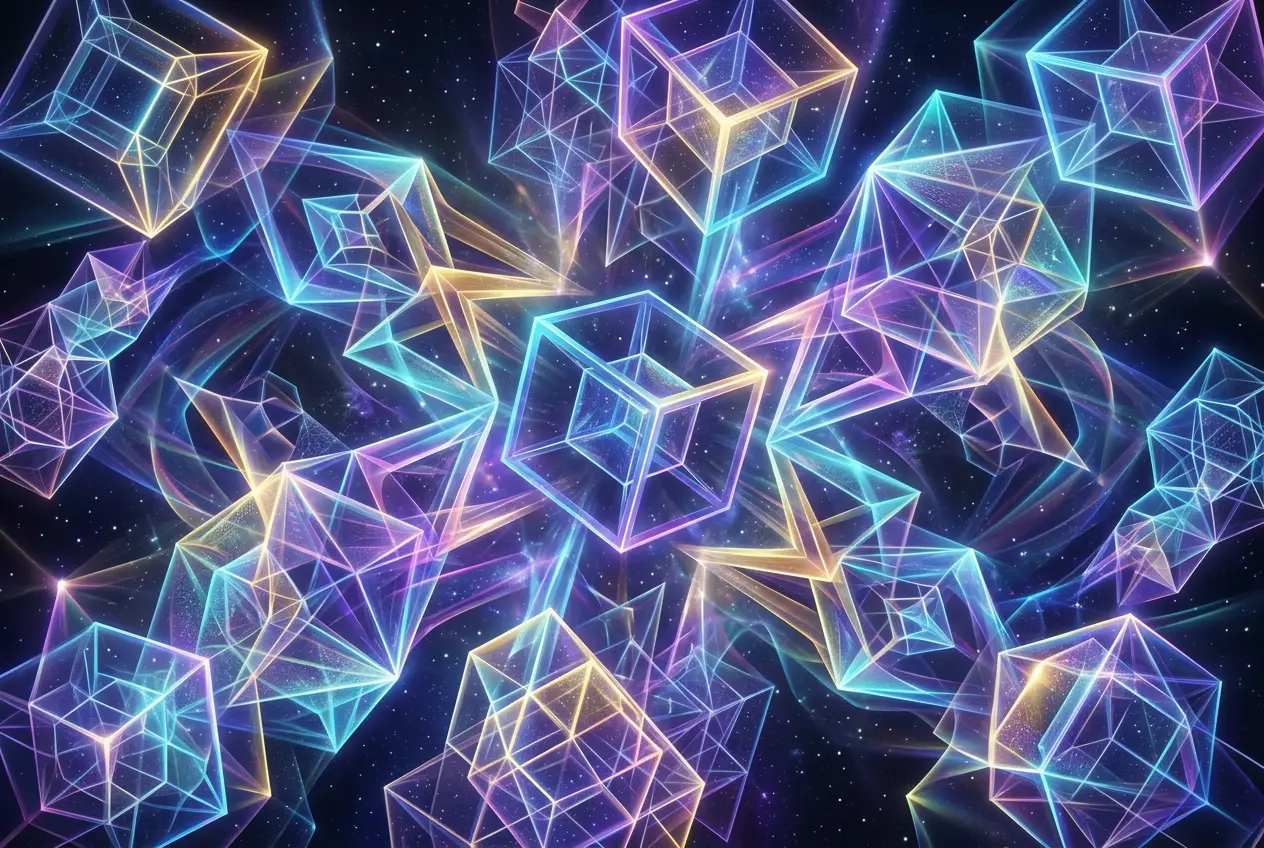
I remember a moment when I was a child, trying to draw a cube on paper. My pencil struggled to convey depth, to make something inherently three-dimensional flatten onto a two-dimensional surface. It was a simple exercise, yet it perfectly illustrated the fundamental limitation of projecting a higher dimension onto a lower one. We live in a world defined by three spatial dimensions – length, width, and height. Everything we see, touch, and experience fits neatly into this familiar XYZ coordinate system. But what if there’s more? What if our universe, or even our perception, is just a slice of a much grander reality, one that includes a fourth spatial dimension we simply cannot grasp? This isn't just the stuff of science fiction; it's a profound question that physicists, mathematicians, and philosophers have wrestled with for centuries.
The Familiarity of Three Dimensions
Before we leap into the unknown, let’s ground ourselves in what we do know. Imagine a point – that’s zero dimensions. Now, draw a line from that point; you’ve created a one-dimensional object, existing only in length. Take that line and extend it sideways; you get a square, a two-dimensional shape with length and width. Finally, stack those squares, or extend the square upwards, and you form a cube – our familiar three-dimensional world, adding height to the mix.
This progression seems intuitive because we can easily move through and perceive all three of these dimensions. I can walk forward (length), turn left (width), and jump up (height). My brain is wired to process this information, building a coherent model of a 3D reality. But here’s the rub: if a two-dimensional being (a "Flatlander" as Edwin Abbott Abbott famously imagined in his novel Flatland) were to encounter a 3D sphere, it would only perceive a cross-section of that sphere. First, a tiny point appears, then it grows into a circle, expands, then shrinks back to a point, and vanishes. The Flatlander would be utterly baffled, experiencing a series of inexplicable changes without understanding the true, higher-dimensional form passing through their world. This analogy, I believe, is crucial for us.
The Mental Block: Why Four Dimensions Are So Hard to Visualize
The leap from 2D to 3D is straightforward for us, but the leap from 3D to 4D spatial dimensions feels like hitting a cognitive wall. Our brains, honed by millions of years of evolution in a 3D environment, simply lack the sensory apparatus or the neural pathways to directly process a fourth spatial axis. When I try to imagine it, my mind defaults to tricks:
- Time as the Fourth Dimension: This is the most common workaround. In physics, particularly in Einstein’s theory of relativity, time is indeed treated as a fourth dimension, forming "spacetime." We move through time, but only in one direction, and it’s fundamentally different from spatial movement. For a deeper dive into spacetime distortions, you might enjoy reading our previous blog on Do Gravity Waves Warp Time? Unpacking Cosmic Ripples.
- Shadow Analogies: Think about a 3D object casting a 2D shadow. The shadow loses information; it doesn't fully represent the object. If we are "shadows" of a 4D reality, we're missing an entire dimension of information.
- Moving a Cube: Just as moving a square "perpendicular" to itself creates a cube, a theoretical 4D object (a tesseract or hypercube) would be formed by moving a cube in a direction perpendicular to all three of our spatial axes simultaneously. This "direction" is what we can't fathom.
As the renowned astrophysicist Carl Sagan famously put it in Cosmos: "The total number of dimensions is a question of profound importance in physics." He understood that our everyday perception could be merely a fraction of reality.
Mathematical Elegance: Defining the Unimaginable
While we can't see a tesseract, mathematicians have no problem describing it. In mathematics, a dimension is simply another independent variable needed to describe a point in space. For a 3D cube, you need (x, y, z). For a 4D hypercube, you’d simply add another coordinate: (x, y, z, w). The properties of such objects can be meticulously calculated, even if they can only be visualized through projections onto lower dimensions.
One of the most profound mathematical inclusions of a fourth dimension comes from Hermann Minkowski, who, building on Einstein's work, introduced Minkowski spacetime. Here, the three spatial dimensions (x, y, z) are combined with time (t) into a single, unified four-dimensional manifold. This is where events occur. While time acts differently than space (we can't move backward through it spatially), this mathematical framework underpins much of modern physics. You can learn more about the concept of spacetime on Wikipedia's Spacetime page (opens in a new tab).
Where Do Hidden Dimensions Reside? The Realm of Theoretical Physics
The idea of extra spatial dimensions isn't confined to thought experiments. It's a cornerstone of several leading theories in theoretical physics, attempting to unify the fundamental forces of nature.
- String Theory: One of the most prominent theories, String Theory, posits that the fundamental constituents of the universe aren't point-like particles, but tiny, vibrating strings. For the mathematics of string theory to work, it requires extra spatial dimensions – often 10 or 11 in total. These extra dimensions are not large and expansive like our familiar three; they are thought to be "compactified" or "curled up" into incredibly tiny spaces, too small for us to detect directly. Imagine a garden hose from afar – it looks one-dimensional. But up close, you see it has a tiny, curled-up second dimension (its circumference). These hidden dimensions could be similarly minuscule.
- M-Theory: An extension of string theory, M-theory suggests 11 dimensions and proposes that our universe might be a "brane" (a membrane-like object) existing within a higher-dimensional bulk. This could be relevant if you've ever pondered if decoding reality: does the universe hide extra dimensions?.
- Kaluza-Klein Theory: This earlier attempt at unification in the 1920s tried to unify gravity and electromagnetism by introducing a fifth dimension (one spatial and four spacetime). It suggested that electromagnetism might just be gravity acting in this curled-up extra dimension.
Could We Ever Perceive a Fourth Dimension?
This is the truly mind-bending question. If these extra dimensions exist, could we ever develop the capacity to perceive them?
- Sensory Augmentation: Perhaps not naturally, but through advanced technology. Imagine a brain-computer interface that could translate fourth-dimensional information into a form our brains could process – maybe as shifts in color, sound, or even a new kind of spatial sensation. What would it feel like to have a "hyper-sense"?
- "Shadow" Interactions: We already interact with something that implies higher dimensions: gravity. In some theories, gravity is thought to be "leaking" into our 3D brane from a higher dimension, which explains its relative weakness compared to other fundamental forces. If we could detect and interpret these subtle leakages, we might be gathering indirect evidence of the fourth dimension.
- Hypothetical 4D Creatures: If a 4D creature were to exist and pass through our 3D world, we would see parts of it appear and disappear, seemingly out of nowhere, without apparent cause. It would be like the Flatlander's experience with the sphere, but even more disorienting. A 4D being could, hypothetically, reach into a locked box from a direction we don't perceive, or tie a knot that's impossible to untie in 3D.
Consider the notion of a "hyper-object." If I were to hold a 3D apple, you see its entire surface. But if I were to hold a 4D hyper-apple, you might only see a 3D cross-section of it. As I rotated the hyper-apple in its fourth dimension, different 3D cross-sections would pass through our reality, making it appear to change shape and form in ways inexplicable by our 3D understanding. For more on how our reality might be structured, check out our piece on Is Our Universe a Hologram? Decoding Cosmic Data.
The Enduring Quest
The concept of a fourth spatial dimension remains one of the most intriguing and challenging ideas in science. It pushes the boundaries of our intuition and forces us to reconsider the fundamental nature of reality itself. While direct observation remains elusive, the mathematical frameworks and theoretical physics models that embrace higher dimensions continue to offer powerful explanations for phenomena we observe, and perhaps, for those we don't yet understand. Our journey into hyperspace is far from over, and with every new discovery in particle physics or cosmology, we might just be peeling back another layer of our universe's multidimensional onion. The universe, I believe, holds wonders far beyond our current comprehension, and the fourth dimension might just be one of its most profound secrets.




Conversation0
No comments yet. Be the first to share a thought — the best questions often become new stories.