


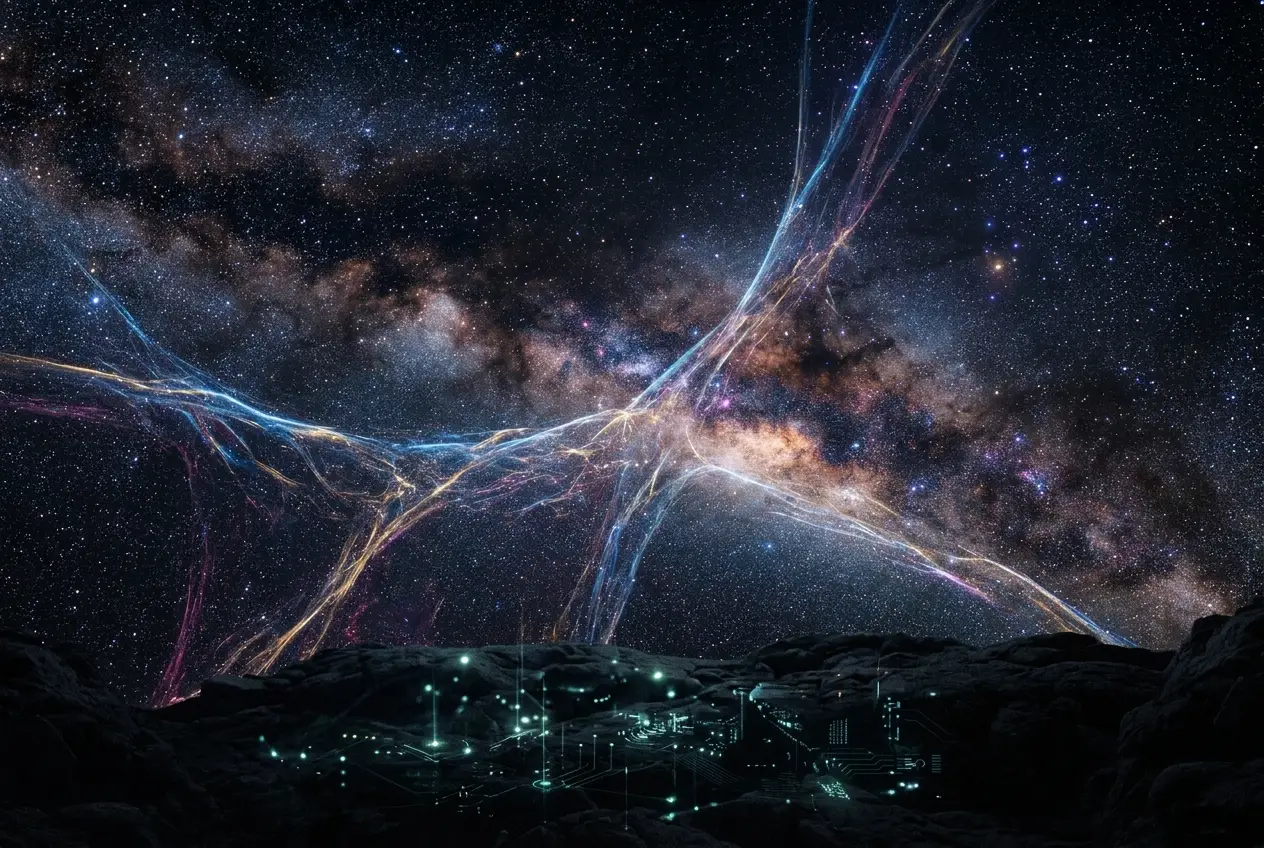
The universe, I've come to believe, is far stranger and more fascinating than we often give it credit for. Beyond the familiar stars and galaxies lies a realm of theoretical physics where concepts like cosmic strings emerge—not the delicate strands we might tie a package with, but incredibly dense, infinitesimally thin, one-dimensional topological defects that could stretch across vast cosmic distances. Imagine a fault line in the fabric of reality itself, a remnant of the Big Bang's earliest moments. What if these bizarre structures, if they exist, don’t just passively traverse the cosmos but actively bend reality in ways that could unlock unimaginable technological advancements for us in the future?
Recently, while diving into some cutting-edge astrophysics papers, I found myself grappling with the mind-boggling implications of these theoretical objects. The idea isn't pure science fiction; it’s a consequence of grand unified theories attempting to explain the fundamental forces of nature. These theories suggest that as the universe cooled after the Big Bang, phase transitions—much like water freezing into ice—could have occurred, trapping energy in linear defects. These aren't just theoretical curiosities; their properties could profoundly impact space-time, gravity, and even the very nature of matter and energy around them.
The Genesis of Cosmic Strings: Ripples from the Big Bang
To truly grasp the significance of cosmic strings, we need to rewind to the very beginning of our universe. In the unimaginably hot and dense conditions just moments after the Big Bang, the fundamental forces we know today—gravity, electromagnetism, and the strong and weak nuclear forces—were believed to be unified into a single, super force. As the universe expanded and cooled, this super force "broke" into the distinct forces we observe, a process called spontaneous symmetry breaking.
Cosmic strings are hypothesized to be the "seams" or "fault lines" left behind by these symmetry-breaking events. Think of a perfect crystal forming from a liquid. Sometimes, defects or imperfections occur in the crystal lattice. In the early universe, these defects wouldn't be in a material but in the very fabric of space-time and the associated fundamental fields. They are not made of atoms or particles as we understand them; instead, they are concentrations of primordial energy packed into an incredibly thin line. A single centimeter of a cosmic string could weigh more than Mount Everest! For further reading on this cosmic phenomenon, a detailed overview can be found on Wikipedia's Cosmic String page (opens in a new tab).
Gravitational Lensing: A Cosmic String's Signature?
One of the most compelling pieces of indirect evidence for cosmic strings would be their unique gravitational signature. Unlike point masses or extended objects like galaxies, a cosmic string would warp space-time in a peculiar way, creating a "gravitational wedge." Light passing by a cosmic string would be bent symmetrically around it, creating two identical images of any distant object behind it.
Astronomers have spent decades searching for these characteristic doubles. While no definitive detection has been made, several tantalizing observations have kept the hunt alive. For instance, observations of distant quasars or galaxies that appear as identical pairs could, in theory, be explained by a cosmic string positioned between us and the source. However, other astrophysical phenomena can also cause such lensing, making definitive identification incredibly challenging. It's a bit like trying to find a perfectly straight, invisible thread amidst a whirlwind of cosmic dust and light.
I recall a discussion I had with a theoretical physicist about how these strings could be far more subtle than we anticipate. "Their influence isn't about crushing force, but about subtle shifts in the very geometry of the cosmos," he explained. This subtlety makes them difficult to pin down, yet their potential impact remains profound.
Time Dilation and Warped Space: Navigating the String's Influence
If cosmic strings truly exist, their extreme density and gravitational effects would have profound implications for space-time. One of the most mind-bending effects is the potential for time dilation. Near a cosmic string, time itself could pass differently. This isn't just a minor clock discrepancy; it could mean that for an observer traversing near a string, time would literally slow down or speed up relative to someone far away.
Imagine the implications for future space travel. If humanity ever develops the capability to harness or even navigate near these structures, they could become cosmic shortcuts or time-manipulating pathways. A journey that takes decades for a conventional spacecraft might be reduced to years or even months for one that strategically utilizes a cosmic string's warped space-time. This is where the concept of "bending reality" truly begins to take shape.
This isn't just speculative; the equations of general relativity, when applied to such objects, predict these effects. The challenge, of course, is finding them and then figuring out how to interact with them without being torn apart by their immense gravitational gradients. For a deeper understanding of the theoretical physics behind these distortions, you can consult Wikipedia's General Relativity page (opens in a new tab).
From Cosmic Strings to Future Tech: A Leap of Imagination
The leap from theoretical cosmic objects to tangible technology requires a huge imaginative leap, but in science, today's theory often becomes tomorrow's engineering challenge. If cosmic strings exist and we could ever understand them well enough, their unique properties could open doors to technologies that sound like pure fantasy.
1. Propulsion and Warp Drives:
The most ambitious idea involves using cosmic strings for interstellar travel. Because they create a deficit angle in space-time—meaning if you were to travel around a string and return to your starting point, you'd find yourself in a slightly different place—they could potentially be exploited for faster-than-light travel. Traversing along such a defect could, in theory, allow a spacecraft to cover vast distances without violating the local speed limit of light. While entirely theoretical, it provides a fascinating avenue for thinking about how we might one day reach distant stars. This concept ties into broader ideas about manipulating spacetime, much like discussions on whether time crystals break physics, a strange state of matter.
2. Energy Harvesting:
Cosmic strings are incredibly energetic. Their enormous mass-energy could theoretically be a source of unimaginable power, if we could ever figure out how to tap into it. This would, of course, require physics and engineering far beyond our current capabilities, perhaps involving quantum-level manipulation of gravity or energy fields.
3. Supercomputers Beyond Our Wildest Dreams:
The extreme conditions near a cosmic string could create environments where matter behaves in ways we can barely conceive. Could these regions become natural super-quantum computers, processing information at speeds and scales currently unimaginable? The idea that fundamental fabric of reality itself could encode computation is mind-boggling, somewhat akin to asking if our universe is a giant neural network.
4. A Bridge to Other Dimensions?
Some theories suggest that cosmic strings, being one-dimensional objects, might offer glimpses or even access to extra dimensions, if they exist. If our universe is part of a larger, multi-dimensional reality, these strings could be the "seams" where our dimension interacts with others. This echoes the profound question of whether the universe hides extra dimensions, a concept that truly challenges our perception of reality.
The Unseen Universe: A Challenge and a Promise
The hunt for cosmic strings is a testament to humanity's insatiable curiosity and our drive to understand the fundamental laws governing our existence. Experiments like the European Space Agency's Planck satellite have set stringent limits on their abundance and properties, but haven't definitively ruled them out. Future gravitational wave detectors, like the Laser Interferometer Space Antenna (LISA), might be sensitive enough to detect the gravitational waves that cosmic strings would emit as they oscillate and interact.
I often think about the sheer audacity of even conceiving of such objects. They are a profound reminder that our current understanding of the universe, while extensive, is still incredibly incomplete. The idea that such powerful, reality-bending entities might be woven into the very fabric of space-time challenges our perceptions and pushes the boundaries of scientific inquiry. It's a journey into the unknown, where the line between theoretical physics and science fiction blurs.
Perhaps one day, we will not only confirm their existence but also unravel their secrets, potentially leading to a new era of technology that utilizes the very geometry of the cosmos. Until then, cosmic strings remain one of the universe's most tantalizing "what ifs," beckoning us to continue our quest for knowledge.




Conversation0
No comments yet. Be the first to share a thought — the best questions often become new stories.