


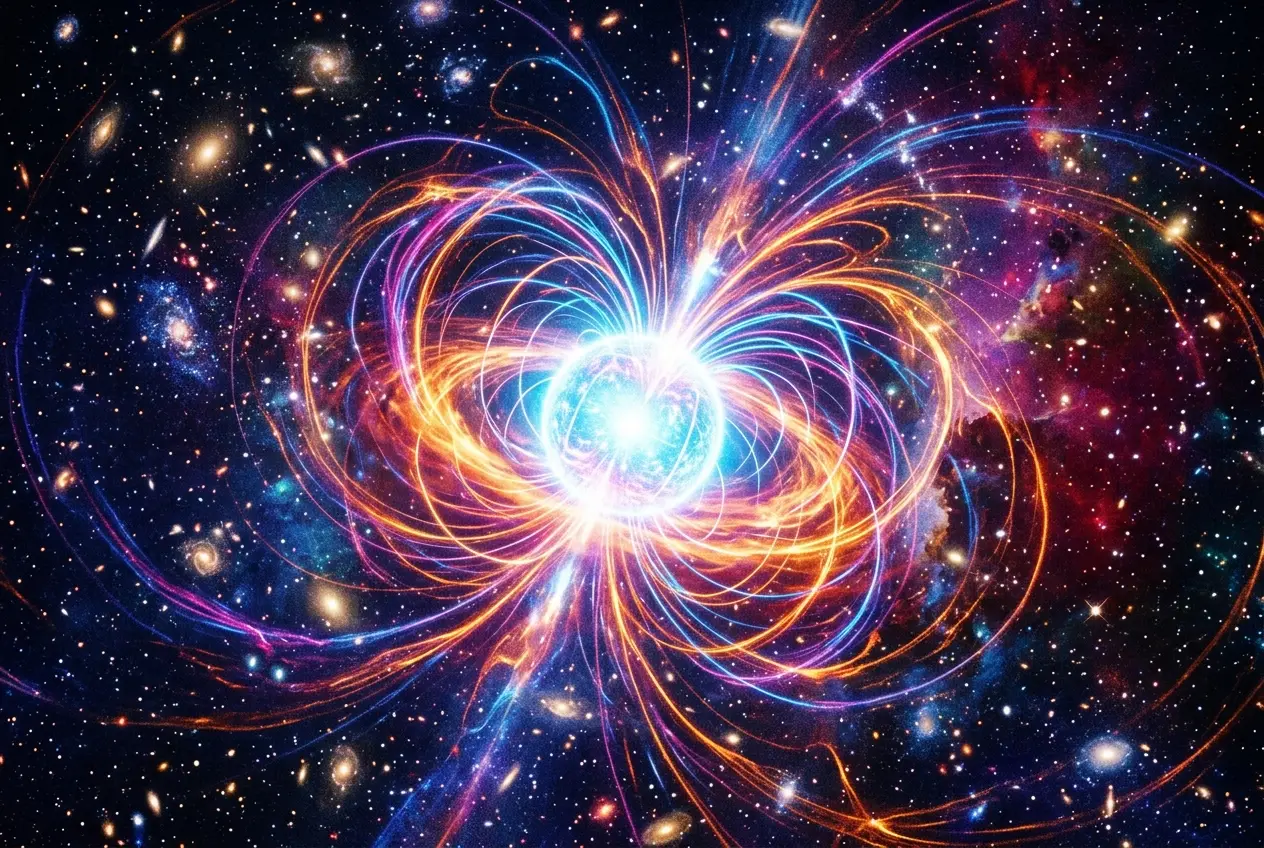
Imagine a magnet so powerful that it could strip the electrons from every atom in your body from a thousand miles away. A gravitational pull so intense that a single teaspoon of its material would weigh billions of tons. A star that can warp the fabric of spacetime, generating seismic events that shake its very core and send ripples of high-energy radiation across the galaxy. This isn't science fiction; it's a magnetar.
Recently, I found myself captivated by these cosmic titans. I mean, we talk about black holes and supernovas, but magnetars feel like the universe's secret weapon, a force of nature so extreme it almost defies comprehension. They are, in essence, a rare and particularly energetic type of neutron star – the collapsed remnants of massive stars far larger than our sun. But what sets them apart, what makes them truly enigmatic, is their staggeringly powerful magnetic fields. These fields are quadrillions of times stronger than Earth's, making them the most magnetic objects known in the universe. The sheer scale of that power is what triggered my curiosity: could humanity ever hope to understand, let alone harness, such an incredible force?
The Birth of a Cosmic Dynamo
To truly appreciate a magnetar, we need to understand its origins. When a star much larger than our sun, typically between 10 and 25 solar masses, runs out of nuclear fuel, its core collapses under its own immense gravity. This collapse triggers a spectacular supernova explosion, blasting away the star's outer layers. What's left behind is an incredibly dense, rapidly spinning core: a neutron star.
Neutron stars are already extreme. They pack the mass of 1.4 to 3 suns into a sphere only about 20 kilometers (12 miles) in diameter – roughly the size of a city. Their gravity is so immense that electrons and protons are crushed together to form neutrons, hence the name. They spin incredibly fast, sometimes hundreds of times per second. But for a neutron star to become a magnetar, it needs an extra ingredient: a primordial magnetic field, inherited from its progenitor star, that gets massively amplified during the collapse. This process, known as a magnetic dynamo, twists and compresses the magnetic field lines to an almost inconceivable intensity.
The result is a magnetic field that would instantly kill you from a distance of 1,000 km, tearing apart the very atoms in your body. If a magnetar were as close as the Moon, it would erase all data on every credit card on Earth. Every piece of iron would be ripped from the ground, causing catastrophic chaos. It's a humbling thought, isn't it? Our most powerful electromagnets pale in comparison.
Unleashing Cosmic Fury: Magnetar Flares and Starquakes
Magnetars aren't just powerful; they're also incredibly active. Their colossal magnetic fields exert immense stress on their crusts, leading to phenomena known as "starquakes." These aren't like earthquakes; they're far more violent, ripping through the star's surface and causing sudden, dramatic releases of energy in the form of gamma-ray flares.
These flares are among the most energetic events in the universe, second only to some supernovae. A single magnetar flare can release more energy in a fraction of a second than the Sun will produce in 100,000 years. Imagine that! For instance, on December 27, 2004, a magnetar named SGR 1806-20 unleashed a flare that briefly overwhelmed every gamma-ray detector on Earth, even though it was 50,000 light-years away. It ionized Earth's upper atmosphere, causing it to expand. This event demonstrated the terrifying power these objects wield across vast cosmic distances. You can read more about this incredible event on Wikipedia's article about the Soft gamma repeater SGR 1806-20 (opens in a new tab).
These flares provide crucial clues to how magnetars work. Scientists believe that the energy for these outbursts comes from the rearrangement of the star's magnetic field lines, which become tangled and twisted over time. When the stress becomes too great, they snap and reconfigure, releasing enormous amounts of energy. This is similar to how solar flares occur on our Sun, but on a scale that is incomprehensible.
The Allure of Extreme Physics: Beyond Our Current Understanding
Studying magnetars pushes the boundaries of our understanding of physics. Their interiors are thought to contain exotic matter, potentially a superfluid of neutrons, protons, and electrons, possibly even strange quarks. The immense magnetic fields are so strong that they affect the very properties of space and matter around them. Light itself can become polarized, and matter can be distorted into long, thin strands.
I often wonder about the implications of such extreme conditions. Could we learn new physics from them? Perhaps these environments harbor clues to a grand unified theory or even insights into the very early universe. The physics at play inside and around a magnetar goes beyond anything we can replicate in a lab. It’s like nature’s ultimate high-energy particle accelerator and magnetic confinement device, rolled into one. For more information on the exotic matter within neutron stars, Wikipedia's article on Neutronium (opens in a new tab) provides a good starting point.
Could Humanity Ever Harness Such Power?
Now for the tantalizing question: could we ever harness this extreme power? The short answer is: probably not in any way we currently understand. Magnetars are incredibly distant, typically tens of thousands of light-years away. The energy they release, while immense, dissipates over these vast distances. Even if we could reach one, the technology required to survive and interact with its environment would be beyond anything we can currently conceive.
However, the idea isn't entirely without merit from a theoretical standpoint. If we consider the far, far future, with advancements in areas like space travel and energy manipulation, perhaps some form of indirect harnessing could be imagined.
Theoretical Concepts, Far-Future Tech:
- Indirect Energy Harvesting: Instead of directly "tapping" the magnetar, perhaps a highly advanced civilization could detect the faint ripples of energy from its flares or the gravitational waves it produces, and use these as a beacon or even a subtle energy source for interstellar communication or propulsion. We've already discussed similar concepts in blogs like Could Antimatter Power Our Future?.
- Magnetic Field Manipulation: Understanding how magnetars generate and sustain such powerful magnetic fields could inspire revolutionary advancements in our own magnetic confinement technologies, crucial for fusion energy reactors here on Earth. Imagine if we could develop materials or field generation techniques that even remotely approach a magnetar's efficiency.
- Probing Exotic Matter: If future probes could somehow withstand the extreme conditions, studying the exotic matter within a magnetar could unlock entirely new physics, leading to breakthroughs in materials science or energy generation that are currently beyond our wildest dreams. This is a topic that resonates with the search for understanding extreme cosmic objects, similar to Black Holes: Are They Nature's Ultimate Quantum Computers?.
The challenges are monumental. We're talking about surviving environments that would instantly vaporize conventional spacecraft, fields that would tear apart matter, and radiation levels that would fry any electronics. It makes the engineering feats required for a Dyson Sphere around our own sun look like child's play by comparison. For further exploration into the theoretical physics surrounding extreme gravity and cosmic phenomena, the Wikipedia article on Gravitational waves (opens in a new tab) offers fascinating insights into how such extreme events ripple through spacetime.
The Grand Cosmic Tapestry
Magnetars serve as a powerful reminder of the universe's immense scale and its capacity for wonder and destruction. They are cosmic laboratories, pushing the laws of physics to their absolute limits and offering us glimpses into phenomena that are both terrifying and deeply inspiring. While direct harnessing of their power remains firmly in the realm of speculative science fiction, the knowledge we gain from studying them profoundly impacts our understanding of physics, astrophysics, and the very fabric of reality.
Every time I learn something new about these objects, I am reminded that the universe is far stranger and more magnificent than we can often imagine. Perhaps our true harnessing of magnetar power isn't about direct energy extraction, but rather the knowledge and inspiration they provide – propelling us to develop technologies and theories that help us better comprehend the cosmos we inhabit. Just as we ponder why stars vanish in Why Do Stars Vanish? Unpacking Cosmic Disappearances, magnetars push us to ask "what if?" about the most extreme ends of stellar evolution.
So, while we might not be building magnetar-powered spaceships anytime soon, the journey of discovery itself is a form of harnessing – harnessing the universe's mysteries to expand our own intellectual frontiers.



Conversation0
No comments yet. Be the first to share a thought — the best questions often become new stories.