


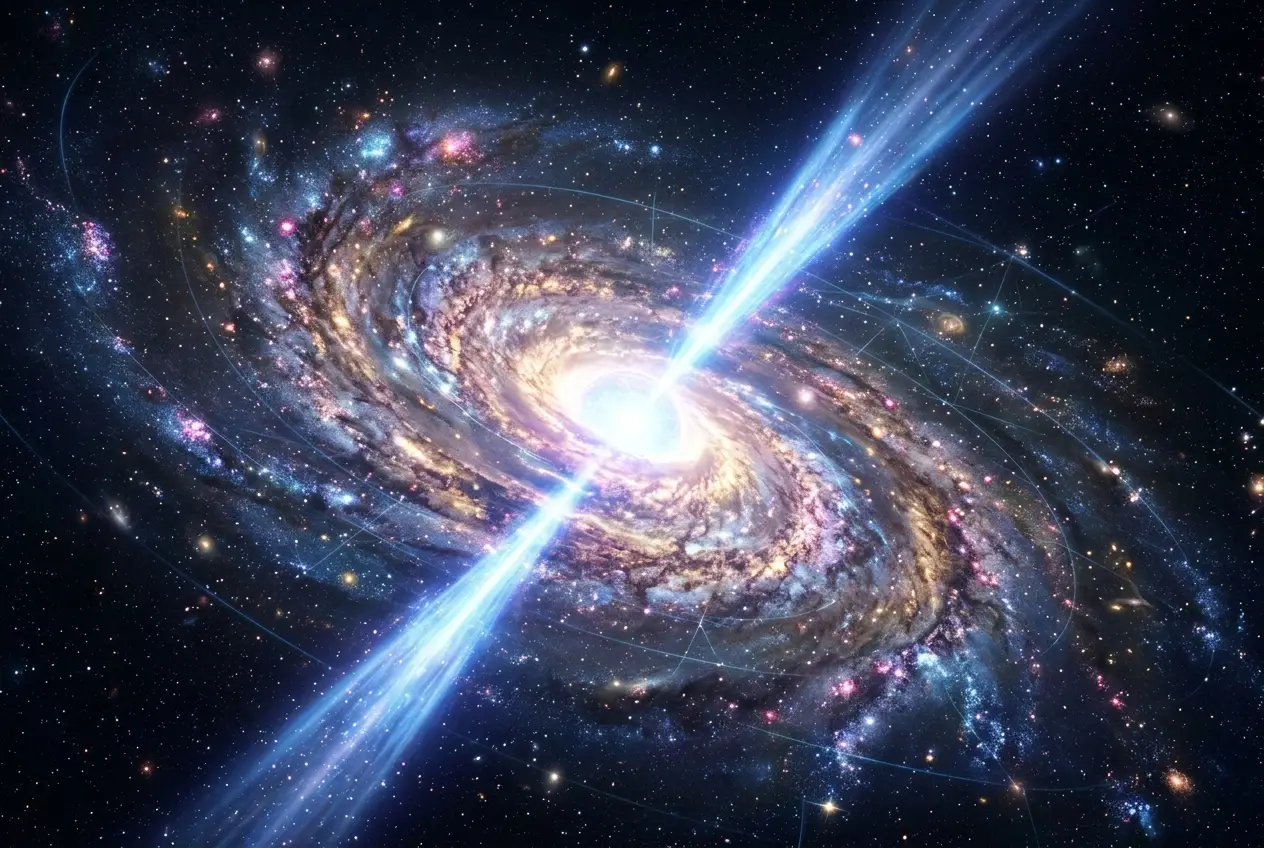
I was recently captivated by a thought experiment: imagine being adrift in the vast, silent ocean of interstellar space, billions of miles from home. No familiar stars to guide you, no GPS signals to lock onto. It’s a terrifying prospect. But what if the universe itself provided a network of unwavering beacons, ticking away with absolute precision, guiding you through the cosmic void? This isn't science fiction; it’s a concept rooted in the enigmatic celestial objects we call pulsars.
These aren't just twinkling stars; they are the universe's most extreme timekeepers, born from the fiery deaths of massive stars. For decades, scientists have studied their unwavering rhythm, but I believe we're only just beginning to grasp their true potential – not just as fascinating astronomical curiosities, but as potential lighthouses for humanity's deepest voyages into the cosmos.
The Cosmic Heartbeat: Unveiling Pulsars
The story of pulsars begins with a serendipitous discovery in 1967. A young graduate student named Jocelyn Bell Burnell, working with her supervisor Antony Hewish at Cambridge University, detected strange, highly regular radio signals emanating from a specific point in the sky. These pulses were so precise, so rhythmic, that for a brief, exhilarating moment, the team wondered if they had stumbled upon extraterrestrial intelligence – jokingly labeling them "LGM-1" (Little Green Men 1).
What they had actually found was far more astonishing and equally alien: rapidly rotating neutron stars. These are the collapsed cores of massive stars, remnants left behind after a spectacular supernova explosion. Imagine a star many times the mass of our Sun, compressed into a sphere no larger than a city, typically just 20 kilometers (12 miles) in diameter. The density is mind-boggling; a teaspoonful of neutron star material would weigh billions of tons.
The Lighthouse Effect: How Pulsars Pulse
The "pulsing" isn't due to the star physically expanding and contracting. Instead, it’s a cosmic lighthouse effect. Neutron stars possess incredibly strong magnetic fields, billions of times more powerful than Earth's. These magnetic fields generate beams of radiation (often radio waves, but also X-rays and gamma rays) that stream out from the magnetic poles. Because the magnetic axis is usually misaligned with the star's rotational axis, these beams sweep across space like a lighthouse beam as the neutron star spins. When one of these beams sweeps past Earth, we detect a pulse.
Some pulsars spin hundreds of times per second – faster than a kitchen blender! This dizzying rotation, combined with their immense density, makes them some of the most extreme objects in the universe. You can learn more about the incredible physics behind these objects on their Wikipedia page (opens in a new tab).
Nature's Atomic Clocks: Precision Beyond Belief
What makes pulsars so valuable is their phenomenal precision. Many pulsars, especially a subclass known as millisecond pulsars, maintain a rotation period with astonishing regularity. Their "ticks" are more stable than the best atomic clocks on Earth over long periods. This isn't just a slight improvement; we're talking about deviations measurable in nanoseconds over years.
This incredible stability has already been leveraged for groundbreaking scientific endeavors:
- Gravitational Wave Detection: Scientists use Pulsar Timing Arrays (PTAs) – networks of pulsars – to detect ultra-low-frequency gravitational waves. These ripples in spacetime cause tiny variations in the arrival times of pulsar pulses. By meticulously timing multiple pulsars, researchers can detect these subtle distortions. For instance, the North American Nanohertz Observatory for Gravitational Waves (NANOGrav) has been instrumental in this field, as detailed in reports like this summary from Wikipedia (opens in a new tab).
- Testing General Relativity: The extreme gravitational environments around pulsars provide natural laboratories to test Einstein's theory of general relativity with unparalleled accuracy. The orbital decay of binary pulsars, for example, directly confirmed predictions about gravitational radiation long before direct gravitational wave detection.
The Future of Navigation: Cosmic GPS
The idea that pulsars could act as a galactic GPS for future space missions is perhaps one of their most exciting prospects. Imagine mapping out the entire Milky Way, not with static landmarks, but with dynamic, ultra-precise time signals.
Here’s why I believe pulsars are uniquely suited for interstellar navigation:
- Unwavering Precision: Their stable periodicity offers an uncorruptible clock signal, far more reliable than any onboard atomic clock that could drift over millennia of interstellar travel.
- Ubiquitous Distribution: While not evenly distributed, pulsars are found throughout our galaxy. A sufficiently advanced spacecraft could identify enough pulsars from any given location to pinpoint its position.
- Unique "Fingerprints": Each pulsar has a distinct pulse period and signature, like a cosmic ID. By identifying a set of known pulsars and measuring their pulse times, a spacecraft could triangulate its position.
The Pioneer 10 and 11 probes, launched in the 1970s, famously carried a gold-anodized aluminum plaque with a diagram illustrating our solar system and the location of our Sun relative to 14 pulsars. This "pulsar map" was intended to help any extraterrestrial civilization that might intercept the probes locate Earth. It was an early, ingenious concept, demonstrating humanity's foresight into using these cosmic beacons.
This isn't merely for finding our way home. For truly long-duration missions, the stars themselves will shift slightly due to proper motion. A pulsar network, however, offers a fixed, fundamental grid. I envision a future where missions to other star systems, or even to distant galaxies, rely on a pre-programmed "pulsar ephemeris" to constantly update their position and velocity with unparalleled accuracy. This could be critical for autonomous probes that operate far beyond the reach of human communication, similar to how we might develop neuro-dust to upload our minds (opens in a new tab) for digital immortality, but on a grander, cosmic scale for navigation.
Pulsars as Probes: Unlocking Cosmic Anomalies
Beyond navigation, pulsars serve as incredible cosmic probes, capable of revealing hidden aspects of the universe.
- Detecting Dark Matter: While speculative, some theories suggest that dense clumps of dark matter could subtly affect the spacetime continuum, leading to minuscule variations in pulsar timing. By monitoring an extensive pulsar network, scientists might one day be able to "map" the distribution of dark matter through its gravitational influence on these cosmic clocks. This could bring us closer to understanding if the universe is a giant neural network (opens in a new tab) or other underlying cosmic structures.
- Unveiling Exoplanet Systems: Variations in a pulsar's timing can also reveal the presence of orbiting planets. The first exoplanets ever discovered were actually found around a pulsar, PSR B1257+12, in the early 1990s. The gravitational tug of these planets on the pulsar caused slight, predictable changes in its pulse arrival times. This shows how incredibly sensitive these cosmic timekeepers are to their environment.
- Gravitational Wave Astronomy: As mentioned, pulsar timing arrays are already opening a new window into the universe, allowing us to "hear" the symphony of gravitational waves generated by supermassive black hole mergers across cosmic distances. This is a field that is still in its infancy, but promises revolutionary insights into the evolution of galaxies and the largest structures in the universe. More on the science of cosmic ripples can be found by understanding how gravity waves warp time (opens in a new tab).
Challenges and the Road Ahead
Despite their immense potential, leveraging pulsars for deep-space navigation isn't without its challenges. The signals are faint and can be affected by the interstellar medium, which can cause dispersion. Distinguishing between intrinsic pulsar timing variations and those caused by intervening matter or gravitational waves requires incredibly sophisticated analysis.
Furthermore, accurately identifying and tracking enough pulsars from an arbitrary point in space, especially far from our solar system, would demand highly sensitive onboard instruments and advanced AI processing capabilities. But given the rapid advancements in radio astronomy, artificial intelligence, and spacecraft autonomy, I am confident that these challenges are not insurmountable.
The vision of a future where autonomous probes navigate by the steady beat of distant pulsars is a testament to humanity's ingenuity and our insatiable curiosity. These celestial timekeepers, once mistaken for alien signals, now hold the promise of becoming our guiding lights across the galactic ocean. They whisper not of little green men, but of a vast, navigable cosmos, waiting for us to explore.
I believe that as we push the boundaries of space exploration, pulsars will transition from being mere objects of study to indispensable tools, charting a course for humanity among the stars. The universe truly is an amazing place, full of wonders that not only spark our imagination but also provide practical solutions for our most ambitious dreams.


Conversation0
No comments yet. Be the first to share a thought — the best questions often become new stories.