


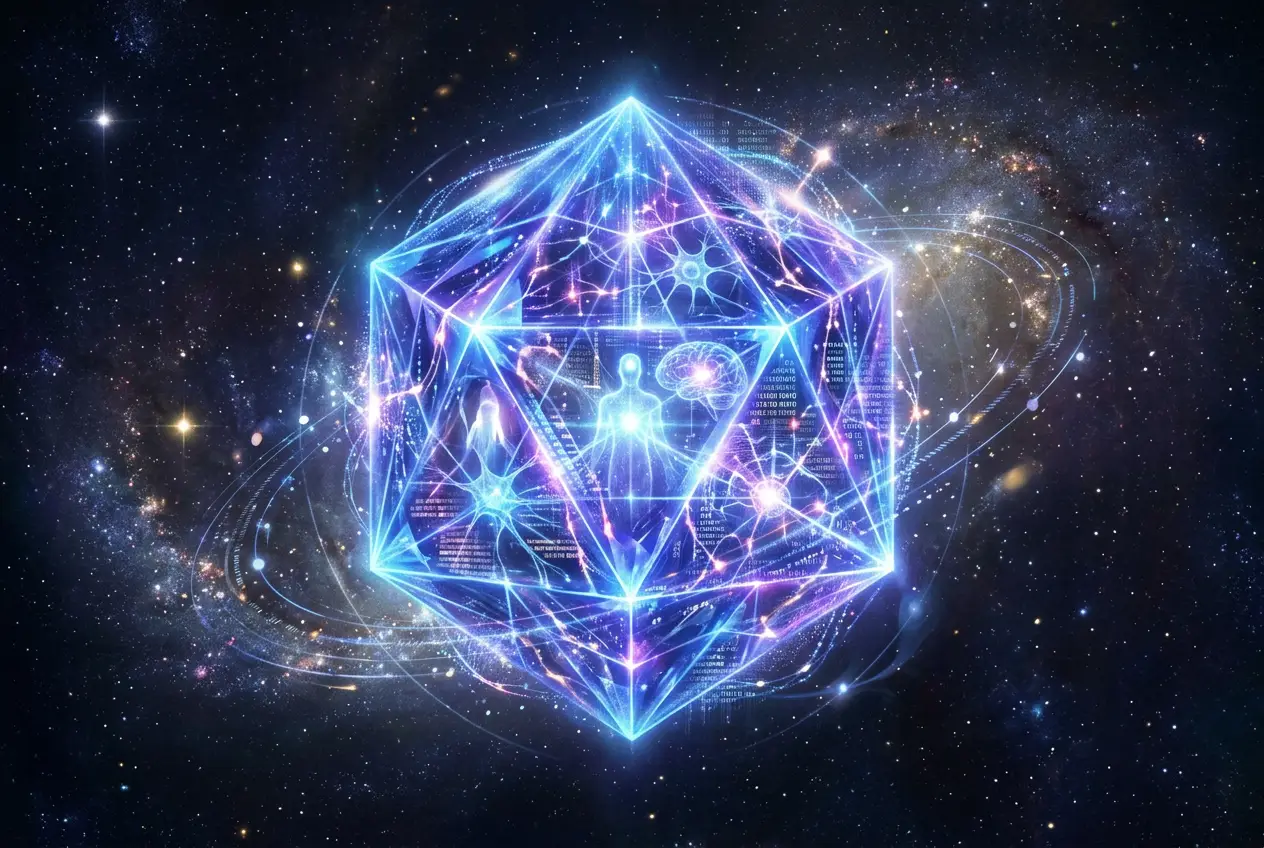
I often find myself lost in thought about the future, particularly when it comes to the ultimate frontier of human existence: mortality. We've conquered diseases, extended lifespans, and even begun to repair the very fabric of our bodies. But what if we could transcend physical decay entirely? What if our very essence, our consciousness, could be preserved, not just in memories, but in a tangible, enduring form? This isn't just the stuff of science fiction; it's a concept being actively explored by scientists and futurists alike, hinting at a radical form of digital immortality. And at the heart of some of these discussions lies an unexpected candidate for eternal storage: crystals.
Recently, I was pondering the sheer amount of information our brains hold. Every memory, every emotion, every learned skill—it’s an unfathomable cosmos of data. How could anything possibly store all of that, let alone keep it stable for millennia? Traditional hard drives fail, even cloud storage faces obsolescence, but the idea of using something as ancient and stable as a crystal has a certain poetic allure. It conjures images of ancient knowledge preserved in timeless structures, much like the mysterious Piri Reis Map or the advanced metallurgical techniques seen in Ulfberht Swords, which hint at technologies far beyond their time, echoing the potential for lost or future methods of preservation.
The Allure of Digital Immortality: Beyond the Biological Clock
The dream of digital immortality, or mind uploading, posits that our consciousness—our unique patterns of thought, memory, and personality—could be extracted from our biological brains and transferred to a digital substrate. Imagine a future where the self is no longer confined to the fleeting lifespan of a human body, but lives on in a network, a simulated reality, or even a highly advanced computational system. This isn't just about extending life; it's about potentially transcending the very definition of being human, opening doors to interstellar travel, virtual existence, and a profound shift in how we perceive identity.
For a deeper dive into how this might work, you can explore concepts around mind uploading on Wikipedia. This concept isn't without its philosophical and ethical quandaries, but the technological pursuit is driven by an incredible ambition to overcome our biological limitations.
Why Crystals? Unpacking the Perfect Storage Medium
When we think of data storage, we typically imagine silicon chips, magnetic tapes, or optical discs. These all have limitations: finite lifespans, susceptibility to environmental degradation, and relatively low densities compared to the information within a living brain. The human brain is estimated to hold between 10 to 100 terabytes of data, but more importantly, it's not just static data; it's dynamic, interconnected, and constantly evolving.
This is where crystals enter the picture. Why are they considered a prime candidate for such an ambitious task?
- Atomic Precision and Stability: Crystals are characterized by their highly ordered atomic structures. This regularity provides inherent stability, making them incredibly resistant to decay and external interference compared to amorphous materials. Imagine information encoded not just by electrons, but by the precise arrangement of atoms or even quantum states within a crystalline lattice.
- Density of Information: The atomic scale of crystals means that information could theoretically be stored at an unprecedented density. Instead of storing a bit of data in a relatively large transistor, you might encode it within the quantum state of an individual atom or a defect in the lattice. Researchers are already exploring concepts like quantum memory, where information is stored in the quantum states of particles within a crystal, potentially offering exponentially higher storage capacity.
- Durability and Longevity: Certain crystals, like diamonds or synthetic sapphires, are among the hardest and most chemically inert materials known. This translates to astonishing longevity. A crystal storing consciousness could potentially last for millions, if not billions, of years, far outstripping any current storage technology.
- Light-Based Storage (Photonic Crystals): The field of photonic crystals is particularly exciting. These are materials engineered with periodic nanostructures that affect the motion of photons. This allows for the manipulation and storage of light, which could be used to encode information at incredibly high speeds and densities. Rather than electrical signals, information could be written and read using light itself, offering a robust and energy-efficient medium. To understand more about photonic crystals, you can refer to their detailed explanation on Wikipedia.
Consciousness: A Data Problem or Something More?
The fundamental hurdle in storing consciousness, whether in crystals or any other medium, isn't just the 'how' of storage, but the 'what' of consciousness itself. Is consciousness merely a complex computational process that can be replicated, or is there an irreducible, non-physical aspect to it?
Many neuroscientists and computational theorists believe that consciousness emerges from the intricate network of neural connections and their dynamic interactions. From this perspective, if we could perfectly map every neuron, every synapse, every neurotransmitter interaction in a brain, and replicate those dynamics in a sufficiently powerful computational substrate, consciousness would emerge. This computational view opens the door for technologies like brain-computer interfaces, which are already making strides in connecting minds to machines, as explored in articles like "Can Brain Interfaces Upload Our Memories?".
However, philosophers grapple with the concept of qualia – the subjective, qualitative aspects of experience (what it "feels like" to see red, taste chocolate). Can these be encoded as data? I believe this is where the real challenge lies. It's one thing to store a blueprint; it's another to perfectly replicate the dynamic, subjective experience it describes. Some theories, like Integrated Information Theory, attempt to quantify consciousness as a measure of integrated information, suggesting it might indeed be a property that could theoretically be replicated if enough information and complexity are captured. For more on the theories of consciousness, Wikipedia offers a great starting point.
The Monumental Challenges Ahead
While the concept is tantalizing, the road to storing consciousness in crystals is fraught with monumental challenges:
- Brain Mapping Precision: We currently lack the technology to scan a living brain at the resolution required to capture every detail of its neural architecture and dynamic activity. Even post-mortem brain preservation for later scanning is a field still in its infancy.
- Data Volume and Dynamics: As mentioned, the sheer data volume is staggering. Moreover, consciousness isn't static; it's a constant flow of information and interaction. A storage medium would need to capture not just a snapshot, but the dynamic process of consciousness.
- Encoding Scheme: Even if we had the perfect crystal, developing an encoding scheme that could represent the complex, non-linear, and often quantum-like interactions within the brain is a problem of unprecedented scale.
- Replication and Retrieval: How would this stored consciousness be "activated" or "read"? Would it require a new kind of interface, perhaps a simulated environment, to bring it to life?
These challenges require breakthroughs in neuroscience, materials science, quantum computing, and artificial intelligence. They push the boundaries of what we understand about the universe, much like inquiries into the universe being a cosmic neural network.
| Feature | Traditional Digital Storage (e.g., SSD, HDD) | Crystalline Consciousness Storage (Theoretical) |
|---|---|---|
| Capacity | Terabytes to Petabytes (limited by physical size) | Potentially Exabytes to Zettabytes per cubic centimeter (atomic/quantum scale) |
| Longevity | Decades (vulnerable to degradation, obsolescence) | Millions to Billions of years (inherent material stability) |
| Stability | Susceptible to heat, magnetic fields, physical shock, data corruption | Highly resistant to environmental factors, extreme conditions |
| Energy Use | Requires continuous power for operation and data integrity | Minimal to no energy for passive storage; energy for read/write operations |
| Read/Write Speed | Milliseconds to microseconds | Potentially femtoseconds (light-based, quantum phenomena) |
| Current Feasibility | High (commercialized, widespread) | Extremely Low (highly theoretical, requires fundamental scientific breakthroughs) |
The Road Ahead: A Fusion of Disciplines
The pursuit of storing consciousness in crystals sits at the intersection of various bleeding-edge fields. It demands a synergy between:
- Materials Science: Developing new crystal structures with tunable properties for information encoding.
- Quantum Physics: Harnessing quantum phenomena (like superposition and entanglement) for ultra-dense and stable information storage, potentially drawing inspiration from "Living Crystals: Computing's Next Frontier" which explores new materials for computational purposes.
- Neuroscience: Gaining a deeper understanding of how consciousness arises from brain activity and developing methods for ultra-high-resolution brain mapping.
- Artificial Intelligence: Creating algorithms capable of processing the immense complexity of neural data and potentially simulating the dynamics of consciousness.
While the concept of "crystal consciousness" remains firmly in the realm of theory and aspirational science, the underlying research in these fields is driving incredible innovations. From new forms of data storage to a deeper understanding of the human mind, the journey itself is transforming our technological landscape.
Conclusion
The idea of preserving our minds within the timeless embrace of a crystal is a breathtaking vision of digital immortality. It pushes us to confront fundamental questions about what it means to be human, the nature of consciousness, and the ultimate limits of technology. While the challenges are immense, the human drive for discovery and transcendence is a powerful force. As we continue to unlock the secrets of matter, energy, and the mind, the dream of storing consciousness in a form that defies time may not be a fantasy, but a distant, glittering possibility on the horizon of our shared future.



Conversation0
No comments yet. Be the first to share a thought — the best questions often become new stories.