


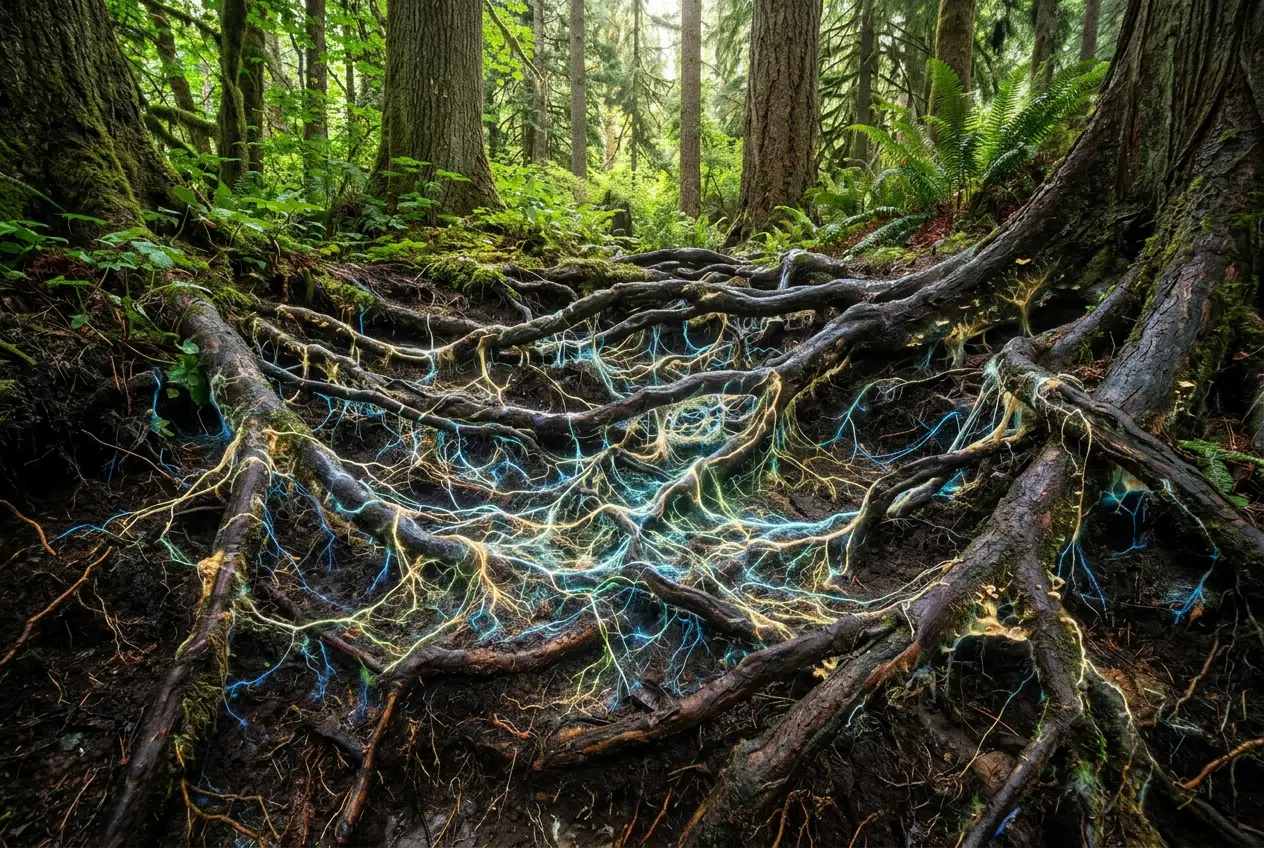
I remember the first time I walked into a truly ancient forest. It wasn't just the towering presence of the trees that struck me, but an almost palpable sense of quiet wisdom, as if the very air hummed with untold stories. For centuries, we’ve admired trees for their majestic solitude, their individual strength, and their vital role in our ecosystem. But what if I told you that beneath our feet, in the silent darkness of the soil, these seemingly solitary giants are engaged in a constant, complex conversation? It’s a network so intricate, so vital, that it could rival our modern internet, a biological broadband spanning entire forests.
Welcome to the "Wood Wide Web," a term coined by ecologist Suzanne Simard. It’s a concept that began as a scientific hunch and has evolved into a well-documented marvel of nature: an underground fungal network, known as mycorrhizal fungi, that connects trees and other plants, allowing them to share resources, send warnings, and even nurture their young. This isn't just about roots intertwining; it's about a sophisticated biological communication system that redefines our understanding of forest ecosystems and, frankly, blows my mind every time I think about it.
The Invisible Architects: Mycorrhizal Fungi
At the heart of this hidden network are the mycorrhizal fungi. These aren't just decomposing organisms; they form a symbiotic relationship with tree roots. The term "mycorrhiza" literally means "fungus root." The fungi wrap around or penetrate the roots of plants, extending their microscopic thread-like structures, called hyphae, far beyond what a plant’s own roots could reach. These vast fungal networks can stretch for miles beneath the forest floor.
What does each party get from this arrangement? The fungi, unable to photosynthesize, receive sugars (carbohydrates) produced by the trees through photosynthesis. In return, the fungi act as an extended root system for the trees, significantly increasing their absorption capabilities for water, nitrogen, phosphorus, and other vital minerals from the soil. It's a classic win-win, but the story gets far more fascinating than a simple exchange of goods.
Beyond Symbiosis: A Forest's Social Network
The true wonder of the Wood Wide Web lies in its ability to connect multiple trees, sometimes even different species, across vast areas. Imagine a single mature Douglas fir tree connected to hundreds of other trees, including saplings, through this fungal grid. It's like a forest-wide nervous system or, as Simard calls it, a "sentient collective" (source: Wikipedia on Mycorrhizal Network (opens in a new tab)).
This connection allows for:
- Resource Sharing: Older, "mother" trees can send vital carbon, nitrogen, and water to young saplings struggling in the shade. Studies have shown that shaded seedlings, which photosynthesize less, receive significant carbon transfers from larger, sun-exposed trees via the fungal network. I find this almost altruistic behavior incredibly moving, a testament to nature's inherent cooperation.
- Warning Signals: When a tree is attacked by insects or disease, it can send biochemical signals through the fungal network to neighboring trees. These signals trigger defense mechanisms in the recipient trees, priming them for attack before it even reaches them. This early warning system is a critical survival strategy for the entire forest. It's akin to a biological cybersecurity alert system.
- Inter-species Communication: It's not just trees of the same species that communicate. Different species can be linked, allowing for a broader exchange of resources and information. A birch tree, which thrives in full sun, might share its surplus carbon with a fir tree in the shade, and vice versa depending on the season and needs.
How Do We Decode Their "Conversations"?
Understanding this hidden communication has required incredible advances in technology and ecological research. For a long time, the underground world remained largely inaccessible to direct observation. Now, scientists use a combination of techniques:
Isotope Tracing
One of the most powerful methods involves isotope tracing. Researchers introduce stable isotopes (like Carbon-13 or Carbon-14, which are non-radioactive and easily detectable) into specific trees. These isotopes act as "tags" for carbon atoms. By monitoring which other trees (and fungi) later show traces of these isotopes, scientists can map the pathways of carbon transfer through the mycorrhizal network. This is how we’ve confirmed that carbon moves between trees and from mother trees to saplings. This method is meticulous and has revolutionized our understanding of these networks.
DNA Sequencing and Metagenomics
To identify the specific fungal species involved and map their connections, DNA sequencing and metagenomics are crucial. By analyzing DNA extracted from soil and root samples, scientists can identify the diverse fungal communities present and reconstruct the intricate web of connections. This allows for a detailed "map" of the Wood Wide Web, showing who is connected to whom. You can read more about metagenomics in ecological studies on Wikipedia's Metagenomics page (opens in a new tab).
Advanced Imaging Techniques
While direct real-time imaging of these networks in their natural environment is challenging, laboratory settings use advanced microscopy to study hyphal growth and interactions. New technologies, including non-invasive geophysical methods and miniature root observation cameras (rhizotrons), are also being developed to gain a clearer picture of the underground world without disturbing it too much.
The Implications for Our Future
The discovery and ongoing research into the Wood Wide Web have profound implications, not just for ecology but for our own technological and philosophical outlook.
1. Reforestation and Conservation: Understanding these networks can dramatically improve reforestation efforts. Instead of planting trees in isolation, promoting healthy mycorrhizal connections can significantly boost sapling survival rates and growth. It emphasizes the importance of preserving established forests, as they contain the complex, mature networks essential for forest health and resilience. This knowledge could inform better practices for managing our precious woodlands, allowing us to build more resilient ecosystems (learn more about forest conservation on Wikipedia's Forest Conservation page (opens in a new tab)).
2. Biomimicry and New Technologies: Nature has once again proven to be the ultimate engineer. The Wood Wide Web is a highly efficient, decentralized, and resilient communication network. Can we draw inspiration from this biological model to design more robust and energy-efficient digital networks? Perhaps future IoT (Internet of Things) systems could mimic the adaptive, resource-sharing principles observed in forests. I can’t help but wonder if we could learn to design systems that are less reliant on central points of failure and more distributed, much like the forest's network.
3. Rethinking Intelligence and Interconnectedness: The Wood Wide Web challenges our anthropocentric view of intelligence. If trees can communicate, share, and collectively respond to threats, does this hint at a form of collective intelligence? It certainly encourages a more interconnected view of life on Earth, reminding us that no organism truly exists in isolation. This paradigm shift might even inspire us to consider how we perceive "intelligence" in artificial systems. For instance, how would our approach to creating AI change if we aimed to build systems that learn from and collaborate with each other, much like the trees? We explored aspects of AI learning in our blog on Can AI Truly Learn From Human Intuition?.
4. Climate Change Mitigation: Healthy forests are crucial carbon sinks. By understanding how to foster strong, connected forest ecosystems, we can enhance their ability to absorb and store carbon, playing a vital role in combating climate change. The resilience imparted by the Wood Wide Web means these forests are better equipped to withstand environmental stresses. This natural infrastructure is arguably one of our most powerful tools against a warming planet.
A Dialogue with Nature
The more we discover about the Wood Wide Web, the more I feel a profound respect for the intricate complexities of the natural world. It's a living testament to cooperation and interdependence, a hidden world of quiet communication that has been operating right under our noses for millennia. It shifts our perspective from viewing trees as individual commodities to recognizing them as integral parts of a larger, interconnected superorganism.
As we continue to develop sophisticated technologies for mapping, sequencing, and analyzing these subterranean wonders, I believe we're only scratching the surface of what the Wood Wide Web can teach us. It’s a powerful reminder that some of the most advanced "technologies" are already perfected in nature, waiting for us to observe, understand, and perhaps, eventually, mimic. It makes me wonder if ancient cultures, who lived so closely with nature, had their own intuitive understanding of such networks. Perhaps they didn't have the scientific tools to prove it, but a deep, innate sense of the forest's interconnectedness. We discussed similar possibilities in our piece on Did Ancient Cultures Deploy Living Sensors?.
So, the next time you walk through a forest, pause for a moment. Close your eyes and imagine the silent symphony of exchange happening beneath your feet – a vast, ancient, and incredibly sophisticated computer, processing life itself. What other secrets does Earth hold, waiting for our curiosity and technology to uncover?





Conversation0
No comments yet. Be the first to share a thought — the best questions often become new stories.