


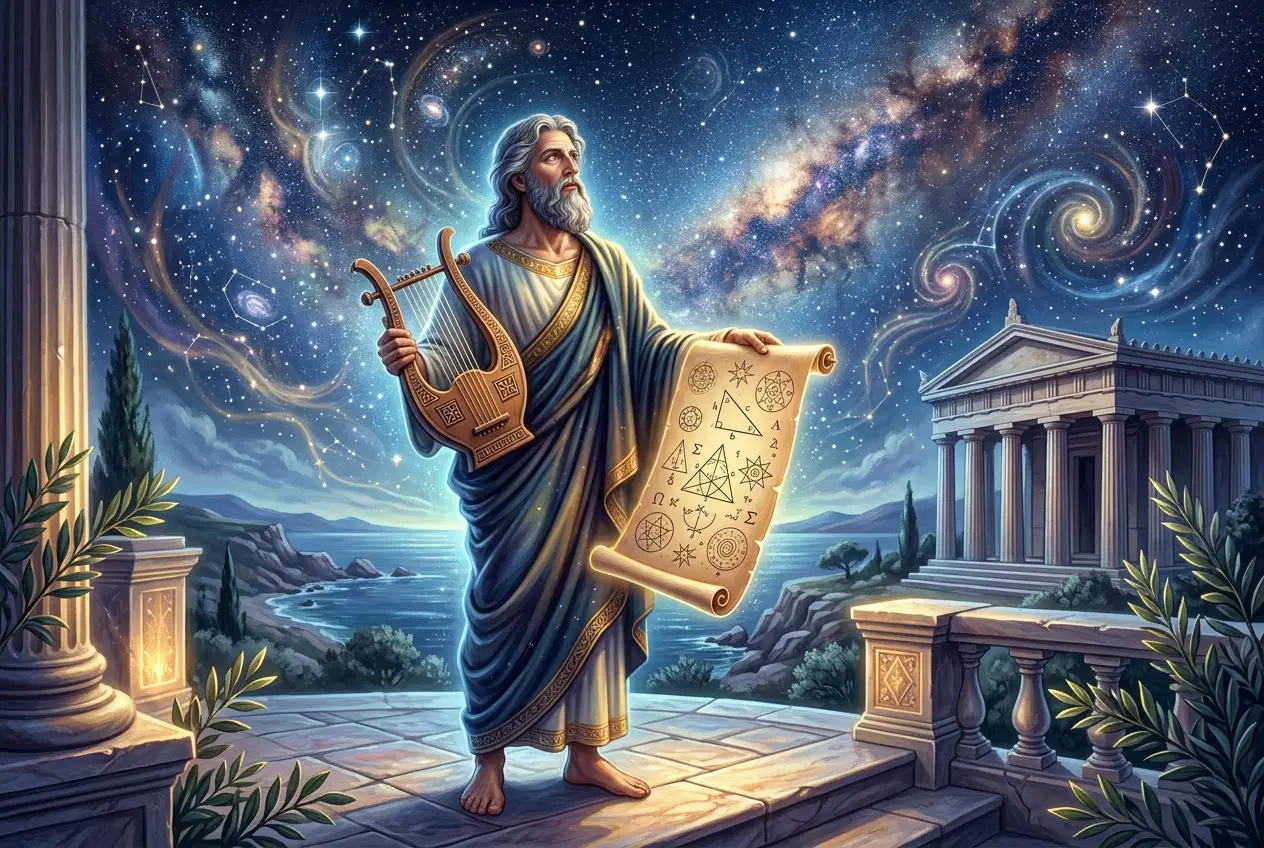
From the moment I first encountered the name Pythagoras, I was struck by the sheer weight of his legacy. It's a name that conjures images of right triangles and mathematical proofs, but the man himself was so much more than a geometer. He was a philosopher, a mystic, a musician, and a spiritual leader whose ideas profoundly shaped Western thought, influencing everyone from Plato to Kepler. His life, shrouded in myth and mystery, is an epic journey through ancient wisdom, philosophical discipline, and intellectual revelation. What I'm about to share with you is a deep dive into the extraordinary life of Pythagoras, a monumental figure whose pursuit of knowledge and harmony resonates even today. Be forewarned, dear reader, this will be a very long exploration, an odyssey through the mind and times of one of antiquity's most captivating intellects.
The Dawn of a Legend: Birth and Early Influences
Pythagoras was born around 570 BC on the island of Samos, a bustling hub of trade and culture in the Aegean Sea. His father, Mnesarchus, was a gem-engraver, a craft that speaks to precision and artistry. His mother was Pythais. While specific details of his early childhood are scarce, it’s understood that Samos, under the tyrannical rule of Polycrates, was a vibrant intellectual environment, exposed to various cultures and ideas. This fertile ground undoubtedly cultivated Pythagoras's burgeoning intellect.
I often wonder about the specific moments that ignite a genius. For Pythagoras, it wasn't a single spark but a confluence of teachings. Early accounts suggest he was tutored by several notable figures of his time. Hermodamas, a local philosopher, is said to have introduced him to Homer and the rudiments of Greek culture. Later, Pherecydes of Syros, a cosmological thinker, may have imparted early ideas about the transmigration of souls and the cyclical nature of existence. Thales of Miletus, considered the first philosopher in the Greek tradition, and his student Anaximander, are also cited as early mentors. It was through these early encounters that Pythagoras began to formulate his unique worldview, a synthesis of philosophical inquiry, mathematical reasoning, and spiritual devotion.
Quenching Thirst for Knowledge: The Great Eastern Journeys
Driven by an insatiable curiosity, Pythagoras embarked on extensive travels that would fundamentally shape his philosophy. Ancient biographers recount his journey to Egypt, a civilization revered by the Greeks for its profound wisdom, advanced mathematics, and esoteric religious practices. It's believed he spent many years there, immersing himself in the teachings of the Egyptian priests. He studied their sacred geometry, their astronomy, and their elaborate rituals. Some historians suggest he might have been initiated into various priestly orders, gaining access to knowledge typically guarded from outsiders. This exposure to a highly structured and symbolic system of knowledge deeply influenced his later mystical and mathematical insights. For more on how ancient cultures engaged with advanced concepts, you might be interested in Did Ancient Atoms: Did Greek Thinkers Foresee Quantum?.
From Egypt, the legend continues, Pythagoras journeyed eastward to Babylon, following in the footsteps of many Greek scholars. Babylon was a powerhouse of astronomical observation and arithmetic, with a sophisticated sexagesimal (base-60) number system and extensive celestial records. Here, he would have encountered Chaldean priests and magi, delving into their astrological lore, numerical mysticism, and advanced arithmetic techniques. It's likely that his exposure to Babylonian mathematics, particularly their understanding of number theory and astronomical cycles, laid the groundwork for his later mathematical breakthroughs. These long years of learning in foreign lands were not just academic pursuits; they were transformative experiences that fused diverse intellectual traditions into a singular, powerful philosophy.
Return to Samos and the Tyranny of Polycrates
Upon his return to Samos, Pythagoras found his homeland still under the grip of Polycrates. While Polycrates was a patron of the arts and sciences, his autocratic rule was not conducive to the kind of free philosophical inquiry Pythagoras envisioned. The atmosphere was one of surveillance and control, clashing with Pythagoras's desire to establish an independent community of scholars. Faced with these constraints, he recognized that Samos was not the place to cultivate his unique vision. This period, though perhaps frustrating, solidified his resolve to seek a new environment where he could fully implement his pedagogical and philosophical ideals.
The Founding of the Pythagorean School in Croton
Around 530 BC, Pythagoras emigrated to Croton, a prosperous Greek city-state in Magna Graecia (southern Italy). Here, he found a community more receptive to his ideas and leadership. He established his famous school, known as the Pythagorean Brotherhood, a tightly-knit community that was part school, part commune, and part religious order. This was not a typical academy; it was a way of life. Admittance was rigorous, involving a period of probation, strict loyalty, and a vow of secrecy.
Life within the Brotherhood: Discipline and Mysticism
Life within the Pythagorean Brotherhood was governed by strict rules and rituals. Members adhered to a communal lifestyle, sharing property and meals. They followed an ascetic regimen, including vegetarianism (or at least avoidance of certain meats and beans) and periods of silence. The pursuit of intellectual and spiritual purity was paramount. I can imagine the intensity of such a life, dedicated entirely to the harmony of mind and spirit.
The school was divided into two main groups: the akousmatikoi (listeners) and the mathematikoi (learners). The akousmatikoi focused on the ethical and religious teachings, adhering to the "akousmata" or oral maxims. The mathematikoi delved deeper into the scientific and philosophical core, studying mathematics, music, astronomy, and the nature of reality. This hierarchical structure reflects the depth and breadth of Pythagoras's system, bridging the mundane with the profound.
The Heart of Pythagorean Philosophy: Number is All
At the core of Pythagorean philosophy was the belief that "All is number." This wasn't merely a statement about quantities but a profound cosmological assertion. Pythagoras and his followers believed that numbers were the fundamental essence of the universe, the underlying structure that governed everything from the orbits of planets to the harmonies of music. They saw numbers not as abstract symbols but as living entities, possessing inherent qualities and significance.
The Decad and the Tetractys
The number 10, or the Decad, held special reverence. It was considered the perfect number, containing the sum of the first four integers (1+2+3+4=10). These first four integers, when arranged geometrically, form the Tetractys, a triangular figure composed of ten points.
The Tetractys was not just a symbol; it was a sacred oath, representing the universe's structure and the source of all things. Each row of the Tetractys was associated with fundamental concepts:
- 1 (Monad): The origin of all things, God, unity, identity.
- 2 (Dyad): Duality, opposition (odd/even, male/female, light/dark).
- 3 (Triad): Harmony, balance, the whole (beginning, middle, end).
- 4 (Tetrad): Justice, cosmic order, the elements (earth, air, fire, water).
Through the Tetractys, the Pythagoreans believed they could unlock the secrets of the cosmos.
Mathematical Revelations: Geometry and Number Theory
While the exact extent of Pythagoras's personal mathematical discoveries is debated (due to the Brotherhood's communal and secretive nature, attributing specific discoveries to individuals is challenging), his school is undeniably credited with groundbreaking advancements.
The Pythagorean Theorem
The most famous legacy attributed to Pythagoras is the Pythagorean Theorem: In a right-angled triangle, the square of the hypotenuse (the side opposite the right angle) is equal to the sum of the squares of the other two sides (). While evidence suggests that the relationship was known empirically by Babylonians and Egyptians centuries earlier, the Pythagoreans are widely believed to have provided the first formal proof of this theorem. This move from practical application to abstract proof was a monumental leap in the development of mathematics. This was a core principle, an elegant truth reflecting the numerical order they believed permeated reality.
The Discovery of Irrational Numbers
Perhaps one of the most unsettling, yet profound, discoveries of the Pythagorean school was that of irrational numbers. Legend has it that Hippasus of Metapontum, a Pythagorean, discovered that the diagonal of a square with sides of length 1 cannot be expressed as a ratio of two integers (i.e., ). This discovery, known as incommensurability, challenged the very foundation of their belief that "all is number," as it meant there were numbers that couldn't be perfectly expressed by the ratios of whole numbers they revered. This was a secret so profound and seemingly contradictory to their philosophy that, according to some accounts, Hippasus was either exiled or drowned at sea for revealing it. It underscored the complexities that emerged even from their pursuit of absolute numerical harmony.
Perfect Numbers and Amicable Numbers
The Pythagoreans were fascinated by the properties of numbers, exploring concepts like perfect numbers (a number that is equal to the sum of its proper divisors, e.g., 6 = 1+2+3) and amicable numbers (pairs of numbers where each is the sum of the proper divisors of the other, e.g., 220 and 284). These investigations weren't just mathematical curiosities; they were seen as pathways to understanding cosmic relationships and divine order. Their exploration of number theory laid critical groundwork for future mathematicians.
The Harmony of the Spheres: Cosmology and Astronomy
The Pythagorean belief that number governed all extended directly to their understanding of the cosmos. They posited a spherical Earth (a revolutionary idea for its time), with other celestial bodies also being spherical. They believed that these celestial bodies moved in concentric spheres, and their movements produced a sublime, inaudible musical harmony—the "Music of the Spheres." Each planet, based on its distance and speed, produced a specific musical note, and together they formed a cosmic symphony. This concept, while poetic, was also an attempt to impose a mathematical and musical order upon the perceived chaos of the heavens. For more on ancient cosmic charting, you might find Did Ancient Cultures Chart Invisible Stars? interesting.
Their cosmological model was not geocentric in the traditional sense. They proposed a central fire around which the Earth, Moon, Sun, and planets revolved. This "central fire" was not the Sun but an unseen entity, with the Earth also revolving around it, rotating on its axis. This heliocentric-like idea was centuries ahead of its time, though it was eventually overshadowed by the Ptolemaic geocentric model for centuries.
Music and Mathematics: The Birth of Acoustics
One of Pythagoras's most enduring contributions, whether personally discovered or developed by his school, is the mathematical relationship between musical intervals. The legend recounts that Pythagoras, passing a blacksmith's shop, noticed that hammers of different weights produced different tones. He then experimented with strings of varying lengths, weights, and tensions. He discovered that harmonious musical intervals (octave, fifth, fourth) correspond to simple numerical ratios.
| Interval | Ratio of String Lengths | Example Frequencies |
|---|---|---|
| Octave | 1:2 | 220 Hz : 440 Hz |
| Fifth | 2:3 | 220 Hz : 330 Hz |
| Fourth | 3:4 | 220 Hz : 293.3 Hz |
This realization was monumental. It provided empirical proof that the seemingly abstract world of numbers governed a concrete, sensory experience: music. It cemented the idea that the universe was fundamentally harmonious and mathematically ordered. This fusion of sensory experience with mathematical principle was a hallmark of Pythagorean thought and laid the groundwork for the scientific study of acoustics. His insights into sound remind me of explorations into ancient soundscapes, such as those discussed in Ancient Soundscapes: A Hidden Data Archive?.
Ethical Doctrines and the Transmigration of Souls
Beyond mathematics and cosmology, Pythagoras also imparted a strong ethical and spiritual framework. Central to his teachings was the doctrine of metempsychosis, or the transmigration of souls. Pythagoreans believed that the soul was immortal and underwent a cycle of rebirths into different bodies (human or animal) until it achieved purification and liberation. This belief had profound implications for their ethics, promoting kindness to all living beings and advocating for a disciplined, ascetic life as a path to spiritual enlightenment.
The Pythagorean lifestyle emphasized virtue, self-control, and purification. They practiced abstinence from certain foods (notably beans, which held a peculiar taboo for reasons debated by scholars), silence, and rigorous self-examination. The goal was to cleanse the soul, allowing it to ascend to a higher plane of existence. This spiritual dimension permeated every aspect of their intellectual pursuits, elevating mathematics and philosophy into a sacred quest for cosmic understanding and personal salvation.
Political Influence and the Fall of the Brotherhood
The Pythagorean Brotherhood was not just an academic institution; it was a powerful social and political force in Croton and other cities of Magna Graecia. Many Pythagoreans held influential positions in local governments, advocating for their ethical principles and seeking to implement a more harmonious and orderly society. Initially, their influence was positive, leading to reforms and stability.
However, their elitist nature, secrecy, and strict adherence to their own doctrines eventually led to resentment from the non-members. The communal living and political power of the Brotherhood were perceived as a threat by rival factions and democratic movements. This friction culminated in violent uprisings against the Pythagoreans, most notably the burning of their meeting houses. This period, often referred to as the "Pythagorean Persecution," forced the remaining members to disperse, effectively ending the Brotherhood as a cohesive political entity in Magna Graecia.
I find it fascinating how easily a group dedicated to harmony can, through its very structure and success, invite discord. The exact details of Pythagoras's death are as shrouded in mystery as much of his life. Some accounts claim he died during one of these persecutions, either immolated in a burning building or hunted down and killed. Others suggest he escaped to Metapontum and starved himself to death in exile, heartbroken by the demise of his school. Regardless of the specifics, his departure marked a significant turning point, sending his disciples across the Greek world, spreading his ideas far and wide.
The Enduring Legacy: From Plato to Modern Science
Despite the dispersal of his school, Pythagoras's influence continued to grow, primarily through his disciples who carried his teachings to Athens and beyond.
Influence on Plato
Perhaps the most significant heir to Pythagorean thought was Plato. Plato's philosophy, particularly his theory of Forms and his emphasis on abstract mathematical structures, bears a striking resemblance to Pythagorean concepts. Plato's belief in the existence of an ideal, perfect realm accessible through reason and mathematics echoes the Pythagorean conviction that numerical relationships underlie ultimate reality. The influence can be seen in Plato's Timaeus, where he describes the creation of the cosmos based on geometric forms. Plato's academy in Athens even had the famous inscription, "Let no one ignorant of geometry enter here," a testament to the Pythagorean elevation of mathematics.
Neoplatonism and Beyond
Through Plato, Pythagorean ideas permeated Neoplatonism and, subsequently, early Christian and Islamic mystical traditions. The idea of a mathematically ordered universe, the pursuit of intellectual and spiritual purification, and the mystical significance of numbers continued to resonate for centuries. Philosophers like Plotinus and Porphyry explicitly cited Pythagoras as a foundational figure.
Renaissance and Scientific Revolution
The rediscovery of ancient Greek texts during the Renaissance revived interest in Pythagorean thought. Scientists like Johannes Kepler, who sought to uncover the mathematical harmonies governing planetary motion, were deeply inspired by the "Music of the Spheres." Galileo Galilei, a proponent of the idea that the "book of nature is written in the language of mathematics," stood firmly in the Pythagorean tradition. Isaac Newton's laws of motion and universal gravitation, while empirically derived, still reflect an underlying belief in a universe governed by elegant mathematical principles, a legacy from Pythagoras. This deep dive into a figure who shaped so much reminds me of the foundational contributions explored in Nikola Tesla: The Enigmatic Genius Who Wired Our Modern World.
Modern Science and Philosophy
Even in modern physics, the search for fundamental mathematical laws and symmetries that govern the universe can be seen as a continuation of the Pythagorean quest. From the intricate equations of quantum mechanics to the elegant structures of string theory, the idea that mathematics is not just a tool for describing reality but is, in some sense, reality itself, remains a powerful driving force in scientific inquiry. The Pythagorean legacy is a testament to the enduring power of abstract thought to illuminate the physical world.
Criticisms and Historical Debates
It's crucial to acknowledge that much of what we "know" about Pythagoras is filtered through later biographical accounts, many of which are hagiographical or legendary. The secretive nature of his Brotherhood and the lack of original writings by Pythagoras himself mean that distinguishing fact from myth is a continuous challenge for historians.
Some scholars argue that many mathematical discoveries attributed to Pythagoras were, in fact, the work of later members of his school. Others point to the esoteric and almost cult-like aspects of the Brotherhood, questioning the extent to which their spiritual beliefs clouded their scientific objectivity. The historical Pythagoras remains an enigmatic figure, a blend of brilliant mathematician, charismatic leader, and mystical sage. Wikipedia offers extensive academic discussions on the historical Pythagoras and his school here (opens in a new tab).
The Cult of Personality vs. The Power of Ideas
I've often found myself pondering the balance between the historical figure and the ideas they represent. With Pythagoras, this tension is particularly acute. Was he truly a divine figure, a miracle worker as some legends claim, or merely an exceptionally brilliant human? The answer, I believe, lies in recognizing that his impact wasn't solely about his personal charisma but about the profound, transferable power of the ideas he championed. The idea that reality could be understood through numbers, that there was a hidden harmony underpinning existence, was a radical and enduring insight.
The Pythagorean Way: A Holistic Pursuit of Knowledge
What truly set Pythagoras apart was his holistic approach to knowledge. For him, mathematics was not separate from philosophy, music was not separate from astronomy, and intellectual pursuit was not separate from spiritual discipline. All were interconnected parts of a unified quest to understand the cosmos and humanity's place within it. This integrated worldview, where science, art, and spirituality converged, offered a path to wisdom that was both rigorous and deeply meaningful.
The Pythagorean school laid the foundations for Western rational thought by emphasizing logical deduction and abstract reasoning. Yet, it simultaneously embraced mysticism and a search for transcendent truths. This duality makes Pythagoras a uniquely compelling figure, a bridge between the empirical and the spiritual, the concrete and the abstract.
Pythagoreanism Today: Beyond the Classroom
While the Pythagorean Brotherhood no longer exists, its spirit lives on. Every time a student learns the Pythagorean theorem, every time a musician understands intervals, every time a physicist searches for mathematical elegance in the universe's laws, they are, in a way, channeling Pythagoras. His ideas continue to inspire those who believe that there is a deep, beautiful order to the universe, waiting to be discovered through careful observation, rigorous thought, and an open mind. For a comprehensive overview of Pythagoreanism, refer to its dedicated page on Wikipedia (opens in a new tab).
In a world increasingly driven by specialization, the holistic vision of Pythagoras serves as a powerful reminder of the interconnectedness of all knowledge. It encourages us to look beyond disciplinary boundaries, to seek the unifying principles that bind the diverse aspects of reality into a harmonious whole.
Conclusion: The Sage Who Harmonized the Cosmos
Pythagoras, the enigmatic sage of Samos, was a man who dared to look at the universe and see not chaos, but number. He envisioned a cosmos built on elegant mathematical principles, a symphony of spheres playing out the divine order. His journey from an inquisitive youth in Samos to the founder of a revolutionary intellectual and spiritual brotherhood in Croton was marked by an unyielding pursuit of truth. His legacy, spanning mathematics, music, astronomy, and philosophy, continues to shape our understanding of the world, reminding us that at the heart of existence lies a profound, beautiful harmony, accessible to those who seek it with an open mind and a disciplined spirit. He taught us that numbers are not just for counting; they are the language of the universe, waiting for us to decipher its majestic script. To delve deeper into the philosophical schools of ancient Greece, a good starting point is Wikipedia's entry on Ancient Greek Philosophy (opens in a new tab).






Conversation0
No comments yet. Be the first to share a thought — the best questions often become new stories.