I’ve always been fascinated by the sheer ambition of ancient civilizations. It’s one thing to build magnificent structures, but quite another to embed within them a profound understanding of the cosmos. For centuries, we’ve admired sites like Stonehenge and Chichen Itza as testaments to early astronomy, mapping solstices and equinoxes. But what if their purpose went far beyond simple calendars? What if these colossal stone circles and precisely aligned temples were, in essence, **cosmic clocks**, capable of tracking celestial cycles with a sophistication that challenges our modern assumptions about prehistoric technology?
Recently, I was delving into the concept of archaeoastronomy – the study of how ancient people understood and used celestial phenomena – and a new perspective began to emerge. It wasn't just about marking seasons for agriculture; it was about integrating the rhythm of the universe into their very societies, perhaps even using these "clocks" for purposes we're only beginning to decipher.
## **Beyond the Calendar: Decoding the Cosmic Rhythm**
Think about a modern clock. It’s a mechanism designed to track time with incredible accuracy, relying on intricate gears, springs, or atomic vibrations. Now, imagine a clock built from massive stones, integrated into the very landscape, its "gears" the orbital dance of planets and stars. This isn't science fiction; it’s a concept gaining traction among researchers who suggest many ancient observatories were far more precise and multi-functional than we typically give them credit for.
Our conventional understanding often frames ancient astronomical sites as rudimentary tools for telling time – marking the longest and shortest days of the year. But the level of engineering and astronomical knowledge required to perfectly align massive structures with specific celestial events, often visible only once a year, points to something much deeper. It suggests a sustained, multi-generational effort dedicated to precision, almost as if these monuments were built to **"keep time" for the universe itself**.
### **The Earth-Sky Nexus: Precision Engineering of the Past**
Let’s consider some of the prime examples that hint at this advanced 'cosmic clock' theory:
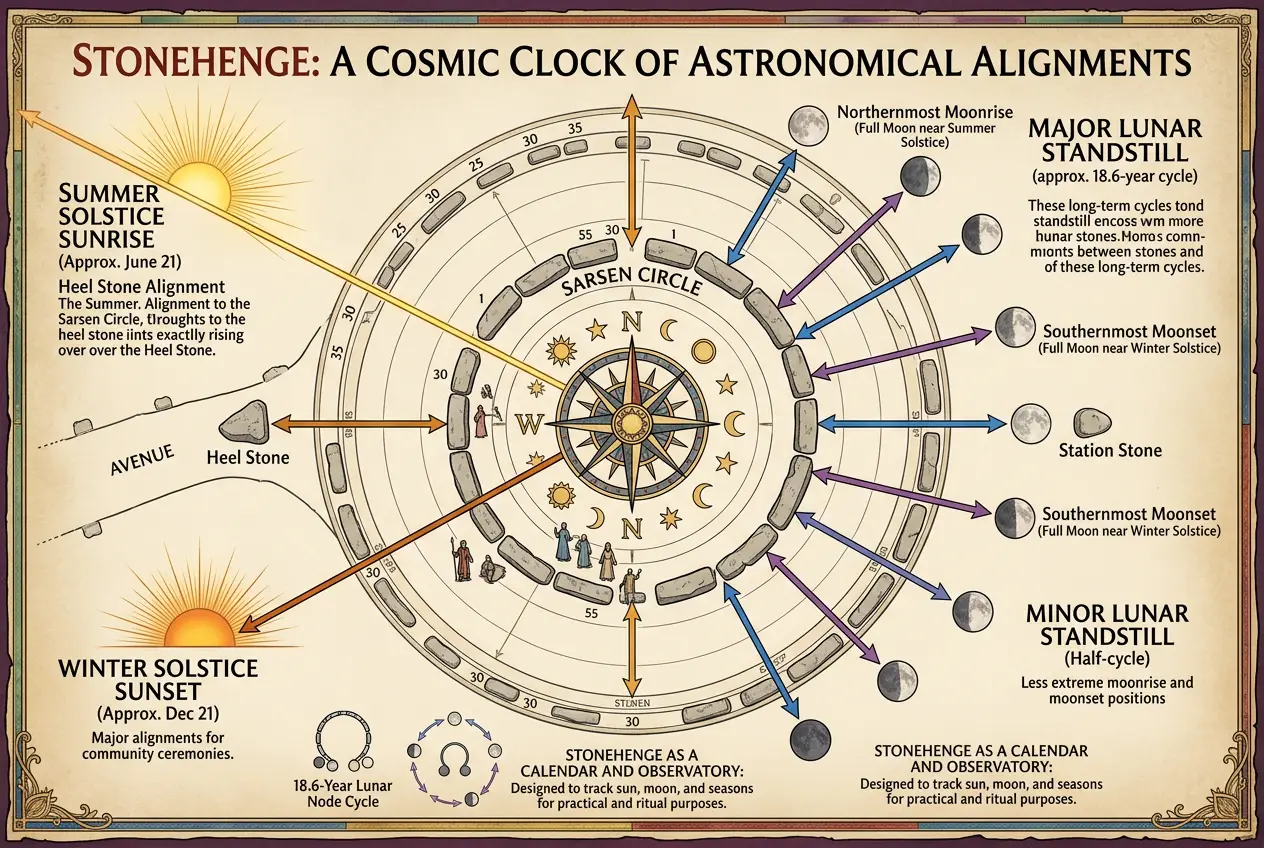
**Stonehenge, England:** This iconic megalithic monument, built between 3000 and 2000 BC, is perhaps the most famous example of ancient astronomical alignment. Its primary axis points directly to the sunrise on the summer solstice and the sunset on the winter solstice. But recent studies suggest its alignments might be far more complex, potentially tracking lunar cycles, eclipses, and even the positions of certain stars over long periods. Dr. Clive Ruggles, a leading archaeoastronomer, notes the challenge of definitively proving such complex functions but acknowledges the sophisticated intent. "The difficulty lies in distinguishing deliberate astronomical intent from coincidental alignments," he explains, "but the sheer number and precision of observations across various cultures suggest a profound purpose."
You can learn more about Stonehenge's astronomical alignments on its [Wikipedia page](https://en.wikipedia.org/wiki/Stonehenge#Astronomical_alignments).
**Chichen Itza, Mexico:** The Pyramid of Kukulcan (El Castillo) at Chichen Itza is a marvel of Maya engineering and astronomical insight. During the spring and autumn equinoxes, the setting sun casts a shadow that creates the illusion of a serpent (Kukulcan) slithering down the pyramid's staircase. But the Maya calendar, a sophisticated system of cycles that went far beyond mere yearly tracking, was also likely encoded into their architecture. The pyramid has 365 steps, representing the solar year, and intricate details reflect Venus’s cycle. It’s a physical manifestation of a highly sophisticated understanding of time, both terrestrial and cosmic. This precision speaks to more than just calendar-making; it’s about a **deep synchronization with the celestial rhythm**.
**Newgrange, Ireland:** This prehistoric monument, older than Stonehenge and the Egyptian pyramids, is a large passage tomb built around 3200 BC. On the winter solstice, a narrow beam of sunlight penetrates its long passage, illuminating the chamber within for approximately 17 minutes. This single, dramatic event isn’t just a show; it’s an incredibly precise time marker, indicating an advanced understanding of solar mechanics and remarkable engineering to capture that specific moment year after year. The meticulous construction points to a society deeply invested in marking and potentially *predicting* the cosmic clock. More information about Newgrange's solstice alignment can be found on [Wikipedia](https://en.wikipedia.org/wiki/Newgrange).
These examples, among many others, highlight a recurring theme: ancient civilizations weren't just passively observing the sky. They were actively engaging with it, building structures designed to mirror its movements and track its cycles over vast stretches of time. It’s almost as if they were creating **physical data processors** for cosmic information.
## **The "Operating System" of Ancient Cosmic Clocks**
If these observatories were cosmic clocks, what was their "operating system"? It was likely a combination of sophisticated mathematics, long-term observational data, and an inherent understanding of cyclic phenomena.
* **Cycles within Cycles:** Ancient astronomers were adept at recognizing patterns. They understood that lunar phases cycle, stars appear in predictable constellations, and planets follow distinct paths. The idea of a "cosmic clock" means not just identifying these cycles, but understanding their interdependencies and using them to predict future events. This kind of predictive power would have been invaluable for agriculture, religious rituals, and even social organization.
* **Architectural Algorithms:** The alignments themselves can be seen as "architectural algorithms." By placing stones or designing structures to specific angles and orientations, they encoded astronomical data into a physical, enduring form. This was their way of *storing* and *processing* celestial information. It reminds me a bit of how ancient civilizations might have used methods akin to early data storage, as explored in articles like [Did Incas' Quipu Knots Encode Cosmic Data?](/blogs/quipu-did-inca-knots-encode-cosmic-data-5089).
* **The Human Interface:** Priests, shamans, or designated astronomers would have been the "users" of these cosmic clocks, interpreting the celestial displays and translating them into actionable information for their communities. Their role was crucial in maintaining the "software" of this complex system.
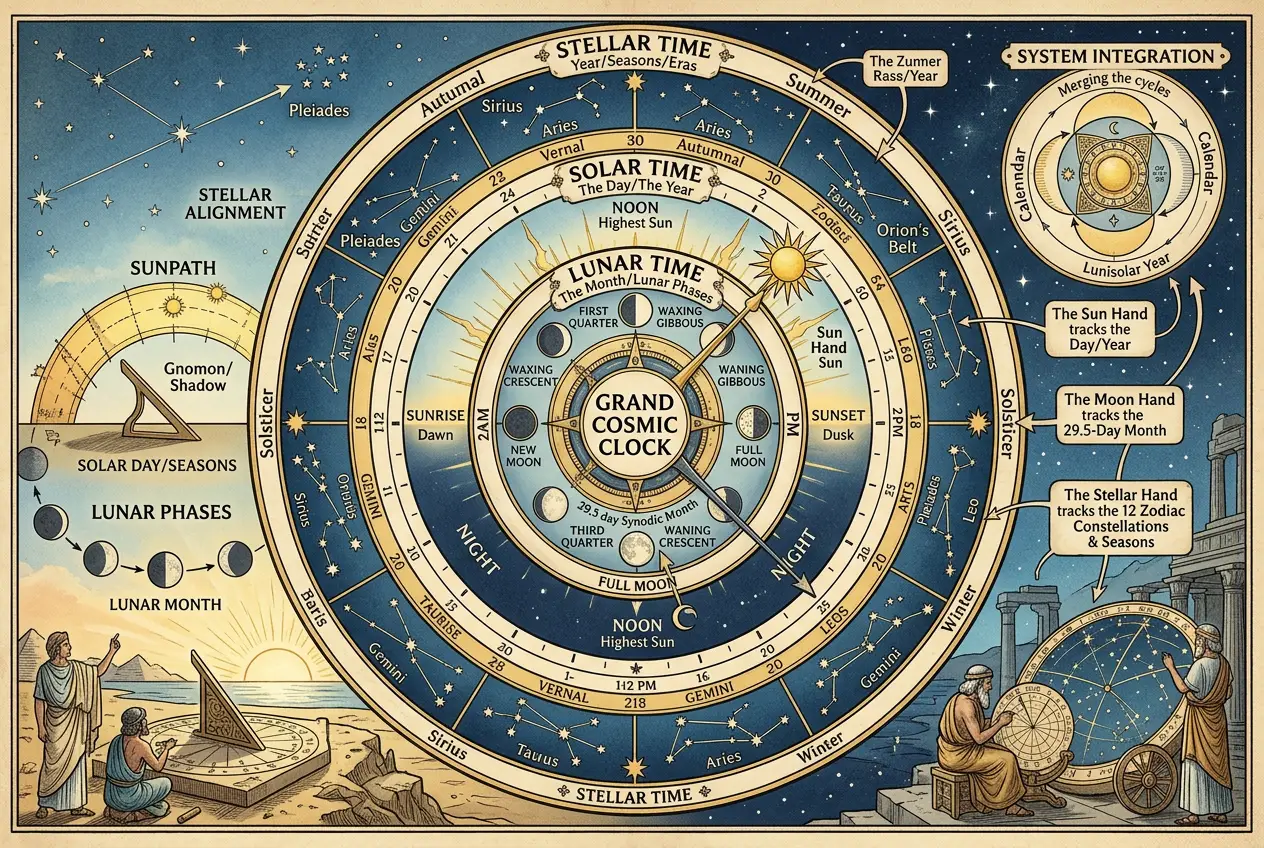
## **The Mystery of Precision: How Did They Do It?**
This is where the "tech mystery" really deepens. Without telescopes, precise measuring instruments, or advanced mathematics as we know them, how did ancient peoples achieve such staggering accuracy?
One theory suggests **long-term, generational observation**. Imagine hundreds of years of meticulous record-keeping, passed down through oral traditions, carvings, or even early forms of notation. Over centuries, subtle shifts in celestial bodies would become apparent, allowing for increasingly precise adjustments in their monumental constructions. This accumulated knowledge would be akin to a massive, distributed database of astronomical observations. This deep connection to observation and the natural world is a recurring theme in ancient ingenuity, such as discussed in [Did Ancient Cultures Decode Nature's Hidden Sounds?](/blogs/did-ancient-cultures-decode-natures-hidden-sounds-8216).
Another possibility involves **sophisticated surveying techniques** that have been lost to time. While we often think of simple ropes and sticks, perhaps they had methods for calculating angles, distances, and celestial positions that were far more advanced. The construction of massive stone blocks, moved and placed with incredible accuracy over vast distances, already hints at forgotten engineering prowess, a topic often discussed when considering [How Ancient Stonework Cut Like Lasers](/blogs/ancient-stonework-did-lost-tools-cut-stone-like-lasers-2819).
Dr. Euan MacKie, a proponent of advanced prehistoric astronomical knowledge, posits that "the very scale and precision of some megalithic sites suggest a level of astronomical and geometrical sophistication that often goes unrecognized." He argues that some alignments are so accurate they imply not just observation, but systematic and repeatable measurement. You can find more insights on archaeoastronomy in general on [Wikipedia's Archaeoastronomy page](https://en.wikipedia.org/wiki/Archaeoastronomy).
## **Why a Cosmic Clock? Societal Implications**
Why invest so much effort in building these cosmic clocks? The implications are vast:
1. **Agricultural Cycles:** Accurate prediction of seasons was paramount for survival. A cosmic clock would ensure optimal planting and harvesting times.
2. **Religious and Spiritual Significance:** Alignments often coincided with important deities or rituals, reinforcing spiritual beliefs and societal order. The universe was seen as a living entity, and these clocks were a way to commune with its divine timing.
3. **Social Cohesion and Power:** Those who could "read" the cosmic clock held immense power and prestige, solidifying their role as leaders or spiritual guides. It was a form of knowledge management that reinforced hierarchy.
4. **Navigation:** For maritime cultures, understanding celestial movements was vital for navigation. While not direct "clocks" for ship timing, the principles would inform their understanding of position and direction. We’ve previously explored related topics, such as [Did Vikings Unlock Polarized Light Navigation with Sunstone?](/blogs/sunstone-did-vikings-unlock-polarized-light-navigation-7151).
These cosmic clocks weren't just scientific instruments; they were the heartbeats of entire civilizations, dictating their daily lives, spiritual beliefs, and long-term planning.
## **Conclusion: A Legacy of Time and Stars**
The idea of ancient observatories as sophisticated cosmic clocks forces us to re-evaluate the intellectual capabilities of our ancestors. It moves beyond the image of primitive sky-watchers to one of highly observant, persistent, and ingenious engineers and astronomers who built monumental machines to track the universe's grand cycles.
While the "how" remains shrouded in the mists of time, the evidence suggests a profound commitment to understanding and integrating celestial mechanics into their world. These were not mere stones; they were the **original supercomputers**, calculating the movements of the heavens, charting the flow of time, and connecting humanity to the infinite dance of the cosmos. As we continue to uncover their secrets, we might find that the ancients had a grasp of universal timing that echoes our own pursuit of precision in atomic clocks and space-time measurements. Perhaps, in some ways, they were simply using the grandest clock of all: the universe itself.
Frequently Asked Questions
Archaeoastronomy is the interdisciplinary study of how ancient people understood and used celestial phenomena, examining archaeological sites and artifacts for astronomical alignments and symbolism to reconstruct past sky knowledge.
Ancient observatories achieved remarkable accuracy through long-term, systematic naked-eye observation over generations, combined with sophisticated surveying and engineering techniques that are still not fully understood. Their precision often rivaled or exceeded what we might expect from cultures without telescopes or advanced mathematics.
While many ancient sites have astronomical alignments, the term 'cosmic clock' implies a level of precision, multi-functionality, and long-term tracking of multiple celestial cycles, beyond just marking solstices or equinoxes. Only a subset of sites exhibit the complexity that suggests such an advanced timekeeping purpose.
These observatories played crucial roles in ancient societies, guiding agricultural cycles, informing religious and spiritual practices, solidifying the power of leaders and priests who interpreted the celestial events, and potentially aiding in navigation and long-term planning.
Yes, many other sites worldwide suggest sophisticated cosmic timekeeping, including Carnac in France, Nazca Lines in Peru (for some interpretations), and various indigenous sites in North America that show precise alignments with celestial events.
Verified Expert
Alex Rivers
A professional researcher since age twelve, I delve into mysteries and ignite curiosity by presenting an array of compelling possibilities. I will heighten your curiosity, but by the end, you will possess profound knowledge.
Leave a Reply
Comments (0)
No approved comments yet. Be the first to share your thoughts!
 Join Us


 Alex Rivers
































Leave a Reply
Comments (0)