


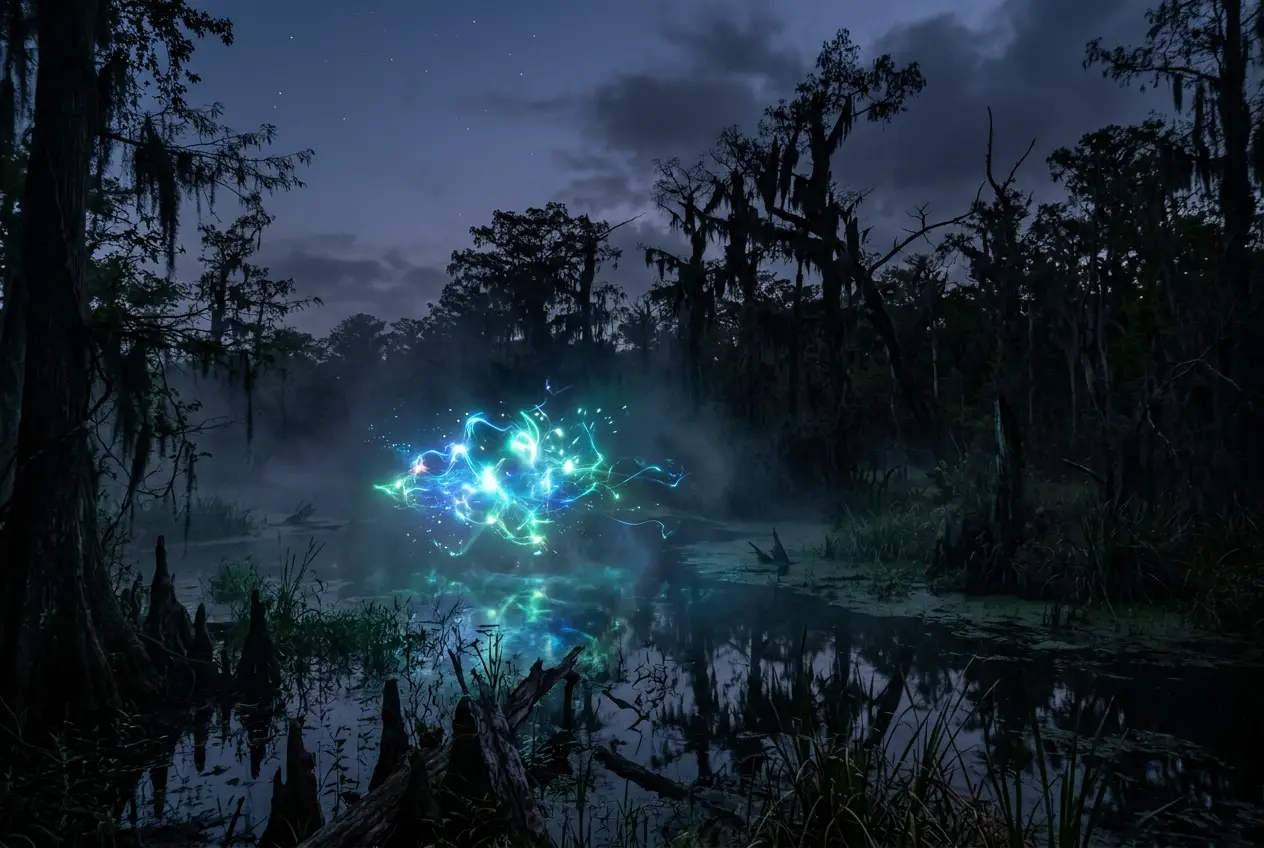
I remember a chilly evening, huddled by a campfire, listening to my grandfather recount tales of strange lights dancing in distant marshes. He called them "ghost lights," eerie orbs that seemed to beckon travelers deeper into the wilderness. For centuries, these unexplained phenomena, known globally as Will-o'-the-Wisps, have captivated and terrified humanity, inspiring countless legends of mischievous spirits and lost souls. But what if these mysterious lights aren't supernatural at all? What if they are a rare, naturally occurring form of plasma, hinting at a fascinating intersection of nature, chemistry, and physics, perhaps even echoing some yet-to-be-understood form of "ancient tech" from our planet itself?
The thought first struck me when I was researching natural energy phenomena. Could something so consistently observed, yet so elusive to definitive explanation, simply be dismissed as folklore? I dove deep into the history and science behind these phantom lights, and what I found suggests a far more complex and intriguing reality than simple marsh gas.
The Ethereal Dance: A Glimpse into Folklore and History
Across cultures and continents, the Will-o'-the-Wisp takes on many forms, each with its own local lore. In England, they were thought to be sprites or fairies, leading travelers astray. In Scandinavia, they were "lyktgubben" (lantern men), spirits of drowned children. Germany knew them as "Irrlichter," and in Japan, they manifested as "Hitodama," the souls of the recently deceased. Common to all these narratives is a glowing, flickering light, often described as blue, green, or pale yellow, appearing in remote, boggy areas, seemingly moving with intent before vanishing as quickly as they appeared.
These aren't just quaint stories; historical accounts of these lights are numerous and span centuries. Early scientists and naturalists meticulously documented sightings, often attempting to explain them within the scientific understanding of their time. The sheer persistence of these accounts, from medieval texts to 19th-century scientific journals, underscores their reality, even if their explanation remained elusive.
Beyond Superstition: Early Scientific Attempts
For a long time, the prevailing scientific theories for Will-o'-the-Wisps revolved around basic chemistry:
- Combustion of Marsh Gas (Methane): The most popular theory attributed the lights to the spontaneous combustion of methane (CH₄), produced by decaying organic matter in swamps and bogs. Methane itself isn't spontaneously flammable at ambient temperatures, but phosphine (PH₃) and diphosphane (P₂H₄), also produced in anaerobic decomposition, are. These can ignite methane upon contact with air, creating a flickering flame.
- Bioluminescence: Another idea suggested the lights were caused by bioluminescent organisms, such as certain fungi, insects, or decaying wood, which produce light through chemical reactions. While many organisms glow, the rapid movement, hovering, and sudden disappearance of Will-o'-the-Wisps don't perfectly align with typical bioluminescent phenomena.
While these theories provided plausible explanations for some marsh lights, they struggled to account for all observed characteristics. Many eyewitness accounts describe lights that float silently, change direction, appear and disappear instantly, and don't generate significant heat or smoke—qualities not easily explained by simple combustion or biological glow. The mystery persisted, leaving room for more advanced scientific inquiry, even leading some to wonder if phenomena like these could somehow tap into unseen energy sources.
The Plasma Hypothesis: A Radical Re-evaluation
This is where the idea of plasma enters the scene, offering a potentially more comprehensive explanation. Plasma, often called the "fourth state of matter," consists of ionized gas where atoms have lost or gained electrons, creating a soup of free ions and electrons. It's the most abundant form of matter in the universe, making up stars, nebulae, and even lightning. What if Will-o'-the-Wisps are tiny, naturally occurring pockets of cold plasma?
How could natural cold plasma form in a swamp? The conditions in marshes are rife with decaying organic matter, releasing various gases, including methane, phosphine, and various volatile organic compounds. Some researchers, notably Dr. J. R. W. G. de Groot, proposed that certain chemical reactions, particularly involving phosphine and diphosphane, could produce localized electric fields intense enough to ionize surrounding gases. This ionization could create a glowing, low-temperature plasma ball.
Consider the potential sequence:
- Gas Generation: Anaerobic bacteria in stagnant water generate methane, phosphine, and other hydrocarbons.
- Electric Field Formation: Specific chemical reactions or localized atmospheric conditions (perhaps involving static electricity or even piezoelectric effects from certain crystals in the soil, though this is more speculative) could create micro-scale electric fields.
- Ionization: These fields ionize the gases, creating a low-temperature plasma that emits light.
- Mobility: Being plasma, these entities could be influenced by ambient electric fields or even weak air currents, explaining their erratic movements without a visible source of propulsion.
One of the fascinating aspects of plasma is its ability to be self-sustaining under certain conditions, albeit for a short duration. This could explain the sudden appearance and disappearance, as well as the lack of apparent combustion by-products. The energy release would primarily be light, not heat, which aligns with many eyewitness accounts. For a deeper dive into the physics of plasma, a good starting point is the Wikipedia article on plasma physics (opens in a new tab).
Connecting to "Ancient Tech" and Anomalies
While the term "ancient tech" usually refers to human-made devices, the concept of naturally occurring advanced phenomena challenges our understanding of what constitutes "technology." If Will-o'-the-Wisps are indeed natural plasma phenomena, they represent a complex physical process that, in a controlled environment, could be incredibly powerful. Imagine if ancient civilizations, through long-lost observational knowledge or accidental discovery, somehow learned to predict, influence, or even harness these natural plasma formations. It sounds like science fiction, but history is replete with examples of cultures observing natural phenomena and incorporating them into their practices, often with explanations that blend science and mysticism. Just as we ponder if lunar anomalies could be unexplained tech, we might ask similar questions about our own planet’s mysterious phenomena.
The idea resonates with ongoing research into "cold plasma technology" today. Modern plasma technology is being developed for everything from sterilizing medical equipment to wastewater treatment and even future propulsion systems. These applications often involve creating and controlling plasma at relatively low temperatures, much like what might be happening with Will-o'-the-Wisps. The fact that nature might be doing something similar, spontaneously, in remote swamps, is a powerful reminder of how much we still have to learn about our world and its hidden physics. It's a bit like discovering a natural radio signal, making one wonder if strange radio bursts from space are any more puzzling.
Challenges and Future Research
Despite the allure of the plasma hypothesis, proving it definitively remains a significant challenge. The fleeting nature of Will-o'-the-Wisps makes them incredibly difficult to study in situ. Controlled laboratory experiments attempting to recreate these phenomena have had mixed success. For instance, some researchers have managed to generate fleeting, glowing balls of plasma using specific gas mixtures and electrical discharges, but consistently replicating the exact conditions and longevity observed in nature is complex. More research is needed to understand the precise chemical kinetics and environmental factors that could lead to natural plasma formation in wetlands. The Wikipedia page on Ignis Fatuus (opens in a new tab) details the ongoing scientific debate.
Moreover, the exact role of phosphine and diphosphane in initiating such reactions is still debated. These compounds are highly toxic and reactive, and their presence in the quantities needed for plasma formation is not always clear. However, new analytical techniques and sensor technologies could eventually allow scientists to detect the subtle chemical and electromagnetic signatures associated with these lights in their natural habitats.
Conclusion: Nature's Own Laboratory
The mystery of the Will-o'-the-Wisp serves as a potent reminder that our planet is a vast, natural laboratory filled with phenomena that continue to defy easy categorization. Whether they are complex chemical reactions, unusual bioluminescence, or indeed, naturally occurring cold plasma, these "ghost lights" beckon us to look beyond simplistic explanations.
I find it incredibly humbling to think that while we spend billions on fusion reactors and plasma engines, nature might have been perfecting its own version of plasma technology in the quiet corners of our world for millennia. Unraveling the secrets of the Will-o'-the-Wisp isn't just about debunking folklore; it's about pushing the boundaries of our scientific understanding, and perhaps, catching a glimpse of the universe's most elegant, inherent "tech." And who knows, perhaps understanding these ancient lights might even inspire future innovations in energy or material science. It's a journey into the unknown that I believe is well worth taking.


Conversation0
No comments yet. Be the first to share a thought — the best questions often become new stories.