


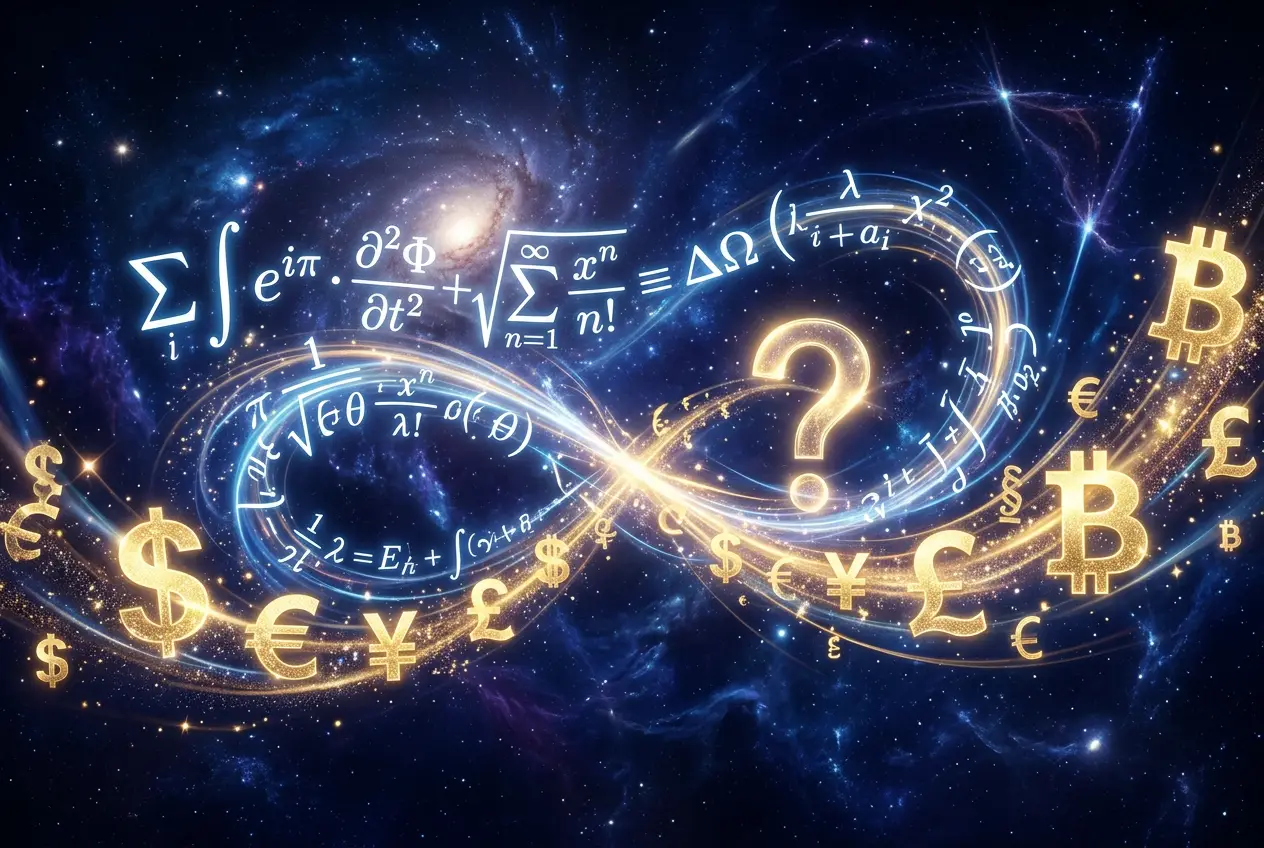
I've always been fascinated by stories of hidden treasures, not just gold and jewels, but intellectual riches. Imagine stumbling upon a problem, a puzzle so profound that its solution doesn't just advance human knowledge but also comes with a life-changing reward. What if I told you such treasures exist, not buried in ancient ruins, but hidden within the intricate tapestry of mathematics? I’m talking about the Millennium Prize Problems, a collection of seven elusive mathematical conundrums, each carrying a cool one-million-dollar prize for its solver.
These aren't your typical high school algebra problems. These are the Mount Everests of mathematics, challenges that have stumped the brightest minds for decades, some even centuries. Solving them wouldn't just make you rich; it would etch your name into the annals of scientific history, potentially unlocking breakthroughs in fields ranging from cryptography to climate modeling, and even the very nature of computation.
The Allure of Unsolved Mathematics: Why a Million Dollars?
The idea of attaching a monetary prize to mathematical problems isn't new. In 1900, mathematician David Hilbert presented 23 unsolved problems that greatly influenced 20th-century mathematics. Building on this legacy, the Clay Mathematics Institute (CMI) in 2000 announced the seven Millennium Prize Problems, identifying them as "important classic questions that have resisted solution for many years." They are considered fundamental to our understanding of mathematics and its applications.
The million-dollar prize isn't merely an incentive; it's a recognition of the immense intellectual effort required and the potential societal impact of their solutions. These problems touch upon core aspects of number theory, geometry, analysis, and theoretical computer science. Solving just one could redefine entire scientific disciplines.
The Riemann Hypothesis: Unlocking the Secrets of Prime Numbers
Perhaps the most famous among the Millennium Problems, and arguably the most significant, is the Riemann Hypothesis. First proposed by Bernhard Riemann in 1859, it concerns the distribution of prime numbers. Prime numbers are the atoms of arithmetic—numbers only divisible by 1 and themselves (2, 3, 5, 7, 11, and so on). Despite their simple definition, their appearance within the sequence of natural numbers is famously erratic and unpredictable.
The hypothesis states that all "nontrivial zeros" of the Riemann zeta function have a real part of 1/2. For those of us who aren't mathematicians, this might sound like gibberish, but its implications are profound. If proven true, it would provide a map, a hidden order, to the seemingly chaotic world of prime numbers. You can learn more about the fascinating history of this problem on Wikipedia's Riemann Hypothesis page (opens in a new tab).
Why does this matter? Prime numbers are the backbone of modern cryptography. The security of online transactions, encrypted communications, and digital privacy all rely on the difficulty of factoring very large numbers into their prime components. A solution to the Riemann Hypothesis could either revolutionize cryptography by offering new, more efficient ways to find primes or, conversely, expose vulnerabilities in existing systems, forcing a complete overhaul of our digital security infrastructure.
I often think about how such an abstract concept, seemingly distant from our daily lives, could have such a tangible impact. It's a testament to the interconnectedness of pure mathematics and practical technology. For a deeper dive into how complex mathematical ideas underpin technology, check out our article on whether our reality might be a digital simulation.
P vs NP: The Ultimate Computational Challenge
Another problem that holds immense practical significance is the P versus NP problem. This question sits at the heart of theoretical computer science and asks: If a solution to a problem can be quickly verified, can it also be quickly found?
- P (Polynomial Time) refers to problems whose solutions can be found relatively quickly by a computer. Think of sorting a list of numbers; as the list grows, the time it takes increases predictably.
- NP (Nondeterministic Polynomial Time) refers to problems where, if you have a potential solution, you can quickly verify if it's correct. For instance, if I give you a proposed timetable for a complex set of meetings, you can quickly check if all constraints are met. But finding that optimal timetable from scratch might be incredibly difficult and time-consuming.
The core question is whether P = NP. If P = NP, it means that for any problem whose solution can be quickly checked, there's also a quick way to find that solution. The implications are mind-boggling. Drug discovery, logistics optimization, artificial intelligence, and even the creation of perfect art could become trivial computational tasks. Imagine an AI that could instantly generate the perfect protein structure for a disease or a computer that could solve any Sudoku puzzle in an instant, no matter its size.
Conversely, if P ≠ NP (which is the widely believed outcome), it means there are fundamental limits to what computers can efficiently solve. This would validate the foundational assumptions of current cryptography, confirming that some problems are inherently hard to solve, even for the most powerful supercomputers. You can explore the fascinating details of this problem on Wikipedia's P versus NP page (opens in a new tab).
Beyond Riemann and P vs NP: Other Uncharted Territories
While the Riemann Hypothesis and P vs NP often grab the spotlight, the other five Millennium Problems are no less challenging or significant:
- Yang-Mills Existence and Mass Gap: This problem comes from theoretical physics, specifically quantum field theory, and asks for a rigorous mathematical foundation for the strong nuclear force, which binds atomic nuclei. Its solution could deepen our understanding of elementary particles and the fundamental forces of the universe.
- Navier-Stokes Existence and Smoothness: This concerns the equations that describe the motion of viscous fluid substances (like water or air). Solving it would give us a complete mathematical understanding of turbulence, with profound implications for weather prediction, aircraft design, and climate modeling. I sometimes wonder if understanding these fluid dynamics could even help us understand the cosmic movements discussed in our blog on dark energy's potential to power tomorrow's tech.
- Hodge Conjecture: Rooted in algebraic geometry, this problem asks whether certain topological features on algebraic varieties (complex geometric objects) can be represented by simpler, "algebraic" cycles. It connects geometry with number theory and analysis.
- Poincaré Conjecture (Solved!): This one stands out as the only Millennium Problem to have been solved. Russian mathematician Grigori Perelman proved it in 2003, refusing both the Fields Medal and the million-dollar prize, citing a desire to avoid public attention and a belief that his work was no greater than that of Richard Hamilton, who contributed significantly to the ideas. The conjecture, in essence, states that every simply connected, closed 3-manifold is homeomorphic to the 3-sphere—a way of classifying three-dimensional spaces.
- Birch and Swinnerton-Dyer Conjecture: This problem deals with elliptic curves and their relation to specific types of L-functions. It's a deeply number-theoretic problem that connects algebraic geometry to the theory of zeta functions, much like the Riemann Hypothesis connects to the distribution of primes.
The Thrill of the Chase: Who Can Solve Them?
The beauty of these problems is that they are open to anyone with the mathematical prowess to tackle them. Most solvers are professional mathematicians, often working in isolation or small teams for years, even decades. They require not just immense intelligence but also tenacity, creativity, and a deep, intuitive understanding of abstract mathematical structures.
Could an AI solve one of these problems? It's a fascinating thought. While AI has made incredible strides in solving complex problems and even proving theorems within specific logical systems, the Millennium Problems often require leaps of intuition, novel conceptual frameworks, and a deep understanding of human mathematical thought that current AI systems have yet to demonstrate. However, as AI continues to evolve, especially in areas like symbolic reasoning and advanced pattern recognition, it's not impossible to imagine a future where AI becomes a formidable partner, if not a sole solver. Our previous blog, Can AI Unlock Ancient Lost Languages?, explores similar themes of AI's potential in complex problem-solving.
Conclusion: More Than Just Money
The lure of a million dollars is undoubtedly strong, but for the mathematicians who dedicate their lives to these challenges, the prize money is secondary. The real reward is the profound intellectual satisfaction of pushing the boundaries of human knowledge, of discovering a hidden truth that redefines our understanding of the universe. These problems remind us that even in an age of advanced technology, there are still vast territories of knowledge waiting to be explored, where the tools are not always supercomputers, but the sheer power of the human mind. So, if you've got a passion for numbers and a knack for puzzles, who knows? The next million-dollar solution might just be waiting for you.





Conversation0
No comments yet. Be the first to share a thought — the best questions often become new stories.