I’ve always been fascinated by the fundamental properties of light. We’re taught it’s a wave, a particle, the fastest thing in the universe, always moving at a constant speed in a vacuum. But what if I told you there’s a bizarre state of matter where light itself behaves like a superfluid, flowing without resistance and exhibiting properties that seem to defy our everyday understanding of physics? It sounds like something straight out of a science fiction novel, yet this phenomenon, known as **superfluid light**, is a very real, albeit exotic, area of modern physics research.
Recently, I stumbled upon some incredible work that makes me question everything I thought I knew about light. Imagine light not just as individual photons zipping along, but as a collective entity, capable of swirling and flowing without losing energy, much like supercooled helium. This isn't just a quirky lab trick; it opens doors to understanding fundamental forces and potentially revolutionizing future technologies, from ultra-efficient data transmission to entirely new forms of computing.
## What Exactly is Superfluid Light?
To grasp superfluid light, we first need a quick detour into two fascinating concepts: **superfluidity** and **Bose-Einstein Condensates (BECs)**.
Superfluidity is a state of matter (often seen in helium-4 at extremely low temperatures) where it behaves like a fluid with zero viscosity. It can flow through microscopic openings, climb walls, and exhibit other counter-intuitive properties because its particles move without friction. This occurs when the particles, called bosons, reach their lowest quantum energy state and behave as a single quantum entity. Think of it as a perfectly coordinated quantum dance where individual identities blur into a collective flow.
Now, imagine this concept applied to light. Normally, photons (light particles) don't interact much. They pass through each other without bothering, which is why we can see through glass or have multiple radio signals coexist. However, under specific extreme conditions, photons *can* be made to interact strongly enough to form what’s called a **photon fluid**. When this photon fluid is cooled sufficiently and confined, it can enter a state analogous to a Bose-Einstein Condensate. This is where the magic of superfluid light begins.
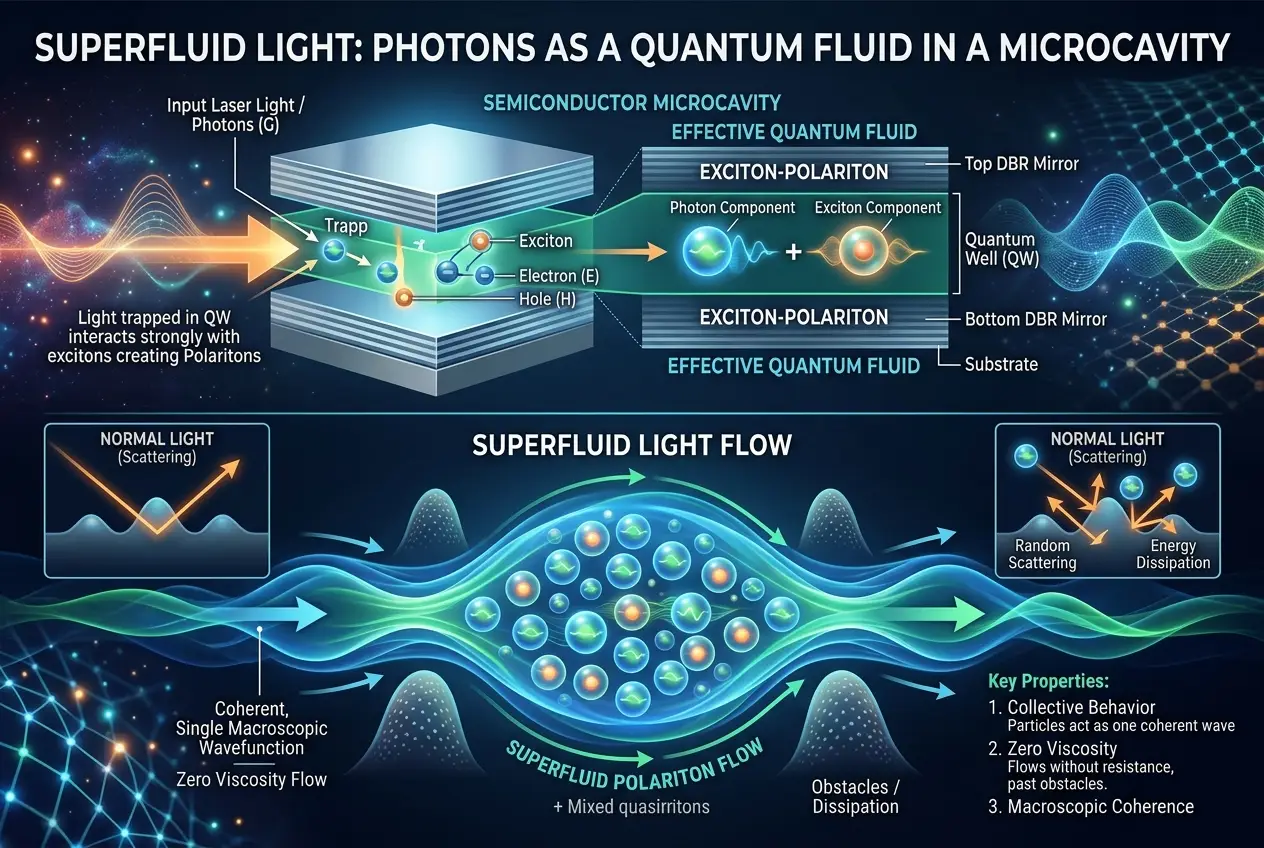
Scientists aren't "cooling" individual photons in the traditional sense, as photons are always moving at the speed of light. Instead, they create an effective medium that makes photons behave as if they have mass and can interact. This is typically achieved by trapping light in a cavity filled with certain materials, like semiconductor microcavities, where photons repeatedly interact with excitons (electron-hole pairs) in the material. This interaction allows the light to acquire effective mass and interact with other photons, leading to a collective quantum state.
### The Quantum Dance: How Photons Become a Fluid
The key to creating superfluid light lies in forcing photons to "feel" each other's presence. In typical environments, photons are lone wolves. But in a specially designed microcavity, they can be made to interact with excited particles in a semiconductor. These hybrid light-matter particles are known as **polaritons**.
"These polaritons are half-light, half-matter quasi-particles," explains a key research paper in *Nature Physics*, "and it is their matter component that allows them to interact with each other, forming a collective quantum state when condensed." This interaction means that instead of just passing through, photons effectively 'push' and 'pull' on each other. When enough of these polaritons are condensed at extremely low temperatures (or sufficiently high densities at room temperature, which is an even more remarkable recent achievement), they can form a Bose-Einstein condensate. When this condensate is made of light-dominated polaritons, it behaves like superfluid light.
One of the most mind-bending aspects is how this fluid light can flow without resistance. If you push a normal fluid, it creates ripples and turbulence. But a superfluid, due to its quantum coherence, bypasses obstacles without losing energy. Imagine a light beam flowing around a corner without scattering, or tunneling through an opaque barrier. These are the kinds of phenomena that superfluid light could exhibit.
## Breaking the Speed Limit (Sort Of) and Other Anomalies
When we talk about light, the ultimate speed limit of the universe, the speed of light in a vacuum (approximately 299,792,458 meters per second), immediately comes to mind. So, can superfluid light *actually* break this limit? Not quite in a vacuum, but it can profoundly alter light's behavior in ways that seem to defy intuition.
The "speed" of superfluid light is a complex concept. In the medium where it forms, the group velocity of light can be significantly reduced, allowing for the formation of the condensate. However, within the superfluid state itself, excitations can propagate at speeds that are not directly limited by the typical "speed of light in that medium." More importantly, the *lack of scattering* is what's truly revolutionary. Light moving through a regular medium is scattered, absorbed, and slowed down due to interactions with atoms. Superfluid light, by avoiding these scattering losses, can move more efficiently and coherently.
One of the most intriguing anomalies linked to superfluid light is its potential to exhibit **Cherenkov radiation** in reverse, or rather, to behave in ways that would typically generate Cherenkov radiation *without* the energy loss. Cherenkov radiation occurs when a particle moves faster than the phase velocity of light in a specific medium, emitting a blue glow. If light itself could act as a 'particle' moving through its own fluid medium, it could lead to exotic phenomena. For more on Cherenkov light and its potential, you can explore `/blogs/can-cherenkov-light-hint-at-faster-than-light-tech-4930`.
Another fascinating aspect is the formation of **quantum vortices**. In a classical fluid, a vortex is a whirlpool. In a superfluid, a quantum vortex is a singularity where the fluid rotates around a point with quantized angular momentum. These vortices are incredibly stable and could potentially be used to store information in entirely new ways. Imagine tiny, stable whirlpools of light acting as quantum bits in a computer!
## The Future is Bright (and Superfluid)
The implications of superfluid light stretch across several cutting-edge fields.
### Ultra-Efficient Computing and Data Transmission
The ability to manipulate light with such precision and efficiency could lead to breakthroughs in **optical computing**. Traditional computers rely on electrons, which generate heat and encounter resistance. Photons, in contrast, are much more efficient. If we can create logic gates and processors using superfluid light, we could build computers that are orders of magnitude faster and more energy-efficient, with minimal heat dissipation.
Consider **quantum computing**. While superfluid light itself isn't directly a quantum computer, the coherent quantum states and potential for stable quantum vortices could provide new platforms for quantum information processing. Imagine using the quantized circulation of light vortices as qubits. This could be a game-changer, complementing other quantum computing approaches. You might be interested in how /blogs/can-quantum-computers-break-times-rules-2969 or how /blogs/can-quantum-computers-break-every-encryption-1438.
### Advancements in Material Science and Sensing
Superfluid light could also pave the way for novel **light-matter interfaces**. By understanding how light can be made to interact and behave collectively, scientists might engineer new materials with unprecedented optical properties. This could lead to:
* **Super-sensitive sensors:** Imagine sensors that can detect minute changes in electromagnetic fields or even gravitational waves with incredible precision, utilizing the frictionless flow of light.
* **New forms of lasers and optical devices:** Devices that generate light with enhanced coherence and reduced noise, opening up new applications in microscopy, spectroscopy, and communication.
### Fundamental Physics Research
Beyond technological applications, superfluid light provides a unique tabletop experiment for exploring fundamental physics. It allows researchers to study complex quantum phenomena, such as phase transitions, topological defects (like quantum vortices), and even analogues of black holes in a controlled lab setting. For instance, creating effective "horizons" for light in such a fluid could help us understand the properties of black holes and the behavior of information at such boundaries, as discussed on Wikipedia's page about Analogue gravity.
It's a testament to human curiosity that we continue to push the boundaries of what's possible, even with something as seemingly fundamental as light. The journey from theoretical concept to experimental realization for superfluid light has been long and arduous, requiring highly specialized equipment and precise control over quantum systems.
### Challenges and the Road Ahead
Despite its immense promise, realizing the full potential of superfluid light isn't without its challenges. Maintaining the ultra-low temperatures or high densities required for these condensates can be technically demanding. Scaling up these systems for practical applications remains a significant hurdle. Furthermore, precisely controlling the interactions between photons and matter to engineer specific behaviors is an active area of research.
However, the rapid advancements in fields like quantum optics and nanotechnology are constantly bringing us closer. Every new discovery, every refined technique, chips away at these challenges, bringing the future of superfluid-powered technology a little closer.
I find myself captivated by the elegance of superfluid light. It's a powerful reminder that the universe, even in its most basic constituents, holds endless surprises. As we continue to delve deeper into the quantum realm, we are consistently rewarded with phenomena that stretch our imaginations and redefine the very fabric of reality. The journey of light, from a simple wave-particle duality to a frictionless quantum fluid, truly showcases the "wow, I didn’t know this!" factor that drives curiosity in science.
**External Links:**
* [Superfluidity on Wikipedia](https://en.wikipedia.org/wiki/Superfluidity)
* [Bose-Einstein Condensate on Wikipedia](https://en.wikipedia.org/wiki/Bose%E2%80%93Einstein_condensate)
* [Polariton on Wikipedia](https://en.wikipedia.org/wiki/Polariton)
* [Analogue Gravity on Wikipedia](https://en.wikipedia.org/wiki/Analogue_gravity)
Frequently Asked Questions
While the theoretical underpinnings for light-matter condensates have existed for some time, the experimental realization and deeper understanding of superfluid light phenomena are relatively recent advancements, with significant progress made in the last two decades. Researchers are continuously exploring new ways to achieve and control this state, even at room temperature.
No, superfluid light does not enable faster-than-light travel in a vacuum. The concept primarily refers to light behaving like a fluid with zero viscosity within a specific medium. While its speed within that medium can be manipulated, and it bypasses typical scattering losses, it still adheres to the universal speed limit of light in a vacuum.
The main difference lies in how photons interact and behave collectively. Normal light consists of photons that largely travel independently. Superfluid light, however, involves photons (often in the form of polaritons) that interact strongly enough to form a collective quantum state, allowing them to flow without resistance and exhibit quantum phenomena like vortices.
Currently, superfluid light can only be created under highly controlled laboratory conditions, typically requiring specialized semiconductor microcavities and precise manipulation of light-matter interactions, sometimes at extremely low temperatures or high densities. It’s not a phenomenon observed naturally in everyday environments.
Potential applications include ultra-efficient optical computers that generate less heat and operate faster than current electronic systems, highly sensitive quantum sensors, and new types of lasers and optical devices with enhanced coherence. It also serves as a unique platform for fundamental research into quantum mechanics and analogue gravity.
Verified Expert
Alex Rivers
A professional researcher since age twelve, I delve into mysteries and ignite curiosity by presenting an array of compelling possibilities. I will heighten your curiosity, but by the end, you will possess profound knowledge.
Leave a Reply
Comments (0)
No approved comments yet. Be the first to share your thoughts!
 Join Us




 Unknown Author


























Leave a Reply
Comments (0)