


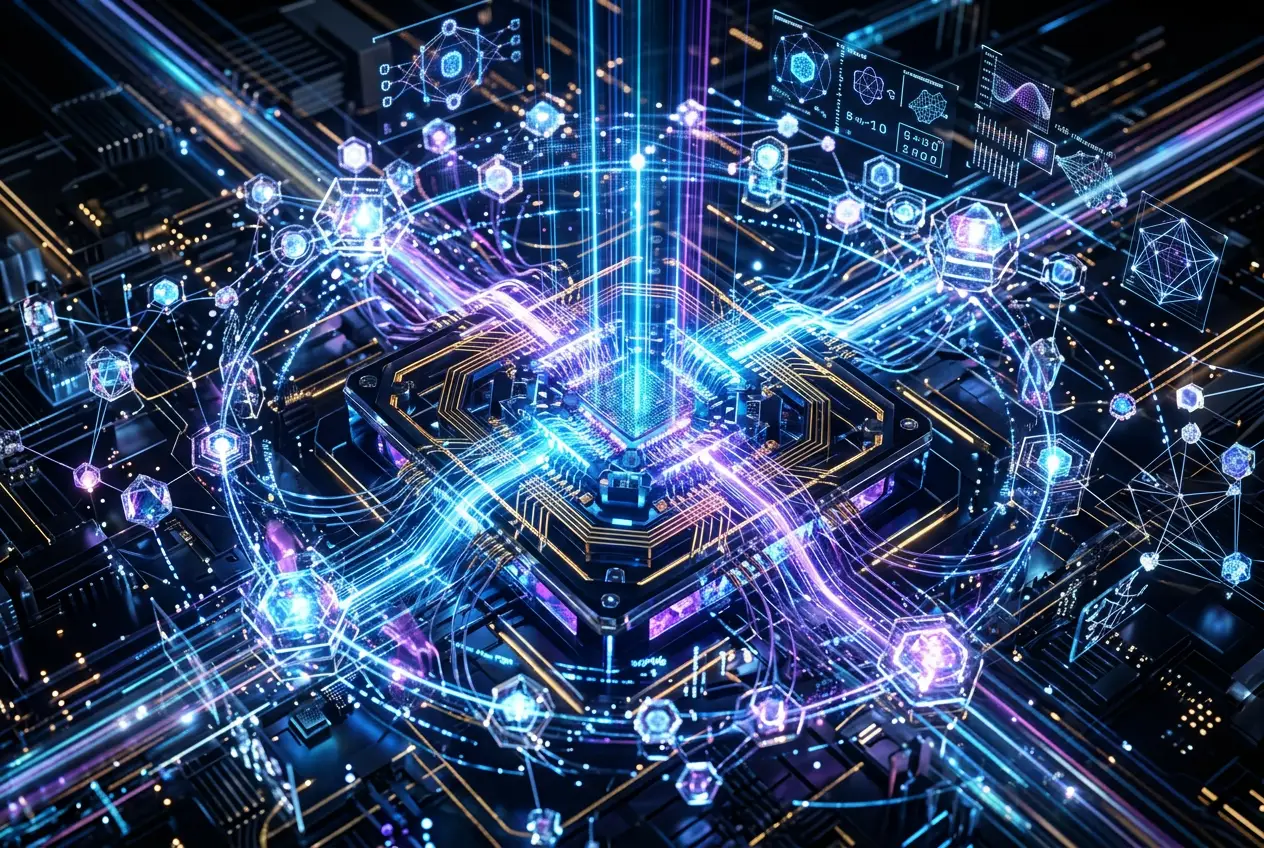
I’ve always been fascinated by the sheer scale of computation, but nothing quite prepared me for the mind-bending leap promised by quantum computing. For decades, supercomputers have stood as the pinnacles of processing power, crunching numbers at speeds unfathomable to the average desktop. They simulate climates, design rockets, and crack complex scientific problems. Yet, a new breed of machine is emerging, one that operates on the very fabric of reality, promising to outstrip even the mightiest supercomputers by factors that seem almost mythological – potentially a million times faster for specific, complex tasks.
The question isn't just if quantum computers are faster, but how they achieve such an astonishing advantage. It's not about better transistors or more efficient cooling; it's about fundamentally rethinking what "computing" even means.
The Reign of Supercomputers: A Brief Look
Before we dive into the quantum realm, let’s appreciate the giants we’re comparing against. Supercomputers are essentially highly optimized classical computers. They achieve their immense speed by networking thousands, sometimes millions, of processors to work on problems simultaneously. Think of them as an army of incredibly smart, incredibly fast calculators all collaborating on one massive problem.
These behemoths operate on the principles of classical physics. Their fundamental unit of information is the bit, which can exist in one of two definitive states: 0 or 1. Every calculation, every piece of data, every instruction is broken down into these binary choices. While they excel at problems that can be neatly divided into sequential or parallel classical operations, their power has limits, especially when confronting problems of exponential complexity.
For instance, simulating truly complex molecular interactions or cracking certain types of encryption can take even the most powerful supercomputer thousands, millions, or even billions of years. This is where the quantum world steps in, not with a faster army of calculators, but with a completely different kind of intelligence.
The Quantum Leap: Bits vs. Qubits
The foundational difference between classical supercomputers and quantum computers lies in their basic unit of information: the bit versus the qubit.
A classical bit is straightforward: it’s either a 0 or a 1. A qubit, however, leverages the bizarre principles of quantum mechanics. Thanks to a phenomenon called superposition, a qubit can exist as a 0, a 1, or both at the same time. It’s like a coin spinning in the air – it’s neither heads nor tails until it lands.
This "both at the same time" state is the first key to quantum computing's power. If you have two classical bits, they can represent one of four possible states (00, 01, 10, 11) at any given time. With two qubits, however, due to superposition, they can represent all four states simultaneously.
Now, scale this up. With n classical bits, you can store n distinct values. With n qubits, you can store 2^n values simultaneously. This exponential increase in information density is what gives quantum computers their potential for unparalleled processing power. A 300-qubit quantum computer, for example, could theoretically represent more values than there are atoms in the observable universe. You can learn more about superposition on Wikipedia's page on Quantum Superposition (opens in a new tab).
The Spooky Connection: Quantum Entanglement
Beyond superposition, there's another, even stranger quantum phenomenon that grants these machines their magic: quantum entanglement. This is what Albert Einstein famously called "spooky action at a distance." When two or more qubits become entangled, they become interconnected in such a way that the state of one instantly influences the state of the others, no matter how far apart they are.
Imagine two entangled coins. If one lands on heads, you instantly know the other is tails, even if you don't look at it and it's light-years away. In quantum computing, this means that measurements or operations on one entangled qubit can immediately affect its partners. This allows for incredibly complex and interconnected calculations across a system of qubits, creating a powerful computational resource. The interconnectedness goes far beyond simple parallel processing; it's a deep, intrinsic linkage that classical computers simply cannot replicate. For a deeper dive, check out the Wikipedia article on Quantum Entanglement (opens in a new tab).
The "How": Quantum Parallelism and Algorithms
So, how do superposition and entanglement translate into a million-fold speedup? The answer lies in quantum parallelism. Because qubits can exist in multiple states simultaneously, a single operation on a quantum register can effectively perform the same calculation on all possible values at once.
Think of it this way: a classical computer solving a maze might try one path at a time. A quantum computer, by virtue of superposition, could explore all paths simultaneously. When a measurement is made, the quantum state "collapses," ideally revealing the correct path. This allows quantum computers to tackle certain problems in exponentially fewer steps than classical ones.
This isn't a universal speedup for every computational task. Your email won't open faster on a quantum computer. Their power is unleashed on problems designed for quantum algorithms. Some of the most famous include:
- Shor's Algorithm: Can efficiently factor large numbers, a task that would take classical computers an impossibly long time for sufficiently large numbers. This has profound implications for modern encryption, as many security protocols rely on the difficulty of factoring large numbers. You can read more about it on Wikipedia's Shor's Algorithm page (opens in a new tab).
- Grover's Algorithm: Offers a quadratic speedup for searching unsorted databases, making certain search tasks much more efficient.
It’s these specialized algorithms that showcase the "million times faster" potential. For problems like simulating complex molecules for drug discovery, optimizing vast logistical networks, or breaking advanced cryptographic codes, quantum algorithms offer solutions that are simply out of reach for even the most powerful supercomputers.
The Road to Quantum Supremacy and Beyond
The journey to harnessing quantum power is not without its significant hurdles. Quantum systems are incredibly fragile. Qubits are prone to decoherence, where their delicate quantum states collapse due to interaction with their environment (heat, electromagnetic fields, vibrations). This is why quantum computers typically operate at near absolute zero temperatures in heavily shielded environments.
Achieving "quantum supremacy" (or quantum advantage, as some prefer) has been a significant milestone. This is when a quantum computer performs a specific computational task that no classical supercomputer could complete in a feasible amount of time. Google, IBM, and others have claimed to reach this point for specific, highly specialized problems. However, turning these demonstrations into practical, error-corrected, and widely applicable machines is the next frontier.
The future applications are vast and transformative:
- Drug Discovery & Materials Science: Simulating molecular interactions with unprecedented accuracy could revolutionize drug development and the creation of new materials.
- Artificial Intelligence: Enhancing machine learning algorithms, particularly in areas like pattern recognition and optimization.
- Financial Modeling: Creating more accurate and complex financial models to predict market behavior.
- Cryptography: While posing a threat to current encryption, quantum computers could also lead to new, quantum-resistant encryption methods.
The path to fully realized quantum computers is long and complex, but the theoretical underpinnings and early experimental successes are incredibly promising. It’s not a matter of if but when these machines will reshape our technological landscape.
A New Era of Computational Power
When we talk about quantum computers being "a million times faster" than supercomputers, it’s essential to understand the context. It’s not about general-purpose speed for everyday tasks. Instead, it refers to their ability to solve specific, highly complex problems that are computationally intractable for even the most powerful classical machines. This leap in capability stems from their ability to leverage the inherent strangeness of quantum mechanics – superposition and entanglement – to explore vast computational spaces simultaneously.
The comparison isn't about replacing classical computers; it's about expanding the very definition of what's computationally possible. As we continue to unravel the mysteries of the quantum world and engineer more stable qubits, we are standing on the precipice of a new computational era, one that promises to unlock solutions to problems we can currently only dream of. The journey is just beginning, and I, for one, can't wait to see what discoveries await us.
If you're curious about other mind-bending concepts in technology and science, you might be interested in whether Quantum Entanglement: A Bridge to Parallel Universes? or exploring the potential future with Atomic Batteries: Powering a future without recharging?. We also delve into the question of Could Our Reality Be a Simulation? Decoding the Matrix Hypothesis, which touches on the limits of computational power in understanding existence itself.





Conversation0
No comments yet. Be the first to share a thought — the best questions often become new stories.