


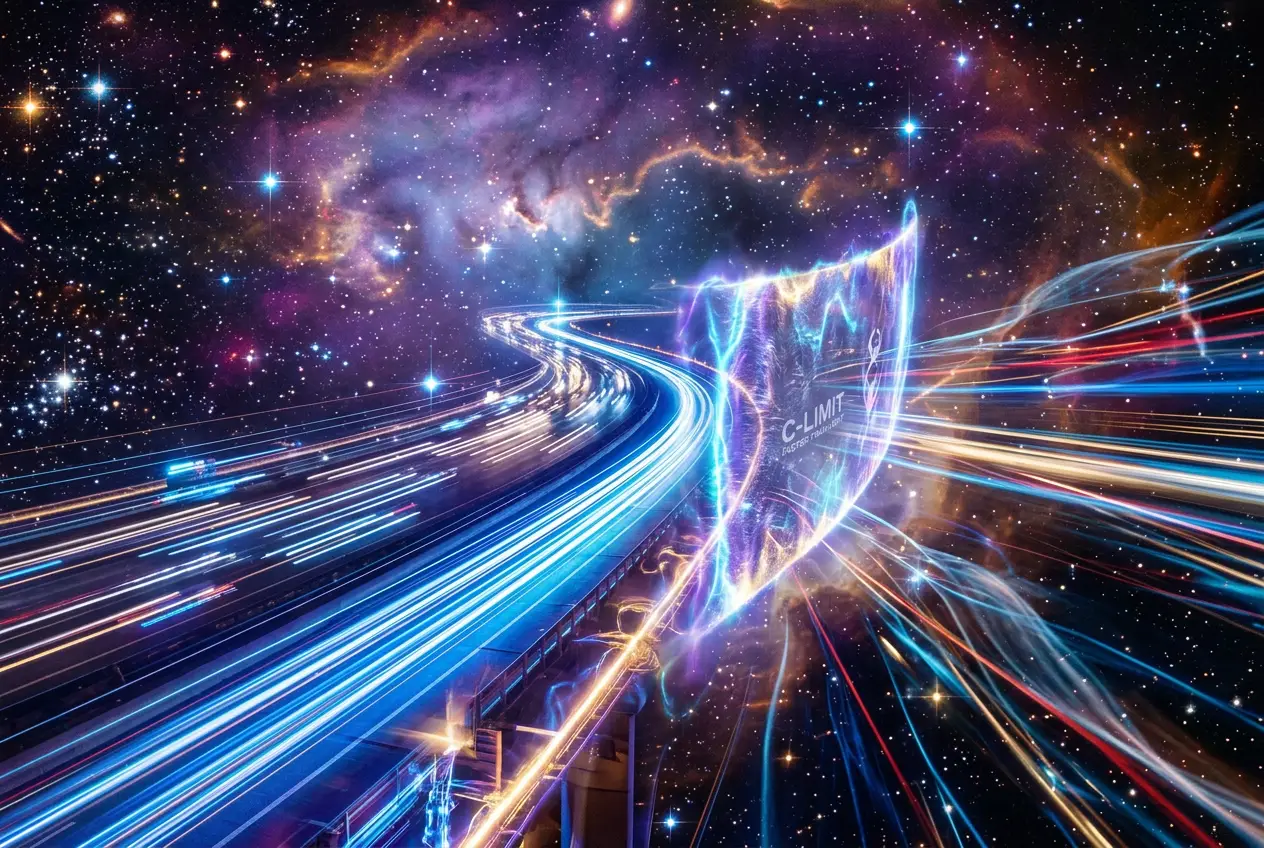
I’ve always been fascinated by the concept of speed. From the thrill of a jet breaking the sound barrier to the astonishing velocities of spacecraft, our human imagination constantly pushes the boundaries of how fast we can go. But there’s one speed limit that dominates all others, a cosmic constant enshrined in the very fabric of our universe: the speed of light. It’s 299,792,458 meters per second in a vacuum, a number so precise, so fundamental, that it shapes everything we know about physics.
Yet, a question continues to tantalize scientists and science fiction enthusiasts alike: Can particles truly break the cosmic limit? Could there be something out there, or even right here, that defies Einstein’s foundational principle? Recently, I found myself diving deep into this exact query, exploring the tantalizing hints, the rigorous science, and the mind-bending theories that attempt to answer it. It’s a journey that challenges our understanding of reality, causality, and the very nature of existence itself.
The Immutable Barrier: Einstein's Cosmic Speed Limit
To understand if anything can break the speed of light, we first need to grasp why it’s considered a limit in the first place. This concept isn't just a suggestion; it's a cornerstone of modern physics, primarily established by Albert Einstein's Special Theory of Relativity in 1905.
Einstein’s theory posits that the speed of light in a vacuum (c) is constant for all observers, regardless of their motion. This seemingly simple idea has profound implications. One of the most counterintuitive is that as an object with mass approaches the speed of light, its mass increases, and it requires an infinite amount of energy to actually reach 'c'. This means that any object with mass can approach 'c', but can never truly reach or exceed it. It's like trying to jump across an ever-widening chasm – the closer you get, the further away the other side seems to move.
For light itself, composed of massless photons, this isn't an issue. Photons must travel at 'c' in a vacuum. They don't experience time or distance in the same way we do. From a photon’s perspective, its journey from a distant star to your eye is instantaneous and covers no distance. This fundamental constant dictates the very speed at which information can travel, limiting our ability to communicate and interact across vast cosmic distances. Without warp drives or other theoretical means of bending spacetime, interstellar travel within human lifespans remains a daunting, if not impossible, challenge (though fascinating concepts like wormholes offer theoretical shortcuts across the universe).
When "Faster Than Light" Isn't Quite What You Think: Cherenkov Radiation
Before we delve into speculative physics, let's explore a phenomenon where particles do appear to move faster than light – with a crucial caveat. This is Cherenkov radiation.
Imagine a supersonic jet breaking the sound barrier, creating a sonic boom. Cherenkov radiation is the electromagnetic equivalent, but for light. When a charged particle, like an electron, travels through a transparent medium (like water in a nuclear reactor) faster than the speed of light in that specific medium, it emits a characteristic blue glow.
Let me clarify: the particle isn't breaking the universal cosmic speed limit of 'c' in a vacuum. It's simply moving faster than light travels through that particular material. Light slows down when it passes through a medium like water or glass. For example, light travels about 25% slower in water than in a vacuum. If an electron zips through water at, say, 80% the speed of light in a vacuum, it's still slower than 'c', but it's faster than light's speed in that water. This effect is utilized in particle detectors and provides beautiful visual proof in nuclear reactors, giving off that iconic eerie blue light. It's a fantastic example of a particle "outrunning" light, but strictly within the rules of relativity.
The Neutrino Anomaly: A Brief Moment of FTL Excitement
For a thrilling, albeit short-lived, period in 2011, the scientific community buzzed with news that neutrinos might have actually broken the cosmic speed limit. The OPERA experiment at the Gran Sasso laboratory in Italy measured neutrinos seemingly arriving 60 nanoseconds earlier than expected after traveling 730 kilometers from CERN.
I remember the widespread excitement and skepticism vividly. If true, it would have shattered the foundations of special relativity and forced a complete rethinking of physics. For months, physicists meticulously re-examined every aspect of the experiment. Was there a flaw in the timing? Could a cable have been loose? As it turned out, the anomaly was eventually attributed to a loose fiber optic cable connection in the GPS system and a faulty oscillator. Once these issues were corrected, the neutrinos behaved exactly as predicted by Einstein.
This event, while ultimately a false alarm, highlights the rigor of the scientific method. Extraordinary claims require extraordinary evidence, and the scientific community's dedication to verification and replication is a testament to its integrity. It also shows how deeply ingrained the speed of light limit is in our current understanding of the universe.
Tachyons: Hypothetical Particles That Always Speed
If normal particles can’t go faster than light, what about particles that are always faster than light? Enter tachyons, hypothetical particles that exist solely in the realm of theoretical physics. Coined by Gerald Feinberg in 1967, the name "tachyon" comes from the Greek tachys, meaning "swift."
Tachyons are a peculiar bunch. Unlike regular matter, which speeds up as it gains energy, a tachyon would slow down as it gains energy. Conversely, to speed a tachyon up, you'd have to remove energy from it. They're predicted to have imaginary mass, a concept that immediately sends a shiver down the spine of classical physics. What's more, a tachyon could never slow down to the speed of light, much like a regular particle can never speed up to it. It exists on the "other side" of the speed barrier.
The biggest issue with tachyons, beyond their imaginary mass and lack of empirical evidence, is the concept of causality. If tachyons existed and could be used to send information, they would allow for messages to be sent backward in time. This creates grandfathers paradoxes and breaks the fundamental principle that cause must precede effect, disrupting the very logical order of our universe. While mathematically consistent within certain frameworks, the physical implications of tachyons remain highly speculative. You can read more about these fascinating hypothetical particles on Wikipedia: Tachyon (opens in a new tab).
The Quantum Realm: "Spooky Action at a Distance"
Another area where things get weird with speed is the quantum world, particularly with quantum entanglement. As I explored in a previous deep dive, "Does Quantum Entanglement Connect Parallel Universes?", two entangled particles, even when separated by vast distances, seem to influence each other instantaneously. If you measure the spin of one particle, the spin of its entangled partner is instantly determined, no matter how far away it is.
This phenomenon, famously dubbed "spooky action at a distance" by Einstein, appears to defy the speed of light. However, despite the apparent instantaneous connection, it's crucial to understand that no information can be transmitted faster than light using entanglement alone. While the states are correlated instantly, there's no way for an observer to control the state of one particle to send a signal to another. It's like having two perfectly synchronized coin flips: if one lands heads, you know the other is tails, but you can't force one coin to land heads to communicate a message. Thus, causality and the cosmic speed limit remain intact, even in the quantum realm.
Bending Space, Not Breaking Speed: The Warp Drive Solution
While particles cannot accelerate past the speed of light in a vacuum, theoretical physics offers a loophole for faster-than-light travel: warping spacetime itself. The most famous concept is the Alcubierre drive, proposed by physicist Miguel Alcubierre in 1994.
The idea isn't to move a spaceship through space faster than light, but rather to manipulate space-time around the ship. An Alcubierre drive would create a "warp bubble" by contracting space in front of the vessel and expanding space behind it. The ship itself would remain stationary within this bubble, moving at sub-light speeds relative to its local spacetime, but the bubble itself, and thus the ship inside it, could travel at an effectively faster-than-light velocity relative to distant points.
This concept, while tantalizing, requires immense amounts of exotic matter – matter with negative mass or energy density – which we currently have no evidence of existing. It also faces significant theoretical challenges regarding energy requirements and controlling the warp bubble. Nevertheless, it represents a clever way to circumvent Einstein's speed limit without violating it directly, a testament to humanity's enduring quest for interstellar travel. You can find more details on the profound implications of special relativity and the speed of light on Wikipedia: Speed of light (opens in a new tab).
The Enduring Mystery: Why Does the Cosmic Speed Limit Exist?
The speed of light isn't just a maximum velocity; it's a fundamental constant that defines the causality and structure of our universe. Without it, the universe as we know it would simply unravel. If information could travel faster than light, cause and effect would lose their meaning, leading to a chaotic, unpredictable reality.
The constancy of 'c' has profound implications for everything from the expansion of the universe to the nature of black holes (which themselves involve the ultimate limits of gravity and spacetime, making them "Nature's Ultimate Quantum Computers" in their own right, as discussed in another blog post). It sets the observable horizon of our universe, defining how far back in time and space we can ever hope to see.
Conclusion: A Limit That Inspires Exploration
The question of whether particles can break the cosmic speed limit leads us down a rabbit hole of theoretical physics, experimental rigor, and philosophical ponderings. While current science, backed by overwhelming evidence, firmly states that nothing with mass can reach or exceed the speed of light in a vacuum, the human spirit of inquiry persists.
From the elegant explanation of Cherenkov radiation to the imaginative concepts of tachyons and warp drives, our quest to understand the universe’s fundamental laws continues to push the boundaries of knowledge. The speed of light isn't just a barrier; it's a profound constant that defines our reality, a cosmic speed bump that keeps the universe in check, and a constant source of wonder that drives us to explore the seemingly impossible. As new experiments emerge and theoretical physics evolves, who knows what subtle nuances or unexpected discoveries might reshape our understanding of this most fundamental limit?



Conversation0
No comments yet. Be the first to share a thought — the best questions often become new stories.