I was recently working on a critical presentation, hours of effort poured into crafting the perfect slides. Suddenly, without warning, a single character in a crucial data table inexplicably changed. It wasn’t a typo I made, nor did I accidentally hit a key. It was a seemingly random, fleeting alteration that, thankfully, I caught. While easily dismissed as a minor software hiccup, it made me wonder: what if some of these bizarre, unexplainable digital anomalies, these "phantom signals" we sometimes encounter, aren't software bugs or human error? What if something far more cosmic is at play, subtly influencing our highly sensitive electronics?
**The Invisible Rain: Understanding Cosmic Rays**
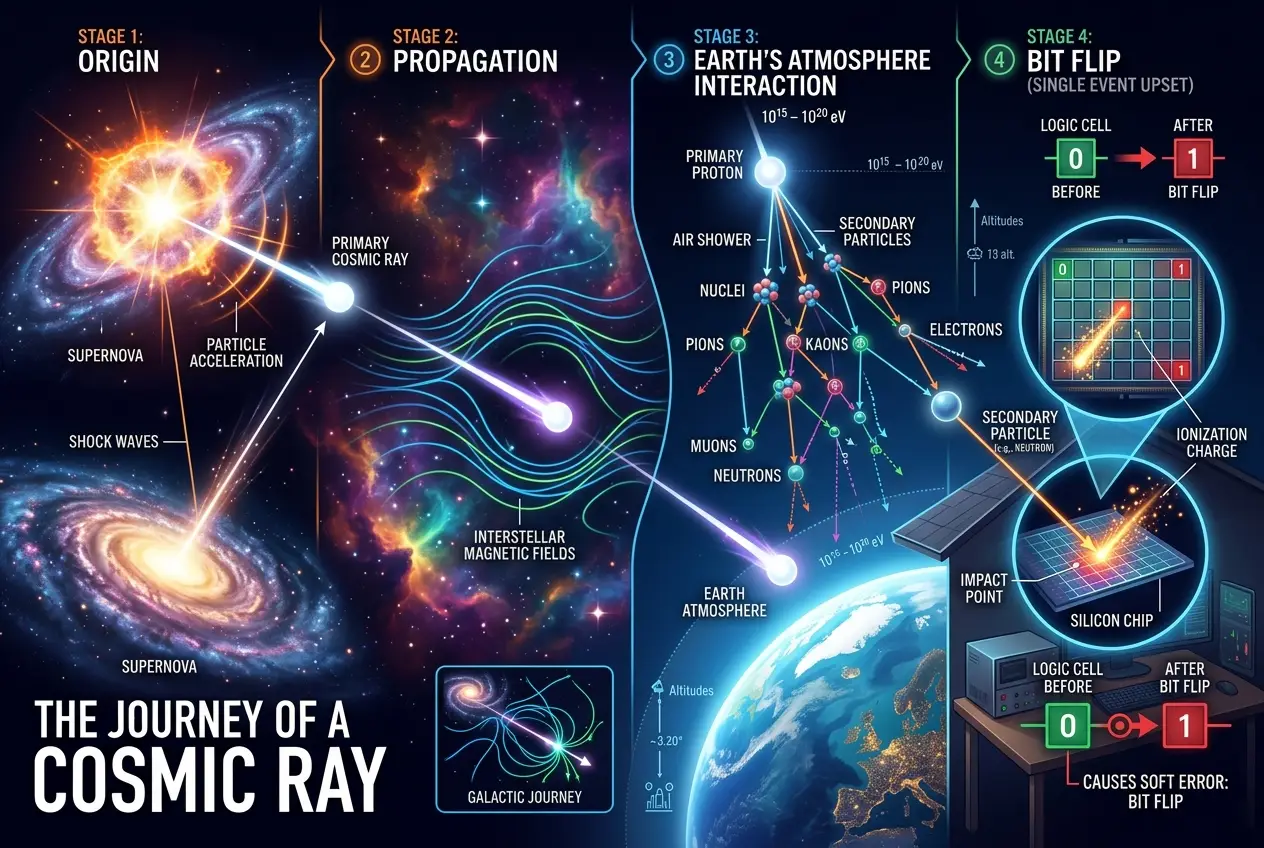
Our world is bathed in an invisible, constant rain of high-energy particles originating from deep space. These are **cosmic rays** – not "rays" in the traditional sense, but atomic nuclei (mostly protons) and electrons accelerated to incredible speeds, often approaching the speed of light. They burst forth from violent cosmic events like supernovae, active galactic nuclei, and even the sun during solar flares.
When these primary cosmic rays hurtle towards Earth, they collide with atoms in our upper atmosphere, creating a cascade of secondary particles – muons, neutrons, electrons, and photons – that shower down to the surface. Most of us are completely unaware of this phenomenon, yet it’s a fundamental aspect of our existence, shaping everything from atmospheric chemistry to potentially, the very integrity of our digital world. Want to know more about the protective shield of Earth and how it might affect us? Check out our article on [how Earth's magnetic field might affect our minds](/blogs/does-earths-magnetic-field-affect-our-minds-6923).
**The Silent Sabotage: How Cosmic Rays Glitch Our Tech**
The concept of a tiny, invisible particle from outer space causing your computer to crash or your data to corrupt sounds like science fiction. Yet, it's a well-documented phenomenon known as a **single event upset (SEU)**, or more commonly, a **soft error**. Unlike "hard errors" which are permanent physical damage to hardware, soft errors are transient, non-destructive changes to the state of a memory cell or logic circuit.
Here’s how it works:
When a high-energy secondary cosmic ray particle (especially a neutron or a muon) strikes a semiconductor device, it can deposit enough energy to flip the state of an individual bit. Imagine a memory cell designed to hold a '0' or a '1'. If a cosmic ray particle hits it, the electrical charge in that cell might momentarily shift, causing the '0' to become a '1' or vice-versa. This isn't damage; it's a temporary alteration of data, a **bit flip**.
> "Cosmic rays are not merely a curiosity for physicists; they are a persistent, albeit subtle, challenge for electronics engineers in our increasingly digital world." - *Attributed to discussions within the IEEE Transactions on Nuclear Science community.*
These soft errors are particularly problematic in devices with high-density memory chips and smaller transistor sizes. As technology advances, transistors shrink, and the voltage used to represent a '0' or '1' decreases. This makes them more susceptible to the tiny energy packets delivered by cosmic rays. A less energetic particle is needed to cause a bit flip in a smaller, lower-power transistor. This implies that as we push the boundaries of miniaturization, our devices might become inherently more vulnerable.
**Real-World Reverberations: From Space to Your Pocket**
While it might seem niche, the impact of cosmic ray-induced soft errors is far-reaching:
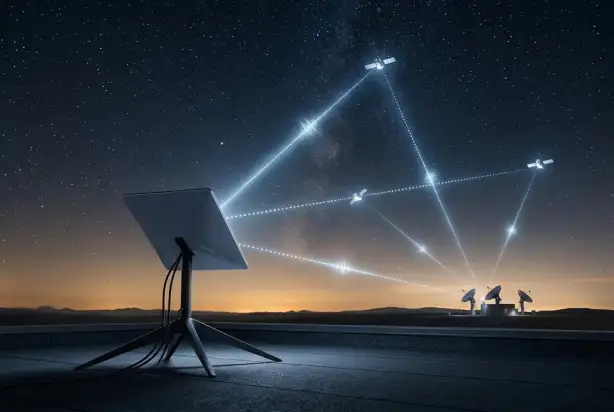
1. **Spacecraft and Satellites:** This is where SEUs were first identified and extensively studied. Satellites operating outside Earth’s protective atmosphere and magnetic field are highly exposed to primary cosmic rays. A single bit flip in critical guidance systems, communication arrays, or scientific instruments can lead to anything from corrupted data to complete system malfunction. Engineers design radiation-hardened components for space missions, incorporating error-correcting codes and redundant systems to mitigate these risks. For more on anomalies in space, you might find our blog on [decoding the Fermi paradox](/blogs/why-is-the-universe-so-quiet-decoding-the-fermi-paradox-5418) interesting.
2. **Data Centers and Servers:** Think about the massive data centers powering the internet, cloud computing, and AI systems. Thousands upon thousands of memory chips are constantly processing and storing vast amounts of data. While Earth's atmosphere filters out most primary cosmic rays, enough secondary particles reach ground level to cause occasional bit flips in these systems. For a massive server farm, even a rare event can lead to data corruption, software crashes, or unexpected reboots. Google famously reported in 2003 that soft errors were indeed occurring in their ground-based servers, leading to system crashes and silent data corruption. This highlights a subtle type of "digital ghost" that can plague our systems, as discussed in our piece on [phantom signals: does our tech create digital ghosts?](/blogs/phantom-signals-does-our-tech-create-digital-ghosts-3531).
3. **Autonomous Vehicles:** As cars become increasingly reliant on complex electronics for navigation, safety, and control, the integrity of their data becomes paramount. A bit flip in a sensor reading or a decision-making algorithm could have catastrophic consequences. The automotive industry is increasingly aware of this, incorporating robust error detection and correction mechanisms.
4. **Consumer Electronics:** Yes, even your smartphone, laptop, or smart home device isn't entirely immune. While the probability of a noticeable, critical error is low for individual devices due to various error correction mechanisms and the sheer redundancy of modern systems, it’s not zero. The occasional inexplicable freeze, crash, or data anomaly might just be a cosmic ray saying hello.
**The Invisible Threat and Our Defenses**
Understanding cosmic rays and their interaction with electronics is crucial for designing reliable technology. Engineers employ several strategies:
* **Error-Correcting Codes (ECC) Memory:** This is a common solution, especially in servers and high-reliability systems. ECC memory uses extra bits to detect and correct single-bit errors. If a cosmic ray flips one bit, the ECC mechanism can often detect it and restore the correct value.
* **Redundancy:** Implementing multiple identical components or computing units and comparing their outputs can help identify and disregard erroneous results caused by SEUs.
* **Radiation Hardening:** For highly critical systems, particularly in space, components are manufactured using specialized materials and designs that are less susceptible to radiation effects.
* **Shielding:** While not always practical or effective against high-energy particles, some level of shielding can reduce exposure.
* **Software Mitigation:** Operating systems and applications can be designed to include checks and balances, validating data integrity at various stages and recovering from minor corruption.
The constant push for faster, smaller, and more energy-efficient electronics makes future devices potentially even more vulnerable. As we contemplate how [AI might design its own evolution](/blogs/can-ai-design-its-own-evolution-decoding-future-machines-4579), the resilience of such advanced systems against these subtle cosmic influences will be a critical design challenge. Some scientists even ponder if such fundamental cosmic interactions could hint at a deeper, underlying structure, making one wonder if [the universe itself is a giant neural network](/blogs/is-the-universe-a-giant-neural-network-2907).
**A Silent Reminder of Our Cosmic Connection**
The fact that particles from dying stars or distant galaxies can subtly alter the data on our laptops is a profound reminder of our cosmic connection. It highlights that even in our most advanced technological creations, we are never truly isolated from the grand, dynamic processes of the universe. It's not just about theoretical physics; it's about the everyday reality of our interconnected digital lives.
So, the next time your computer acts a little strange, or a digital anomaly pops up, remember the invisible rain. It might just be a whisper from the cosmos, a tiny particle that traveled light-years just to flip a single bit on your screen. It's a humbling thought, affirming that even our cutting-edge tech exists within a much larger, more mysterious cosmic canvas.
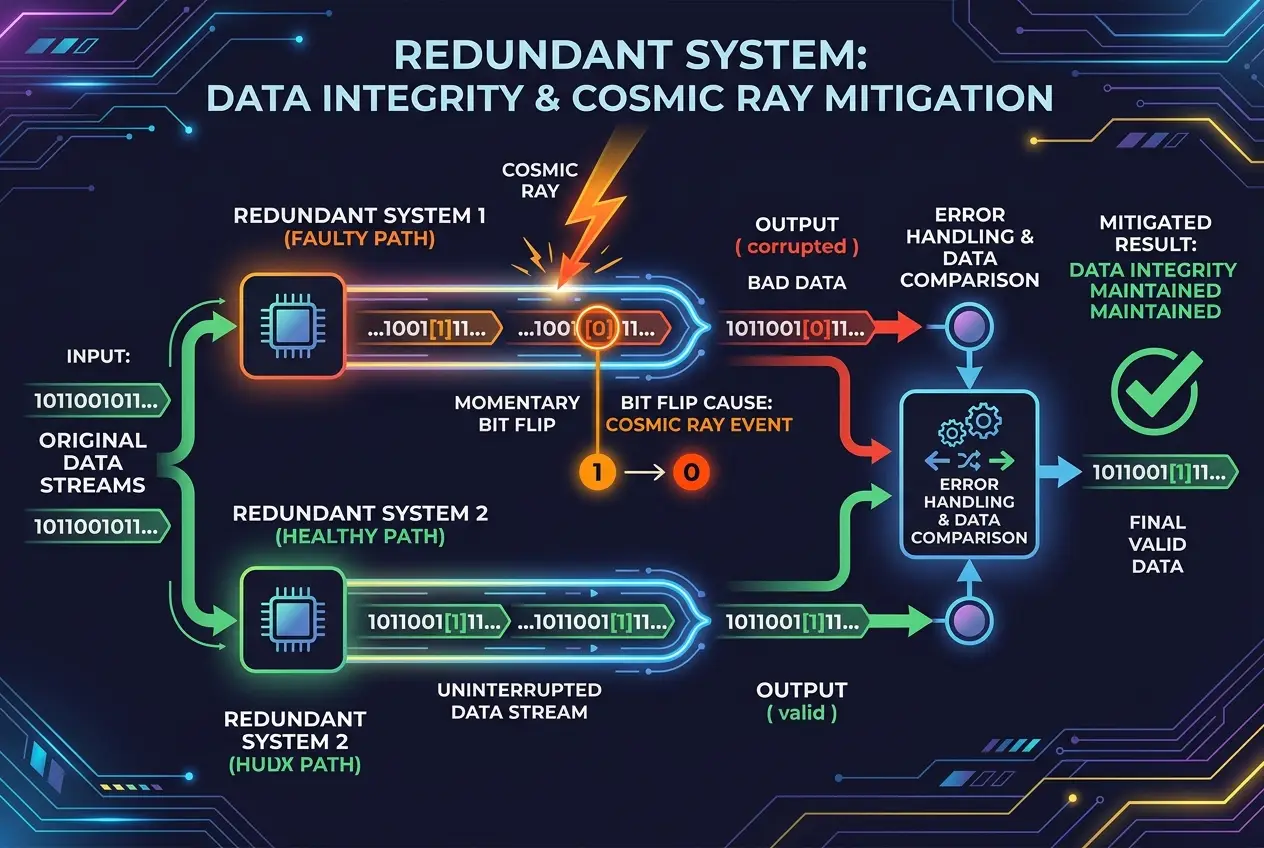
The challenge remains for engineers and scientists to continue developing resilient systems, ensuring that this relentless cosmic drizzle doesn’t disrupt the intricate dance of our digital future. After all, the reliability of our data is becoming increasingly central to our civilization, and understanding threats from the smallest and largest scales is paramount.
Frequently Asked Questions
A soft error (or Single Event Upset, SEU) is a transient, non-destructive change in the state of a memory cell or logic circuit, typically caused by a high-energy particle like a cosmic ray. Unlike a hard error, it doesn't permanently damage the hardware; it just flips a bit of data.
While cosmic rays are energetic, the Earth's atmosphere and magnetic field provide significant shielding, protecting life on the surface. While some radiation reaches us, it's generally not considered harmful in daily life. Their impact is primarily on highly sensitive microelectronics.
While the probability of a single cosmic ray causing a noticeable, critical error in a consumer device is relatively low, it’s not zero. Modern devices often have built-in error correction. In aggregate, across billions of devices globally, these events happen constantly, though most go unnoticed or are self-corrected.
Devices with high-density memory chips, smaller transistor sizes, and those operating outside Earth's protective atmosphere (like satellites and spacecraft) are most vulnerable. Servers and data centers are also at higher risk due to their vast number of sensitive components running continuously.
Engineers use several methods, including Error-Correcting Code (ECC) memory, system redundancy (having backup components), radiation-hardened components for critical applications, and robust software algorithms that validate data integrity and recover from minor corruptions.
Verified Expert
Alex Rivers
A professional researcher since age twelve, I delve into mysteries and ignite curiosity by presenting an array of compelling possibilities. I will heighten your curiosity, but by the end, you will possess profound knowledge.
Leave a Reply
Comments (0)
No approved comments yet. Be the first to share your thoughts!
 Join Us




 Unknown Author
































Leave a Reply
Comments (0)