


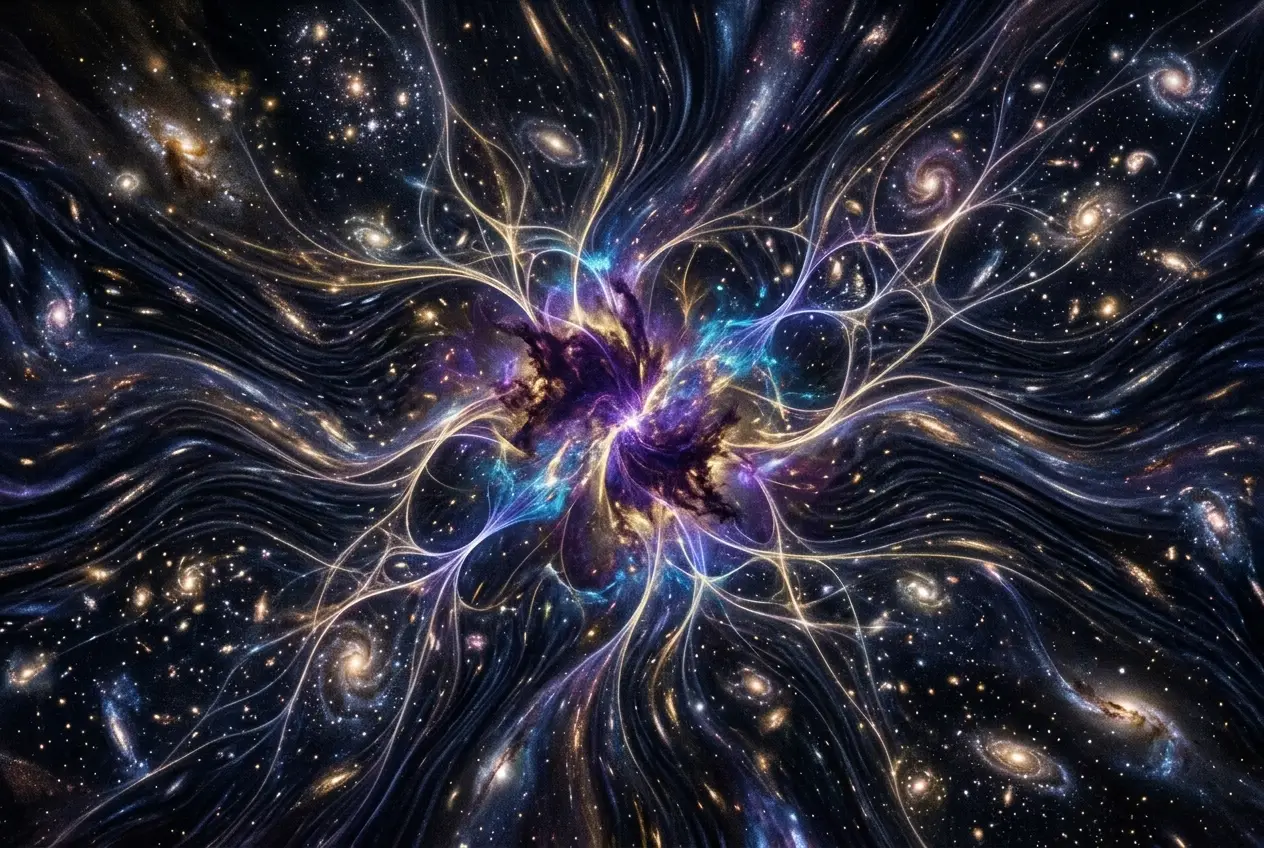
I was recently pondering the vast, mysterious stretches of our universe, and something struck me. We're constantly trying to map its visible structures – galaxies, nebulae, star clusters. But what about the invisible forces? The ones pulling and pushing at the very fabric of reality? It's like trying to understand an ocean by only observing its waves, without acknowledging the deep, unseen currents below. One of these currents, the most enigmatic of all, is dark energy. And it led me down a rabbit hole: could this colossal, invisible force be secretly weaving the universe's ultimate shortcuts – cosmic wormholes?
It's a question that sounds ripped straight from a science fiction novel, yet it touches upon some of the most profound mysteries in modern astrophysics. Dark energy, the invisible hand accelerating the expansion of our universe, and wormholes, theoretical tunnels through spacetime, both challenge our fundamental understanding of reality. Could they, perhaps, be connected in a way we've only just begun to imagine?
The Universe's Greatest Enigma: Dark Energy
To even begin to unravel this connection, we first need to understand what we mean by "dark energy." Imagine peering into the night sky, observing distant galaxies. For decades, astronomers believed that the gravitational pull of all matter in the universe would gradually slow down its expansion, much like a ball thrown upwards eventually slows due to Earth's gravity. However, in the late 1990s, groundbreaking observations of distant supernovae revealed something entirely unexpected: the universe's expansion isn't slowing down; it's speeding up.
This acceleration implies the existence of a mysterious force counteracting gravity, pushing everything apart. Scientists named this elusive entity dark energy. It's thought to comprise about 68% of the total energy density of the universe, dwarfing ordinary matter and dark matter combined. Despite its dominance, we know remarkably little about it. Is it a property of space itself, a constant energy density known as the cosmological constant? Or is it a dynamic field, a kind of "quintessence" that changes over time? The answers remain frustratingly out of reach, but its effects are undeniable. Its anti-gravitational nature is what makes it so fascinating in the context of wormholes. You can learn more about its profound impact on cosmology on its Wikipedia page (opens in a new tab).
Wormholes: Shortcuts Through Spacetime
Now, let's talk about wormholes. The concept of a wormhole first emerged from Albert Einstein's theory of General Relativity, specifically from a solution to its equations proposed by Einstein and Nathan Rosen in 1935, leading to the term "Einstein-Rosen bridge." Imagine our universe as a vast, flat sheet. To get from point A to point B, you'd usually travel across the surface. A wormhole, however, would be like folding that sheet, bringing A and B together, and punching a hole directly through, creating a shortcut.
These theoretical tunnels could connect two different points in spacetime, potentially linking distant regions of the universe, different universes, or even different points in time. The allure of instantaneous interstellar travel, bypassing light-years of cosmic distance, is incredibly powerful. However, there's a catch, and it's a big one. For a wormhole to be traversable – stable enough and wide enough for anything to pass through – it would require something truly extraordinary: exotic matter. This isn't just unusual matter; it's matter with negative energy density, violating known energy conditions. This negative energy would essentially prop open the wormhole, preventing it from collapsing in on itself.
"Space-time tells matter how to move; matter tells space-time how to curve." — John Wheeler, paraphrasing Einstein. This fundamental principle underscores the challenge: to curve spacetime into a stable wormhole, you need specific, often extreme, conditions of matter and energy. For a deeper dive into these theoretical structures, consult the Wormhole entry on Wikipedia (opens in a new tab).
The Intriguing Intersection: Dark Energy and Wormholes
This is where the speculation gets truly exciting. If dark energy is indeed a form of negative pressure, acting as an anti-gravitational force, could it somehow provide the exotic matter, or at least the conditions, necessary for wormholes to exist or even form naturally?
Think about it:
- Negative Pressure: Dark energy is characterized by negative pressure, which gives it its repulsive gravitational effect. This negative pressure bears a striking conceptual resemblance to the negative energy density required to stabilize a traversable wormhole. Could the very force accelerating the universe also be the key ingredient for cosmic shortcuts?
- Stretching Spacetime: Dark energy is continuously stretching the fabric of spacetime on cosmological scales. In regions where this expansion is extreme or localized fluctuations occur, could it create areas of intense curvature that might spontaneously fold in on themselves, forming embryonic wormholes?
- Cosmic Scaffolding: Some theoretical models propose that dark energy isn't uniform but might have localized variations or textures. These variations could, in principle, create complex structures within spacetime, acting as a kind of "scaffolding" that could facilitate wormhole formation or stabilization. For example, if dark energy can also warp our sense of time, as explored in "Does Dark Energy Warp Our Sense of Time?", its effects on spacetime could be even more profound, potentially including the generation of wormhole-like structures.
This isn't to say dark energy is exotic matter. They are distinct concepts. However, the repulsive nature of dark energy offers a tantalizing possibility that its properties might somehow alleviate the exotic matter requirement for wormholes, or at least play a critical role in their formation. The mathematical frameworks of General Relativity, on which these ideas are built, allow for such theoretical possibilities, but translating them into observable phenomena is the ultimate hurdle. You can delve into the foundational theory that underpins these concepts by reading about General Relativity on Wikipedia (opens in a new tab).
The Quest for Evidence and the Challenges
The biggest challenge, of course, is the lack of any observational evidence for wormholes. Even if dark energy could create or stabilize them, how would we find them?
- Gravitational Lensing Anomalies: Wormholes, like black holes, would severely warp spacetime. Scientists might look for unusual patterns in gravitational lensing – where the gravity of massive objects bends light from background sources – that can't be explained by known cosmic structures.
- Exotic Signatures: If a wormhole were traversable, matter or radiation passing through it could emit unique signatures. However, detecting these across interstellar distances would be incredibly difficult.
- Instability: Even with a theoretical source of negative energy from dark energy, the stability of such wormholes remains a huge problem. Most theoretical wormholes are incredibly fragile, collapsing at the slightest disturbance, making them unsuitable for any kind of passage.
The search for such anomalies continues. While the universe offers many curious phenomena, evidence for traversable wormholes remains firmly in the realm of theoretical physics. However, the ongoing quest to understand dark energy, which itself is a cosmic anomaly, might one day lead us to unexpected revelations about the very fabric of our reality. The journey into understanding faster-than-light travel, even through theoretical means like wormholes, continues to fascinate, much like the debate surrounding do-tachyons-exist-decoding-faster-than-light-travel-4797.
A Gateway to New Realities?
If dark energy were indeed weaving wormholes across the cosmos, the implications would be staggering.
- Interstellar Travel: The dream of reaching distant star systems in a human lifetime could become a reality, revolutionizing space exploration and potentially ushering in an era of galactic colonization.
- Intergalactic Communication: Instantaneous communication across billions of light-years would transform our understanding of the universe and our place within it.
- New Physics: Such a discovery would fundamentally rewrite our physics textbooks, providing unprecedented insights into the nature of spacetime, gravity, and the enigmatic dark energy itself. It might even reveal hidden dimensions, a concept explored in
decoding-reality-does-the-universe-hide-extra-dimensions-5269, making wormholes simply connections through these higher-dimensional pathways.
Consider the profound implications; if such cosmic shortcuts exist, the universe becomes a much smaller, more accessible place. It would change our perception of distance, time, and perhaps even the possibilities for life beyond Earth. Black holes, for all their destructive power, are also extreme examples of spacetime curvature, and their study, as discussed in black-holes-are-they-natures-ultimate-quantum-computers-5819, often provides insights into other exotic spacetime phenomena.
Conclusion
The idea that dark energy could be creating cosmic wormholes remains a tantalizing hypothesis, a frontier where the known universe meets the edges of theoretical possibility. It’s a testament to the immense unknowns that still permeate our understanding of the cosmos. While definitive proof is nowhere in sight, the very existence of such questions pushes the boundaries of our scientific inquiry, driving us to look deeper, to question harder, and to dream bigger. As we continue to probe the mysteries of dark energy, perhaps one day, we'll find that the force pushing galaxies apart is also the architect of the universe's most incredible shortcuts.
Conversation0
No comments yet. Be the first to share a thought — the best questions often become new stories.