


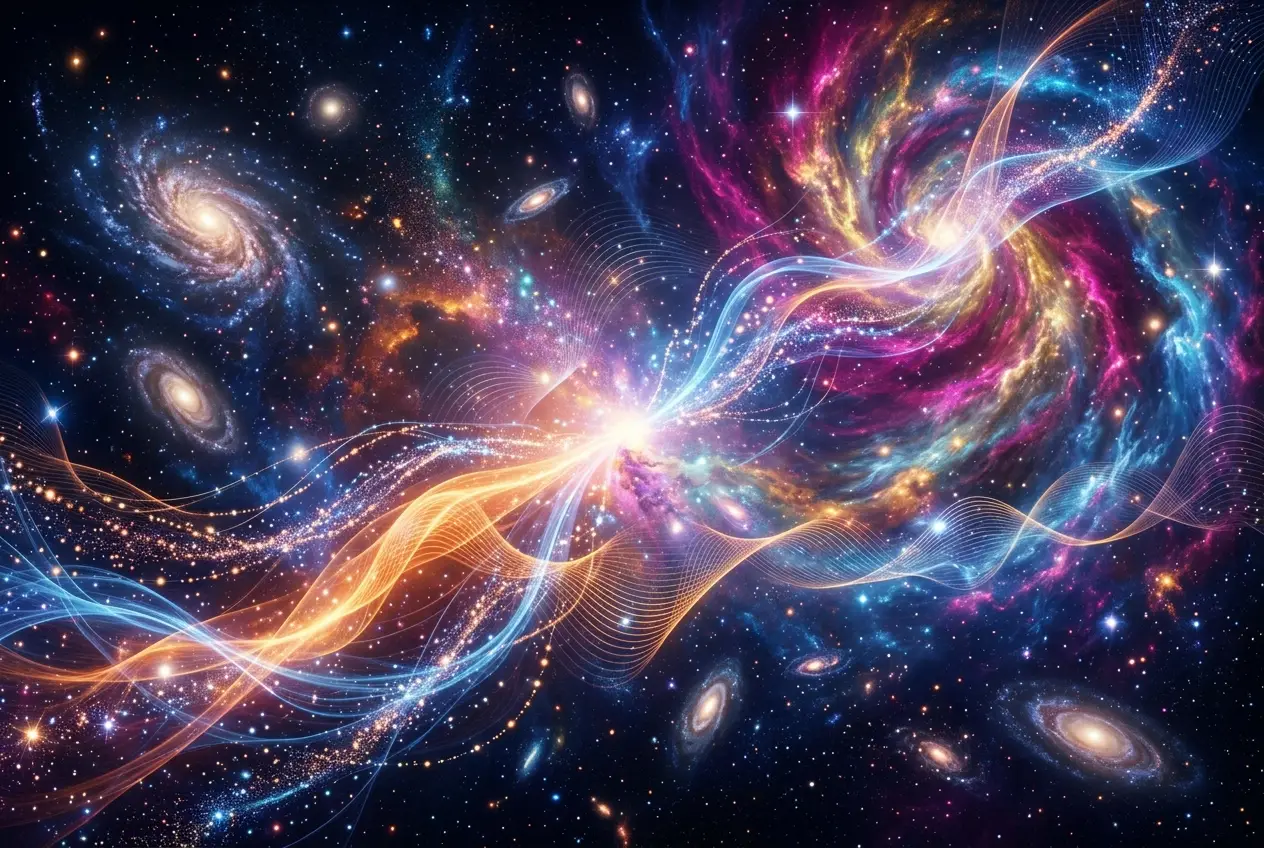
Have you ever gazed up at the night sky and felt a profound sense of connection to something vast and unknowable? I certainly have. That sparkling tapestry of stars, galaxies, and nebulae isn't just a pretty picture; it's a dynamic, living canvas constantly broadcasting information across unimaginable distances. For centuries, humanity has sought to understand these celestial messages, from ancient stargazers charting constellations to modern scientists analyzing radio waves. But what if the universe isn’t just sending out random signals? What if, embedded within the very fabric of light itself, there’s a secret language, a cosmic dialect awaiting our decipherment?
This isn't a flight of fancy born from science fiction; it’s a question that increasingly captivates physicists, astronomers, and information theorists. The universe is a grand orchestra of energy, and light – in all its forms across the electromagnetic spectrum – is its primary messenger. From the gentle glow of ancient starlight reaching our eyes to the powerful bursts of gamma-rays, every photon carries a payload of information about its origin, journey, and the fundamental laws governing its existence. Unpacking this "language" could redefine our understanding of existence, technology, and perhaps, even life beyond Earth.
The Electromagnetic Spectrum: A Universal Alphabet
Before we dive deeper into the idea of a cosmic language, let's appreciate its medium: the electromagnetic spectrum. It’s a vast range of radiation, from long radio waves that can travel billions of light-years, to microwaves, infrared, visible light, ultraviolet, X-rays, and ultra-energetic gamma-rays. Each segment of this spectrum acts like a different "tone" or "letter" in the universe’s immense alphabet, conveying distinct types of information.
When I observe the cosmos, I see these different forms of light telling different stories. Radio waves might reveal cold, dense gas clouds where new stars are forming, while X-rays could expose superheated gas swirling around a black hole. Visible light, the tiny sliver our eyes can perceive, paints galaxies in their majestic hues. Understanding this spectrum is our first step in comprehending cosmic messages.
Astronomers use specialized telescopes to "listen" to these different parts of the spectrum. Radio telescopes, for example, are gigantic dishes designed to capture faint radio signals from deep space, allowing us to peer through cosmic dust clouds that block visible light. This multi-spectral approach is crucial, as each wavelength reveals a different layer of universal truth. For a deeper dive into how we might pick up faint echoes, you might find our previous discussion on whether our devices are hiding alien echoes insightful.
Pulsars, Quasars, and Fast Radio Bursts: Cosmic Transmitters?
Beyond the general emission of light, certain astrophysical phenomena act like cosmic lighthouses or even rapid-fire telegraphs.
Pulsars: These rapidly rotating neutron stars emit beams of electromagnetic radiation that sweep past Earth like a lighthouse beam. Their regularity is so precise that they were once considered potential candidates for alien communication signals. The rhythmic pulses themselves carry information – their timing, intensity, and spectral properties tell us about the pulsar's mass, rotation rate, and magnetic field.
Quasars: The incredibly luminous cores of distant galaxies, powered by supermassive black holes, are among the brightest objects in the universe. They blast out immense amounts of energy across the spectrum, acting as powerful beacons that allow us to study the early universe. While not "coded" in an obvious sense, their emissions are rich in spectroscopic data, revealing the chemical composition and velocities of matter billions of years ago.
Fast Radio Bursts (FRBs): These are perhaps the most enigmatic of cosmic signals. As discussed in our post on decoding cosmic enigmas, FRBs are transient radio pulses lasting only a few milliseconds, originating from distant galaxies. Their extreme brightness and short duration are baffling. While many scientists believe they are natural phenomena (perhaps from magnetars or colliding black holes), their precise, repeatable nature for some sources has led to speculation about their potential artificial origin. Could they be short, coded messages, or perhaps unintended byproducts of advanced alien technology, much like radar pings from Earth?
Universal Constants and the Fabric of Reality
If light is a language, what constitutes its grammar and vocabulary? Many believe the answer lies in the fundamental physical constants of the universe. The speed of light (c), Planck's constant (h), the gravitational constant (G), and the charge of an electron (e) are some examples. These constants define the very laws of physics, remaining consistent across the observable universe.
Imagine an advanced civilization attempting to communicate. They wouldn't send messages in English or binary, but in terms of universal truths. For instance, they might encode information using the ratios of fundamental constants, or by manipulating quantum properties of light in ways we are only beginning to comprehend. This idea suggests that the "language" isn't about specific words, but about embedded patterns and relationships that reveal the universe's intrinsic nature. As Nobel laureate Richard Feynman once quipped, "The first principle is that you must not fool yourself – and you are the easiest person to fool." This applies to interpreting cosmic signals; we must differentiate between natural patterns and deliberate communication.
Quantum Light: A Deeper Level of Communication?
Beyond classical electromagnetic waves, the quantum nature of light offers even more profound possibilities for a cosmic language. Photons, the fundamental particles of light, possess quantum properties like spin and polarization that can be entangled. Quantum entanglement allows two particles to be linked in such a way that the state of one instantly affects the state of the other, regardless of distance.
Could this quantum entanglement be a basis for a truly universal, instantaneous form of communication? While entangled particles can't transmit information faster than light, their shared states could theoretically be used to encode information in a highly secure and robust manner. If alien civilizations are as advanced as some hypothesize, they might be leveraging such phenomena. Our exploration into quantum entanglement for interstellar communication dives into this very concept.
The implications of discovering such a quantum cosmic language would be staggering. It would suggest a level of technological sophistication far beyond our current capabilities and open new avenues for understanding the very structure of reality. Perhaps the universe isn't just a collection of random events, but a highly interconnected system, much like a giant neural network, where information is constantly being processed and exchanged.
Looking for Patterns: SETI and Beyond
The Search for Extraterrestrial Intelligence (SETI) has primarily focused on radio signals, listening for artificial patterns or narrow-band transmissions that stand out from natural cosmic noise. While this remains a vital endeavor, the concept of a "language of light" broadens our search significantly.
- Optical SETI (OSETI): This branch specifically looks for rapid, short pulses of visible light, potentially high-powered laser beacons from advanced civilizations. Such signals could be used for focused, directional communication over interstellar distances.
- Anomalous Light Signatures: What if alien technology leaves specific light signatures, not necessarily intentional messages, but observable byproducts? For instance, Dyson spheres or other megastructures might alter a star's light in detectable ways. Anomalies in exoplanet transits, as discussed in our piece Do Exoplanet Transits Hide Alien Tech?, could also hint at intelligent activity.
The challenge lies not just in detecting these signals, but in discerning if they are truly artificial or simply unusual natural phenomena. The universe is full of surprises, and what seems anomalous today might be explained by a new astrophysical mechanism tomorrow. We must remain open-minded yet rigorous in our scientific approach.
The Future of Cosmic Linguistics
Our quest to understand the universe's light-based language is still in its infancy. Advanced telescopes like the James Webb Space Telescope are already giving us unprecedented views into the early universe, allowing us to analyze light from billions of years ago with incredible detail. Future instruments, both ground-based and space-based, will push these boundaries even further.
Perhaps the "Rosetta Stone" for this cosmic language won't be a single signal, but an accumulation of data revealing consistent patterns that defy natural explanation. It might involve a new theory of information, one that goes beyond our current digital frameworks and embraces the inherent informational properties of quantum mechanics and spacetime itself.
I believe the universe is teeming with information, constantly communicating its secrets through the medium of light. Whether it's the fundamental constants etched into the spectrum of every star, the rhythmic dance of pulsars, or the cryptic flashes of FRBs, we are slowly learning to read its vast, luminous library. The journey to decode these cosmic whispers is one of humanity's grandest adventures, promising insights that could forever change our place in the cosmos.
Conclusion
The notion of light as the universe's secret language transforms our scientific pursuits into an epic quest for meaning. It urges us to look beyond simple detection and into the deeper informational structures embedded within cosmic phenomena. As our technological capabilities advance, so too does our potential to finally understand the profound messages written across the night sky, whispered through billions of years of light. The universe is talking; are we ready to listen and comprehend?





Conversation0
No comments yet. Be the first to share a thought — the best questions often become new stories.