I remember the first time I truly pondered the sheer scale of the universe. It wasn't looking through a telescope or reading a textbook; it was during a quiet evening, staring at the night sky, realizing that every pinprick of light represented something unimaginably vast and ancient. What if, I thought, among all those silent, shimmering stars, there were whispers we couldn't yet hear? Fast forward to today, and my thoughts often drift back to that feeling of profound wonder, especially when considering phenomena like **Fast Radio Bursts (FRBs)**. These are some of the most enigmatic and powerful signals in the cosmos, detected only fleetingly, yet carrying an energy that defies easy explanation.
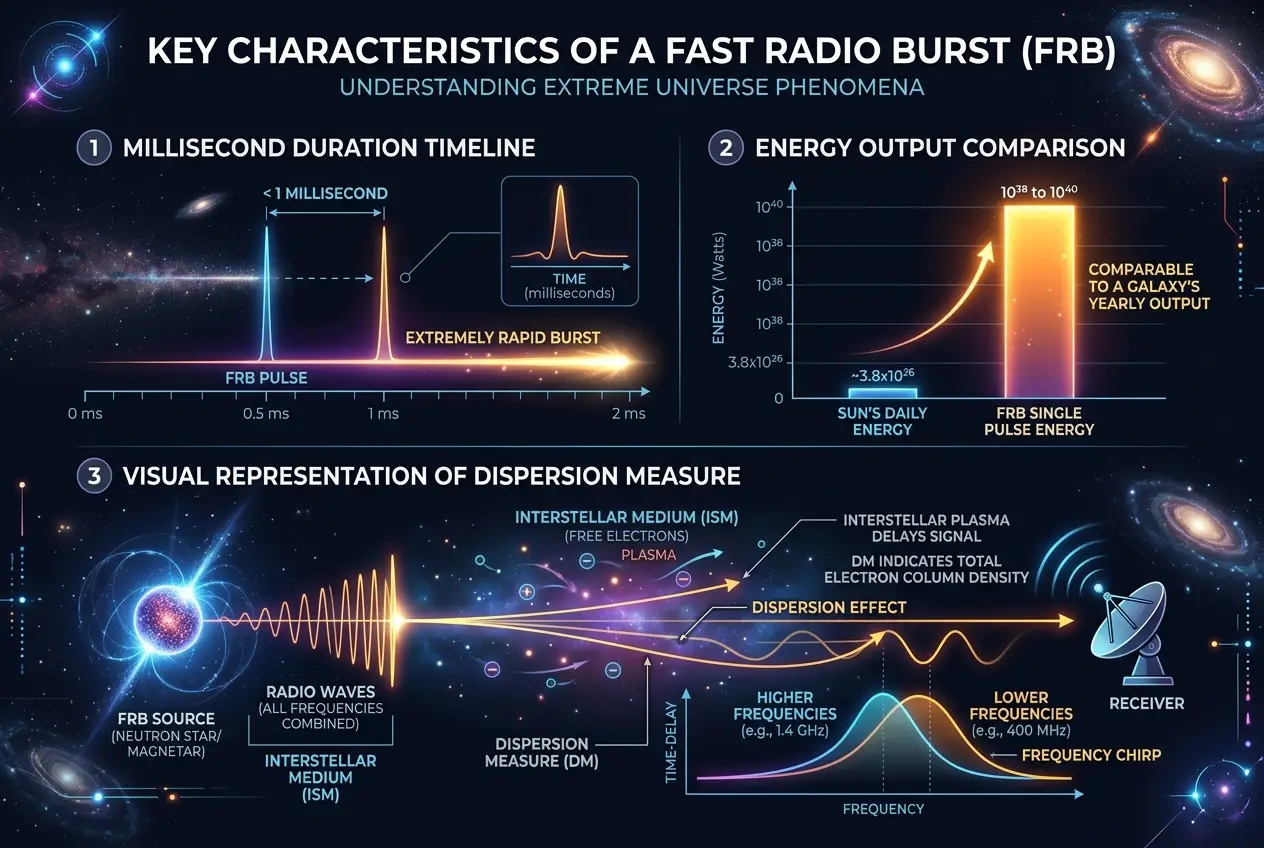
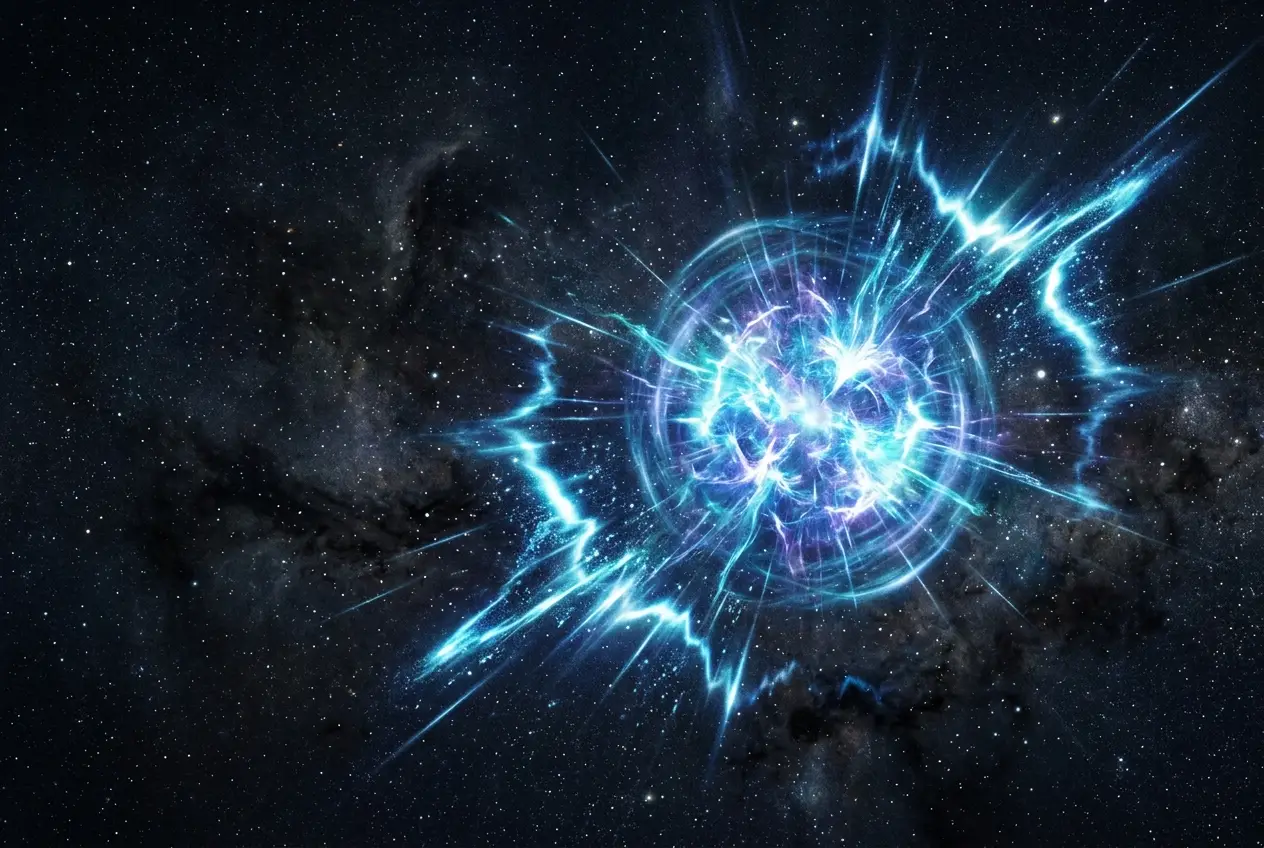
Imagine receiving a radio signal from a galaxy billions of light-years away. It’s not a steady hum, nor a rhythmic pulse. Instead, it’s a burst, lasting mere milliseconds – less time than it takes to blink. But in that minuscule fraction of a second, it outshines entire galaxies, packing more energy than our Sun produces in a full day. This is the bewildering reality of Fast Radio Bursts, cosmic riddles that have captivated astronomers and ignited our collective curiosity about the universe's most extreme events.
The Echoes of the Unknown: What Exactly Are FRBs?
Fast Radio Bursts are exactly what their name suggests: extremely brief, intense flashes of radio waves originating from distant astrophysical sources. The very first FRB, known as the **Lorimer Burst (FRB 010621)**, was actually discovered by accident in 2007, hidden within archival data from the Parkes Observatory in Australia. It was a single, powerful "blip" that stood out, prompting a decade-long quest to understand its nature. For a long time, the scientific community debated whether these were genuine cosmic phenomena or terrestrial interference, or even instrumental glitches. Today, thanks to advanced radio telescopes and repeated detections, we know they are very real and very much from beyond our galaxy.
One of the most crucial clues to their cosmic origins is their **dispersion measure (DM)**. When radio waves travel through space, they encounter free electrons in the interstellar and intergalactic medium. Higher frequency radio waves travel slightly faster than lower frequency waves. This means that a signal that started as a sharp, instantaneous burst arrives at Earth "smeared out" in time, with the high frequencies arriving first and the low frequencies lagging behind. The greater the distance the signal has traveled, the more pronounced this smearing effect. FRBs exhibit DMs far too large to originate from within our Milky Way galaxy, firmly placing their sources in distant galaxies, some even billions of light-years away. This "cosmic time delay" is like a stamp marking their incredible journey across the universe. For a deeper dive into how dispersion measure helps us map the cosmos, check out this [Wikipedia article on Dispersion Measure](https://en.wikipedia.org/wiki/Dispersion_measure).
Decoding the Signals: Repetitive vs. One-Off Bursts
Initially, all detected FRBs appeared to be one-off events, leading to theories involving catastrophic stellar explosions. However, the discovery of **FRB 121102** in 2014 changed everything: it was the first repeating FRB. This meant its source wasn't destroyed in the process, pointing towards a less cataclysmic origin. Since then, numerous other repeaters have been identified, including **FRB 180916.J0158+65**, which showed a curious 16-day periodicity, bursting for about four days, then going silent for 12, before resuming.
The existence of both repeating and non-repeating FRBs suggests there might be multiple types of sources, or perhaps a single class of objects capable of both types of behavior under different conditions. This bifurcation only adds to the mystery, compelling me to think about the different "flavors" of cosmic cataclysms or exotic stellar events that could be at play.
The Prime Suspects: Where Do FRBs Come From?
Pinpointing the exact mechanisms behind FRBs is one of the biggest challenges in modern astrophysics. The sheer energy involved, coupled with their extreme brevity, requires extraordinary phenomena. Here are some of the leading theories:
Magnetars: Cosmic Beacons of Unfathomable Power
Currently, **magnetars** are considered the most promising candidates for at least some FRBs, particularly the repeating ones. A magnetar is a type of neutron star, the super-dense remnant of a massive star that has collapsed. What sets magnetars apart is their incredibly powerful magnetic fields – hundreds or even thousands of times stronger than those of typical neutron stars, and quadrillions of times stronger than Earth’s magnetic field. Such immense magnetic stress can cause "starquakes" in the magnetar's crust, which can trigger powerful flares and bursts of radiation, including radio waves.
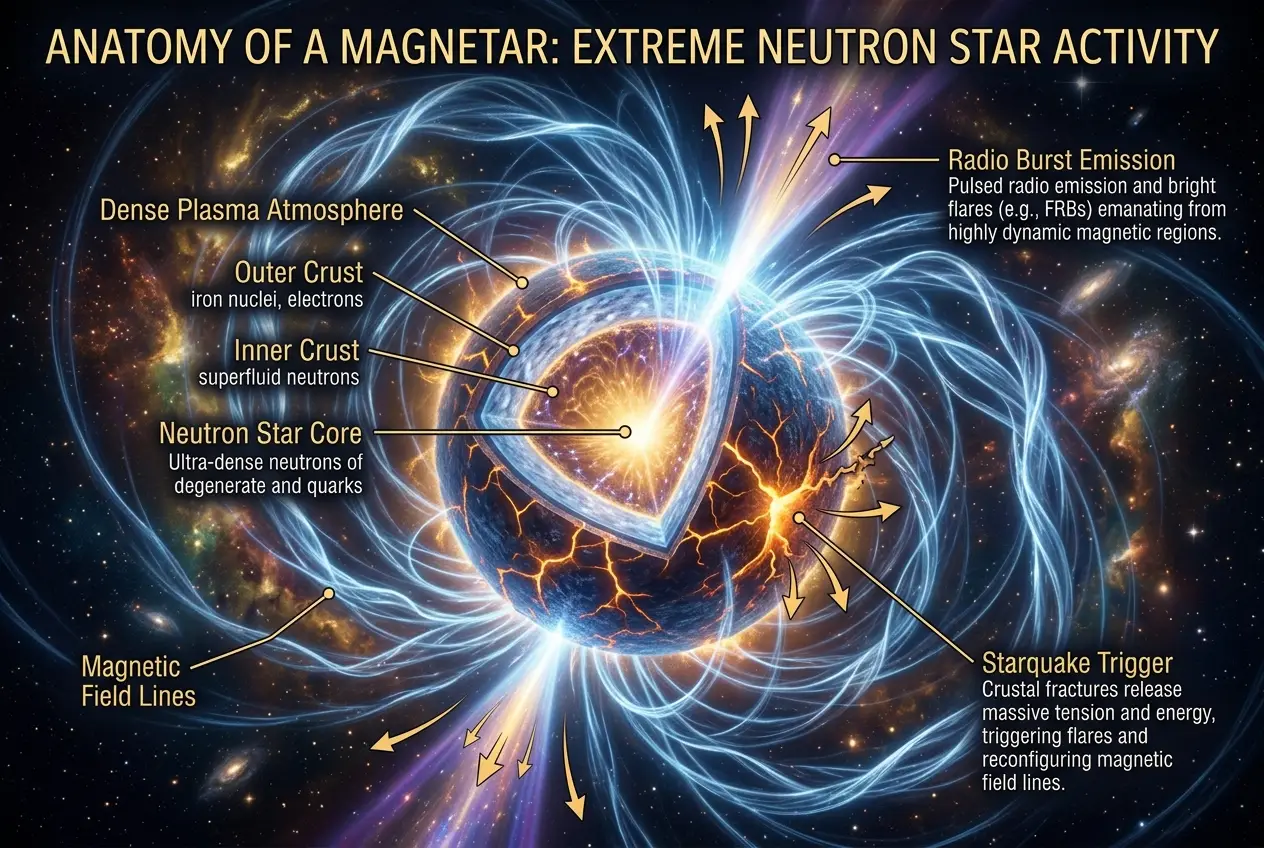
In 2020, astronomers detected an FRB-like burst from a magnetar within our own Milky Way galaxy, **SGR 1935+2154**. This discovery was a game-changer, providing direct observational evidence that magnetars *can* produce such intense radio flashes. While this burst wasn't as powerful as the extragalactic FRBs, it strongly supports the magnetar hypothesis, especially for repeaters. The extreme energy needed for the more distant FRBs would simply imply even more violent events on these distant magnetars. For more information on these fascinating objects, see the [Wikipedia page on Magnetars](https://en.wikipedia.org/wiki/Magnetar).
Other Contenders and Speculative Ideas
While magnetars hold the lead, scientists haven't ruled out other exotic possibilities for non-repeating FRBs:
* **Blitzars:** This is a hypothetical scenario where a rapidly spinning neutron star, too massive to sustain itself against gravitational collapse, eventually slows down enough to collapse into a black hole. This catastrophic event could release an enormous burst of energy.
* **Neutron Star Mergers:** The collision of two neutron stars is known to produce gravitational waves and kilonova explosions. It's plausible that such mergers could also generate powerful, short-lived radio bursts.
* **Black Hole Interactions:** While less favored now, early theories considered extreme events involving black holes, such as a black hole consuming a neutron star, or even the evaporation of primordial black holes.
* **The "Alien" Hypothesis:** It's almost impossible to talk about mysterious cosmic signals without addressing the possibility of **extraterrestrial intelligence**. While fascinating, most scientists view this as a last resort, preferring to explore natural astrophysical explanations first. The immense energy of FRBs, and their seemingly random nature (though some repeaters have patterns), make them an inefficient mode of communication for a civilization. However, I can't deny that the thought of such distant signals being a greeting from an advanced civilization still sparks the imagination. If you're curious about other potential alien tech, you might enjoy our article on "Are Dark Forests Hiding Alien Tech?" /blogs/are-dark-forests-hiding-alien-tech-2150.
The Hunt for FRBs: Our Cosmic Listening Posts
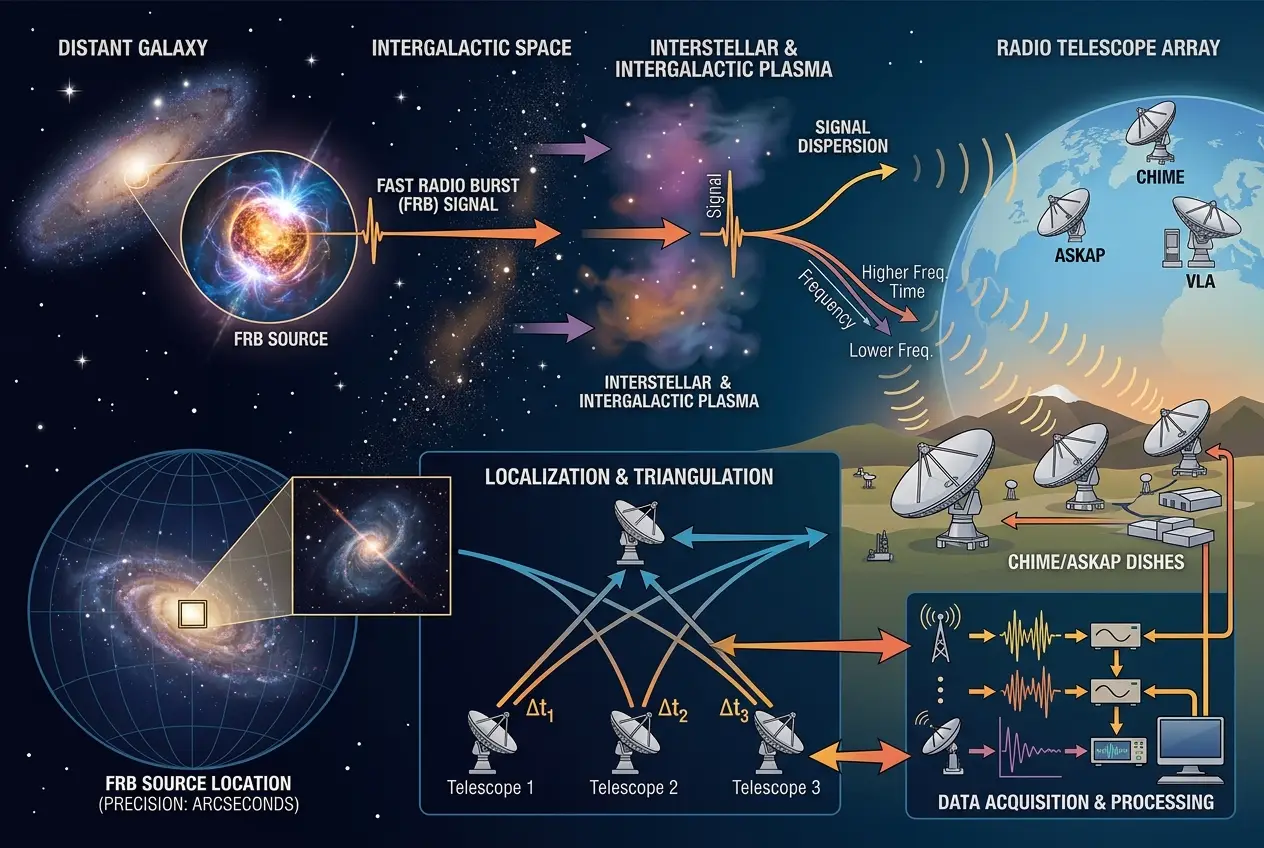
Detecting FRBs requires specialized instruments and a bit of luck. Radio telescopes are our ears to the universe, and arrays of these dishes are crucial for both detection and localization.
* **CHIME (Canadian Hydrogen Intensity Mapping Experiment):** Located in British Columbia, Canada, CHIME is a groundbreaking radio telescope that doesn't look like traditional dishes. It's a stationary cylindrical antenna array designed to survey a vast portion of the northern sky simultaneously. Its wide field of view and powerful processing capabilities have made it a prolific FRB detector, discovering hundreds of new bursts and numerous repeaters. Learn more about this innovative instrument on its [Wikipedia page](https://en.wikipedia.org/wiki/CHIME_(telescope)).
* **ASKAP (Australian Square Kilometre Array Pathfinder):** Located in Western Australia, ASKAP is another powerful array that has been instrumental in localizing FRBs to their host galaxies. By linking multiple dishes, astronomers can achieve very high angular resolution, allowing them to pinpoint the source of an FRB with incredible accuracy.
* **Arecibo Observatory (Puerto Rico):** Before its collapse, the iconic Arecibo telescope, with its enormous single dish, was responsible for discovering some of the earliest repeating FRBs, including FRB 121102.
Localizing an FRB is critical. Once we know *which* galaxy it comes from, astronomers can study that galaxy in detail, looking for potential host environments like dense star-forming regions or active galactic nuclei, which can provide further clues about the source. This ability to trace a signal back to its galactic home is a huge leap forward in understanding these transient events. We're slowly starting to decode the universe's hidden language. For a deeper look into how we decipher cosmic data, consider reading "Decoding Reality: Does the Universe Hide Extra Dimensions?" /blogs/decoding-reality-does-the-universe-hide-extra-dimensions-5269.
What Can FRBs Tell Us About Our Universe?
Beyond identifying their source, FRBs are proving to be invaluable cosmic probes. Their journey across billions of light-years allows us to study the vast, otherwise invisible spaces between galaxies:
* **Mapping the Intergalactic Medium:** The dispersion measure of FRBs directly depends on the amount of ionized gas (plasma) they travel through. By measuring the DMs of distant FRBs, scientists can estimate the density of the intergalactic medium, which is largely made up of "missing" baryonic matter that has been hard to account for.
* **Weighing the Universe:** FRBs could potentially help us refine measurements of the total amount of matter in the universe, providing insights into the cosmic web and the distribution of both normal and dark matter.
* **Probing Dark Energy:** By observing FRBs from different cosmic epochs, we might even gain new insights into the expansion rate of the universe and the mysterious dark energy that drives it.
* **Extreme Environments:** Understanding FRBs pushes the boundaries of our knowledge of extreme astrophysical conditions, revealing the physics of highly magnetized objects, neutron star mergers, and other energetic events that shape the cosmos. Sometimes, these cosmic events can even lead to stars disappearing, as explored in "Why Do Stars Vanish? Unpacking Cosmic Disappearances" /blogs/why-do-stars-vanish-unpacking-cosmic-disappearances-6442.
The Future of FRB Research
The field of FRB research is booming. New telescopes are being built, and existing ones are being upgraded to detect more bursts and with greater precision. Astronomers are eager to:
* **Increase Detections:** More FRBs mean more data, allowing for better statistical analysis and potentially revealing new classes of bursts or patterns.
* **Improve Localization:** Precisely locating more FRBs will lead to detailed studies of their host galaxies and environments, which is crucial for understanding their origins.
* **Multi-Messenger Astronomy:** Combining FRB observations with gravitational waves, neutrinos, and other electromagnetic signals could unlock entirely new insights into the most violent events in the universe. Imagine detecting an FRB simultaneously with a gravitational wave signal from a neutron star merger – that would be a monumental discovery!
The universe continues to unveil its secrets in spectacular fashion, and Fast Radio Bursts are undoubtedly one of its most intriguing recent revelations. These fleeting signals, traveling across cosmic distances, are not just mysterious flashes in the pan; they are powerful tools, helping us to map the invisible fabric of the cosmos and understand the most extreme physics at play.
As I look up at the night sky now, I don't just see distant stars; I imagine the silent, invisible radio waves, carrying messages of unimaginable power, waiting for us to tune in and truly listen. The quest to decode these cosmic enigmas is far from over, and with every new burst detected, we get a little closer to understanding the spectacular, tumultuous, and utterly fascinating universe we inhabit. Stay curious, because the universe always has another secret to share.
Frequently Asked Questions
FRBs are mysterious primarily because of their extreme brevity (milliseconds), immense energy output (outshining entire galaxies), and their distant extragalactic origins, making their precise source and mechanism hard to pinpoint despite various theories.
No, not all FRBs are the same. Astronomers have identified both 'one-off' FRBs, which burst once and are never seen again, and 'repeating' FRBs, which burst multiple times from the same source. This suggests there might be different mechanisms or types of sources at play.
While the idea of alien signals is captivating and often raised due to their mysterious nature, most scientists consider it highly unlikely. The immense energy of FRBs makes them an inefficient and impractical means of communication for an advanced civilization. Current research focuses on natural astrophysical phenomena like magnetars.
Scientists detect FRBs using large radio telescopes and arrays, like CHIME and ASKAP, which constantly scan vast areas of the sky. Sophisticated computer algorithms analyze the enormous amounts of data to identify these fleeting signals, often by looking for the characteristic 'dispersion measure' that indicates their cosmic origin.
Studying FRBs can provide invaluable insights into the universe's composition, including mapping the distribution of 'missing' baryonic matter in the intergalactic medium, refining measurements of cosmic distances, and probing the extreme physics of highly magnetized neutron stars and other energetic cosmic events.
Verified Expert
Alex Rivers
A professional researcher since age twelve, I delve into mysteries and ignite curiosity by presenting an array of compelling possibilities. I will heighten your curiosity, but by the end, you will possess profound knowledge.
Leave a Reply
Comments (0)
No approved comments yet. Be the first to share your thoughts!
 Join Us


 Unknown Author























Leave a Reply
Comments (0)