


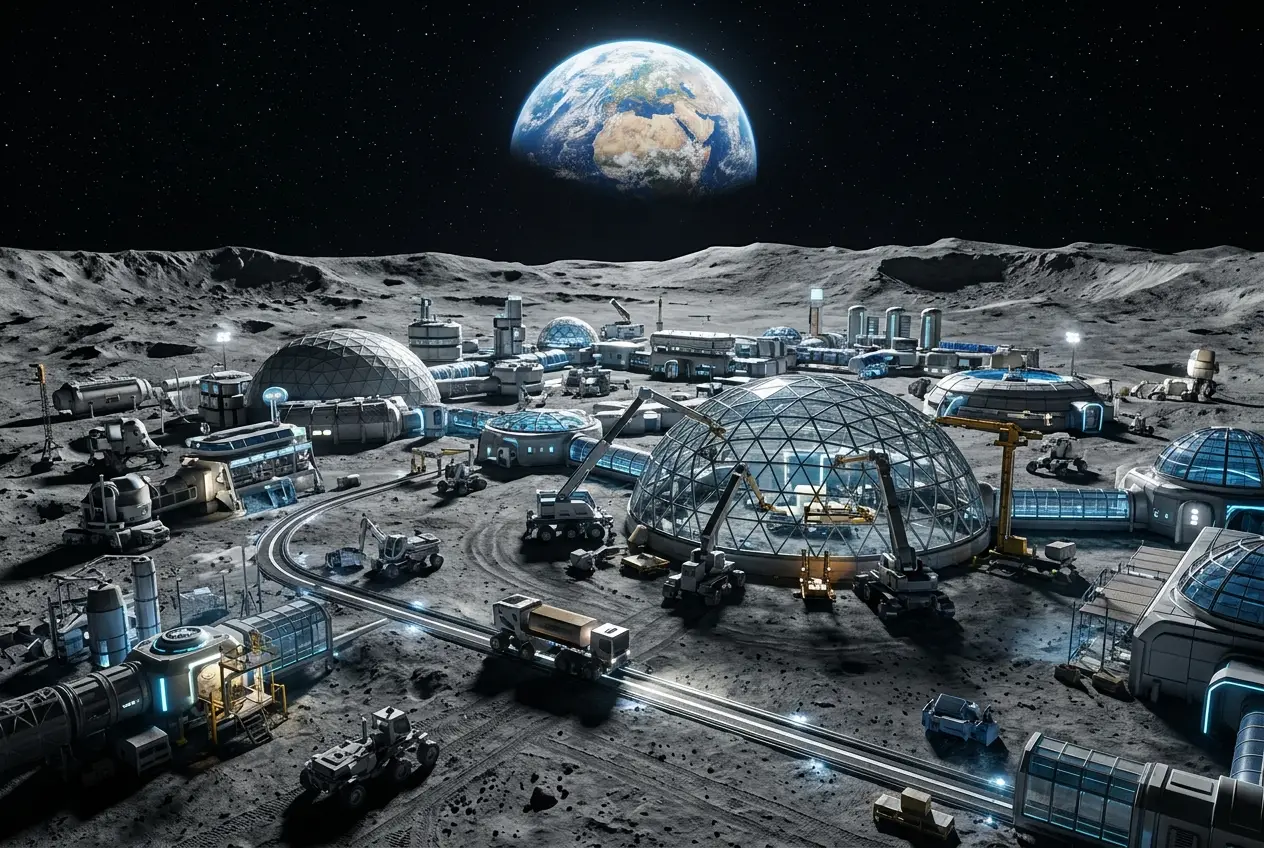
The dream of humans living on the Moon has captivated us for generations. From science fiction novels to ambitious space agency proposals, the idea of a lunar outpost, perhaps even a full-fledged city, has always felt just on the horizon. But how do we get there? The challenges are monumental: harsh radiation, extreme temperatures, zero atmosphere, and the sheer logistical nightmare of transporting all necessary materials and personnel from Earth. For a long time, these obstacles seemed almost insurmountable.
Recently, however, I've been pondering a game-changer – Artificial Intelligence. What if the very brains behind our digital revolution could also be the architects and builders of our off-world future? The thought isn't just a fantasy anymore; it’s rapidly becoming a focal point for space agencies and private companies alike. Imagine a swarm of highly intelligent, autonomous robots, guided by advanced AI, working tirelessly on the lunar surface, transforming regolith into habitable structures without a single human astronaut having to lift a heavy tool. It sounds like something out of a futuristic movie, yet the foundational technologies are being developed right now.
The Lunar Dream: More Than Just a Flag
Building a permanent human settlement on the Moon isn't just about planting a flag. It's about creating a sustainable home, a scientific research hub, and potentially a gateway for deeper space exploration. This necessitates not just shelters, but infrastructure: power generation, life support systems, communication networks, and manufacturing capabilities. The scope is enormous, pushing the boundaries of engineering, materials science, and, increasingly, artificial intelligence.
Historically, lunar missions have been characterized by incredibly complex, bespoke machinery operated by highly trained astronauts. The Apollo missions, while heroic, were short-duration forays, not construction projects. As we look towards sustained presence, the traditional model of human-led construction becomes impractical, if not impossible, due to cost, risk, and physiological limitations of working in a hostile environment. This is where AI truly shines.
AI as the Master Builder: From Design to Deployment
The role of AI in building a lunar city can be broken down into several critical phases, each presenting unique opportunities for automation and optimization.
1. Generative Design and Optimization
One of the most exciting applications of AI in lunar construction is generative design. Instead of human engineers painstakingly drawing up blueprints, AI algorithms can explore millions of design permutations based on specified parameters: structural integrity, thermal insulation, radiation shielding, material efficiency, and even aesthetic appeal. Given the unique challenges of the Moon – particularly the lack of atmosphere and significant radiation – traditional Earth-based designs simply won't cut it.
An AI can quickly iterate and optimize structures specifically for lunar conditions, finding novel shapes and material compositions that humans might never conceive. This could involve intricate lattice structures for minimal material use, or designs that naturally integrate with the existing topography. Companies like Autodesk are already leveraging generative design for complex engineering problems on Earth, and extending this to lunar habitats is a logical next step. Imagine an AI designing a self-sufficient dome that perfectly blends regolith-based 3D printing with inflatable modules for maximum efficiency and safety.
2. Autonomous Resource Utilization (ISRU)
The cost of transporting materials from Earth is prohibitive. A single kilogram of payload to the Moon can cost upwards of $1 million. For a city, that's astronomical. Therefore, In-Situ Resource Utilization (ISRU) is paramount. This means using local lunar resources, primarily regolith (lunar soil), to build and sustain the outpost.
AI-powered robots could autonomously:
- Survey and prospect: Using machine learning, rovers could analyze lunar surface data to identify prime locations for resource extraction, detecting water ice in shadowed craters or concentrations of specific minerals.
- Extract and process: Robotic excavators, guided by AI, could efficiently gather regolith. Other AI-controlled systems could then process this regolith, melting it down, sintering it, or separating out elements for 3D printing materials, oxygen production, or even solar cell components. Research is ongoing into how regolith can be turned into a construction material; one promising avenue is 3D printing using solar concentrators to melt the lunar dust. This could significantly reduce reliance on Earth-supplied building blocks. For more on resource utilization in space, check out this Wikipedia article on ISRU (opens in a new tab).
3. Robotic Construction and Assembly
This is where AI truly takes center stage. A fleet of autonomous robots, from large excavators to agile assembly bots, could perform the actual construction.
- 3D Printing with Regolith: Large-scale 3D printers, managed by AI, could extrude lunar regolith into structural components or even entire habitat shells. This technology is already being explored by agencies like NASA. For instance, teams are developing methods to melt lunar dust using microwaves or lasers to create sturdy structures.
- Precision Assembly: Smaller, more dexterous robots could assemble pre-fabricated components, install internal systems (life support, power grids), and connect habitat modules. AI vision systems would guide these robots, ensuring precision and detecting errors in real-time.
- Swarm Robotics: A "swarm" of simpler, interconnected robots, each performing a small part of a larger task, could offer redundancy and efficiency. If one robot fails, others pick up the slack. This concept has been explored for terrestrial construction and could be revolutionary for space. Discover more about the potential of smart dust which could pave the way for distributed robotic systems.
The Brain of the Operation: Centralized AI Control
Beyond individual tasks, a central AI system would act as the "brain" of the entire lunar construction project. This AI would:
- Project Management: Schedule tasks, allocate resources, manage robot fleets, and optimize workflows to ensure the most efficient construction timeline.
- Monitoring and Maintenance: Continuously monitor the status of robots, equipment, and newly constructed structures. It could predict potential failures, initiate repairs, and perform routine maintenance autonomously.
- Learning and Adaptation: Over time, the AI would learn from its experiences, refining its strategies, improving efficiency, and adapting to unforeseen challenges on the lunar surface. This iterative learning process is key to long-term sustainability.
- Safety Protocols: Implementing complex safety protocols for both robots and future human inhabitants, ensuring radiation shielding is effective, structural integrity is maintained, and environmental controls are optimal.
Overcoming Challenges: Where AI Still Needs to Grow
While promising, the path to AI-built lunar cities isn't without its hurdles.
- Autonomy in Unpredictable Environments: The Moon is a harsh mistress. Unexpected seismic activity, micrometeoroid impacts, dust accumulation, and communication delays with Earth can all disrupt autonomous operations. AI systems need to be incredibly robust, able to make complex decisions with limited human oversight.
- Energy Constraints: Power is a precious commodity on the Moon. AI and robotic systems require significant energy. Developing efficient power sources (e.g., advanced solar arrays, small nuclear fission reactors) that can be installed and maintained autonomously is critical.
- Material Science Innovation: While regolith is abundant, effectively turning it into diverse, high-performance construction materials suitable for a wide range of applications remains an active area of research. AI could accelerate material discovery and characterization.
- Ethical and Regulatory Frameworks: As AI becomes more autonomous, questions arise about decision-making, accountability, and the long-term implications of self-replicating or self-improving systems operating beyond Earth.
The Future is Bright (and Lunar)
The notion of AI building our future on the Moon isn't just a tech fantasy; it's an increasingly practical approach to expanding humanity's reach into the cosmos. By offloading the most dangerous, repetitive, and resource-intensive tasks to intelligent machines, we can dramatically accelerate the timeline for lunar colonization. This frees up human astronauts to focus on scientific research, exploration, and the uniquely human aspects of living off-world.
This isn't about replacing humans, but empowering them. Imagine the kind of advancements we could unlock if a self-sustaining lunar base was within our grasp, built piece by piece by AI-driven constructors. We might even find ourselves needing to understand how AI can truly predict science's next big leap to fully realize the potential of these lunar projects. The next great human adventure may well begin not with a giant leap for mankind, but with a calculated, autonomous construction sequence powered by AI.
The future of lunar exploration, and perhaps even our future as a multi-planetary species, is inextricably linked to the advancements in AI and robotics. The Moon, once a distant dream, is slowly becoming a tangible goal, thanks in part to the silent, tireless work of algorithms and machines. Perhaps, one day, we will look up at the familiar glow of the Moon and know that an entire city, thriving with life, was built by intelligence – both human and artificial. For more insights into how AI and space are converging, consider exploring the ambitions of asteroid mining which faces similar logistical and technological hurdles that AI could help overcome.






Conversation0
No comments yet. Be the first to share a thought — the best questions often become new stories.