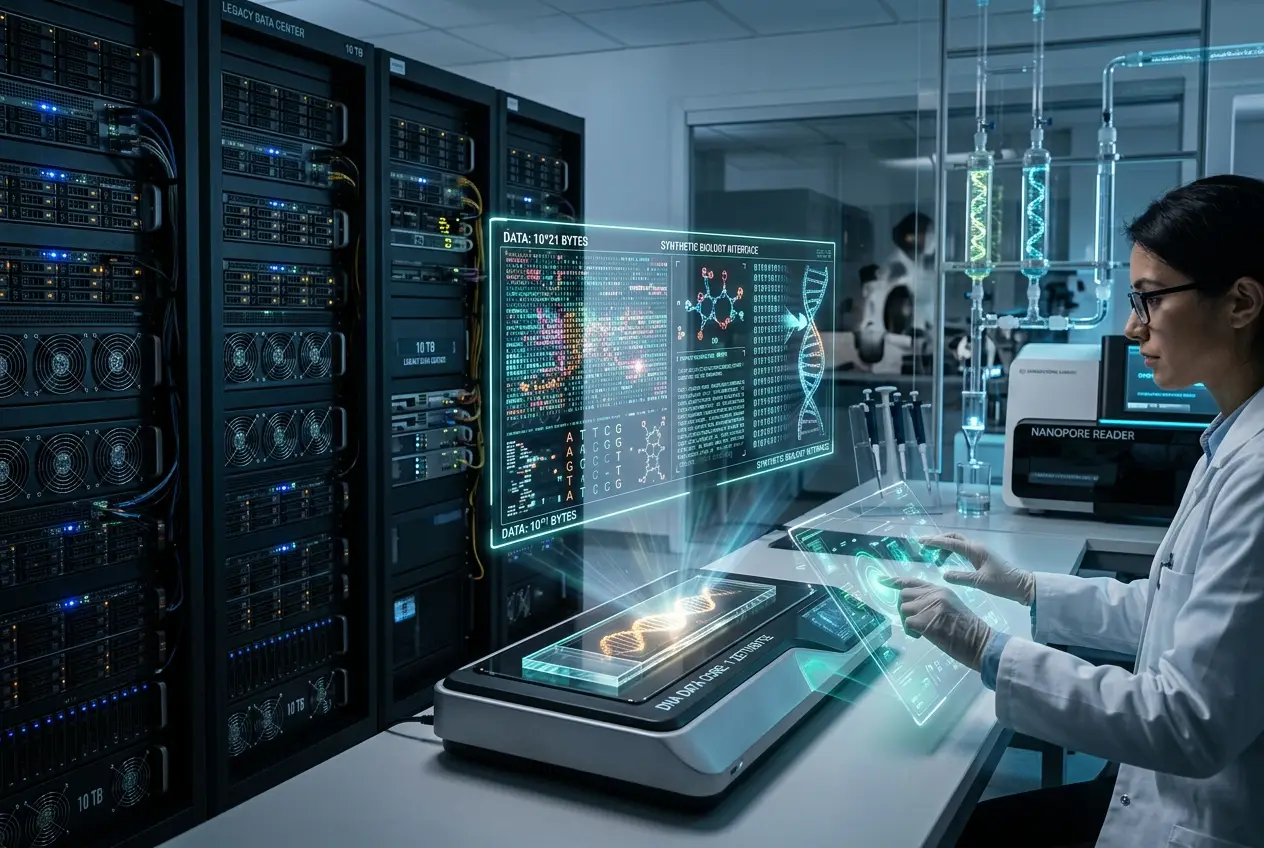
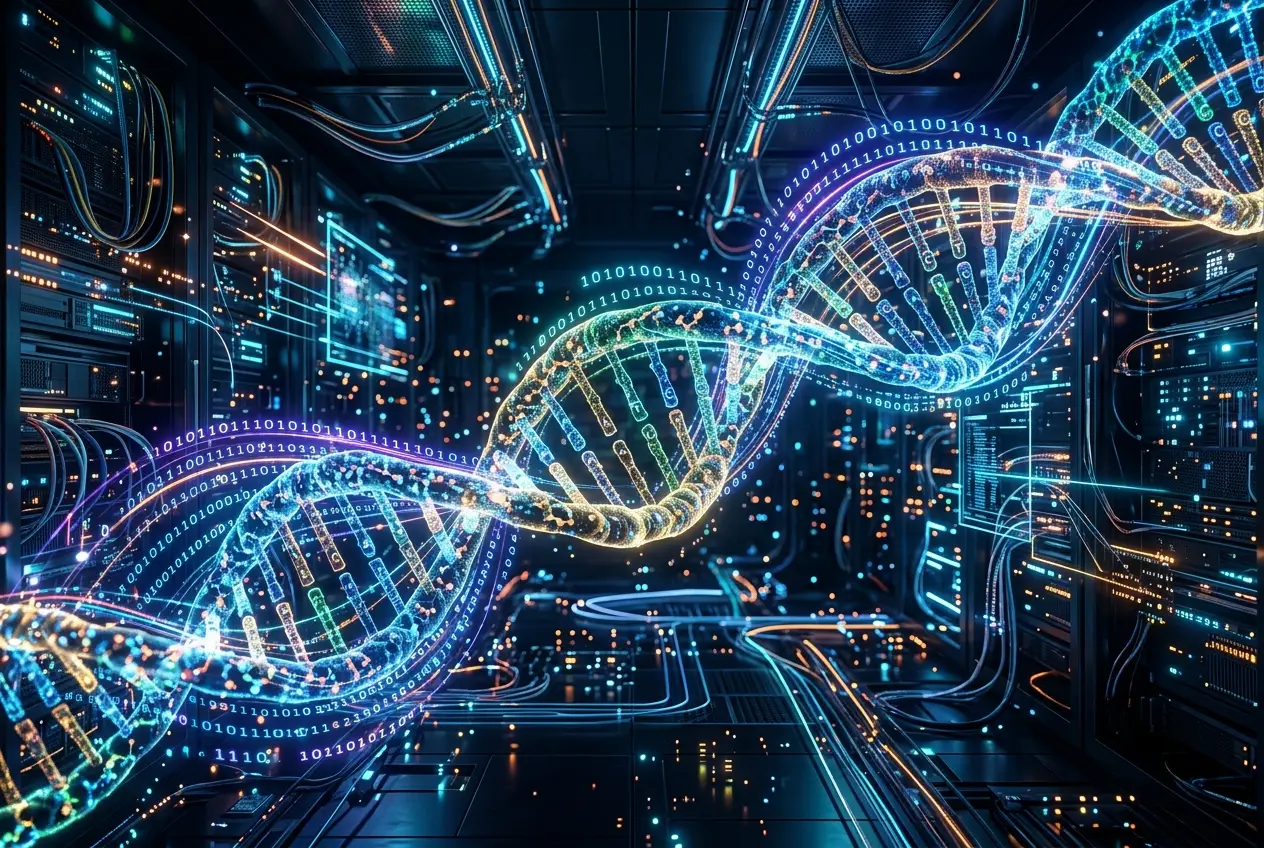
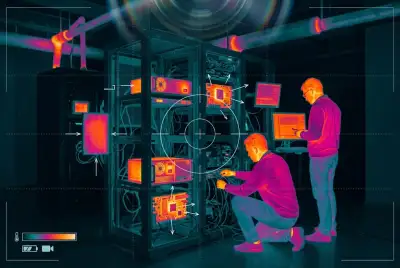
I recently stumbled upon a concept that absolutely blew my mind: what if the tiny, intricate molecule that defines life itself—DNA—could become the ultimate hard drive? We live in an age where digital data is exploding. Every photo, every video, every email, every line of code, every scientific discovery, every transaction, every scroll on social media creates an unimaginable deluge of information. Our current data centers, vast warehouses brimming with blinking servers, consume enormous amounts of energy and space. They're also relatively fragile, susceptible to environmental factors, and have a finite lifespan. So, what happens when we simply run out of space, or energy, or reliable methods to keep this digital deluge safe for centuries, even millennia?
This question, I realized, isn't just a philosophical musing. It's a pressing challenge for computer scientists and biologists alike. And the answer, incredibly, might lie within us, within every living cell on Earth: **DNA**.
### The Looming Data Crisis: Why We Need a New Solution
Think about the sheer scale. Estimates suggest that by 2025, the global datasphere could reach 175 zettabytes (ZB). To put that into perspective, one zettabyte is a trillion gigabytes. Imagine trying to store all of humanity's accumulated knowledge, art, and history for tens of thousands of years. Traditional magnetic hard drives and solid-state drives simply aren't up to the task for truly long-term, high-density storage. They degrade, require constant power, and are limited by physical size and manufacturing costs.
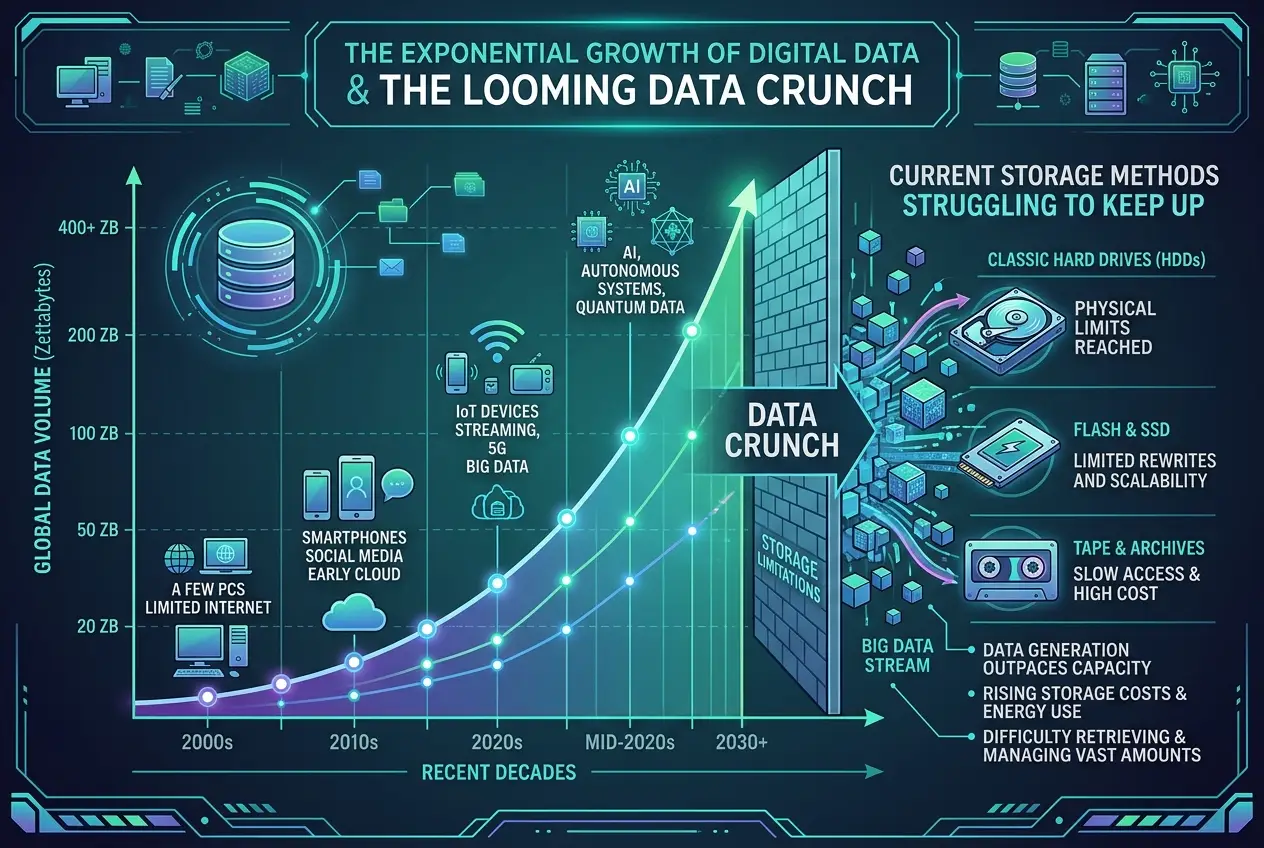
This isn't just about saving your vacation photos. It's about preserving humanity's scientific records, historical archives, and cultural heritage. What if future civilizations unearthed our digital data, only to find it corrupted or unreadable due to obsolete technology? It’s a compelling argument for radical innovation in data storage, and that’s where the magic of DNA enters the picture.
### DNA: Nature's Miraculous Hard Drive
Deoxyribonucleic acid, or DNA, is the instruction manual for life. It’s a double helix structure, a complex molecule made of four nucleotide bases: adenine (A), guanine (G), cytosine (C), and thymine (T). The sequence of these bases carries all the genetic information that makes you, you, and every other living thing what it is.
What makes DNA so appealing for data storage?
1. **Incredible Density:** A single gram of DNA can theoretically store up to 215 petabytes (PB) of data. That's 215 million gigabytes! To store the world's current digital data, you'd need less than 20 grams of DNA. Compare that to acres of data centers.
2. **Longevity:** DNA is remarkably stable. Under ideal conditions (like those found in ancient bones or fossils), DNA can survive for tens of thousands, even millions of years. This far surpasses the lifespan of any current digital storage medium.
3. **No Power Required (for storage):** Once data is encoded into DNA and synthesized, it doesn't require electricity to maintain its integrity. It just... exists. Power is only needed for writing and reading.
4. **Future-Proof:** As long as life exists, DNA will be studied and understood. The "reader" for DNA (sequencing technology) is constantly improving and will likely remain relevant for as long as humans are interested in biology.
"The amount of digital data that humanity produces is growing exponentially, and current storage technologies are struggling to keep up," states a fascinating article on the subject. "DNA offers a solution with unprecedented density, longevity, and sustainability." Source: [Wikipedia - DNA digital data storage](https://en.wikipedia.org/wiki/DNA_digital_data_storage)
### How Does it Work? Encoding Digital Information into DNA
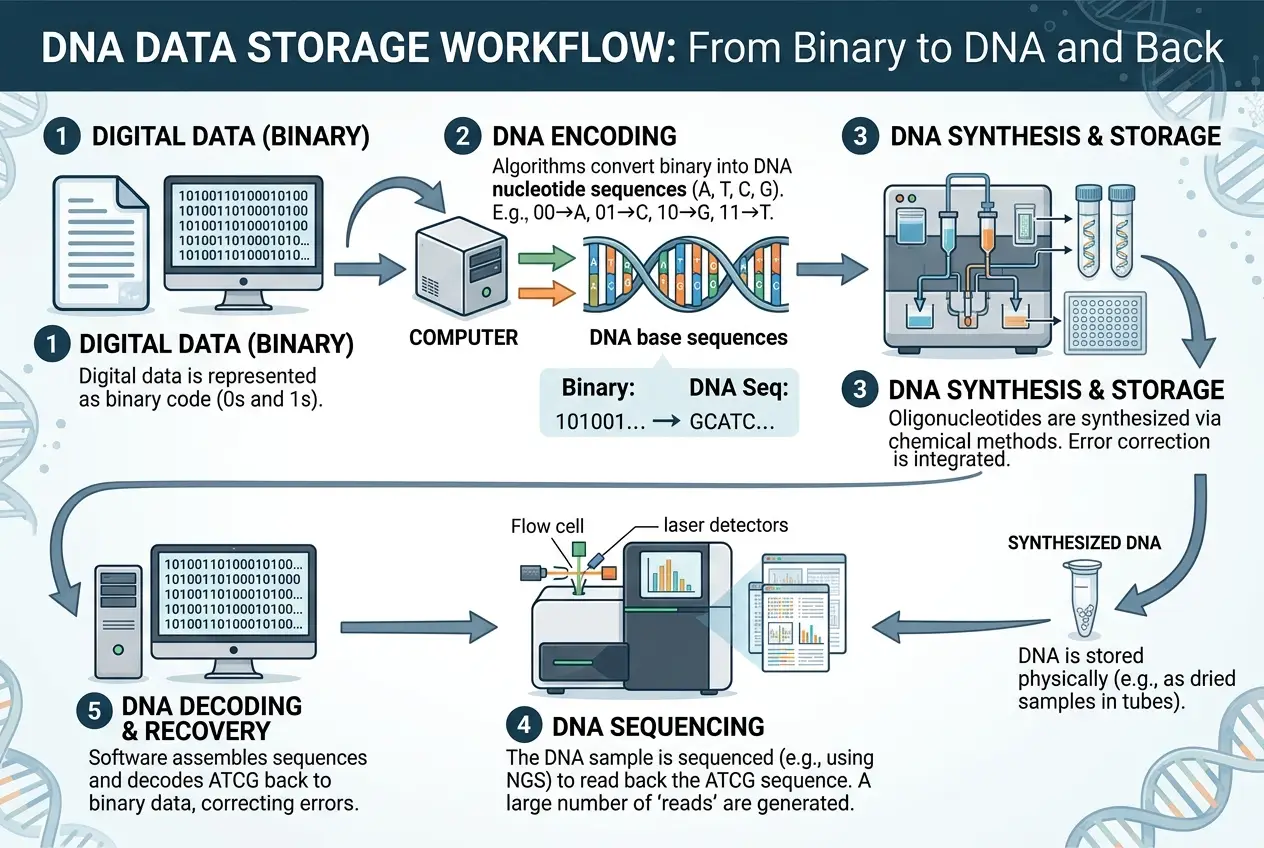
The process of DNA data storage involves three primary steps:
1. **Encoding:** Digital information (which is fundamentally binary, 0s and 1s) needs to be translated into the four-letter alphabet of DNA (A, T, C, G). Various encoding schemes exist. A simple method might assign binary pairs to DNA bases: 00=A, 01=C, 10=G, 11=T. More sophisticated schemes build in redundancy and error correction to ensure data integrity.
2. **Synthesis:** Once encoded, the desired DNA strands are chemically synthesized. This process involves building the DNA molecule base by base according to the encoded sequence. Modern DNA synthesizers can create millions of short DNA strands simultaneously.
3. **Storage:** The synthesized DNA is then stored. This can be in a lyophilized (freeze-dried) state, in solution, or even encapsulated in microscopic beads or glass. It requires a relatively small, dark, and cool environment, but not power.
To retrieve the data:
1. **Sequencing:** The stored DNA is sequenced, meaning its exact base order (A, T, C, G) is determined. Advances in DNA sequencing technology have made this process incredibly fast and affordable.
2. **Decoding:** The sequenced DNA data is then translated back into its original binary form using the inverse of the encoding scheme, reconstructing the original digital file.
### Challenges on the Path to the DNA Hard Drive
While the promise of DNA storage is immense, significant hurdles remain before it becomes a mainstream solution.
* **Cost:** DNA synthesis and sequencing, while decreasing in price, are still expensive, especially for large-scale data sets. Current costs are far from competitive with traditional storage for everyday use.
* **Speed:** Writing and reading data to and from DNA is currently much slower than electronic methods. It can take hours or even days to synthesize and sequence meaningful amounts of data. For archival purposes, this might be acceptable, but not for active data.
* **Random Access:** Accessing specific bits of information within a large pool of DNA is challenging. Unlike a traditional hard drive where you can jump to a specific sector, DNA storage is more like a massive tape library where you have to sequence segments to find what you need. Researchers are exploring ways to implement random access, such as by incorporating "address tags" into DNA strands.
* **Error Rates:** While DNA is stable, errors can occur during synthesis, storage, and sequencing. Robust error-correction codes are crucial to ensure data fidelity, adding complexity and overhead.
### Beyond Archiving: The Future Possibilities
Despite the challenges, the pace of research is breathtaking. Companies like Microsoft have been actively exploring DNA storage for archival purposes, demonstrating the storage and retrieval of vast amounts of data, including the entire English Wikipedia. For more on this, you can read about their efforts: [Wikipedia - Microsoft Research](https://en.wikipedia.org/wiki/Microsoft_Research).
I believe the implications extend beyond mere archiving. Imagine:
* **Self-assembling data centers:** DNA could potentially "grow" its own storage capacity.
* **Data embedded in products:** DNA tags could store information about manufacturing, provenance, or recycling instructions directly within materials.
* **Biocomputing integration:** If living systems can store data, could they also process it? This ties into fascinating concepts explored in blogs like whether [living cells can build our next supercomputers](https://curiositydiaries.com/blogs/can-living-cells-build-our-next-supercomputers-6472).
* **Tiny, durable data capsules:** For space missions or extreme environments, DNA could offer unprecedented resilience.
This convergence of biology and information technology is truly a frontier. It reminds me of how we're constantly trying to [unlock the universe's hidden code](https://curiositydiaries.com/blogs/can-ai-unlock-the-universes-hidden-code-2950), whether it's in the cosmos or the microscopic world of genetics. The idea that the very blueprint of life could also be the blueprint for the future of digital data storage feels almost poetic. It's a testament to the elegant efficiency of nature that we, with all our technological prowess, are now looking to its fundamental mechanisms for our most advanced problems.
The challenges are considerable, but the potential rewards are revolutionary. As researchers refine synthesis and sequencing technologies, and develop more efficient encoding and retrieval methods, DNA data storage could transition from a scientific marvel to a practical necessity, safeguarding humanity's digital legacy for untold generations. It’s a solution that not only promises to solve our impending data crisis but also fundamentally redefines our understanding of what constitutes "information storage." We might just be on the cusp of building the ultimate, living hard drive.
The journey from understanding how [ancient runes stored data](https://curiositydiaries.com/blogs/ancient-runes-did-they-store-data-like-code-1197) to exploring if [our universe is a hologram decoding cosmic data](https://curiositydiaries.com/blogs/is-our-universe-a-hologram-decoding-cosmic-data-8116) has shown us that information comes in many forms. DNA storage is just the latest, and perhaps most profound, chapter in this ongoing quest.
Frequently Asked Questions
Digital data (0s and 1s) is converted into sequences of the four DNA bases (A, T, C, G) using specific encoding schemes, much like a biological alphabet. Each base or pair of bases can represent a binary value.
Under optimal conditions, such as freeze-dried or within protective materials, DNA can store data for tens of thousands to even millions of years, far surpassing the lifespan of traditional electronic storage media.
Not yet. While incredibly promising, current DNA data storage faces challenges regarding cost, speed of writing and reading, and efficient random access. It is primarily being explored for long-term archival storage rather than active, frequently accessed data.
The primary advantages are its astounding data density (grams for zettabytes), extreme longevity without power, and its future-proof nature as DNA will always be relevant to biological study.
Absolutely. The ability to encode and retrieve data from biological molecules opens doors to integrated biocomputing systems, where biological processes could potentially be used not just for storage but also for processing information, blurring the lines between living systems and computation.
Verified Expert
Alex Rivers
A professional researcher since age twelve, I delve into mysteries and ignite curiosity by presenting an array of compelling possibilities. I will heighten your curiosity, but by the end, you will possess profound knowledge.
Leave a Reply
Comments (0)
No approved comments yet. Be the first to share your thoughts!
 Join Us
 Unknown Author



Leave a Reply
Comments (0)