I was recently staring up at the night sky, watching a meteor shower, and a thought struck me: we are constantly bombarded by invisible forces from the cosmos. Beyond the occasional shooting star, our planet is a giant target for high-energy particles originating from deep space – cosmic rays. We build elaborate shields for our spacecraft, and our atmosphere provides a natural one for us, but what if these tireless travelers from distant supernovae and black holes aren't entirely blocked? What if, even in their attenuated form, cosmic rays are doing more than just occasionally glitching our electronics? Could they, in fact, be subtly influencing the very seat of our consciousness: our brain activity?
It's a question that sounds like science fiction, yet a growing body of scientific inquiry is beginning to explore the intricate, often overlooked, connections between cosmic phenomena and biological processes. We know our world is a complex tapestry of physical forces, but often, the most subtle ones are the hardest to detect and understand.
## The Unseen Deluge: What Are Cosmic Rays?
Imagine particles accelerated to nearly the speed of light, traveling billions of light-years across the galaxy before slamming into Earth's atmosphere. These are **cosmic rays**, a stream of high-energy atomic nuclei (mostly protons, but also helium and heavier elements) and electrons. They originate from violent events in the cosmos: supernovae explosions, active galactic nuclei, and perhaps even mysterious dark matter interactions. When these primary cosmic rays hit our upper atmosphere, they collide with gas molecules, producing a cascade of secondary particles – muons, electrons, positrons, and neutrinos – that rain down to the Earth's surface.
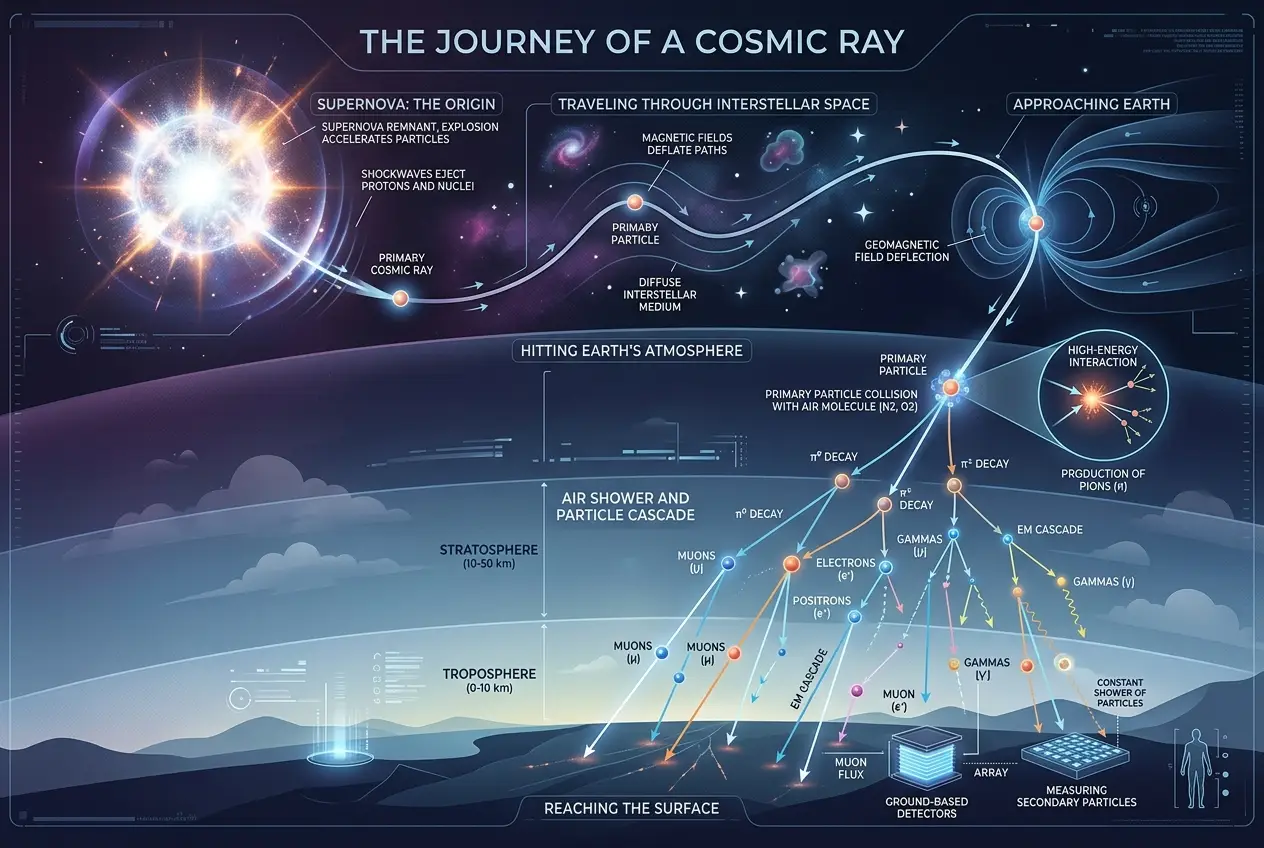
While the primary cosmic rays are largely deflected by our planet's magnetic field and absorbed by the atmosphere, a significant number of these secondary particles reach us, even at sea level. You might not see them, but they're passing through you right now. For decades, the focus has been on their potential to cause electronic errors or increase cancer risk for astronauts. But what about a more immediate, subtle impact on our physiology, particularly our nervous system?
## Brain-Environment Interaction: A Hidden Link?
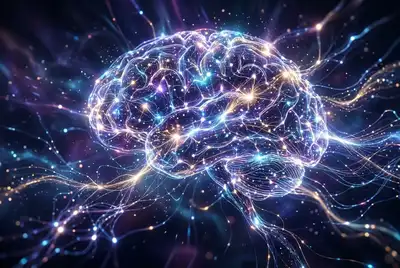
The human brain is an incredibly complex electrochemical system, generating its own weak electromagnetic fields and relying on precise ion flows for neural communication. It's highly sensitive to its environment. We know light affects our circadian rhythms, sound shapes our perception, and even subtle shifts in atmospheric pressure can influence some individuals. Is it a stretch to consider that a constant, albeit low-level, bombardment of energetic particles could have *any* effect?
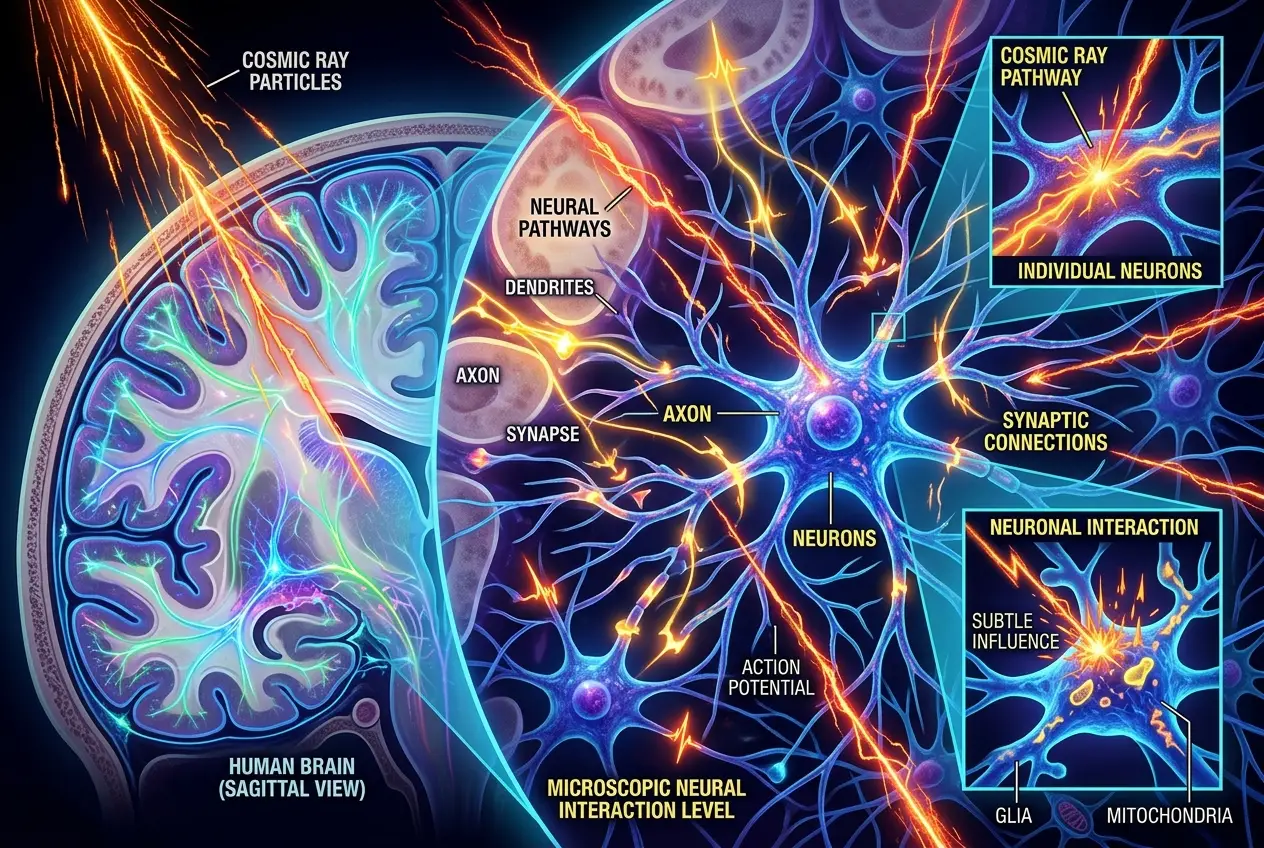
Some researchers are beginning to suggest it isn't. The idea isn't that cosmic rays are giving us superpowers or immediate damage, but rather that they might introduce slight perturbations, "noise" into the system, or perhaps even trigger specific cellular responses over long periods.
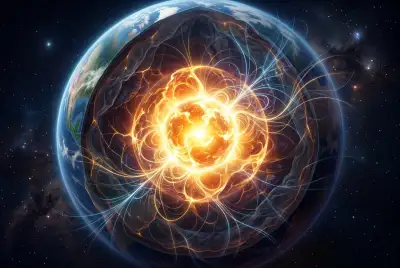
One fascinating area of research looks at how our brains might respond to geomagnetic field fluctuations, which can be influenced by solar activity, a source of some lower-energy cosmic rays. Studies have explored links between geomagnetic storms and changes in human behavior, mood, and even reported increases in hospital admissions for cardiovascular or neurological events. You can dive deeper into how our planet's magnetic field affects us in this related blog: [Does Earth's Magnetic Field Affect Our Minds?](https://curiositydiaries.com/blogs/does-earths-magnetic-field-affect-our-minds-6923)
## The Physics of Influence: How Could It Work?
For cosmic rays to influence brain activity, there needs to be a plausible physical mechanism. Here are a few hypotheses being explored:
1. **Ionization and Cellular Damage (or Repair?):** As secondary cosmic ray particles pass through living tissue, they can ionize atoms, stripping away electrons. While high doses are harmful, very low doses might cause subtle changes to cell membranes, DNA, or protein structures. The body is constantly repairing itself, but persistent low-level ionization could, theoretically, influence cellular signaling pathways.
2. **Quantum Effects in the Brain:** This is a more speculative, yet highly intriguing, hypothesis. The field of **quantum biology** explores how quantum mechanical phenomena might play a role in biological processes. Could the coherent quantum states within microtubules (protein structures in neurons) or ion channels be sensitive to the energy deposited by a passing cosmic ray particle? While evidence is sparse, the idea posits that the brain might not be purely classical. For more on this, check out: [Could Quantum Biology Unlock Life's Deepest Secrets?](https://curiositydiaries.com/blogs/could-quantum-biology-unlock-lifes-deepest-secrets-6147)
3. **Neurotransmitter Modulation:** The release and reuptake of neurotransmitters are crucial for brain function. Could a minor interaction with a cosmic ray particle subtly alter the conformation of a protein involved in neurotransmitter synthesis or receptor binding? This is an area ripe for further investigation.
4. **Electromagnetic Induction:** While cosmic rays are particles, their interaction with matter can generate localized electromagnetic fields. Could these fields, however fleeting, induce tiny currents within neural networks, potentially influencing the firing patterns of neurons?
"The brain is an exquisite instrument, capable of detecting the most subtle changes in its environment. We are only just beginning to understand the full spectrum of external forces that might shape its intricate workings." – *Unknown Neuroscientist*
## Evidence and Experiments: Seeking the Signal in the Noise
Directly proving a link between cosmic rays and brain activity is incredibly challenging. The "signal" would likely be very subtle, easily drowned out by the brain's inherent noise and other environmental factors. However, several approaches are being explored:
* **Animal Studies:** Researchers might expose test animals to controlled levels of radiation mimicking cosmic rays and observe changes in behavior, cognitive function, or brain physiology. For example, studies on mice have shown that simulated deep-space radiation can impair cognitive functions like memory and decision-making over time, raising concerns for long-duration space missions.
* **Epidemiological Studies:** Analyzing large datasets of human health and behavior in relation to cosmic ray flux (which varies with solar cycles and Earth's magnetic field strength) could reveal correlations. This is complex, as many confounding factors exist.
* **In Vitro Experiments:** Studying brain cells or neural networks in a lab setting while exposing them to low levels of radiation could provide insights into cellular responses at a fundamental level.
* **Magnetoencephalography (MEG) and Electroencephalography (EEG):** These techniques measure the brain's electrical activity. If cosmic rays induce even transient changes in neural firing, highly sensitive MEG or EEG systems might theoretically detect them, perhaps as micro-events or subtle shifts in background rhythms.
One interesting observational study, though not directly on brain activity, found a correlation between cosmic ray flux and cloud formation on Earth, which impacts weather and climate. If cosmic rays can influence such large-scale atmospheric phenomena, their direct effect on a biological system like the brain, albeit more localized, isn't entirely outside the realm of possibility. You can read more about cosmic rays on [Wikipedia's Cosmic Ray page](https://en.wikipedia.org/wiki/Cosmic_ray).
## Future Implications: From Space Travel to Neuro-Anomalies
If a definitive link were established, the implications would be profound:
* **Space Travel:** Understanding how cosmic rays affect the brain is critical for long-duration human missions to Mars and beyond. Protective shielding might need to consider not just overall radiation dose, but specific neurobiological impacts.
* **Earth-Based Health:** Could cosmic ray variations contribute to subtle shifts in population health, mood patterns, or cognitive performance over time? This could open new avenues for understanding unexplained neurological anomalies or chronic conditions.
* **Neuroscience Research:** It would add another layer of complexity to our understanding of brain function, pushing the boundaries of neuroscience to incorporate astroparticle physics.
* **Technological Shielding:** Developing better shielding for sensitive electronics and potentially even biological systems on Earth might become a new area of focus.
This line of inquiry reminds me of the broader search for subtle signals from the cosmos, like those explored in this article about deciphering strange planetary signals: [Why Do Some Planets Sing in Radio Waves?](https://curiositydiaries.com/blogs/why-do-some-planets-sing-in-radio-waves-4437)
The idea that our very thoughts and feelings might be, however minutely, influenced by events billions of light-years away is a truly humbling one. It underscores the profound interconnectedness of everything in the universe, from the grand scale of galactic dynamics to the intricate wiring of the human brain. While concrete evidence is still emerging, the scientific journey to uncover these hidden cosmic whispers within us promises to be one of the most exciting frontiers of exploration.
Ultimately, the question of whether cosmic rays influence our brain activity is a testament to scientific curiosity itself. It pushes us to look beyond the obvious, to listen for the faint echoes of the universe within our own biology, and to continually question the boundaries of what we think we know.
| Cosmic Ray Type | Origin | Composition | Typical Interaction with Biological Tissue | Potential Biological Effect (Hypothesized) |
| :-------------- | :------------------------------ | :------------------------------------------ | :------------------------------------------ | :----------------------------------------- |
| Primary | Supernovae, Galactic Nuclei | Protons (89%), Helium (10%), Heavy Ions (1%) | High ionization, direct cell damage | DNA mutation, cell death (mostly in space) |
| Secondary | Atmospheric collisions | Muons, Electrons, Neutrinos, Photons | Lower ionization, energy deposition | Subtle cellular signaling changes |
| Solar Energetic | Solar Flares, Coronal Mass Ejections | Protons, Electrons | Moderate ionization, short-term exposure | Oxidative stress, DNA damage |
## Conclusion: A Universe Within and Without
The journey to understand the potential influence of cosmic rays on human brain activity is just beginning. It requires a remarkable synergy between astrophysics, neuroscience, and quantum biology. While direct, undeniable proof remains elusive, the ongoing research encourages us to view ourselves not as isolated beings, but as integral parts of a vast, dynamic cosmos, constantly interacting with its unseen forces. Our brains, far from being solely terrestrial machines, might just be cosmic receivers, processing signals from the deepest reaches of space.
Frequently Asked Questions
On Earth's surface, the vast majority of primary cosmic rays are blocked by the atmosphere and magnetic field. The secondary particles that reach us are generally at very low levels, and while they can contribute to background radiation exposure, they are not considered immediately dangerous in daily life. Long-duration space travel, however, poses significant risks due to much higher exposure to primary cosmic rays.
Detecting a direct link is challenging. Scientists are using animal models exposed to simulated cosmic radiation, epidemiological studies correlating cosmic ray flux with health data, and in vitro experiments on neural cells. Highly sensitive brain imaging techniques like MEG and EEG are also being explored to look for subtle, transient changes in electrical activity.
Quantum biology is an emerging field that investigates whether quantum mechanical phenomena (like superposition or entanglement) play a role in biological processes. In the context of cosmic rays, some theories propose that the brain's quantum states within microtubules or ion channels could be sensitive to the energy deposited by a passing cosmic ray, potentially influencing neural function.
Solar flares and other solar events produce solar energetic particles, which are a form of cosmic ray, but generally lower in energy than galactic cosmic rays. Intense solar activity can temporarily increase radiation exposure in space and subtly affect Earth's magnetic field, which in turn can influence the flux of both solar and galactic cosmic rays reaching us. The direct impact on human brain activity is still a subject of ongoing research.
Many environmental factors influence the brain, including light (affecting circadian rhythms and mood), sound (shaping perception and emotional responses), temperature, air pressure, and even subtle changes in Earth's electromagnetic fields. Our bodies and brains are constantly adapting and responding to the world around us.
Verified Expert
Alex Rivers
A professional researcher since age twelve, I delve into mysteries and ignite curiosity by presenting an array of compelling possibilities. I will heighten your curiosity, but by the end, you will possess profound knowledge.
Leave a Reply
Comments (0)
No approved comments yet. Be the first to share your thoughts!
 Join Us


 Unknown Author























Leave a Reply
Comments (0)