


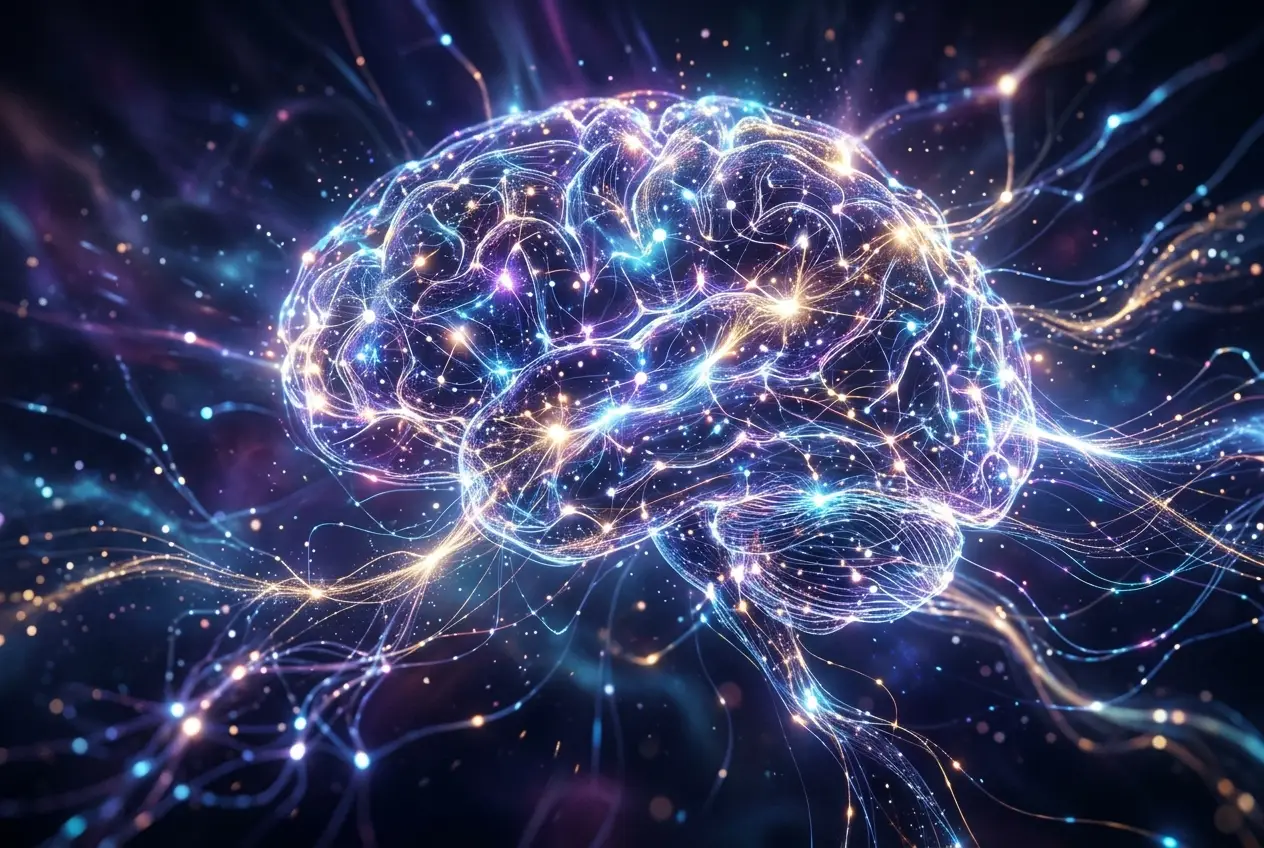
I often find myself contemplating the profound shifts occurring in technology, especially at the intersection of biology and computing. It’s hard not to be captivated by the relentless march toward a future where the lines blur between organic and artificial. Recently, I've been diving deep into the concept of neuro-dust, a fascinating development that promises to revolutionize how we interact with our own brains – and potentially, how we achieve a form of digital immortality.
The idea of uploading human consciousness, of transferring our very essence into a digital realm, has long been the stuff of science fiction. Think of the elaborate constructs in "Altered Carbon" or the serene digital afterlife in "San Junipero." But what if the seeds of this reality are already being sown in laboratories today, not with massive brain scanners, but with microscopic particles barely visible to the naked eye? This is where neuro-dust enters the conversation, propelling us from abstract theory into the realm of tangible, if nascent, technological possibility.
What Exactly is Neuro-Dust? The Brain's New Best Friend?
Imagine a swarm of tiny, wireless sensors, each no larger than a grain of sand, floating within your brain. These aren't invaders; they're sophisticated listeners, designed to record and transmit neural activity with unprecedented detail. That, in essence, is neuro-dust. Developed by researchers, notably at the University of California, Berkeley, these minuscule devices are an evolution of Brain-Computer Interfaces (BCIs), aiming for a level of intimacy with our grey matter that was previously unimaginable.
Unlike traditional BCIs, which often involve implants with wires or surface electrodes, neuro-dust probes are envisioned to be completely wireless and minimally invasive. They're designed to communicate with external devices, transmitting data about individual neuron firing. This opens up incredible possibilities, from monitoring brain activity in real-time to potentially diagnosing and treating neurological disorders with pinpoint accuracy.
"The ultimate goal is to build a high-resolution brain-machine interface that can be implanted in the brain with minimal invasiveness," says Michel Maharbiz, a professor of electrical engineering and computer sciences at UC Berkeley and a co-developer of the neuro-dust concept. This vision goes beyond just reading signals; it's about creating a truly symbiotic relationship between our biological brains and external computational power. You can learn more about the early concepts of this technology on Wikipedia's page on neural dust (opens in a new tab).
From Sensing Neurons to Storing Consciousness
The journey from sensing neuronal activity to achieving consciousness uploading is colossal, but neuro-dust presents a compelling pathway. Here's how I envision the theoretical progression:
Phase 1: High-Resolution Brain Mapping
Current neuro-dust research focuses on sensing and transmitting data from individual neurons. With billions of neurons and trillions of synaptic connections, a truly comprehensive map of the human brain's activity would require an immense array of these sensors. This mapping isn't just about 'on' or 'off' signals; it involves understanding the precise timing, strength, and chemical interactions that constitute thought, memory, and emotion.
Phase 2: Decoding and Encoding Neural Information
Once we can read the brain's signals with such fidelity, the next monumental step is to decode them. What specific patterns correspond to a memory of your first pet? What complex electrochemical dance represents the feeling of joy? And, crucially, can we then encode that information back into a synthetic medium? This involves understanding the very language of consciousness, a challenge that borders on the philosophical as much as the scientific.
Phase 3: Digital Emulation and Uploading
If we achieve a sufficiently detailed map and can decode its information, the theoretical leap to recreating that pattern in a digital substrate becomes plausible. This isn't just copying data; it's about simulating the dynamic, complex processes that give rise to consciousness. Neuro-dust, by providing an unprecedented data stream from the living brain, could be the key data pipeline for this grand endeavor. Imagine the continuous stream of every thought, every sensation, every memory, being mirrored and stored in a vast, powerful digital network. This concept is often discussed under the umbrella of digital immortality (opens in a new tab).
The Science Behind the Dream: Challenges and Advancements
While the prospect is thrilling, the scientific hurdles are immense.
- Powering the Dust: How do you power billions of microscopic, wireless devices inside a living brain without generating heat or requiring constant battery replacements? Researchers are exploring methods like ultrasound or light to wirelessly power these devices.
- Data Bandwidth: The sheer volume of data generated by a full-brain neural network is staggering. Transmitting this wirelessly and processing it in real-time requires breakthroughs in wireless communication and computing power. It might make you wonder if even the internet is gaining a collective mind (opens in a new tab) if this data were pooled.
- Ethical and Philosophical Questions: Beyond the technical, the implications are profound. If a digital copy of "me" exists, is it truly me? What happens to the original? These are not trivial questions and are often discussed within the field of transhumanism (opens in a new tab).
Despite these challenges, advancements in related fields offer glimmers of hope. Brain-Computer Interfaces (BCIs) are already allowing paralyzed individuals to control prosthetic limbs with their thoughts. We've even explored whether these interfaces could one day read our dreams (opens in a new tab). The ability to store complex information, as seen in experimental methods like DNA data storage, hints at the possibility of retaining vast amounts of human experience in non-biological forms.
Digital Immortality: A New Horizon for Humanity?
The ultimate promise of neuro-dust, in this grand vision, is digital immortality. Imagine a future where, as our physical bodies decline, our consciousness can seamlessly transition into a digital realm, or even a new, synthetic body. This isn't merely extending life; it's potentially transcending the limitations of biological existence altogether.
Could our memories, personalities, and experiences be preserved indefinitely? This concept challenges our very definition of life, death, and identity. If successful, it would redefine what it means to be human, perhaps even allowing for a kind of digital empathy, as we pondered with the question: Can AI Truly Feel? (opens in a new tab)
Of course, the ethical dilemmas are immense. Questions of digital rights, ownership of consciousness, and the potential for new forms of inequality arise. Will digital immortality be accessible only to the wealthy? What about the environmental impact of maintaining vast data centers required to house billions of uploaded minds? These are questions we must begin to grapple with now, as the technology inches closer to reality.
Beyond Immortality: Enhanced Cognition and Collective Minds
Even if full consciousness uploading remains elusive, neuro-dust still offers revolutionary possibilities for augmenting human cognition. By providing a direct, high-bandwidth link between our brains and external computing power, we could achieve:
- Instantaneous Knowledge Access: Imagine accessing the entire internet with a thought, or learning a new skill by simply downloading it directly into your neural network.
- Enhanced Sensory Perception: Neuro-dust could potentially integrate new sensory inputs, allowing us to "see" in infrared, "hear" radio waves, or even perceive the nuances of complex data patterns directly.
- Collective Consciousness: A network of uploaded or augmented minds could form a collective intelligence, sharing thoughts and experiences in ways we can barely comprehend. This echoes the concept of a collective consciousness (opens in a new tab) or shared mental space.
The journey towards these futuristic scenarios is long and fraught with both scientific and ethical challenges. However, the foundational research in neuro-dust and advanced BCIs demonstrates a tangible path forward. It’s a path that could redefine not just how long we live, but how we think, feel, and connect with the very fabric of reality.
The Road Ahead
The idea of neuro-dust uploading our minds is incredibly ambitious, but it’s precisely this kind of bold vision that drives scientific progress. From the first crude electrical signals recorded from a brain to the microscopic marvels of neuro-dust, humanity has consistently pushed the boundaries of understanding our most complex organ.
I believe that the ethical and philosophical debates must evolve alongside the technology. As we gain the power to potentially reshape our very existence, we must do so with profound consideration for what it truly means to be human, and what kind of future we want to build. The promise of digital immortality, enabled by technologies like neuro-dust, isn't just a scientific quest; it's a conversation about our ultimate destiny.

Conversation0
No comments yet. Be the first to share a thought — the best questions often become new stories.