


I once spent a summer backpacking through Peru, drawn by the whispers of ancient Incan traditions and the mysteries of their spiritual practices. One evening, deep in the Sacred Valley, I found myself participating in a traditional ceremony. The shaman led the ritual, employing a mesmerizing blend of rhythmic drumming, chanting, and a potent, earthy brew. As the hours passed, the repetitive sounds began to work on me. My mind, initially buzzing with skepticism, slowly yielded to a profound sense of calm, followed by vivid imagery and an altered perception of time. It wasn't just a psychological experience; it felt deeply physiological, almost as if my brain was being tuned to a different frequency.
This experience, along with countless stories from across the globe – from indigenous sweat lodges to Sufi whirling dervishes, monastic chants, and even ancient Greek mystery rites – sparked a compelling question in my mind: Did our ancestors, without the aid of modern neuroscience, intuitively understand and deliberately manipulate brainwave states for specific purposes? Could their rituals have been an early form of "brainwave technology"?
The Unseen Symphony: A Glimpse into Our Brain's Rhythm
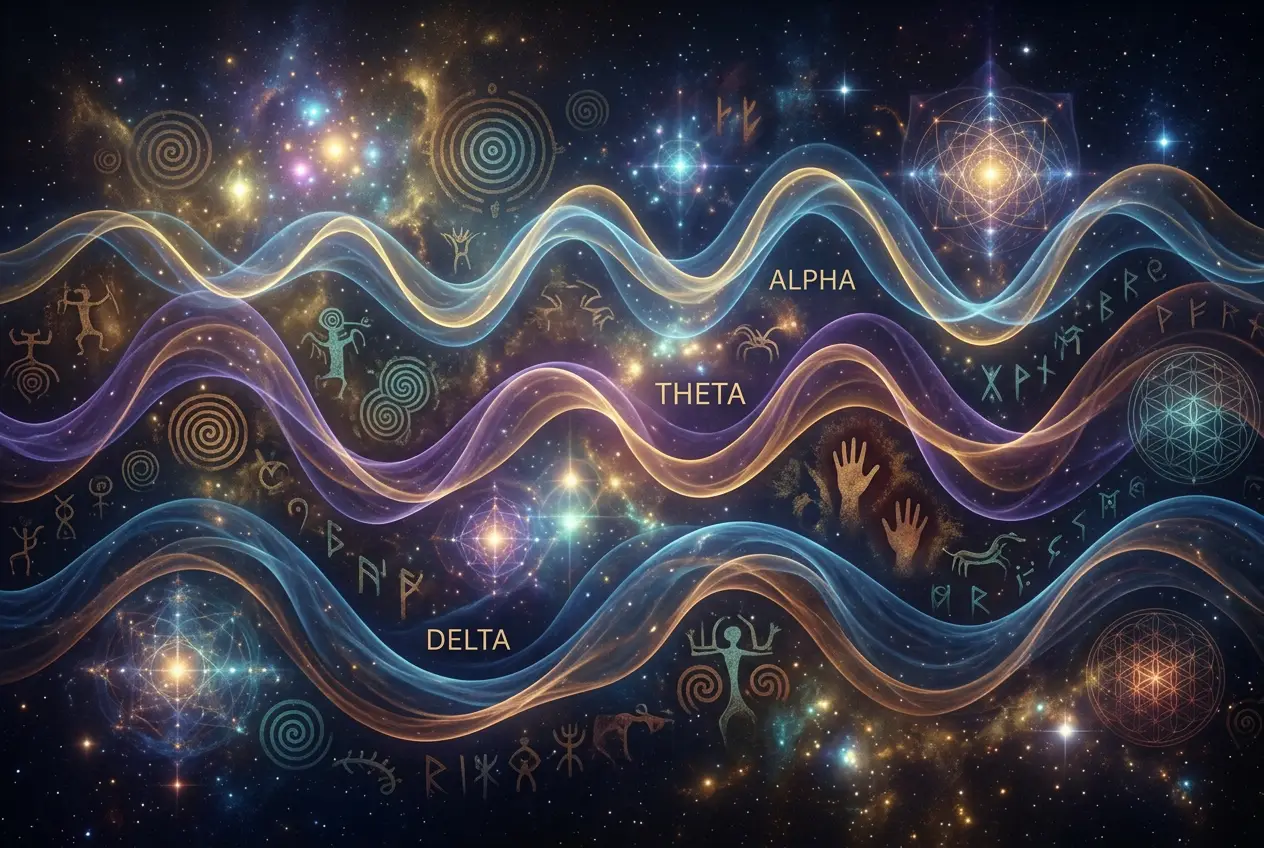
Before we dive into ancient practices, let's briefly understand what brainwaves are. Our brains are incredibly complex electrical organs, constantly generating electrical impulses as neurons communicate. These impulses create rhythmic patterns, or oscillations, that can be measured and categorized into different frequency bands, each associated with distinct states of consciousness:
- Gamma Waves (30-100+ Hz): High-frequency, associated with intense focus, peak performance, problem-solving, and cognitive processing.
- Beta Waves (13-30 Hz): Active, alert, awake states, logical thinking, concentration. This is our default waking state.
- Alpha Waves (8-13 Hz): Relaxed alertness, meditative states, creativity, bridging conscious and subconscious.
- Theta Waves (4-8 Hz): Deep relaxation, light sleep, REM sleep, vivid dreams, deep meditation, intuition, spiritual experiences.
- Delta Waves (0.5-4 Hz): Deep, dreamless sleep, healing, restoration.
Modern science, especially in fields like neurofeedback and biofeedback, actively explores how we can intentionally shift these brainwave states for therapeutic benefits, enhanced performance, or deeper meditation. But what if ancient civilizations were already experts in this, using rudimentary tools like drums, chants, and specific breathing techniques?
Ancient Wisdom: Unlocking the Brain's Hidden Potential
I've always been fascinated by how different cultures independently arrived at similar ritualistic practices, often involving repetitive sensory input. It suggests a shared, perhaps inherent, understanding of their profound effects.
1. Rhythmic Entrainment: The Drum's Hypnotic Pulse One of the most potent tools in ancient rituals was rhythmic drumming. Across continents, shamans, healers, and spiritual leaders have employed drums, rattles, and other percussion instruments to induce altered states. The consistent, percussive beat can act as a powerful external stimulus, guiding the brain to synchronize its electrical activity with the rhythm – a phenomenon known as brainwave entrainment.
For instance, a drumbeat oscillating between 4 to 7 beats per second (roughly 4-7 Hz) directly corresponds to the theta brainwave state. This is the state often associated with deep meditation, trance, visions, and heightened intuition. When I felt that profound shift in the Peruvian ceremony, the rhythmic drumming was undoubtedly a key factor. Research has shown that sustained rhythmic drumming at specific frequencies can indeed induce theta and alpha states, reducing anxiety and promoting a sense of well-being (Source: Wikipedia on Brainwave Entrainment (opens in a new tab)). This ancient "technology" was surprisingly precise in its effect.
2. Vocalizations and Chanting: The Power of the Human Voice Think of the Gregorian chants in European monasteries, the "Om" mantra in Hinduism and Buddhism, or the complex vocables used in Native American ceremonies. These aren't just melodic expressions; they are often designed with specific pitches, tones, and repetitions that can profoundly impact the listener's and practitioner's brain.
"The human voice, when used intentionally with specific frequencies and rhythms, becomes a sophisticated instrument capable of inducing states of profound spiritual experience," notes Dr. David Huron, a leading researcher in the psychology of music. He suggests that specific vocalizations might have been perfected over millennia to reliably elicit desired neurophysiological responses.
Chanting, particularly resonant, low-frequency sounds, can activate the vagus nerve, which plays a critical role in regulating the nervous system. This activation can promote relaxation, lower heart rate, and shift brain activity towards alpha and theta states. Many spiritual traditions around the world utilize specific tones and breathwork to achieve deep meditative states, hinting at an intuitive understanding of bio-acoustic principles. For a deeper dive into how ancient sound practices might have affected consciousness, you might want to read our blog on /blogs/lost-frequency-did-ancients-heal-with-sound-9797.
3. Dance and Movement: Body as a Conduit From the whirling dervishes of the Sufi tradition to ecstatic dance rituals found in countless cultures, repetitive physical movement often accompanies sound to induce altered states. The continuous motion, especially when synchronized with music, can lead to a sensory overload that bypasses the rational mind, facilitating a deeper connection to intuition or spiritual experiences. This kinesthetic input, combined with auditory entrainment, can lead to powerful shifts in brainwave activity. It’s a form of active meditation that uses the body to guide the mind.
4. Breathwork and Hyperventilation: Manipulating Internal Chemistry Ancient yogis perfected pranayama, a system of breath control techniques, thousands of years ago. Many indigenous cultures also incorporate specific breathing patterns into their rituals. Techniques like rapid, shallow breathing (hyperventilation) or deep, slow breathing can alter oxygen and carbon dioxide levels in the blood, directly impacting brain chemistry and electrical activity. Hyperventilation, for instance, can lead to a temporary alkalization of the blood, which can reduce cerebral blood flow and increase neuronal excitability, sometimes leading to dissociative states or visions (Source: Wikipedia on Hyperventilation Syndrome (opens in a new tab)). While potentially risky if not guided, these practices show a sophisticated understanding of how internal physiological states can be manipulated to achieve altered consciousness.
The Scientific Lens: How Ancient Tech Aligns with Modern Discovery
What ancient shamans and priests achieved through intuition and ritual, modern science is now beginning to map with precision. The concept of resonance is central to both. Just as a tuning fork can make another nearby object vibrate at its frequency, external rhythms and frequencies can influence our brain's internal rhythms.
Modern neuro-acoustics research extensively studies how sound and vibration interact with the human brain and nervous system. Techniques like binaural beats (two slightly different frequencies played into each ear, creating a perceived third frequency in the brain) are explicitly designed to induce specific brainwave states, such as relaxation (alpha/theta) or focus (beta). It's a highly controlled, technological approach to what ancient practitioners achieved through communal, organic means.
I find it remarkable that without fMRI machines or EEG sensors, our ancestors developed systems that effectively acted as biofeedback loops. They learned what sounds, rhythms, and movements produced specific internal states, then codified these into rituals. It was a form of empirical neuro-engineering. While the mechanisms weren't understood scientifically, the effects were clearly observed and replicated across generations. The question of whether ancient cultures used sound and other stimuli to affect minds is also explored in /blogs/does-infrasound-affect-minds-science-of-ancient-whispers-3394.
The idea that our brains might be more responsive to specific external stimuli than we realize even connects to the fascinating, yet complex, discussion around whether /blogs/is-our-brain-a-quantum-machine-3312. While that delves into a different level of complexity, it highlights the mysterious depths of our own biology.
Why Did They Do It? The Purpose Behind the Rituals
The purpose of inducing these brainwave states wasn't just for entertainment or random experimentation. Ancient rituals often served vital functions within their communities:
- Healing: Many trance states were believed to facilitate physical and spiritual healing, allowing shamans to "journey" for remedies or insights.
- Problem Solving & Guidance: Accessing deeper states of consciousness could be seen as connecting with ancestral spirits, deities, or collective wisdom for guidance in difficult times, be it for hunting, warfare, or community decisions.
- Spiritual Connection: The ultimate goal for many was a direct, unmediated experience of the divine or the cosmos, leading to profound spiritual insight and a sense of unity.
- Community Bonding: Shared ecstatic experiences could strengthen social cohesion and reinforce cultural narratives.
- Vision Quests: For individuals, these practices were often part of rites of passage, guiding them through personal transformation and self-discovery.
The Legacy of Ancient Brainwave Tech
The echoes of ancient brainwave tech resonate even today. From modern meditation practices to sound baths, guided imagery, and even some therapeutic music, we continue to seek ways to intentionally alter our consciousness for well-being and insight. The difference is that now we have scientific tools to measure and understand how these changes occur.
I believe there's still much to learn from these ancient practices. They represent a vast, untapped repository of empirical knowledge about the human mind and its relationship with the external world. As we continue to develop sophisticated neuro-technologies, it's worth reflecting on how our ancestors, with nothing but their ingenuity and the resonant world around them, managed to tap into the very frequencies that define our consciousness. They weren't just performing rituals; they were, in a very real sense, engaging in a primal form of neuro-engineering, manipulating the unseen symphony of the brain to unlock profound experiences.
The next time you hear a rhythmic drumbeat or a resonant chant, pause and consider: you might be experiencing a direct link to humanity's oldest, most profound "technology" – the deliberate shaping of consciousness itself.




Conversation0
No comments yet. Be the first to share a thought — the best questions often become new stories.