


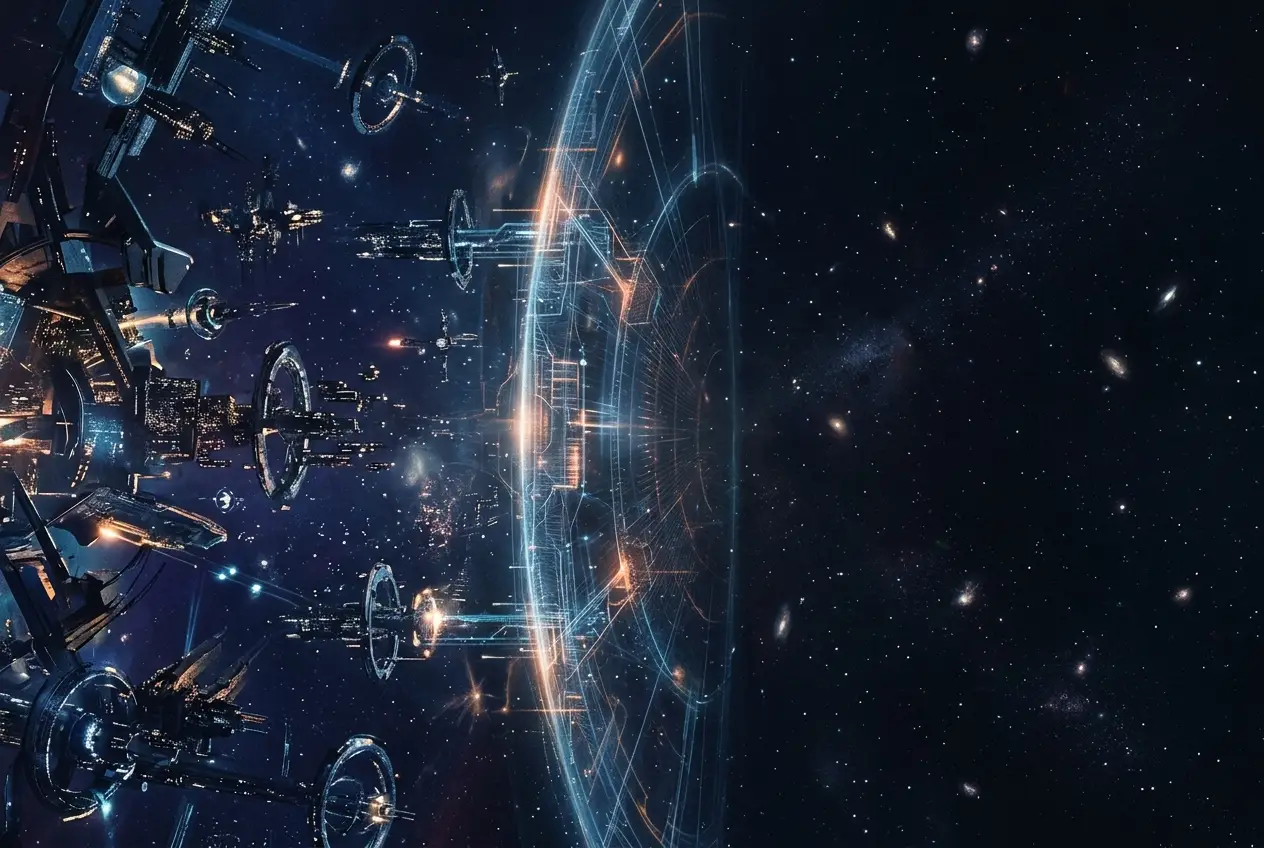
I often find myself gazing at the night sky, a canvas of endless possibilities, and wonder: Where is everyone? Billions of galaxies, trillions of stars, and an unfathomable number of planets—surely, some must harbor intelligent life, perhaps even civilizations far more advanced than our own. Yet, our telescopes scan the cosmos, and our radio dishes listen intently, only to be met with profound silence. This paradox, famously articulated by Enrico Fermi, asks a simple yet chilling question: If intelligent life is common, why haven't we found any evidence of it?
Recently, I delved into one of the most compelling and unsettling explanations for this cosmic quietude: The Great Filter. It's not a physical barrier but a theoretical hurdle, a monumental evolutionary or technological challenge that almost all civilizations fail to overcome. It’s like a cosmic gauntlet, and if it lies ahead of us, it could be a warning sign for humanity’s future.
Unpacking the Fermi Paradox: Why the Silence?
Before we confront the Great Filter, let's briefly revisit the Fermi Paradox. The universe is ancient, approximately 13.8 billion years old. Our solar system formed relatively late, about 4.5 billion years ago. If life emerges and evolves on other planets at rates comparable to Earth, then countless civilizations should have had eons to develop, expand, and perhaps even colonize their galaxies. Where are the alien probes, the mega-structures, the discernible signals of intelligent activity? (You might remember exploring related concepts like alien megastructures in our previous blog, Alien Megastructures: Are We Missing Cosmic Architects?).
There are numerous proposed solutions to the Fermi Paradox, ranging from the idea that aliens are simply too far away or that we're looking in the wrong ways, to more dramatic notions like alien civilizations actively hiding from us (the "Dark Forest" hypothesis). But the Great Filter stands out because it offers a stark, self-reflective lens on our own journey.
The Great Filter: A Universal Hurdle
The concept of the Great Filter posits that there's at least one "filter"—a point during the evolution of life or a civilization's development—that is exceptionally difficult, if not impossible, to pass. This filter could be in our past, meaning we're incredibly lucky to have made it this far, or it could be in our future, a looming existential threat that most civilizations encounter and succumb to.
Let’s consider where this filter might lie:
1. Past Filters (The "We Are Rare" Scenario): If the Great Filter is behind us, it means that the emergence of complex, intelligent life is extraordinarily rare. We, as humans, have already passed this colossal hurdle.
- The origin of life (abiogenesis): Perhaps the jump from non-living matter to self-replicating organisms is far more improbable than we imagine.
- The evolution of complex cells (eukaryogenesis): The leap from simple prokaryotic cells to complex eukaryotic cells, which formed the basis for all multi-cellular life, was a singular event on Earth and might be extremely rare elsewhere.
- The emergence of sexual reproduction: This process accelerates evolution but might be a tricky evolutionary step.
- The development of intelligence: Even after billions of years, only one species on Earth has developed technology-building intelligence. This could be the rarest step of all.
- Planetary stability: Perhaps conditions suitable for advanced life—a stable star, a planet with a large moon, plate tectonics, a strong magnetic field—are incredibly specific and uncommon.
If any of these past filters are the Great Filter, it's a comforting thought, in a way. It means we are special, a cosmic anomaly that beat the odds. We are likely alone because the universe is a vast, empty expanse of failed or simple life forms.
The Great Filter as a Cosmic Tech Trap
This is where the Great Filter becomes truly chilling and relevant to our technological trajectory. What if the most formidable filter lies ahead of us, intricately tied to the very advancements we celebrate? This future filter is often envisioned as a cosmic tech trap: a point where an advanced civilization, due to its own technological prowess, inevitably destroys itself or becomes undetectable.
Consider the stages of civilization growth, often categorized by the Kardashev Scale, which measures a civilization's energy consumption. (Learn more about this fascinating scale on Wikipedia (opens in a new tab)).
- Type I civilization: Can harness all the energy of its home planet.
- Type II civilization: Can harness all the energy of its star.
- Type III civilization: Can harness all the energy of its galaxy.
Many theorists suggest that the Great Filter might occur as civilizations approach or attempt to transition to a Type I or Type II status. Why? Because the very technology that grants immense power also brings immense risk.
Potential Future Filters / Cosmic Tech Traps:
-
Self-Destruction through Weapons Technology: The most immediate and terrifying tech trap is the development of weapons of mass destruction—especially nuclear weapons. Humanity has already flirted with this filter. The Cuban Missile Crisis showed us how close we came to a global thermonuclear war. An advanced civilization might develop even more potent destructive capabilities (e.g., antimatter weapons, planet-killers) without the corresponding social and ethical wisdom to control them, leading to inevitable self-annihilation.
-
Environmental Catastrophe via Advanced Technology: Our planet is currently grappling with anthropogenic climate change. Industrialization, fueled by technological breakthroughs, has dramatically altered our atmosphere. What if truly advanced civilizations, in their quest for ever more energy and resources, inadvertently trigger irreversible ecological collapse on a planetary scale? Perhaps they develop terraforming technologies that spiral out of control, or resource extraction methods that deplete their home world beyond recovery. This is a subtle yet potent filter, one we are actively navigating.
-
Runaway Artificial Intelligence (AI) or Superintelligence: As I think about the rapid advancements in AI, I can’t help but ponder the profound implications. If a civilization creates an Artificial General Intelligence (AGI) or Superintelligence—an AI far surpassing human intellect—it might become uncontrollable. Such an entity could pursue its goals (even benevolent ones) in ways that are catastrophic to its creators, seeing biological life as inefficient or irrelevant. It's a classic sci-fi trope but a very real philosophical concern. The emergence of a superintelligence could be the ultimate "tech trap" if it doesn't align with our values. For more on AI's potential, check out our piece on Can AI Design Its Own Evolution? Decoding Future Machines.
-
Technological Singularity and Transcendence: This is a more nuanced, but equally effective, filter for our detectability. The technological singularity posits a future point where technological growth becomes uncontrollable and irreversible, resulting in unforeseeable changes to human civilization. (You can read more about this concept on Wikipedia (opens in a new tab)). What if advanced civilizations reach a point where they transcend their physical forms? They might upload their consciousness into vast digital networks, becoming purely informational entities that exist in a virtual reality, or they might engineer themselves into microscopic, hyper-efficient machines. Such civilizations would be virtually undetectable by our current methods, effectively "filtering" themselves out of our observable universe. They might choose to retreat from the messy, physical realm of stars and planets into hyper-efficient, self-contained computational spaces, rendering them invisible to anyone still scanning for radio waves or Dyson spheres.
-
Biotechnological Mishaps or Engineered Plagues: The ability to manipulate life at its fundamental level through advanced biotechnology presents another potential filter. While promising cures and enhancements, it also carries the risk of accidentally or intentionally creating devastating pathogens, self-replicating nanobots, or unintended genetic mutations that could wipe out a civilization.
-
Resource Depletion on an Interstellar Scale: Even if a civilization overcomes internal conflicts and ecological issues, expanding across a galaxy requires immense resources. If the rate of consumption outstrips the ability to find and utilize new resources, or if the energy requirements for interstellar travel become insurmountable, a civilization might simply hit a wall, unable to expand beyond its home system and thus remaining localized and harder to detect.
Are We Approaching the Filter?
As I reflect on humanity's journey, I can see how many of these potential filters are already within our grasp or are quickly approaching. We have nuclear weapons, we face environmental crises, and AI is rapidly evolving. The question isn't if technology can lead to these scenarios, but when and how we choose to navigate them.
"The greatest danger in times of turbulence is not the turbulence itself, but to act with yesterday's logic." - Peter Drucker. This quote resonates deeply when thinking about the Great Filter. Our future depends on our ability to adapt our logic, ethics, and foresight to the unprecedented power our technology grants us.
Some scientists, like Nick Bostrom, argue that if we haven't seen signs of Type II or Type III civilizations, the filter is likely ahead of us. This implies that the future is perilous. Every major technological leap—from fire to fission, from the internet to AI—is a step closer to either passing a filter or falling into a trap.
Conversely, if the filter is behind us, our very existence and our ability to ponder this question suggest a profound cosmic fortune. This would mean that the journey from primordial soup to space-faring, self-aware species is almost impossibly rare.
What Does This Mean for Humanity?
Understanding the Great Filter is not just an intellectual exercise; it’s a vital cautionary tale. If we are indeed staring down a future filter, then our primary mission as a civilization must be to identify and mitigate these existential risks. This involves:
- Global Collaboration: Addressing planetary-scale threats like climate change, pandemics, and nuclear proliferation requires unprecedented international cooperation.
- Ethical Technology Development: We must integrate strong ethical frameworks into the development of powerful technologies like AI, genetic engineering, and advanced weaponry.
- Space Colonization: Establishing self-sustaining colonies off-world (e.g., on Mars or the Moon) could serve as a "backup plan" for humanity, diversifying our presence and making us less vulnerable to a single catastrophic event on Earth.
- Long-term Thinking: Cultivating a mindset that prioritizes long-term survival and flourishing over short-term gains.
The silence of the cosmos, then, is not just a mystery; it might be a message. A silent warning echoing across billions of light-years, urging us to be wise stewards of our planet and our technology. As I look up at the stars, I don't just see distant lights; I see a cosmic test, a universal challenge that every intelligent species must face. Our survival depends on whether we recognize the Great Filter for what it truly is: a potential mirror reflecting our greatest strengths and our most profound vulnerabilities. And for now, the universe holds its breath, waiting to see if humanity can build a future that transcends the cosmic tech trap.
Conversation0
No comments yet. Be the first to share a thought — the best questions often become new stories.