


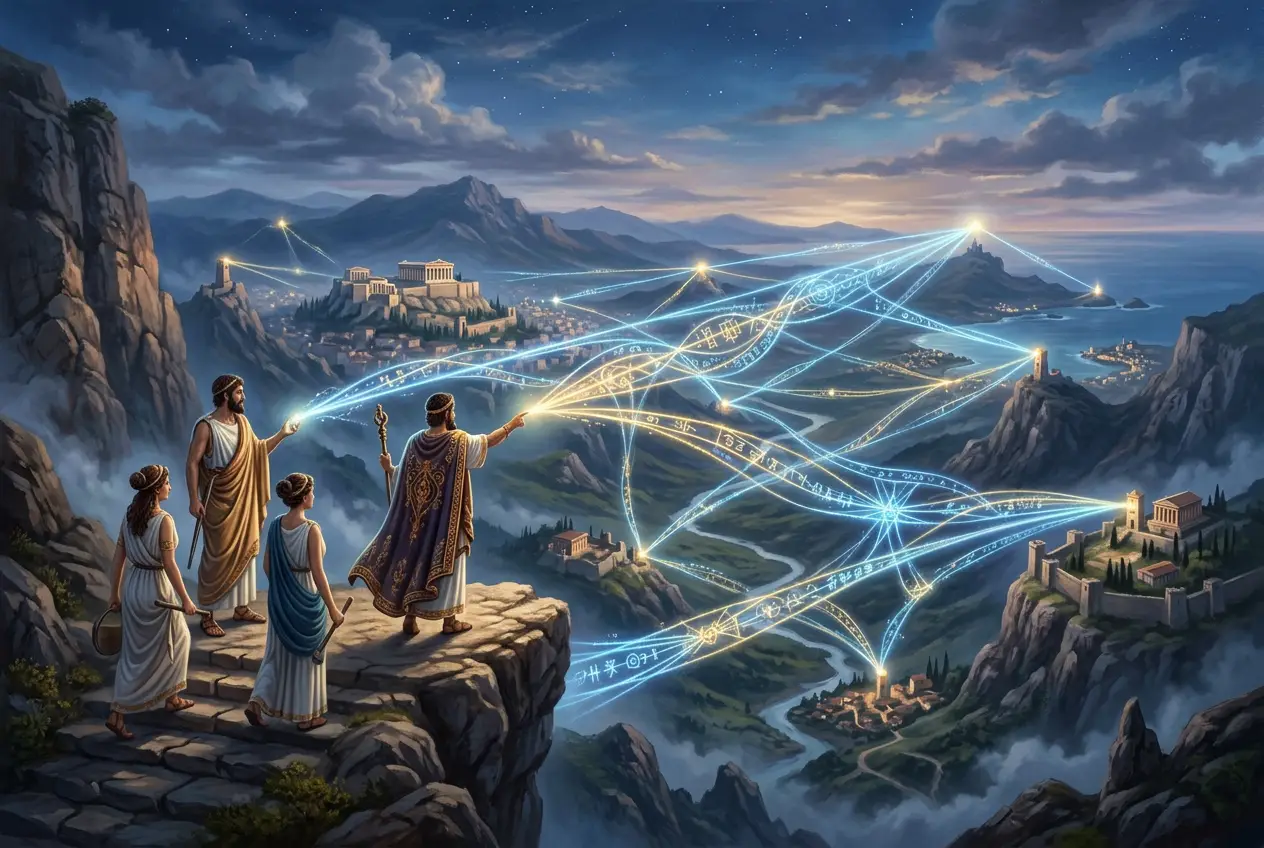
I’ve always been fascinated by the ingenuity of ancient civilizations. We often assume that without our modern silicon chips and fiber optics, they were limited to shouting across valleys or sending messengers on horseback. But what if I told you there’s compelling evidence suggesting they might have harnessed one of the fastest modes of communication available: light itself? Not just any light, but intelligently controlled, mirror-reflected beams capable of transmitting messages over vast distances.
Imagine standing atop a mountain, gazing at the horizon, not for an approaching army, but for a flicker of light from a distant outpost—a message from a city hundreds of miles away, relayed in mere minutes. This isn't science fiction from a forgotten era; it's a concept rooted in historical accounts and archaeological finds, suggesting that ancient mirrors were far more than just tools for vanity or illumination. Could they have been the precursors to our modern optical communication systems?
The Spark of an Idea: Ancient Optical Telegraphs
When I first delved into the history of communication, the focus was often on smoke signals, drums, or semaphore flags. These methods are effective but inherently limited by weather, line of sight, and the complexity of messages they can convey. Then I stumbled upon mentions of ancient mirror use that went beyond the mundane, hinting at something truly sophisticated.
The idea isn't entirely new. The heliograph, a device using mirrors to reflect sunlight over long distances for telegraphic communication, was widely used in the 19th and early 20th centuries, particularly by military forces. It proved incredibly effective for sending coded messages across vast, rugged terrain where wires or radio were impractical. This modern application immediately made me wonder: if we could do it with relatively simple technology in the 1800s, what capabilities might advanced ancient cultures have possessed, especially those renowned for their astronomical knowledge and engineering prowess?
Early Glimpses: Light Signals in History
Ancient texts and historical accounts provide tantalizing clues. For instance, the Greek historian Polybius (c. 200–118 BC) described a complex semaphore system that used torches to represent letters of the alphabet, relayed across successive stations. While not mirror-based, it demonstrated a clear understanding of line-of-sight optical communication for military and administrative purposes. However, a simpler and faster method might have involved mirrors.
The Romans, too, were masters of engineering and communication, establishing an extensive network of roads and signaling posts. While direct evidence of large-scale mirror-based communication is scarce, their practical approach to problem-solving suggests they would have exploited any effective means of rapid information transfer. For more on ancient communication methods, you might find our blog on the /blogs/phaistos-disc-ancient-data-or-lost-code-9785 fascinating, exploring other forms of ancient data.
The Science of Light Beaming
At its core, mirror communication relies on a few fundamental principles of physics: reflection, line of sight, and the speed of light.
- Reflection: Mirrors are highly efficient at reflecting light. The smoother and more polished the surface, the clearer and more focused the reflected beam. Ancient civilizations certainly possessed the ability to create highly polished metal mirrors (bronze, silver) or obsidian mirrors.
- Line of Sight: For communication, there needs to be an unobstructed path between two points. Ancient peoples often built their settlements and lookout posts on elevated positions, naturally facilitating long-distance line of sight.
- Speed of Light: This is the game-changer. Light travels at approximately 299,792,458 meters per second in a vacuum. Even accounting for atmospheric interference, an optical signal travels virtually instantaneously over terrestrial distances. Compared to a messenger taking days or weeks, light communication is incredibly fast.
The Power of the Sun and the Clarity of Night
Sunlight provides an abundant and powerful light source for daytime communication. A well-aimed mirror can reflect sunlight into a brilliant flash visible for many miles. At night, fire or lamps could be used. While less powerful, a focused beam from a well-crafted mirror could still be seen from a significant distance, especially against a dark sky.
Consider the precision required. Ancient astronomers, like those who might have mapped invisible skies as discussed in our /blogs/did-ancient-cultures-map-invisible-skies-7497 post, had an incredible understanding of celestial mechanics. This precision could easily translate to terrestrial aiming.
The Antikythera Mechanism: A Glimpse into Ancient Precision
While not a communication device, the Antikythera Mechanism, discovered in a shipwreck, is a profound testament to the sophistication of ancient Greek engineering and their understanding of complex mechanics. This device, a marvel of gears and dials, was essentially an analog computer used to predict astronomical positions and eclipses. Its existence shatters the notion that ancient technology was primitive. If they could build such intricate gearworks for calculating celestial movements, the idea of designing sophisticated mirror systems for communication becomes far more plausible. For more on this, Wikipedia’s article on the Antikythera Mechanism is an excellent resource: https://en.wikipedia.org/wiki/Antikythera_mechanism (opens in a new tab).
This level of precision wasn't an isolated incident. Think about the accuracy of ancient monuments like the pyramids, which align with cardinal directions and astronomical events. Such feats required not just immense labor but also advanced knowledge of geometry, surveying, and observation.
Hypothetical Ancient Heliographs
Let’s theorize about how an ancient mirror communication system might have worked:
- Fixed Stations: A network of strategically placed stations, perhaps elevated watchtowers or temples, each equipped with trained operators.
- Signaling Mirrors: Polished metal mirrors (bronze, silver, or even obsidian) capable of being precisely angled.
- Coding System: A pre-arranged code. This could be as simple as single flashes for 'danger' or sequences of flashes for a more complex alphabet (similar to Morse code, but with light).
- Relay System: Messages could be relayed from one station to the next, covering vast distances across empires.
The "Wow" Factor: Why This Matters
The possibility that ancient civilizations employed advanced optical communication methods is more than just a historical curiosity; it fundamentally shifts our understanding of their capabilities. It suggests:
- Technological Sophistication: It implies a deeper understanding of optics and engineering than commonly attributed, perhaps even rivaling some advancements of the early modern era.
- Strategic Advantage: Rapid communication was a tremendous military and administrative asset, allowing empires to react quickly to threats, coordinate troop movements, or disseminate decrees.
- Cross-Cultural Exchange: Such systems would foster faster exchange of ideas, goods, and cultural practices across vast geographical areas.
- Lost Knowledge: If such systems existed, why is direct evidence so scarce? Perhaps the materials (polished metal) were often recycled, or the practices were closely guarded secrets, passed down orally or within specific guilds. Just as we ponder if /blogs/ancient-robotics-did-automatons-precede-ai-3011, we should also consider if complex optical networks existed.
Archaeological Evidence and Unanswered Questions
While we have accounts of beacon fires and signal towers, direct archaeological evidence for sophisticated mirror-based communication devices is still somewhat elusive. This doesn't mean it didn't exist. Mirrors were valuable items, often melted down or repurposed. Furthermore, the operational aspects of such a system wouldn't necessarily leave grand ruins, unlike monumental architecture.
However, the discovery of highly reflective artifacts in ancient sites, alongside the strategic placement of certain structures, keeps the possibility alive. For example, some historians have speculated about the use of mirrors in the ancient world for everything from signaling to focusing sunlight for practical purposes, as detailed in Wikipedia's article on "Mirrors in Ancient Greece and Rome": [https://en.wikipedia.org/wiki/Mirror#Ancient_Greece_and_Rome (opens in a new tab)].
Modern Parallels and Future Implications
Today, optical fiber communication forms the backbone of the internet, transmitting vast amounts of data using light pulses. Laser communication is being explored for high-speed data transfer in space. The principle remains the same: light as a carrier of information.
If ancient cultures truly mastered such techniques, it challenges our linear view of technological progress. It suggests cycles of discovery and loss, where advanced knowledge could emerge, thrive, and then vanish, only to be rediscovered millennia later. It also encourages us to look at ancient artifacts and historical accounts with fresh eyes, searching for subtle clues of forgotten ingenuity. What other "impossible" ancient technologies might still be hiding in plain sight? Perhaps we should also consider how /blogs/unseen-forces-did-tesla-discover-free-energy-1748, given how much ancient technology remains a mystery.
I believe the question isn't whether ancient civilizations could have beamed information using mirrors, but rather to what extent they did. The evidence, though circumstantial, paints a picture of peoples far more ingenious and technologically savvy than often portrayed. It compels us to wonder: what other secrets are still hidden within the annals of history, waiting for us to shine a light on them?



Conversation0
No comments yet. Be the first to share a thought — the best questions often become new stories.