


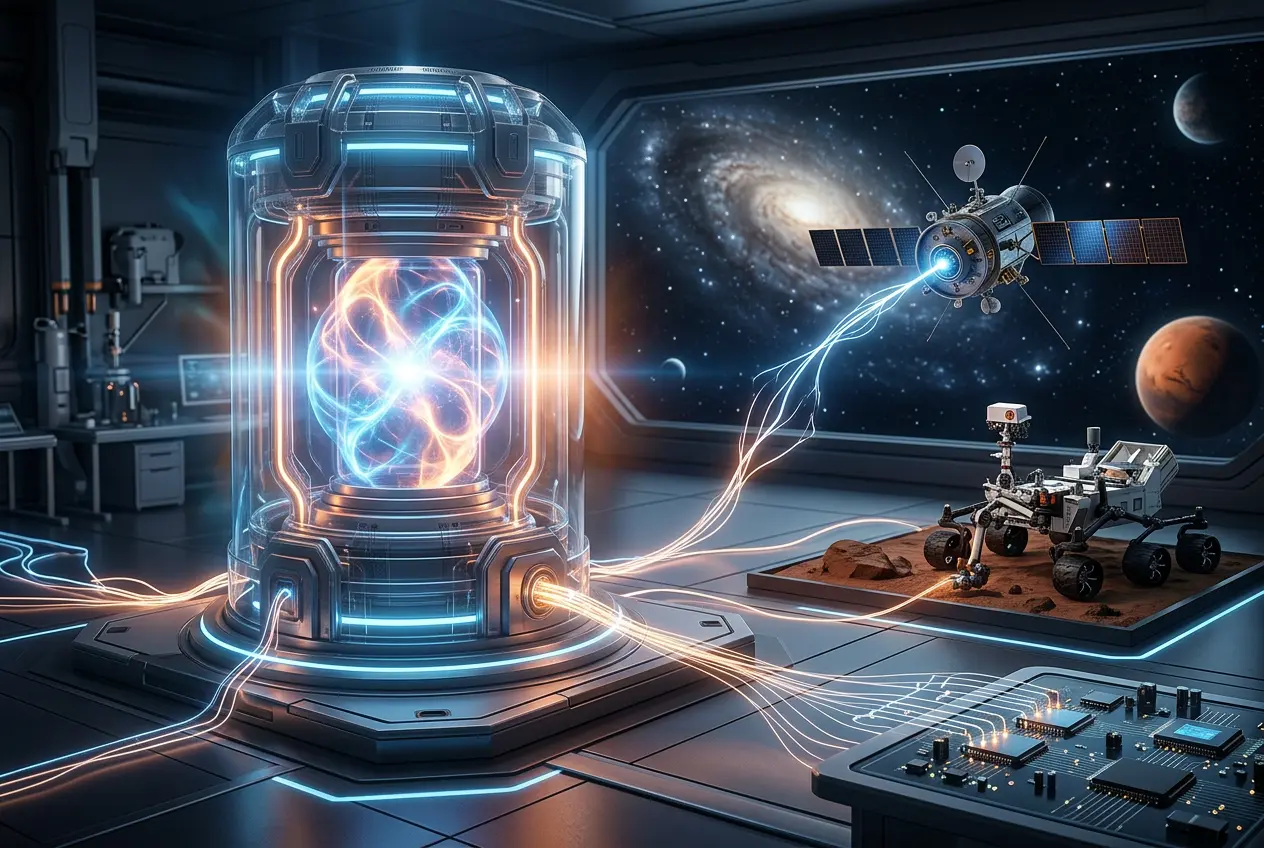
I've always been fascinated by the pursuit of endless energy. From science fiction tales of perpetual motion machines to real-world advancements in solar and wind power, the dream of a power source that just keeps going without needing a top-up has captivated humanity for centuries. But what if I told you that such a power source, one that can run for decades, even centuries, already exists and is quietly powering some of humanity’s most ambitious endeavors? I'm talking about atomic batteries, often shrouded in mystery, yet holding the potential to revolutionize how we power everything from our deepest space probes to perhaps, one day, even our implantable medical devices.
When most people hear "nuclear" and "battery" in the same sentence, their minds jump to nuclear power plants and their massive, complex reactors. But atomic batteries are a completely different beast. They don't rely on fission, the splitting of atoms, to generate vast amounts of power. Instead, they harness the gentle, continuous decay of radioactive isotopes to produce a steady trickle of electricity. Think of it as a tiny, contained radioisotope power generator, designed for longevity, not brute force.
The Silent Hum of Decades: How Atomic Batteries Work
At their core, atomic batteries, also known as radioisotope thermoelectric generators (RTGs) or nuclear batteries, operate on a surprisingly simple principle: radioactive decay. Certain unstable isotopes, like Plutonium-238, Strontium-90, or Nickel-63, naturally release energy as they transform into more stable elements. This decay process generates heat. The genius of an atomic battery lies in converting this heat directly into electrical energy.
The most common type, the Radioisotope Thermoelectric Generator (RTG), uses a phenomenon called the Seebeck effect. This effect states that a temperature difference across a junction of two dissimilar conductors or semiconductors creates a voltage. In an RTG, pellets of a radioactive isotope (like Plutonium-238 dioxide, a ceramic material) are placed in a container. As the isotope decays, it emits alpha particles, which are absorbed within the material, generating significant heat. This heat is then conducted to an array of thermoelectric couples (often made of materials like silicon-germanium or bismuth telluride). One side of these couples is kept hot by the isotope, while the other side is kept cooler, often by radiating heat into space or the environment. This temperature difference generates a small but continuous electric current.
For a deeper dive into thermoelectric effects, you can explore the Wikipedia page on them: Thermoelectric effect - Wikipedia (opens in a new tab).
Beyond RTGs: Other Nuclear Battery Designs
While RTGs are the most well-known, especially in space exploration, they aren't the only type of nuclear battery. Scientists and engineers are exploring several other fascinating designs:
- Betavoltaic Devices: These convert the energy from beta particle decay (high-energy electrons) directly into electricity, similar to how solar cells convert sunlight. Isotopes like Nickel-63 or Tritium are often used. These are typically lower power but can be made very small, making them ideal for micro-applications.
- Optovoltaic Devices: These use beta decay to produce light (luminescence), which is then converted into electricity by a photovoltaic cell.
- Alphavoltaic Devices: Similar to betavoltaic but utilize alpha particles.
- Stirling Radioisotope Generators (SRGs): These are more efficient than RTGs, using the heat from radioactive decay to power a Stirling engine, which then drives an alternator to produce electricity. While more efficient, they involve moving parts, which can introduce reliability concerns compared to the solid-state RTGs.
Where Do These "Eternal" Batteries Power Our World?
The unique properties of atomic batteries – their longevity, reliability, and independence from sunlight – make them indispensable for specific, often extreme, applications.
Space Exploration: The Unsung Heroes of Deep Space
This is where atomic batteries truly shine. Solar panels become ineffective the further a spacecraft travels from the Sun. For missions to the outer planets or interstellar space, RTGs are the only viable long-term power solution. I often think about the incredible journeys these batteries enable. Take NASA's Voyager 1 and 2 probes, launched in 1977. They are still transmitting data from interstellar space, powered by their original RTGs, decades after their intended lifespan. The Curiosity and Perseverance rovers on Mars also use RTGs, providing continuous power for their instruments and movement, regardless of dust storms or Martian night. Without them, our understanding of the outer solar system and Mars would be vastly poorer.
For more on the incredible Voyager program, visit their official NASA page: Voyager - NASA (opens in a new tab).
Terrestrial Niche Applications: Remote and Extreme Environments
On Earth, atomic batteries are used in niche applications where traditional power sources are impractical or impossible to maintain:
- Remote Scientific Stations: Powering automated weather stations or seismic sensors in the Arctic or Antarctic.
- Lighthouses and Buoys: Providing reliable power in isolated marine environments.
- Underwater Systems: Powering deep-sea sensors or transponders where cabling is infeasible.
- Medical Devices (Experimental/Historical): Though largely phased out due to safety concerns and better alternatives, early cardiac pacemakers sometimes used tiny plutonium-powered betavoltaic cells, offering extremely long lifespans.
The Promises and Perils: Why Aren't They Everywhere?
Given their incredible longevity, it's natural to wonder why atomic batteries aren't powering our smartphones or electric cars. The answer lies in a combination of factors:
High Cost and Rarity of Fuel
The isotopes used, particularly Plutonium-238, are extremely difficult and expensive to produce. Pu-238 is a byproduct of nuclear reactor operations and requires specialized processing. This scarcity drives up the cost significantly. You can learn more about the challenges of Plutonium-238 production on its Wikipedia page: [Plutonium-238 - Wikipedia](https://en.wikipedia.org/wiki/Plutonium-238).Low Power Output
While they last for ages, the power output of atomic batteries is relatively low. An RTG on a spacecraft might generate a few hundred watts – enough for scientific instruments and communication, but nowhere near what's needed for a typical household or a vehicle. Imagine trying to power your laptop with a battery that only provides enough current for a small LED lightbulb!Radiation Concerns
This is perhaps the most significant hurdle for widespread adoption. The radioactive material, even when safely encased, poses a potential radiation hazard if the casing is breached, say, in an accident. While extremely robust containment systems are designed, public perception and regulatory challenges remain a major barrier to terrestrial applications beyond highly controlled environments.Weight and Size
RTGs, especially those designed for deep space, are relatively heavy and bulky due compared to the power they produce, due to the need for shielding and robust construction.Looking Ahead: Miniaturization and New Isotopes
Despite these challenges, research into atomic batteries continues, driven by the desire for ultra-long-lasting, compact power sources. Scientists are exploring:
- New Isotopes: Investigating isotopes like Nickel-63 or Tritium for betavoltaic devices, which have shorter half-lives but emit less penetrating radiation, potentially allowing for smaller, safer designs for micro-power applications like micro-sensors or implantable devices.
- Improved Conversion Efficiency: Developing more efficient thermoelectric materials and exploring alternative conversion methods like dynamic systems (Stirling engines) to extract more power from the decaying isotopes.
- Nano-scale Atomic Batteries: Imagine tiny power sources embedded directly into circuits, providing power for decades without external recharging. This is a frontier of active research, moving towards integrating these power sources at the chip level.
I believe the true potential lies in these miniaturized applications. Think about the implications for remote IoT sensors, tiny medical implants that never need surgery for battery replacement, or autonomous systems operating for decades in harsh, inaccessible environments. The future of atomic batteries might not be in replacing your AA cells, but in powering the devices we never even knew could exist, functioning silently, reliably, and independently for a lifetime.
If you're interested in other profound technologies that push the boundaries of energy, you might also enjoy reading our article on the theoretical aspects of "Black Holes: Nature's Ultimate Quantum Computers" – it delves into different forms of extreme energy and information processing: Black Holes: Nature's Ultimate Quantum Computers. Or, for a dive into historical tech mysteries, check out "Did Ancient Greeks Build a Cosmic Computer?" which explores an ancient analogue computing device: Did Ancient Greeks Build a Cosmic Computer?.
The concept of "eternal" power, once confined to the realm of fiction, is slowly but surely becoming a quiet reality, powering our reach into the cosmos and enabling new frontiers here on Earth. While they won't be powering your smartphone anytime soon, the silent hum of atomic batteries will continue to drive some of humanity's most ambitious technological dreams forward, one slow, steady electron at a time.




Conversation0
No comments yet. Be the first to share a thought — the best questions often become new stories.