


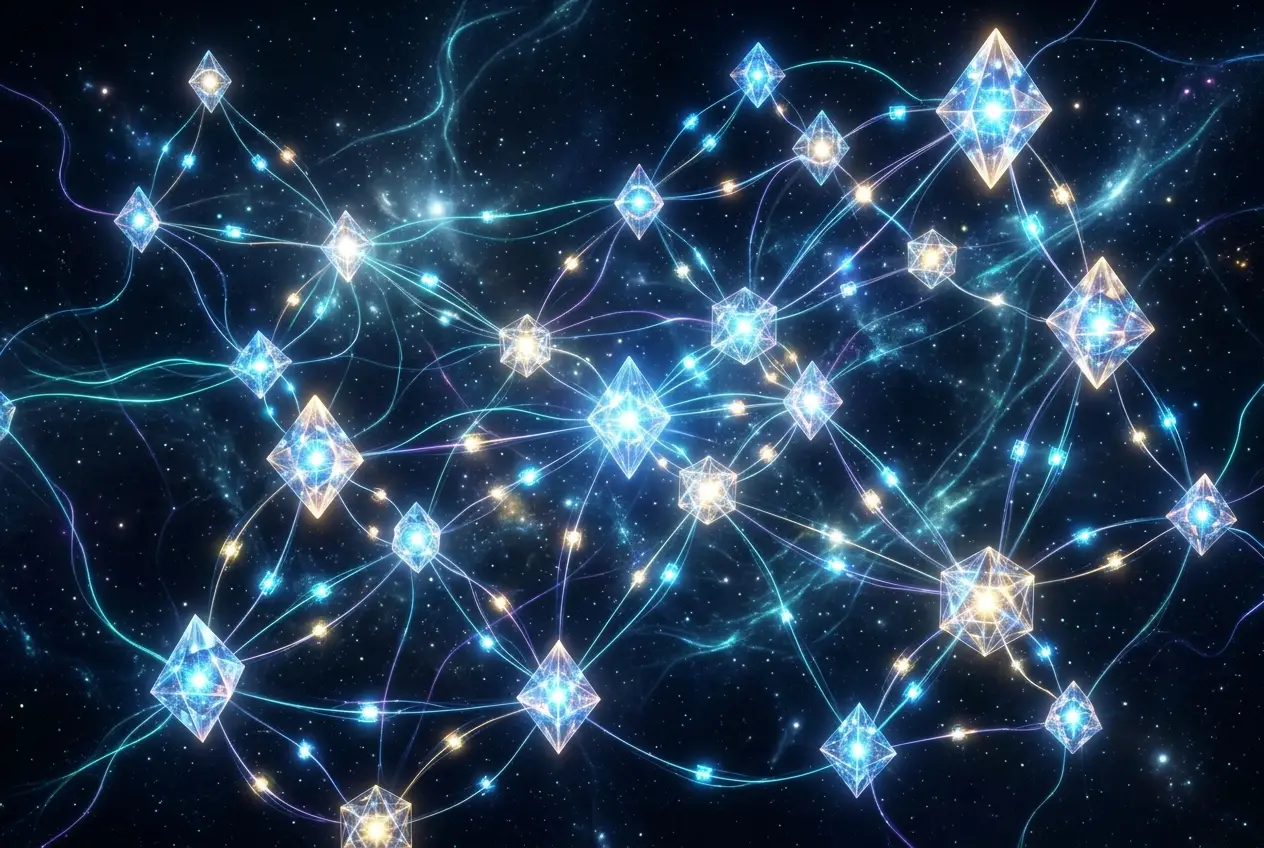
I often find myself contemplating the future of technology, specifically how our fundamental tools will evolve. Take the internet, for instance. For all its incredible power, it’s still fundamentally classical, sending information as bits (0s and 1s) that can be copied, intercepted, and sometimes, even broken. But what if we could build an internet far beyond anything we imagine today—one that leverages the mind-bending principles of quantum mechanics? This isn't science fiction; it’s the ambitious goal of building a quantum internet, and I believe the key might just lie in trapping light within tiny, specially designed crystals.
The Dawn of a Quantum Realm: Why a New Internet?
Our current internet infrastructure, built on classical physics, has transformed the world. From streaming movies to global communication, it underpins modern society. Yet, it faces growing challenges, especially concerning security and computational power. As classical computers become more powerful, existing encryption methods could one day become vulnerable. Moreover, certain computational tasks remain intractable, even for the most powerful supercomputers.
Enter quantum mechanics. This branch of physics describes the universe at its most fundamental level, where particles can exist in multiple states simultaneously (superposition) and become intrinsically linked regardless of distance (entanglement). These properties allow for a new form of information processing: quantum computing. A quantum internet aims to connect these quantum processors, enabling revolutionary applications like truly unbreakable encryption, distributed quantum computing, and hyper-sensitive networked sensors.
I remember thinking about the sheer audacity of trying to harness something as ephemeral as quantum states for a global network. It sounds almost impossible, right? Yet, scientists worldwide are making significant strides.
The Challenge of Quantum Communication
The basic unit of quantum information is the qubit, which, unlike a classical bit, can be 0, 1, or both simultaneously. Photons, particles of light, are ideal carriers for qubits because they travel at light speed and interact weakly with their environment, reducing decoherence (loss of quantum state). However, sending individual photons over long distances is incredibly difficult. They can be absorbed, scattered, or simply lost. Even worse, the "no-cloning theorem" of quantum mechanics means you can't simply copy a qubit to amplify it, unlike classical signals. This makes traditional repeaters, which boost signals by copying them, impossible for quantum networks.
So, how do we send quantum information across continents without losing it? This is where the magic of quantum memory comes into play, and specifically, light trapped in crystals.
Crystals as Quantum Vaults: Trapping Light for Qubits
Imagine a crystal not just as a pretty gemstone, but as a tiny, perfect vault designed to hold precious quantum information. That's essentially what researchers are developing. These crystals can temporarily store the quantum state of a photon, acting as a buffer or a node in a larger network.
One promising approach involves rare-earth-doped crystals. These are conventional crystals (like yttrium orthosilicate or praseodymium-doped yttrium silicate) that have been infused with trace amounts of rare-earth ions. These ions, when cooled to cryogenic temperatures, possess unique electronic structures that allow them to absorb and re-emit photons without disturbing their fragile quantum states.
Another exciting avenue involves diamond nitrogen-vacancy (NV) centers. Here, a nitrogen atom replaces a carbon atom in a diamond lattice, with a vacant site next to it. This NV center acts like a tiny artificial atom with electron spins that can be controlled and used as qubits. These NV centers can efficiently interact with photons, allowing them to capture and release quantum information while maintaining coherence. For more details on quantum memory, Wikipedia offers a comprehensive overview: Quantum memory (opens in a new tab).
The process generally works like this:
- A photon carrying a qubit enters the specially prepared crystal.
- The crystal absorbs the photon, transferring its quantum state to the electron spins of the embedded ions or defects.
- The quantum state is held within the crystal for a certain period (coherence time).
- On demand, the crystal re-emits a photon, ideally preserving the original quantum state.
I find this concept particularly elegant. It's like catching a fleeting thought and holding it perfectly still, then releasing it exactly as it was.
Building the Quantum Network: Repeaters and Entanglement
So, once we can trap light and store qubits in crystals, how do we build an internet? This is where quantum repeaters become crucial. Unlike classical repeaters that copy and amplify signals, quantum repeaters work by distributing entanglement.
Imagine two distant quantum nodes, each with its own crystal-based quantum memory. To establish a connection, an entangled pair of photons is generated. One photon goes to node A, the other to node B. Each node stores its photon's quantum state in its crystal. If the connection between A and B is too long for a single photon to travel reliably, intermediate quantum repeaters are used. These repeaters don't copy the photons; instead, they perform a Bell-state measurement on incoming entangled photons from adjacent segments. This measurement "extends" the entanglement across the repeaters, effectively creating a direct entangled link between the two distant end nodes.
This process is complex and relies heavily on the ability to store qubits reliably in crystals and perform precise quantum operations. For a deeper dive into the mechanics of quantum repeaters, you can refer to the Wikipedia article: Quantum repeater (opens in a new tab).
Current Progress and the Road Ahead
While the concept sounds futuristic, tangible progress is being made. Research groups around the world, like those at QuTech in the Netherlands and the Quantum Internet Alliance, are building prototype quantum networks. They are demonstrating entanglement distribution over increasingly longer distances, using techniques involving trapped ions, superconducting qubits, and, critically, quantum memories based on these specialized crystals.
One of the biggest hurdles I see is maintaining coherence—the ability of a quantum system to maintain its quantum state without decohering. Environmental interference, even tiny vibrations or temperature fluctuations, can cause qubits to lose their delicate states. This is why many experiments are performed at extremely low, cryogenic temperatures. Scaling these systems up from laboratory settings to a global network is another monumental challenge.
Applications That Will Change Everything
If we succeed in building a functional quantum internet, the implications are profound:
- Unbreakable Encryption (Quantum Cryptography): The principles of quantum mechanics mean that any attempt to eavesdrop on a quantum communication link would inevitably disturb the quantum state, alerting the communicating parties. This is known as Quantum Key Distribution (QKD), offering truly impenetrable security for sensitive data. This goes beyond the theoretical limits of what traditional cryptography can achieve. We’ve explored the power of quantum computers against encryption in our blog: Can Quantum Computers Break Every Encryption?
- Distributed Quantum Computing: Imagine pooling the processing power of multiple distant quantum computers, allowing them to solve problems far beyond the capacity of any single machine. This could accelerate discoveries in medicine, materials science, and artificial intelligence.
- Ultra-Precise Sensing: Networked quantum sensors could offer unprecedented precision for applications ranging from deep-space navigation to medical diagnostics, leveraging entanglement to make measurements far more accurate than classical methods.
- Secure Interstellar Communication: While still very speculative, a quantum internet could potentially enable communication with quantum computers on other celestial bodies, offering secure and perhaps even faster-than-light (through theoretical loopholes of entanglement) data transfer. We've touched upon related ideas in Can Quantum Entanglement Fuel Interstellar Comm?.
The Vision of a Connected Quantum Future
Building a quantum internet is not just about faster data transfer; it's about fundamentally rethinking how information can be processed and secured. The idea that common, everyday crystals, when engineered at the quantum level, could become the building blocks of this future, is truly mind-boggling. I believe the journey will be long, filled with complex scientific and engineering challenges, but the destination—a world powered by the quantum—promises to be incredibly rewarding.
It’s a testament to human ingenuity that we’re moving from mere optical communication, where light carries classical bits, to a future where light itself is intricately woven into the fabric of quantum information. If you're fascinated by the potential of light-based computation, you might enjoy our post: Can Light Think? The Dawn of Optical Computing.
In conclusion, the vision of a quantum internet, underpinned by the remarkable ability of crystals to trap and store light's quantum essence, is rapidly evolving from theoretical speculation to experimental reality. As research progresses, these quantum memories could indeed become the vital nodes in a network that will redefine communication, security, and computing for generations to come.



Conversation0
No comments yet. Be the first to share a thought — the best questions often become new stories.