


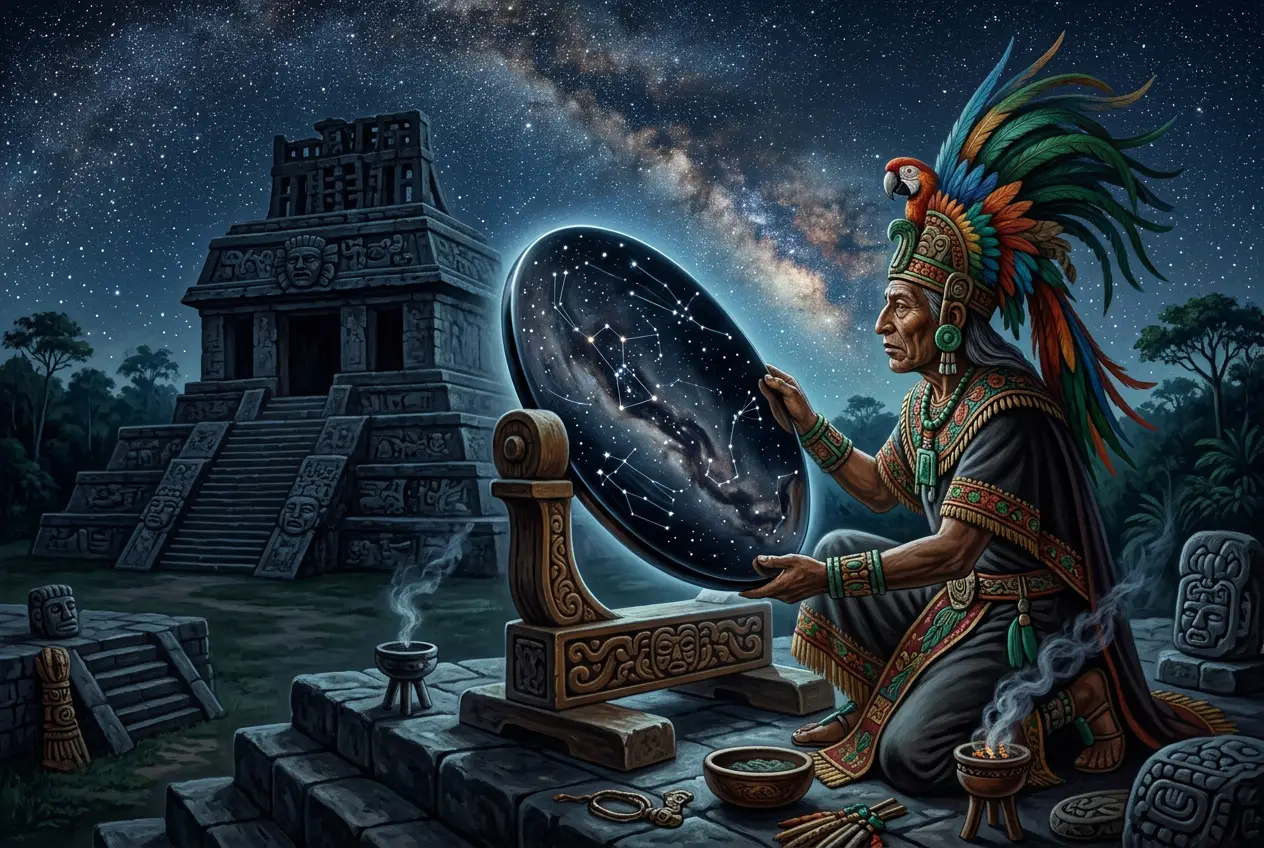
I remember a recent trip to a museum, standing before an exhibit on Mesoamerican artifacts. Amidst intricate pottery and jade carvings, one object truly caught my eye: a highly polished disk of obsidian. It was dark, almost impossibly smooth, and held a subtle, eerie sheen that seemed to absorb the light around it. Most people might just see a vanity mirror, but I couldn't shake the feeling that something so meticulously crafted, from such a unique material, held a deeper secret. Could ancient civilizations, particularly those in Mesoamerica, have used these obsidian mirrors for something far more complex than just self-reflection? Could they have been tools to decode the very heavens above us?
It’s a thought that triggers wonder, isn't it? We often associate advanced optics and astronomical observation with modern telescopes or, at best, the intricate bronze instruments of ancient Greeks. But what if a naturally occurring volcanic glass held a key to unlocking cosmic mysteries for civilizations thousands of years ago? This isn't just about gazing at one's reflection; it's about harnessing a material's inherent properties to perceive the unseen, to connect with the cosmos in ways we're only beginning to understand.
The Enigma of Obsidian: More Than Just a Rock
Obsidian, a naturally occurring volcanic glass, forms when molten lava cools so rapidly that crystal growth is inhibited. This fast cooling results in a hard, brittle material with exceptionally sharp edges when fractured – making it prized for tools and weapons across many ancient cultures. But its unique properties extend beyond mere sharpness. When polished, obsidian can achieve an astonishingly smooth, reflective surface.
Ancient Mesoamerican cultures, particularly the Maya and Aztecs, were masters of working with obsidian. They crafted everything from sacrificial knives and ceremonial objects to elaborate mirrors. These mirrors were not just mundane items; they were imbued with profound symbolic and ritualistic significance. Often associated with deities like Tezcatlipoca (the "Smoking Mirror" god), obsidian mirrors were believed to be conduits to other realms, tools for divination, and even portals for communicating with ancestors or gods.
But what if this spiritual significance was rooted in a practical, scientific understanding of the material's optical properties?
Optical Qualities of Obsidian: A Different Kind of Reflection
Unlike modern glass mirrors which use a metallic coating, obsidian mirrors achieve their reflectivity through the inherent smoothness of the polished volcanic glass itself. This fundamental difference is crucial. While a perfect modern mirror aims for a flat, undistorted reflection, obsidian, with its slight imperfections and unique refractive index, might have offered a different kind of visual experience.
Think about it:
- Subtle Distortions: The inherent molecular structure of volcanic glass, even when polished, can create subtle distortions. These distortions, far from being flaws, might have been intentionally leveraged. Imagine a reflection of the night sky, where stars twinkle, but perhaps their precise positions are slightly shifted or diffused in a way that highlights patterns or relationships not immediately obvious to the naked eye.
- Absorptive Properties: Obsidian is incredibly dark, often appearing black. This darkness means it absorbs a significant amount of light, preventing internal reflections and glare that might plague other reflective surfaces. This could have made it ideal for observing faint celestial objects or subtle atmospheric phenomena, especially in low light conditions.
- Focusing Light (or lack thereof): While not true lenses, large, carefully ground obsidian surfaces could, hypothetically, have been shaped to focus light in a rudimentary way, perhaps intensifying the image of a distant star or planet for closer study. Or, conversely, they could have diffused light to reveal broader celestial patterns.
"The use of obsidian mirrors among Mesoamerican cultures was deeply intertwined with their worldview," notes ancient history researcher Dr. Elizabeth Benson. "They weren't merely functional items; they were instruments of perception, blurring the lines between the material and the divine." This perspective pushes us to look beyond simple utility and consider how ancient peoples might have interpreted and utilized phenomena we now classify purely as "scientific." For more on the material properties of obsidian, you can refer to this comprehensive Wikipedia article: Obsidian (opens in a new tab).
Decoding the Ancient Skies: A Hypothesis
Let's venture into the realm of possibility. Ancient civilizations were astute astronomers, tracking celestial movements with remarkable precision. The Maya, for example, developed sophisticated calendars and predicted eclipses with astonishing accuracy. They built intricate observatories like El Caracol at Chichen Itza, carefully aligning structures to celestial events. You can read more about their advanced astronomical knowledge here: Maya Astronomy (opens in a new tab).
Could obsidian mirrors have played a role in these observations?
1. Enhanced Celestial Observation
Imagine an ancient astronomer, perhaps a priest-king, using a large, polished obsidian mirror to gaze at the night sky. The mirror wouldn't magnify like a modern telescope, but its dark, reflective surface might have:
- Reduced light pollution: By isolating the reflected light from the faint starlight, it could have made dimmer objects more visible.
- Highlighted subtle colors: Some researchers suggest that obsidian’s unique interaction with light might have enhanced the perception of subtle colors in nebulae or planetary atmospheres that are difficult to discern with the naked eye.
- Pattern recognition: The slight distortions could have "filtered" the sky, causing certain star patterns to stand out or appear more coherent, aiding in the identification of constellations or the tracking of planetary paths. This is reminiscent of how some visual artists intentionally distort images to emphasize certain elements.
This idea aligns with the concept of ancient peoples using simple, yet effective, optical tools as we explored in previous posts like our discussion on whether ancient lenses revealed hidden worlds or how ancient observatories functioned as cosmic clocks.
2. Observing Atmospheric Phenomena
Beyond the stars, the ancient world was deeply connected to atmospheric phenomena – clouds, lightning, aurorae (in higher latitudes). Obsidian mirrors might have been used to observe these:
- Solar observation (indirectly): While dangerous to look directly at the sun, an obsidian mirror could have provided a filtered, indirect reflection of solar events like sunspots or atmospheric disturbances caused by solar flares.
- Cloud formations and weather prediction: Subtle shifts in cloud patterns, hard to discern against the vast sky, might have been made more apparent on the dark, reflective surface, aiding in rudimentary weather prediction.
- Glimpsing rare phenomena: Perhaps phenomena like sprites or other upper-atmospheric electrical discharges, which are transient and subtle, could have been captured or made more discernible in the unique reflection of an obsidian mirror.
3. Ritual and Divination: A Scientific Undercurrent?
The ceremonial use of obsidian mirrors for divination and scrying is well-documented. While often dismissed as pure superstition, could there have been a more grounded, yet spiritual, understanding at play?
- Altered perception: Staring into a dark, reflective surface, especially under specific lighting conditions (e.g., moonlight or firelight), can induce a semi-hypnotic state. This state might enhance pattern recognition or allow the observer to notice subtle details in the reflection that they might otherwise overlook.
- Psychological priming: If a culture believes a mirror can reveal truths, the act of scrying itself, combined with the unique visual input from obsidian, could have facilitated a form of guided intuition or pattern interpretation based on observed celestial events.
The Modern Perspective: Recreating Ancient Optics
Modern scientists and historians have begun to explore the practical applications of ancient obsidian artifacts. Researchers have, for instance, experimented with recreating ancient obsidian tools and have found them to be surprisingly effective. The field of archaeoastronomy continually seeks to understand how ancient peoples observed and interpreted the cosmos using the tools available to them.
Recreating and testing ancient obsidian mirrors with precise measurements of their optical properties could offer fascinating insights. We could model how different curvatures or polishing techniques would affect the reflection of celestial objects. Would they create specific types of diffraction? Would certain patterns emerge that are not visible otherwise? This kind of experimental archaeology could bridge the gap between archaeological finds and scientific understanding.
"The more we delve into ancient technologies, the more we realize the sophistication often hidden behind seemingly simple materials," says Dr. Benavides, an expert in archaeoastronomy. "We might be projecting our modern understanding of 'technology' too narrowly when looking at these incredible artifacts." This echoes our exploration of ancient advanced materials, like the capabilities of Damascus steel and whether it surpassed modern material science.
The Lingering Questions
The idea that ancient obsidian mirrors were sophisticated tools for astronomical observation or decoding celestial patterns remains largely a hypothesis. It challenges our conventional understanding of ancient technology and their scientific capabilities. However, given their mastery of obsidian, their deep astronomical knowledge, and the profound symbolic significance attached to these mirrors, it's a compelling narrative worth exploring further.
Did ancient Mesoamericans truly use obsidian's peculiar optical properties to gain a unique perspective on the cosmos? Did they interpret the subtle distortions, the deep absorption, and the unique reflections as messages from the divine, perhaps even as a form of "cosmic display" that revealed deeper truths about the universe's mechanics? The answers remain elusive, hidden perhaps in the silent, dark reflections of these enigmatic ancient mirrors. But what I do know is that every time I see an obsidian artifact, I no longer just see a shiny rock; I see a potential window into an ancient mind, trying to read the universe with tools far more imaginative than we often give credit for.
Ultimately, the obsidian mirror stands as a powerful symbol of human curiosity – a testament to our timeless drive to understand our place in the universe, using whatever means, ancient or modern, we can muster.


Conversation0
No comments yet. Be the first to share a thought — the best questions often become new stories.