


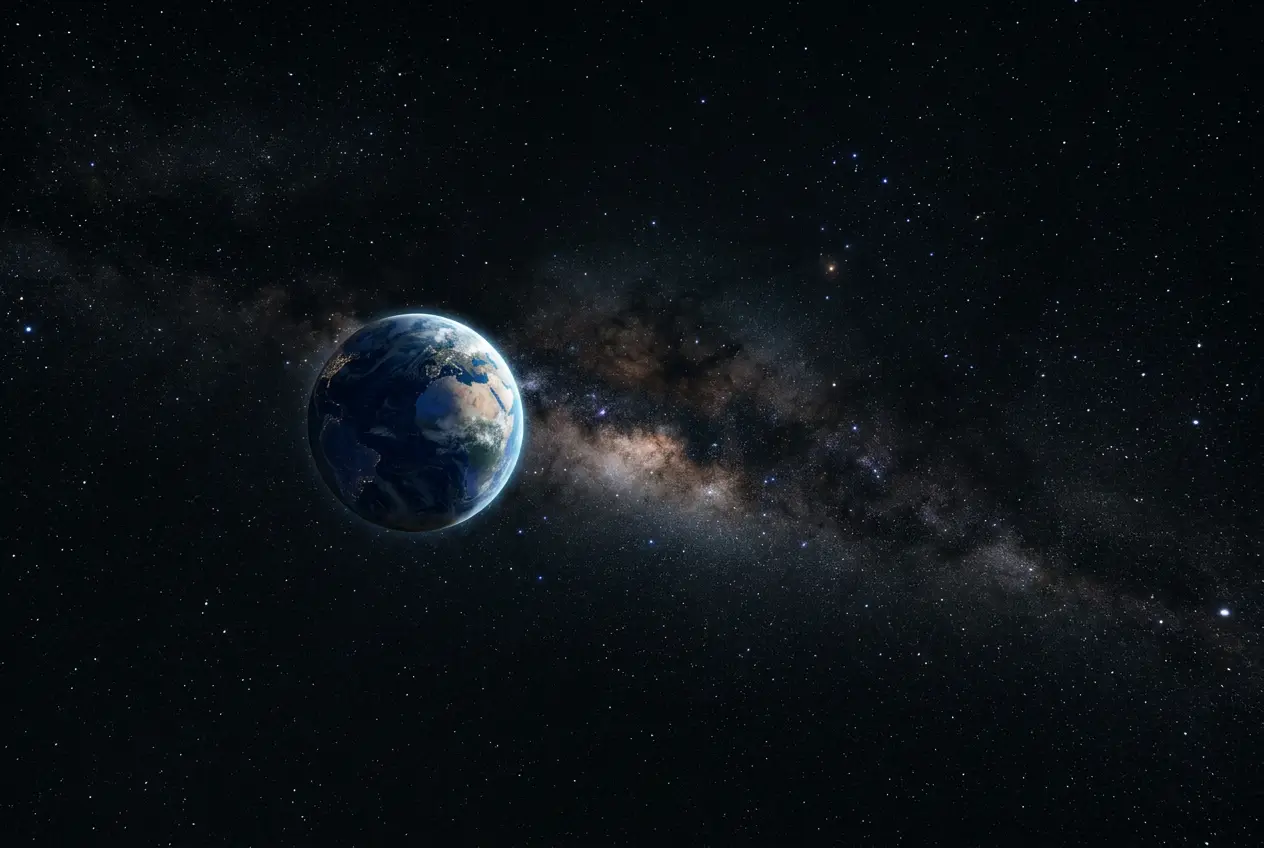
I remember staring up at the night sky as a child, utterly captivated by the countless pinpricks of light. Each one, I was told, was a star, many with their own planets. The sheer scale of it all was mind-boggling. "Are we alone?" I’d ask my dad, a question I’m sure countless others have posed. He’d usually just smile and say, "The universe is a big place, son."
That simple question, "Are we alone?", has haunted humanity for centuries. It's the core of what’s known as the Fermi Paradox. Enrico Fermi famously, or perhaps infamously, asked: "Where is everybody?" Given the vastness of the universe, the billions of galaxies, each with billions of stars, and the likelihood of Earth-like planets existing in countless numbers, it seems statistically improbable that we are the only intelligent, technological civilization. Yet, here we are, listening to the cosmic silence.
This silence is what gave rise to one of the most compelling, and frankly, chilling, ideas in astrobiology: The Great Filter. It’s a hypothetical barrier or series of barriers that makes the emergence of intelligent, space-faring life incredibly difficult. Imagine a grand cosmic obstacle course, and most civilizations either stumble and fall, or never even make it to the starting line.
Unpacking the Great Filter: What Could It Be?
The Great Filter isn’t a single, definitive event; it’s a concept encompassing any and all obstacles that could prevent life from reaching an interstellar stage. These barriers could be behind us, meaning we’ve already passed them, or they could be ahead of us, looming in our future. The implications of where the filter lies are profound and shape our understanding of humanity's place in the cosmos.
Filters Behind Us: A Cosmic Stroke of Luck?
If the Great Filter is in our past, it means something incredibly rare and improbable had to happen for us to exist. This would suggest that life, especially complex, intelligent life, is far rarer than we currently estimate.
1. The Origin of Life (Abiogenesis): The leap from non-living chemicals to self-replicating organisms is one of the greatest mysteries of science. While we can simulate aspects of it in labs, the precise conditions and mechanisms remain elusive. Some theories suggest it was an extremely rare fluke, requiring a perfect storm of environmental factors that might only occur once in a billion planetary systems. If so, most planets are barren, devoid of even microbial life.
2. The Jump to Eukaryotic Cells: For nearly two billion years, life on Earth remained simple prokaryotes. The evolution of complex eukaryotic cells – with their membrane-bound organelles and nuclei – was a monumental leap, enabling multicellularity and specialization. This "great leap forward" may have been another extremely rare event, a bottleneck for all advanced life forms. You can learn more about this incredible evolutionary step on Wikipedia (opens in a new tab).
3. The Rise of Complex Multicellularity: From single-celled organisms to complex animals and plants required another series of evolutionary innovations. The Cambrian Explosion, for example, saw an incredible diversification of animal life in a relatively short geological period. Could this burst of complexity be a rarity in the universe?
4. The Development of Intelligence and Technology: Even with complex life, the path to tool-making, abstract thought, and eventually, advanced technology capable of interstellar communication or travel, is not guaranteed. Many species on Earth are intelligent, but none have developed the kind of technology we possess. Perhaps the conditions for our specific brand of intelligence and technological advancement are exceptionally unique. This path to a truly advanced civilization, one capable of capturing its star's entire energy, might be a filter itself, as explored in the concept of a Dyson Sphere.
If any of these past filters are indeed the "Great Filter," then our existence is a miracle, and we might truly be alone, or at least one of an incredibly select few. This prospect is both humbling and, in a strange way, comforting.
Filters Ahead of Us: The Ominous Future
This is where things get truly unsettling. If the Great Filter lies ahead, it means that many civilizations likely reach our current stage (or even beyond), only to be extinguished before they can become interstellar. This implies a future fraught with peril, a cosmic test that most fail.
1. Self-Destruction Through Technology: Our own history offers a stark warning. The development of nuclear weapons brought humanity to the brink of self-annihilation. Climate change, runaway AI, bioweapons, or novel energy sources gone awry could all represent filters. What if advanced AI, as it learns to dream, also develops unforeseen existential threats? A civilization might develop technology capable of interstellar travel, but simultaneously create its own undoing.
2. Resource Depletion and Environmental Collapse: A growing technological civilization demands immense resources. The finite nature of planetary resources, coupled with the environmental impact of industrialization, could lead to a civilization's collapse before it can spread to other worlds. Depleting resources or altering a planet's climate beyond recovery could be a common trap.
3. Cosmic Catastrophes: While less likely to be a universal filter for all civilizations, localized cosmic events could certainly wipe out individual ones. Supervolcanoes, asteroid impacts, gamma-ray bursts, or nearby supernova explosions are all potential planet-killers. While we might survive one, a series could be devastating. For more on the vastness of cosmic possibilities, consider exploring types of multiverses.
4. Failure to Achieve Interstellar Travel: The sheer engineering challenge and energy requirements of interstellar travel are immense. Perhaps most civilizations simply hit a wall here, unable to develop the necessary propulsion or sustainability to colonize other star systems before they face other internal or external challenges. The difficulties in maintaining life and data over vast periods could even make something as fundamental as Earth's ancient "living rocks" seem like advanced data storage by comparison, a topic explored in are-living-rocks-earths-oldest-data-storage-9847.
If the Great Filter is ahead, then our continued silence from the cosmos isn't a sign of our uniqueness, but rather a terrifying premonition. It means we could be hurtling towards a universal catastrophe that has claimed countless other intelligent species. This perspective makes the search for extraterrestrial intelligence not just a scientific endeavor, but a desperate quest for insight into our own potential future.
"The Fermi Paradox is the contradiction between the high probability estimates for the existence of extraterrestrial intelligence and the lack of observational evidence to support it." - Seth Shostak, Senior Astronomer, SETI Institute
The Simulation Hypothesis: An Alternative Filter?
While not strictly part of the traditional Great Filter framework, the Simulation Hypothesis offers another intriguing explanation for the cosmic silence. If our reality is merely a sophisticated computer simulation, as posited by philosophers and scientists alike, then the "empty" cosmos could simply be an artifact of the simulation itself. The simulators might have no reason to fill the universe with other active civilizations, or perhaps we are part of an isolated "experiment." This idea challenges our very perception of existence, delving into whether our reality could be a simulation. In this scenario, the filter isn't about overcoming physical barriers but about the nature of our simulated existence.
What Does This Mean for Humanity?
The concept of the Great Filter is not meant to be a fatalistic prophecy but a profound thought experiment. It encourages us to critically examine our trajectory as a species. If the filter is behind us, we should cherish our improbable existence and strive to protect it. If it’s ahead, it’s a powerful call to action: to overcome the challenges that threaten our long-term survival.
Understanding the Great Filter compels us to invest in sustainable technologies, foster global cooperation, develop ethical AI, and expand our reach into space. Our future, and perhaps the future of intelligent life in this galaxy, may very well depend on our ability to identify and navigate this cosmic test. The silence of the universe might not be empty; it might be a warning. And listening to that warning could be the key to ensuring humanity's continued journey among the stars. Our curiosity, our drive to explore, and our capacity for innovation are our greatest tools in facing whatever filter lies ahead.
Conversation0
No comments yet. Be the first to share a thought — the best questions often become new stories.