


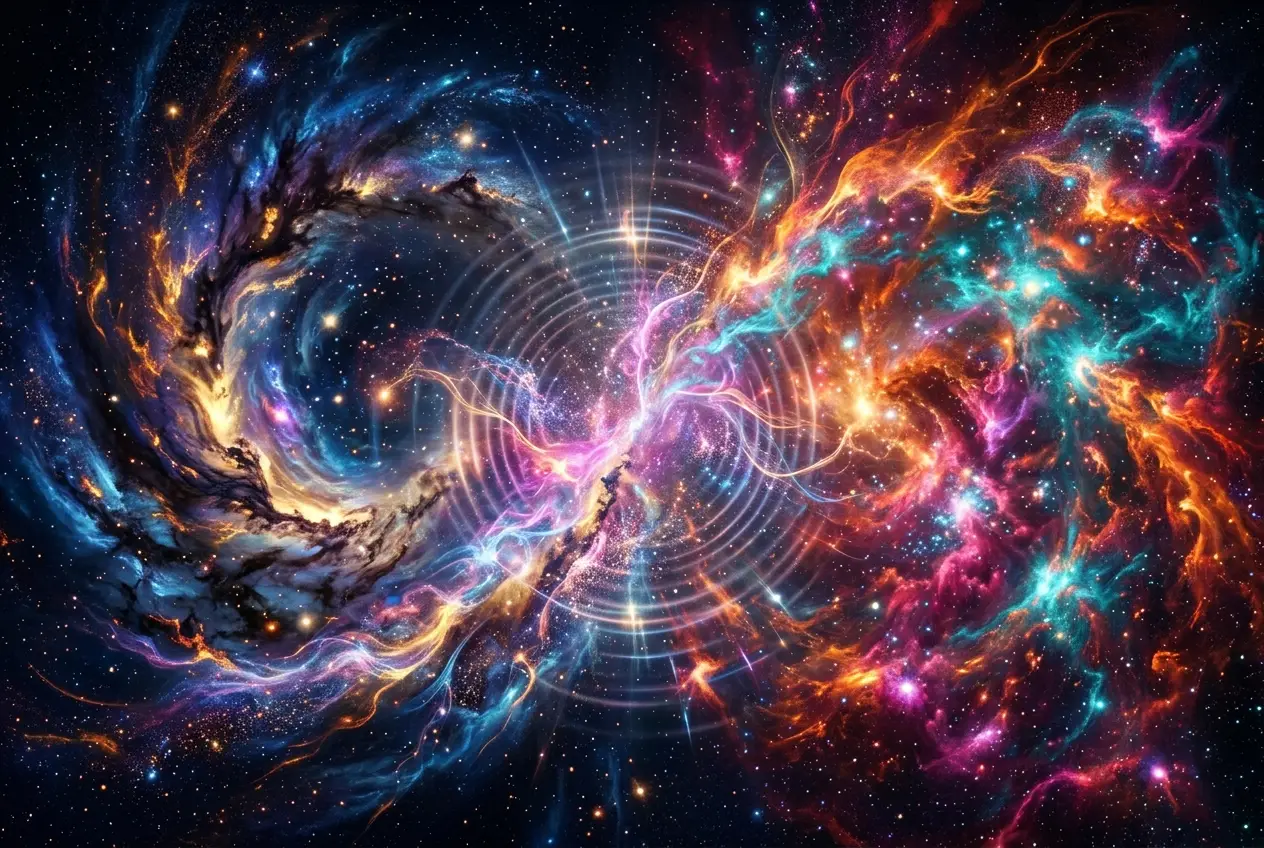
I remember staring up at the night sky as a child, convinced there was more to reality than what my eyes could see. More stars, more planets, more... everything. It was a simple, youthful wonder, but as I delved deeper into the mysteries of physics, that childhood fascination evolved into a profound curiosity: What if that "more" wasn't just beyond our galaxy, but right here, co-existing with us in an unseen dimension? What if our universe isn't alone? And what if, at this very moment, other universes are not just existing parallel to ours, but actively colliding?
The idea of parallel universes, or a "multiverse," has long been a staple of science fiction, painting vivid pictures of alternate realities where every choice leads to a different destiny. But for physicists, it's far more than fiction. It’s a serious, albeit mind-bending, consequence of several leading scientific theories. From quantum mechanics to string theory, evidence, or at least strong theoretical implications, points towards an existence far grander and stranger than our single observable universe.
The Multiverse Theory: A Cosmic Smorgasbord
Before we dive into the dramatic notion of cosmic collisions, let’s briefly explore the leading theories that suggest a multiverse. The concept isn’t a single, monolithic idea, but rather a collection of different models, each with its own fascinating implications.
1. The Infinite Universe Theory: Imagine our universe as a bubble in an infinitely stretching fabric of space-time. If space is truly infinite and matter is distributed in a finite number of ways, then eventually, patterns of matter must repeat. This means somewhere out there, infinitely far away, there’s an exact copy of you, reading this exact blog. And another, and another. It’s mind-boggling, but statistically, if space is infinite, it’s practically inevitable.
2. Bubble Universes (Inflationary Multiverse): This theory stems from the concept of cosmic inflation, the rapid expansion of the early universe. Some versions of inflation suggest that space is expanding forever, and during this eternal expansion, new "bubble universes" can continuously sprout off from our own. Each bubble could have different physical laws, constants, and dimensions. Our universe would just be one of countless such bubbles, floating in an ever-expanding cosmic foam. You can read more about how theories consider hidden dimensions in this context in our blog on extra dimensions.
3. Many-Worlds Interpretation of Quantum Mechanics: This is perhaps the most famous and philosophically challenging. Quantum mechanics, the study of the very small, tells us that particles exist in a superposition of states until observed. When an observation is made, the wave function "collapses," and only one outcome is realized. The Many-Worlds Interpretation (MWI) posits that all possible outcomes are realized, but in different, non-interacting parallel universes. Every quantum event, every decision, branches the universe into countless new realities. It's a universe of infinite possibilities, constantly splitting.
4. Brane Worlds (String Theory): String theory, attempting to unify all fundamental forces, suggests that the universe isn't made of point-like particles, but tiny vibrating strings. Critically, these strings require extra spatial dimensions beyond the three we perceive. Sometimes, these extra dimensions are "compactified" or curled up, making them invisible. But in some string theory models, our entire universe is a "brane" – a giant, three-dimensional membrane – floating in a higher-dimensional space called the "bulk." Other branes, i.e., other universes, could exist parallel to ours within this bulk.
These different multiverse models, while varied, share a common thread: they challenge our anthropocentric view of the cosmos, hinting at a reality far more expansive and intricate. For more on how we conceptualize reality, explore the idea of our universe as a hologram.
The Collision Course: When Worlds Meet
The concept of colliding universes isn't just a dramatic thought experiment; it's a specific prediction arising from some of these multiverse theories, particularly the bubble universe and brane world models.
Imagine two bubbles in a cosmic foam, floating closer and closer. What happens when they touch? Or visualize two parallel branes, usually separated by an imperceptibly tiny gap in the bulk. What if that gap shrinks, or they exert gravitational forces upon each other?
In the bubble universe scenario, a collision could leave a definitive imprint on our universe. When our bubble universe crashes into another, the impact could create a "bruise" or "scar" in the fabric of space-time. This scar might manifest as a circular cold or hot spot in the Cosmic Microwave Background (CMB), the ancient relic radiation from the Big Bang.
For brane worlds, a collision could be even more profound. In some models, the Big Bang itself was not an isolated event, but rather the result of a collision between two branes. Our universe, and everything within it, could be the direct product of such an impact. What if another such collision is imminent, or has already subtly happened?
Seeking the Scars: How Do We Look for Cosmic Collisions?
Detecting evidence of parallel universe collisions is a monumental task, requiring instruments of incredible sensitivity and an understanding of physics that pushes current boundaries. But scientists are already looking for potential "scars" or anomalies.
1. Anomalies in the Cosmic Microwave Background (CMB): The CMB is our oldest map of the universe, a faint glow from when the universe was just 380,000 years old. It’s incredibly uniform, but it does have tiny fluctuations in temperature. These fluctuations are the seeds of all the galaxies and structures we see today. If our universe had collided with another, it might have left a distinctive, non-random pattern in the CMB – perhaps a series of concentric circles of unusual temperatures, or large, inexplicable cold spots.
- Scientists use data from missions like the Planck satellite and the WMAP mission to meticulously map the CMB. While initial analyses have found some intriguing anomalies, none have been definitively attributed to inter-universe collisions. For example, some models predict specific patterns like "dipoles" or "quadrupoles" if our universe suffered a glancing blow from another. Researchers continue to refine their statistical methods to distinguish between random cosmic fluctuations and true signatures of collisions. Dr. Matthew Johnson, a theoretical physicist at Perimeter Institute, has been at the forefront of this research, developing mathematical models to predict collision signatures. According to Johnson, "If our universe collided with another, it would leave a very specific, statistically unlikely pattern in the cosmic microwave background radiation. It's like finding a dent in a perfect sphere." (Source: Wikipedia on Cosmic Microwave Background Anomalies (opens in a new tab))
2. Gravitational Wave Signatures: If brane collisions involve immense energy and cataclysmic events, they could generate powerful gravitational waves. While current gravitational wave observatories like LIGO and Virgo are primarily designed to detect events like black hole mergers, future, more sensitive detectors might be able to pick up the fainter, more exotic signatures of cosmic-scale collisions. These would be very different from typical astrophysical gravitational waves, potentially presenting a unique "chirp" or background noise that hints at a larger cosmic event.
3. Dark Matter and Dark Energy Interactions: Some theories propose that dark matter, the invisible substance making up about 27% of our universe, might be interacting with matter from a parallel universe. A collision could have transferred dark matter or dark energy from one universe to another, influencing the expansion rate or structure formation in our own. Investigating the mysterious nature of dark matter could potentially reveal hints of inter-universe interactions, as explored in our piece on dark matter hiding a universe we can't see.
4. Fundamental Constant Variations: If universes have different physical laws and constants, a collision could locally affect the values of our own fundamental constants (like the speed of light or Planck’s constant). Observing subtle, unexplained variations in these constants across vast cosmic distances could be another tantalizing clue.
The Implications: A Universe Reimagined
The prospect of colliding universes is not just a scientific curiosity; it has profound philosophical implications. If our universe is merely one of many, a single bubble in a cosmic ocean, it fundamentally changes our perception of existence and our place within it.
- Rethinking the Big Bang: If the Big Bang was a brane collision, it moves away from a singular point of creation to a dynamic interaction within a larger, pre-existing bulk.
- The Uniqueness of Our Universe: Are our physical laws and constants finely tuned by chance, or are they simply one set among an infinite array of possibilities? This question, known as the "fine-tuning problem," finds a natural explanation in the multiverse, where every possible set of laws exists somewhere.
- The Search for Life: If other universes exist, especially those with different laws, could life exist in forms we can barely imagine? Could entire civilizations flourish under physics that would be alien to us?
While no definitive proof of colliding universes has been found yet, the ongoing search pushes the boundaries of cosmology and fundamental physics. It reminds us that our understanding of reality is still nascent, and the cosmos holds secrets far grander and more astonishing than we can currently comprehend. The universe, or perhaps the multiverse, continues to whisper its tales through cosmic echoes, inviting us to listen more closely.
Could we ever truly detect and understand such events? The journey requires not just bigger telescopes and more sensitive detectors, but also a shift in our conceptual frameworks, daring to imagine beyond the familiar confines of our observable universe. The quest for cosmic collisions is, in essence, a quest to truly understand where—and what—we are.
Conversation0
No comments yet. Be the first to share a thought — the best questions often become new stories.