I often find myself gazing at the night sky, feeling the vastness of the cosmos, yet knowing that what I perceive is merely a fraction of reality. What if the universe isn’t just vast, but also *deeper*? What if our familiar three spatial dimensions are just one thin slice of a much larger, more complex cosmic pie, and these hidden layers are actively shaping the very physics we observe? This isn't science fiction; it’s a profound question at the heart of modern physics, exploring whether **extra dimensions** could be the unseen engines powering some of the universe's most exotic phenomena.
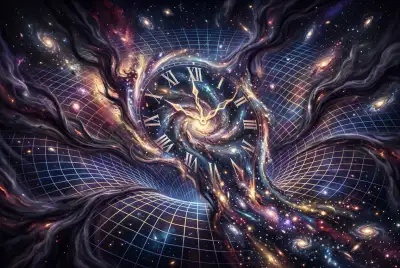
For centuries, our understanding of the universe has been anchored in four dimensions: length, width, height, and time. This framework, brilliantly articulated by Einstein, describes how gravity works and how particles interact. Yet, as our precision in observing the cosmos grows, mysterious anomalies persist. The weakness of gravity compared to other fundamental forces, the elusive nature of dark matter, and the accelerating expansion driven by dark energy all hint that our current model might be incomplete. Could the answer lie in dimensions we can't directly perceive, woven into the very fabric of spacetime?
### The Whispers of a Hidden Reality: Why Extra Dimensions?
The idea of extra dimensions isn't new; it has roots in early 20th-century theories. One of the earliest proponents, Theodor Kaluza, suggested in 1919 that unifying Einstein's general relativity with Maxwell's electromagnetism could be achieved if the universe possessed a fifth dimension. This groundbreaking concept, later refined by Oskar Klein, proposed that this extra dimension might be **"compactified"**, or curled up into an incredibly tiny circle, too small for us to detect directly. Imagine a garden hose from afar – it looks one-dimensional, but up close, an ant can walk around its two-dimensional surface. This analogy gives us a simple way to visualize a hidden, curled-up dimension.
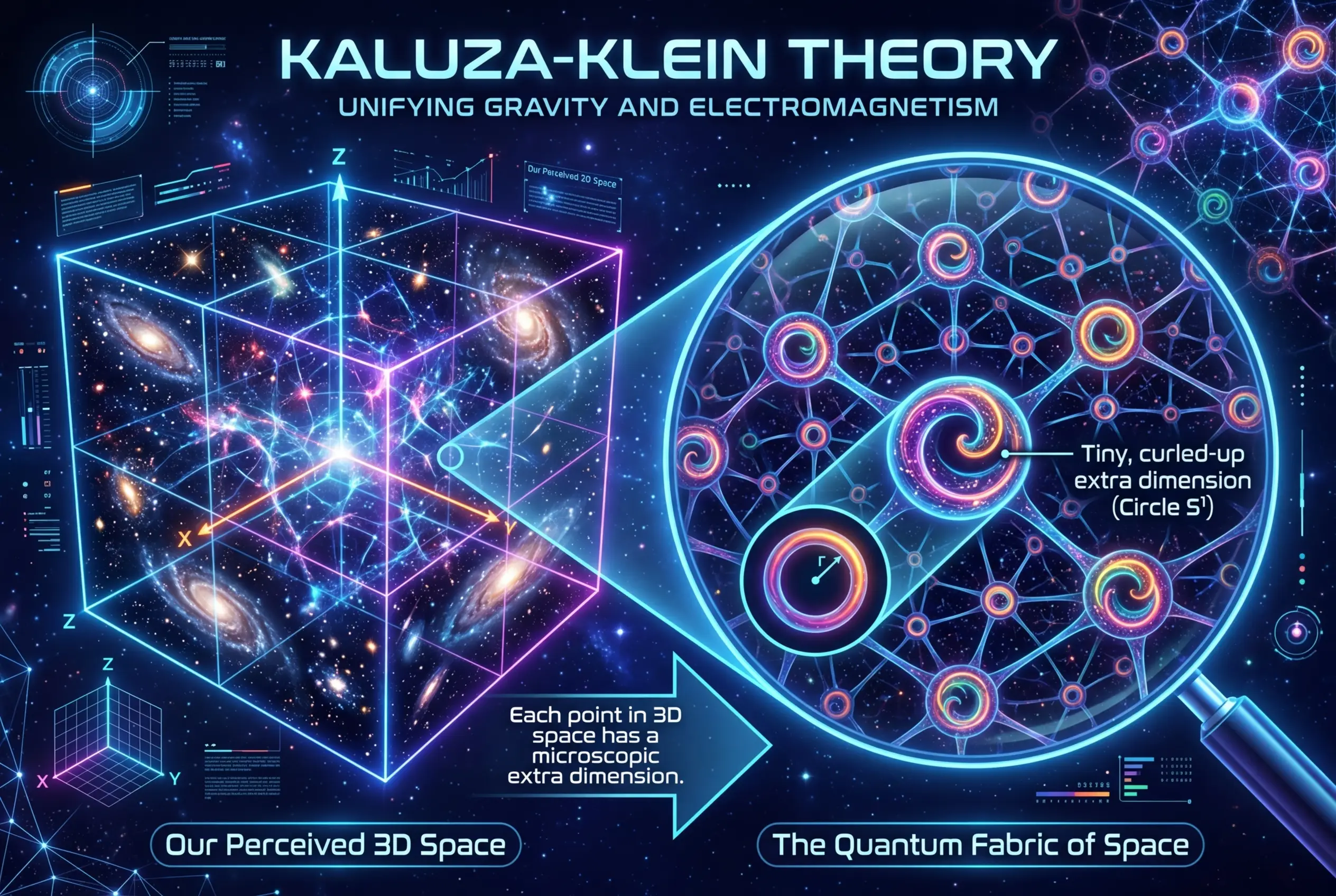
While Kaluza-Klein theory didn't fully unify all forces, it laid the groundwork for modern theories that posit multiple extra dimensions. Today, the most prominent framework championing their existence is **String Theory** and its successor, **M-theory**. These theories propose that fundamental particles aren't point-like objects but tiny, vibrating strings or membranes. For these strings to exist consistently, the universe requires far more than four dimensions – often 10 or 11. Most of these extra dimensions are thought to be compactified, perhaps in incredibly complex, geometric shapes called Calabi-Yau manifolds, much too small to ever observe directly.
"The more we learn about the universe, the more we realize how much we don't know." – Albert Einstein
### The Hierarchy Problem: Gravity's Weakness and Leaky Dimensions
One of the most compelling reasons physicists theorize about extra dimensions is the perplexing **hierarchy problem**. Simply put, gravity is astronomically weaker than the other fundamental forces (electromagnetic, strong nuclear, and weak nuclear forces). If you hold a magnet near a paperclip, the tiny magnet easily overcomes the gravitational pull of the entire Earth. Why such a colossal discrepancy?
Some theories, particularly those involving **Large Extra Dimensions (LEDs)**, propose an elegant solution. What if gravity isn't inherently weak, but simply *appears* weak to us because much of its influence "leaks" into these large extra dimensions? In this "brane world" scenario, our entire observable universe – all the matter, light, and other forces – is confined to a 3-dimensional "brane," while gravity is free to propagate through the bulk of higher dimensions. This could explain why gravity feels so diluted in our brane, as much of its strength is spread thin across the wider, unseen cosmic landscape. You can learn more about how spacetime might store data in these complex frameworks by checking out our blog on [Could Spacetime Store Quantum Data?](/blogs/could-spacetime-store-quantum-data-2719).
### Exotic Physics from Beyond: Dark Matter and Dark Energy
The cosmos is teeming with mysteries that current physics struggles to explain, namely **dark matter** and **dark energy**. Dark matter, an invisible substance that makes up about 27% of the universe, provides the gravitational glue that holds galaxies together, yet we can't detect it directly. Dark energy, comprising roughly 68% of the universe, is an even more enigmatic force accelerating the universe's expansion. Could extra dimensions be the key to unlocking these cosmic conundrums?
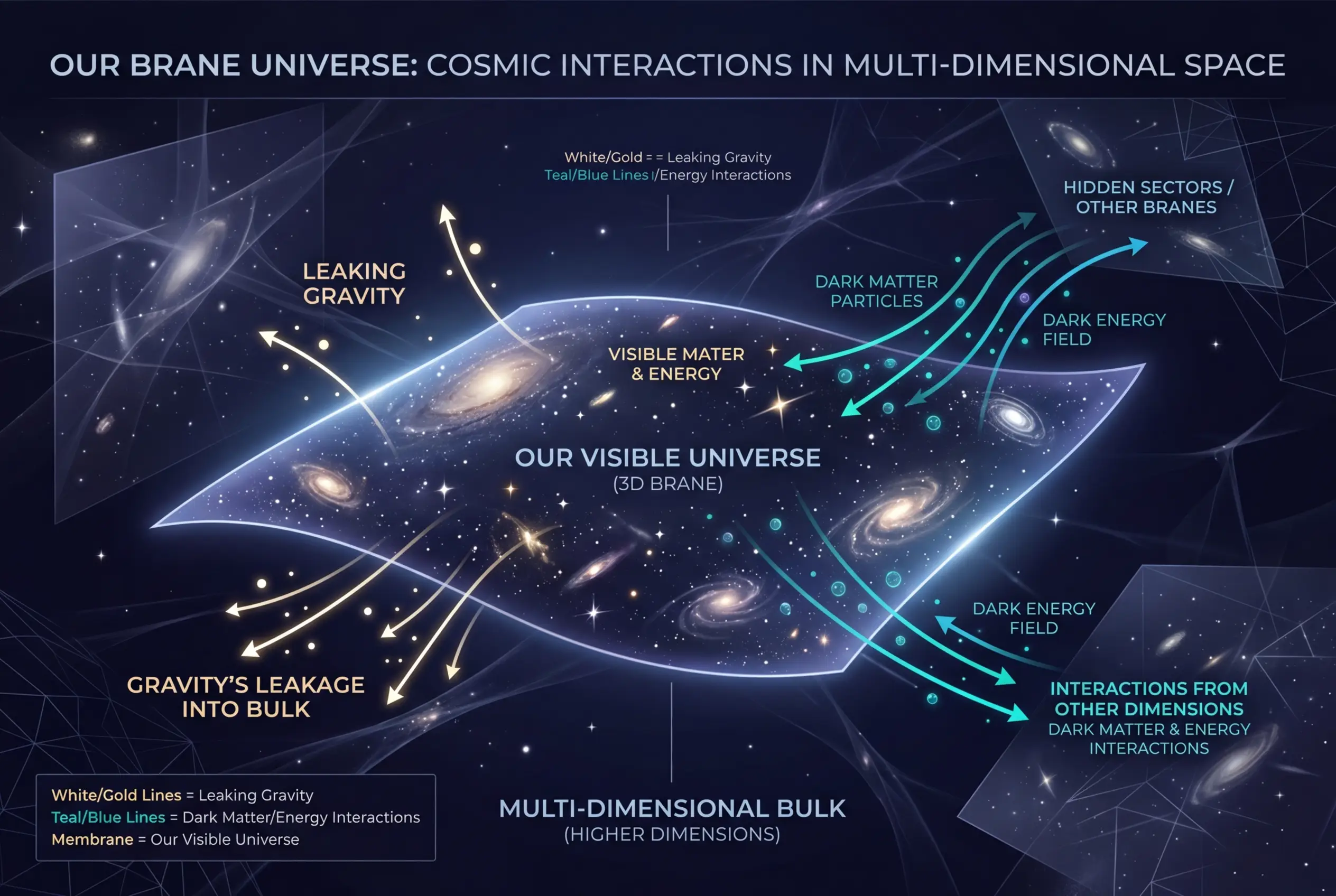
Some models suggest that dark matter particles might be **Kaluza-Klein particles** – ordinary particles that acquire extra mass by moving in the compactified extra dimensions. In essence, these particles would be "vibrating" differently in higher dimensions, making them undetectable by our usual means. Similarly, dark energy could be a manifestation of the dynamics of these hidden dimensions. Perhaps it’s the vacuum energy of these extra dimensions, or some exotic field residing there, that influences the expansion of our perceived reality. The concept that cosmic ripples might tear spacetime, as discussed in [Do Quantum Ripples Tear Spacetime?](/blogs/do-quantum-ripples-tear-spacetime-1543), could be another way to visualize such interdimensional influences.
### Hunting for the Unseen: Experimental Probes
Detecting extra dimensions is an enormous challenge, but physicists are actively pursuing several avenues:
1. **Particle Colliders (e.g., LHC):** If extra dimensions exist, especially large ones, particle collisions at extreme energies could produce tell-tale signs. When particles collide at the Large Hadron Collider (LHC), they create a shower of new particles. If gravity can leak into extra dimensions, some energy from these collisions might "disappear" into these unseen realms. Detecting a significant amount of **missing energy** could be indirect evidence of particles briefly venturing into or from higher dimensions. Another possibility is the creation of **Kaluza-Klein gravitons**, which would be heavier versions of gravitons (the hypothetical force carriers of gravity) that could be detected. You can read more about how the universe itself might compute by visiting our blog [Can the Cosmic Web Compute Our Universe's Fate?](/blogs/can-the-cosmic-web-compute-our-universes-fate-1603).
For a deeper dive into the Large Hadron Collider's role in exploring fundamental physics, check out its Wikipedia page: [Large Hadron Collider](https://en.wikipedia.org/wiki/Large_Hadron_Collider).
2. **Gravitational Wave Detectors:** If gravity truly propagates through higher dimensions, it might behave differently at very small distances or produce distinct gravitational wave signatures. Experiments like LIGO and Virgo, designed to detect ripples in spacetime, might one day detect anomalies that point to extra dimensions. Some theories even suggest that gravitational waves could "escape" into the bulk, altering their observed properties.
3. **Tabletop Experiments:** Scientists are also conducting highly sensitive tabletop experiments to test gravity's behavior at extremely small scales. Deviations from Newton's inverse-square law at sub-millimeter distances could indicate that gravity is "spreading out" into an extra dimension.
Further insights into the theoretical frameworks, like String Theory, that predict extra dimensions can be found on Wikipedia: [String Theory](https://en.wikipedia.org/wiki/String_theory).
### The Promise of Exotic Technology
If extra dimensions are real and we could somehow interact with or exploit them, the implications for technology and our understanding of the universe would be staggering.
* **New Forms of Energy:** Could we tap into energy sources residing in other dimensions? Or perhaps exploit the "leakage" of fundamental forces for new power generation methods?
* **Faster-Than-Light Travel/Communication:** While highly speculative, some physicists have pondered if navigating through extra dimensions could offer shortcuts through spacetime, potentially enabling interstellar travel or communication that bypasses the limitations of light speed in our 3D world.
* **Novel Materials:** The influence of extra dimensions could lead to the discovery or creation of materials with utterly bizarre properties, unlike anything we currently understand. Imagine materials that derive their strength or superconductivity from interactions in a hidden dimension.
* **Enhanced Computing:** If our universe is indeed a giant neural network, as explored in [Is the Universe a Giant Neural Network?](/blogs/is-the-universe-a-giant-neural-network-2907), then perhaps extra dimensions play a role in its computational power, opening pathways for new forms of computing.
The journey to uncover extra dimensions is a testament to human curiosity and our relentless pursuit of deeper truth. It challenges our perception of reality, pushing the boundaries of what is possible and what remains hidden. While direct proof remains elusive, the theoretical elegance and the potential to resolve some of physics' greatest enigmas make the hunt for these hidden dimensions one of the most exciting frontiers in science. Whether they are compactified coils, vast branes, or something we haven't even conceived, the possibility that extra dimensions **power exotic physics** reminds us that the universe is far stranger, and far more wondrous, than we could ever imagine.
 Join Us



 Unknown Author
















Leave a Reply
Comments (0)