


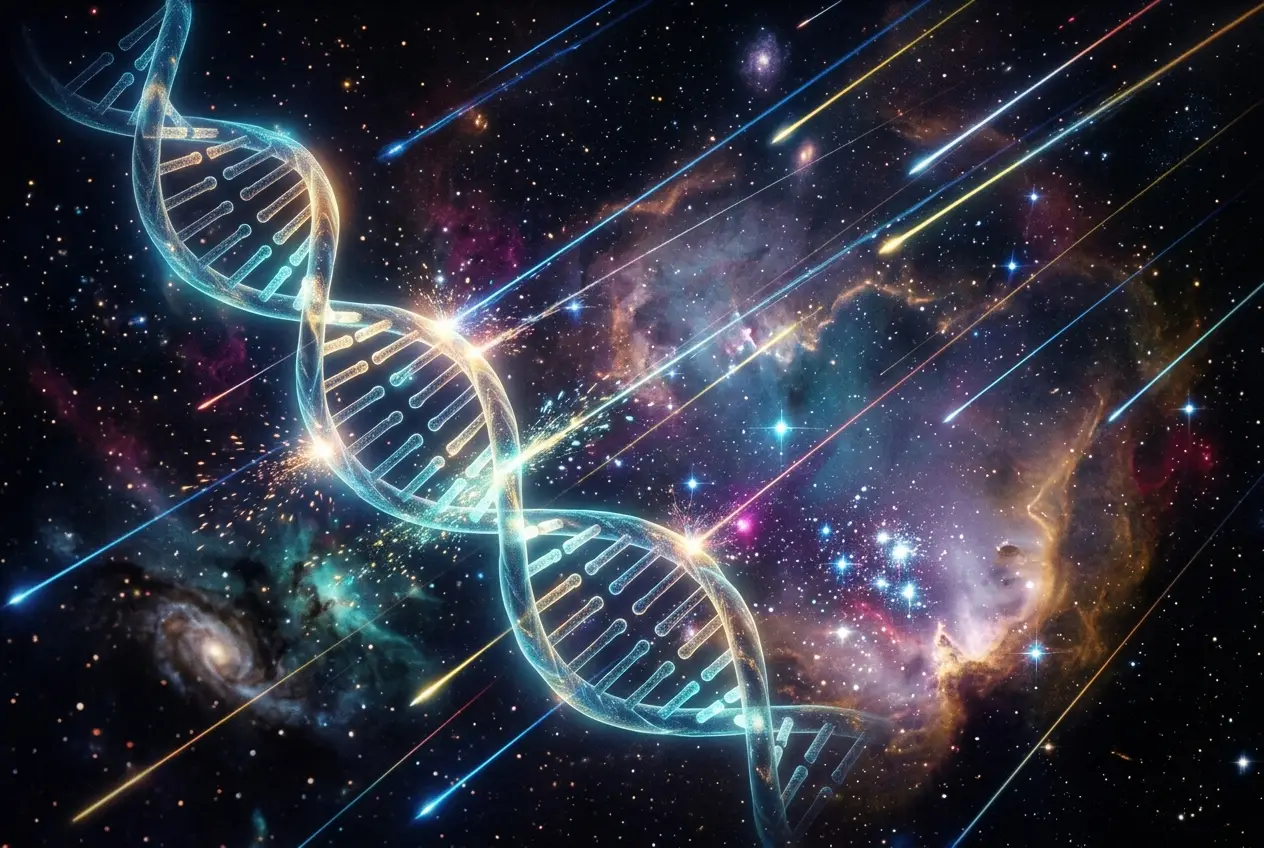
I’ve always been captivated by the idea of interstellar travel, of humans venturing beyond our planetary cradle to explore new worlds. It's a dream that fuels my imagination, picturing sprawling space stations and brave astronauts making their way to distant stars. But recently, I've been pondering the unseen hazards that lie between us and that future. Beyond the vacuum and temperature extremes, there’s a silent, invisible threat that could fundamentally alter what it means to be human: cosmic radiation.
When I consider the vast emptiness of space, I often think of it as a pristine void. Yet, it's anything but. It's a cosmic shooting gallery, constantly bombarded by high-energy particles traveling at relativistic speeds. These aren't just faint whispers; they are powerful bullets, and our biological bodies, particularly our delicate DNA, are directly in their crosshairs. The question that truly piqued my curiosity, and honestly, a little bit of my anxiety, is: could these cosmic rays actually change our DNA?
What Exactly Are Cosmic Rays? An Invisible Barrage
Before we dive into the potential genetic alterations, let's first understand what we're up against. Cosmic rays aren't a single type of radiation; they're a complex spectrum of high-energy particles originating from various astrophysical phenomena. I categorize them broadly into two main types:
- Galactic Cosmic Rays (GCRs): These are the true heavyweights, originating from outside our solar system, primarily from supernova remnants and other violent events in distant galaxies. GCRs consist mostly of protons (about 87%), helium nuclei (about 12%), and a small but significant percentage of heavier atomic nuclei (HZE ions, like iron, silicon, and carbon) which are far more damaging due to their mass and charge. They are constantly present, a steady, high-energy drizzle. For more technical details on their composition and origin, I often refer to this comprehensive resource on cosmic rays: https://en.wikipedia.org/wiki/Cosmic_ray (opens in a new tab)
- Solar Energetic Particles (SEPs): These are generated much closer to home, primarily by our own Sun during solar flares and coronal mass ejections (CMEs). SEPs are typically protons and electrons, and while individually less energetic than GCRs, they can be emitted in massive, unpredictable bursts. I recall reading about instances where a powerful solar storm could deliver a lethal dose of radiation to an unprotected astronaut in just hours. This makes space weather prediction crucial, similar to how we need to understand terrestrial gamma-ray flashes for certain atmospheric phenomena. You can read more about the impact of solar storms on our technology and environment in our blog: Could Solar Storms Ignite Digital Chaos?
The Cosmic Punch: How Radiation Damages DNA
So, how do these particles, traveling at nearly the speed of light, interact with something as minuscule and intricate as our DNA? The process is quite direct and, frankly, brutal. When a high-energy particle (like a GCR proton or heavy ion) collides with an atom in our body, it can strip away electrons, creating ions and free radicals. This process is called ionization.
I've learned that this damage can occur in two primary ways:
- Direct Ionization: The cosmic ray particle directly hits a DNA molecule, breaking its chemical bonds. This can lead to single-strand breaks (SSBs) or, more critically, double-strand breaks (DSBs). DSBs are particularly dangerous because they are harder for the cell to repair correctly and can lead to significant genetic instability.
- Indirect Damage (Free Radicals): More commonly, the cosmic ray interacts with water molecules (which make up a large percentage of our body mass). This interaction generates highly reactive free radicals, such as hydroxyl radicals. These free radicals then attack the DNA, causing oxidative damage, base modifications, and again, those dreaded strand breaks.
Our cells are remarkably resilient, equipped with sophisticated DNA repair mechanisms. Enzymes tirelessly work to fix these breaks and correct errors. However, cosmic ray exposure is different from typical radiation exposure on Earth. The particles are of much higher energy, and the heavy ions create what scientists call "complex lesions" or "clustered damage." These are multiple breaks or damaged sites in close proximity, which overwhelm the cell's repair machinery. When repairs fail or are done incorrectly, that’s when the genetic alterations begin.
The Biological Consequences: More Than Just Cancer
The immediate thought when I hear "radiation damage" is cancer. And rightly so; genetic mutations caused by cosmic rays can indeed lead to uncontrolled cell growth. But the implications extend far beyond that:
- Genetic Mutations: These are changes in the DNA sequence. While some mutations are benign or even silent, others can alter protein function, disrupt cellular processes, or initiate carcinogenesis.
- Increased Cancer Risk: This is perhaps the most well-known consequence. The chronic exposure to GCRs during long-duration space missions significantly elevates the lifetime risk of various cancers.
- Neurocognitive Impairment: This is a particularly concerning area. Studies have shown that cosmic ray exposure can damage brain cells, leading to inflammation, impaired synaptic function, and reduced neurogenesis. This could manifest as memory deficits, reduced decision-making ability, and anxiety – clearly undesirable traits for astronauts on critical missions. This effect is often studied in the field of radiobiology: https://en.wikipedia.org/wiki/Radiobiology (opens in a new tab)
- Accelerated Aging: Radiation exposure can accelerate cellular senescence, a process where cells stop dividing and release inflammatory signals. This contributes to tissue degeneration and could lead to premature aging. The concept of reversing or halting aging is a fascinating area, though it contrasts sharply with the damaging effects of radiation. You can explore this further in our blog on longevity: Can We Halt Aging: The Quest for Immortality?
- Epigenetic Changes: Beyond changes to the DNA sequence itself, cosmic rays can induce epigenetic modifications. These are changes in gene expression without altering the underlying DNA. They can influence how genes are turned on or off, potentially leading to long-term health effects that are inherited or persist even after the initial exposure.
Astronauts and Deep Space: A Unique Challenge
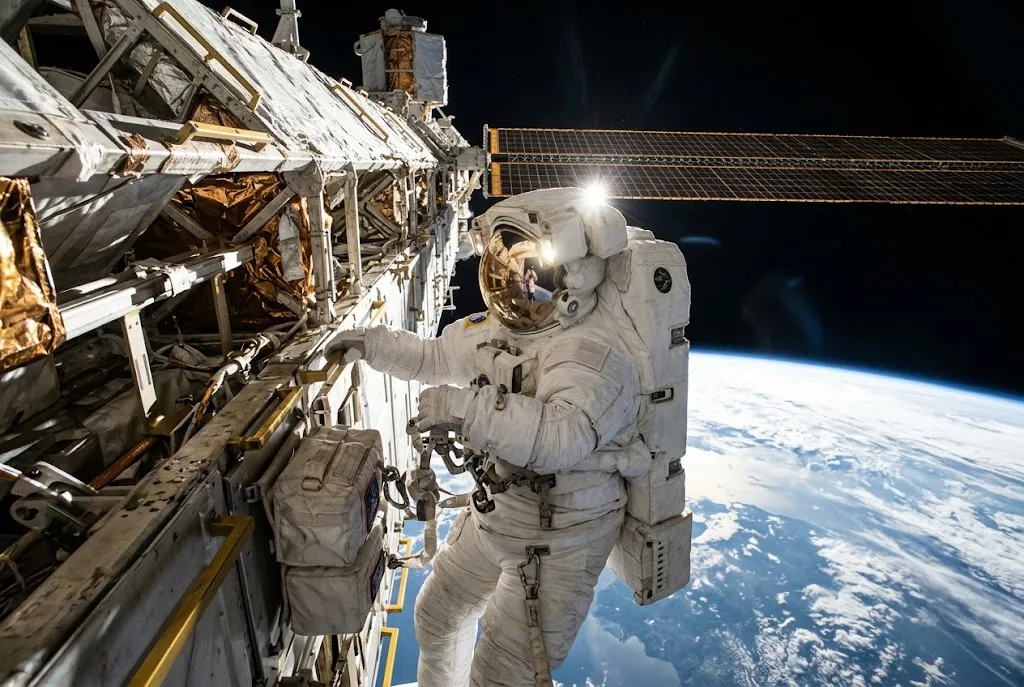
For astronauts on the International Space Station (ISS), Earth’s magnetosphere and atmosphere still offer some protection. However, once we venture to the Moon, Mars, or beyond, that natural shield is gone. I imagine a Martian astronaut, months into their journey, facing an accumulation of DNA damage. The radiation dose increases dramatically with distance from Earth and duration of exposure.
The cumulative effect is what truly worries researchers. It's not just a single hit; it's a constant barrage over months or years. For extended missions to Mars, estimating the exact risk and developing effective countermeasures is a top priority for space agencies like NASA. We even see similar discussions about cosmic rays affecting our everyday technology here on Earth. For instance, consider how cosmic rays can impact electronics, a topic we covered in Do Cosmic Rays Secretly Glitch Our Tech?
The Quest for Countermeasures: Shielding Our Future
The challenges posed by cosmic radiation are significant, but they are not insurmountable. Scientists and engineers are actively researching and developing various strategies to protect future space explorers:
-
Improved Radiation Shielding:
- Passive Shielding: This involves using materials to physically block or attenuate radiation. While thick lead or aluminum walls are effective, they are prohibitively heavy for space missions. Researchers are exploring lighter, more efficient materials, such as polyethylene and water, which contain a high concentration of hydrogen atoms to stop charged particles.
- Active Shielding: This is a more futuristic approach involving generating magnetic or electric fields around the spacecraft to deflect charged cosmic rays, much like Earth’s magnetosphere. This technology is still in its infancy but holds immense promise.
-
Pharmacological Countermeasures: Developing drugs that can protect cells from radiation damage (radioprotectants) or enhance DNA repair mechanisms after exposure. These might include antioxidants or specific enzyme activators.
-
Biological Resilience: Research into therapies that could make astronauts more resilient to radiation, perhaps through gene editing to enhance DNA repair pathways or even through selective breeding in future generations of space travelers. This raises profound ethical questions but is a frontier being explored.
-
Optimized Mission Planning: Timing missions to avoid periods of high solar activity, using planetary bodies (like Mars itself) as temporary shields by burying habitats underground, and designing spacecraft with "storm shelters" are all practical strategies.
The journey to truly conquer space, I believe, hinges on our ability to understand and mitigate these cosmic threats. It's a race against an invisible enemy, but one that humanity is determined to win.
Conclusion: Redefining Humanity's Place in the Cosmos
The thought of cosmic rays altering our DNA is both a daunting challenge and a profound catalyst for scientific innovation. It forces us to confront the fundamental fragility of our biological existence when confronted with the raw power of the cosmos. As we push the boundaries of space exploration, preparing for missions to Mars and beyond, understanding these effects isn't just about astronaut safety—it's about the very future of human adaptation and evolution in an extraterrestrial environment.
I believe that the solutions we develop for radiation protection won't just benefit astronauts. They could lead to breakthroughs in cancer treatment, anti-aging therapies, and even a deeper understanding of our own genetic makeup here on Earth. The universe is challenging us to evolve, not just technologically, but biologically. And in doing so, it compels us to uncover the secrets of our own resilience, ensuring that when we finally step onto another planet, we do so not just as visitors, but as a species truly ready for the cosmic frontier.
Conversation0
No comments yet. Be the first to share a thought — the best questions often become new stories.