I sometimes stare up at the night sky, a canvas splattered with distant stars and hazy galaxies, and feel an overwhelming sense of wonder. But what if that seemingly chaotic cosmic dance isn't chaotic at all? What if, beneath the shimmering veneer of nebulae and the silent sprawl of dark space, lies an invisible, intricate network processing the very destiny of everything? This isn't science fiction; it's a question increasingly pondered by cosmologists and theoretical physicists: **could the cosmic web be the universe's ultimate computer, actively computing its own fate?**
The idea might sound fantastical, even a touch dramatic, but when you delve into the sheer scale and complexity of the universe's largest structures, it begins to make a strange kind of sense. Forget ancient mechanisms or even human-built supercomputers; we’re talking about a computational engine forged from gravity, dark matter, and the very fabric of spacetime.
## Unveiling the Universe's Grand Architecture: The Cosmic Web
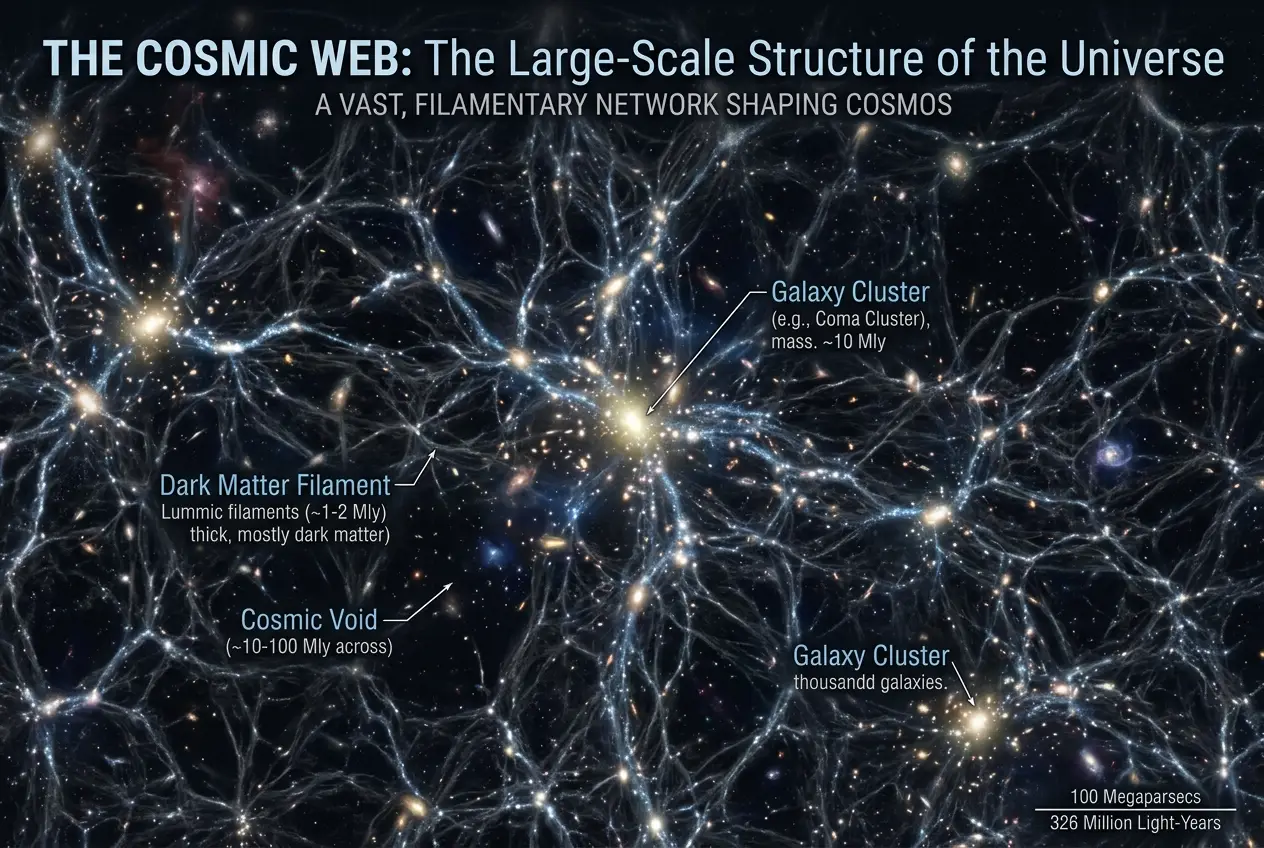
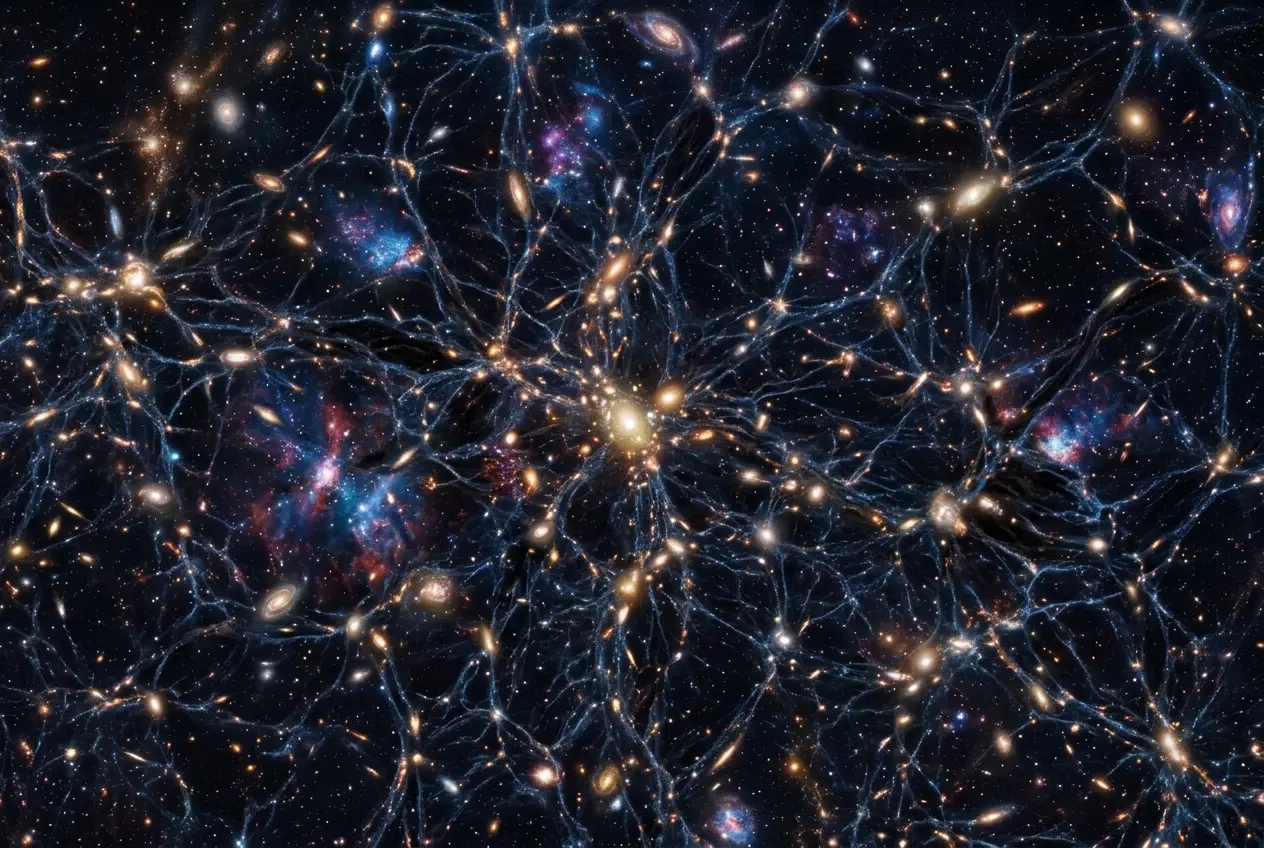
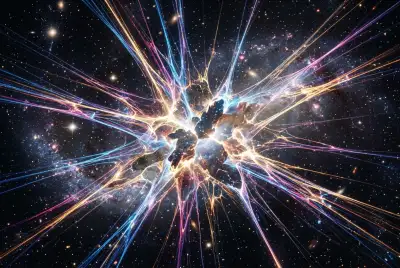
Before we dive into its computational potential, let's understand what the cosmic web actually is. Imagine the universe not as a uniform, bland soup of galaxies, but as a colossal, three-dimensional spiderweb. This "cosmic web" is the largest known structure in the universe, a vast lattice of galaxy clusters, filaments, and immense voids.
Galaxies aren't just randomly scattered; they gather into dense clusters, which are connected by long, slender filaments of gas and dark matter. Between these filaments and clusters lie gargantuan, relatively empty regions known as cosmic voids. This filamentary structure is the direct consequence of gravity acting on tiny quantum fluctuations in the early universe, amplified over billions of years. Think of it as the universe's skeletal system.
It’s crucial to understand that **dark matter** plays the starring role here. While ordinary matter (the stuff we're made of) makes up only about 5% of the universe's mass-energy budget, dark matter accounts for roughly 27%. We can't see it, touch it, or directly detect it, but its gravitational influence is undeniable. The cosmic web is predominantly made of these invisible dark matter filaments, which act as gravitational scaffolding, drawing in ordinary matter and gas to form galaxies and galaxy clusters along their paths. Without dark matter, the universe would likely be a much emptier, less structured place. You can read more about its enigmatic nature in our post, [Does Dark Matter Hide an Invisible Universe?](/blogs/does-dark-matter-hide-a-universe-we-cant-see-2793).
## From Cosmic Scaffolding to Cosmic Computing?
The leap from a gravitational scaffold to a computational engine is significant, but it's rooted in the very nature of information and physics. Computation, at its most fundamental, is about processing information. Our universe is governed by physical laws that dictate how particles interact, how energy flows, and how structures evolve. Could these fundamental processes, unfolding across cosmic scales, constitute a form of universal computation?
### Information Theory in the Cosmos
Physicists like John Wheeler famously coined the phrase "It from Bit," suggesting that information is fundamental to the universe. Every particle, every interaction, every gravitational pull carries information. When a black hole swallows matter, it's not just absorbing mass; it's also processing and perhaps even storing information, as explored in discussions around the information paradox. Black holes, in a sense, are indeed incredible information processors, a topic we touched upon in [Black Holes: Are They Nature's Ultimate Quantum Computers?](/blogs/black-holes-are-they-natures-ultimate-quantum-computers-5819).
The cosmic web, with its vast network of interacting gravitational fields, matter, and energy, could be seen as an immense, distributed information processing system. Each galaxy, each star, each particle contributes to the overall gravitational field, which then influences the movement and evolution of every other component. This continuous, dynamic interaction is, in essence, a massive parallel computation.
### The Universe as a Neural Network
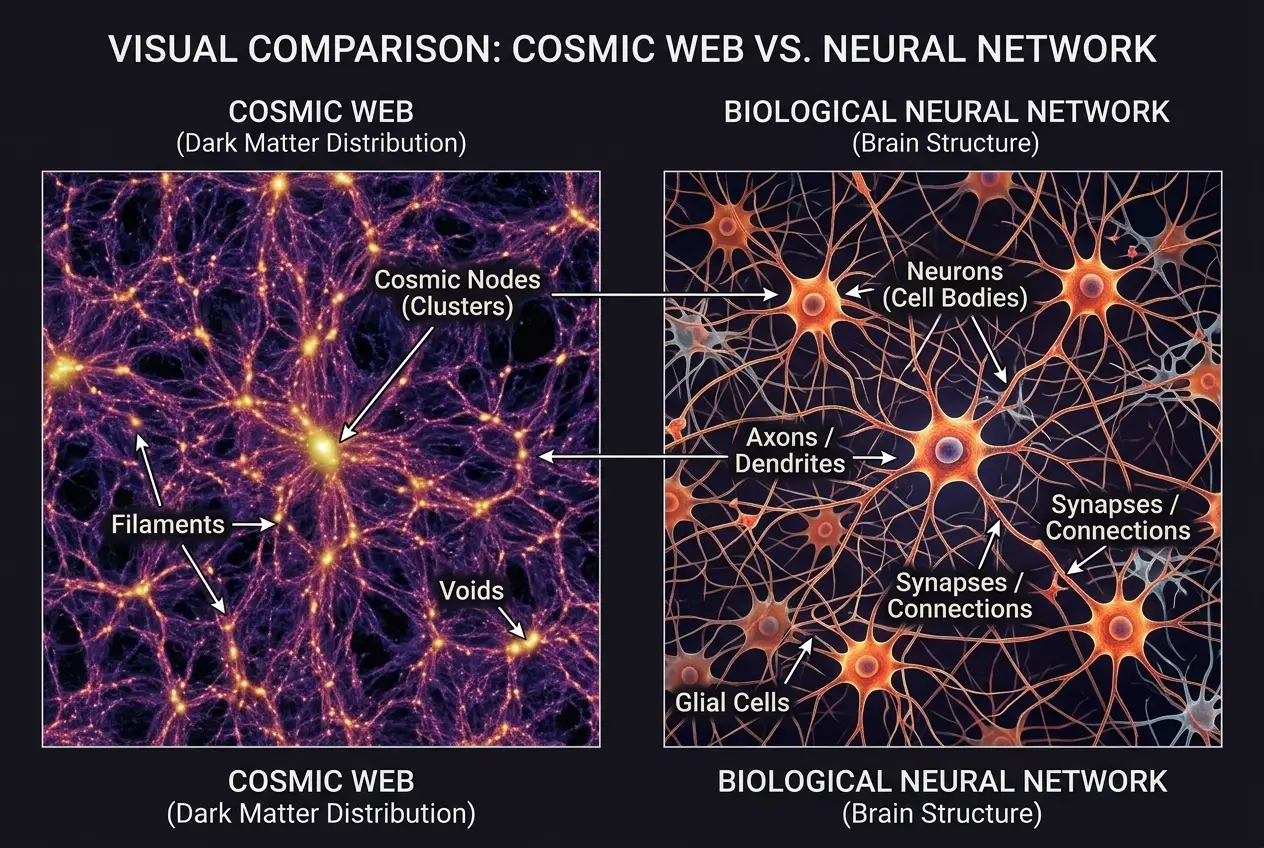
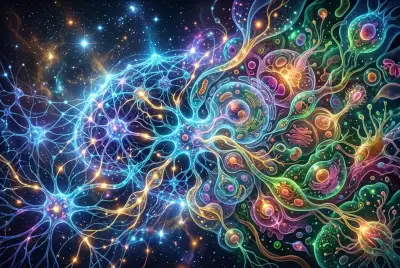
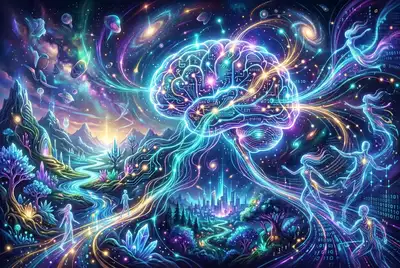
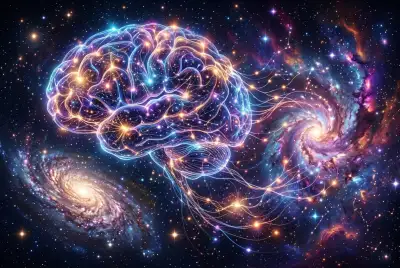
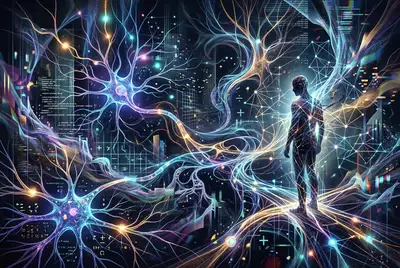
Another fascinating analogy gaining traction is the idea of the universe, or at least structures like the cosmic web, behaving like a **neural network**. Our brains consist of billions of neurons connected by trillions of synapses, processing information through complex firing patterns. When you look at simulations of the cosmic web, with its nodes (galaxy clusters) and interconnected filaments (dark matter threads), the resemblance to a biological neural network is striking.
In a neural network, input signals are processed through layers of interconnected nodes, ultimately leading to an output or a learned pattern. In the cosmic web, the "inputs" could be the initial conditions of the early universe – the tiny quantum fluctuations. The "processing" would be the relentless action of gravity, driving the formation of structures. The "output" is the universe we observe today, and its future evolution. This comparison has led some to ask, [Is the Universe a Giant Neural Network?](/blogs/is-the-universe-a-giant-neural-network-2907).
**What kind of computation would it perform?** Perhaps it's "computing" the most energy-efficient configurations for matter, or simulating its own future evolution. The universe doesn't need to "think" in a human sense; its "computation" is simply its physical evolution according to the laws of physics. However, the complexity and interconnectedness of this evolution could be framed computationally.
## The Role of Dark Energy and Cosmic Expansion
The computational aspect of the cosmic web isn't static; it's profoundly influenced by the universe's expansion, driven by **dark energy**. While dark matter pulls things together, dark energy pushes everything apart, accelerating the expansion of the universe. This constant tug-of-war is another layer of dynamic processing.
As the universe expands, the filaments of the cosmic web are stretched, and the voids grow larger. This changes the gravitational interactions and thus alters the "computation." The universe is not just computing; it's computing on a dynamic, expanding hardware. The Lambda-CDM model, our current best description of cosmology, integrates these components – dark energy (Lambda) and cold dark matter (CDM) – to explain the universe's structure and evolution. You can delve deeper into the standard model of cosmology on [Wikipedia](https://en.wikipedia.org/wiki/Lambda-CDM_model).
## Simulating the Cosmic Web: Our Best Bet?
Since we can't directly "read" the universe's computation, how do we explore this idea? The answer lies in **cosmological simulations**. Supercomputers on Earth run complex algorithms that mimic the conditions of the early universe and simulate how gravity, dark matter, and dark energy would interact over billions of years. These simulations produce cosmic web structures that remarkably resemble astronomical observations.
Projects like the IllustrisTNG simulation, for instance, track billions of particles representing dark matter, gas, stars, and black holes across vast cosmic volumes. These simulations are, in a sense, us trying to *replicate* the universe's own computation. If our simulations can accurately predict the structure and evolution of the cosmic web, it suggests that the underlying physical laws are indeed a form of deterministic computation.
### Evidence from Gravitational Lensing
One of the most compelling pieces of evidence for the cosmic web, particularly its dark matter components, comes from **gravitational lensing**. Massive objects, like galaxy clusters and the dark matter filaments, warp spacetime around them. This warping acts like a lens, bending the light from distant background galaxies. By observing these distortions, astronomers can map the distribution of mass, including the invisible dark matter, and confirm the existence and structure of the cosmic web. This phenomenon is a powerful tool in modern astronomy, and you can learn more about it on [Wikipedia](https://en.wikipedia.org/wiki/Gravitational_lens).
## What Would it Mean for Humanity?
If the cosmic web is indeed a computational engine, what does this imply for our understanding of reality, or even our place in the cosmos?
1. **A Deeper Understanding of Physical Laws:** It would reinforce the idea that the universe is fundamentally governed by elegant, computable laws. Our scientific endeavor is essentially reverse-engineering this cosmic computation.
2. **The Limits of Prediction:** If the universe computes its own fate, does that mean our future is predetermined? Not necessarily in a fatalistic sense. The computation is so complex, with so many variables, that true determinism remains elusive for any observer within the system. We're part of the computation ourselves.
3. **Search for Extraterrestrial Intelligence:** Could intelligent life emerge as a result of, or even influence, this cosmic computation? While some seek alien tech in distant stars, perhaps the greatest "intelligence" is woven into the cosmic fabric itself. This perspective offers a novel angle when considering phenomena like the Fermi Paradox, which we discussed in [Why is the Universe So Quiet? Decoding the Fermi Paradox](/blogs/why-is-the-universe-so-quiet-decoding-the-fermi-paradox-5418).
4. **Inspiration for Future Computing:** Could understanding the universe's "natural computer" inspire new paradigms for artificial intelligence or quantum computing? Perhaps there are fundamental efficiencies in cosmic-scale computation that we have yet to grasp.
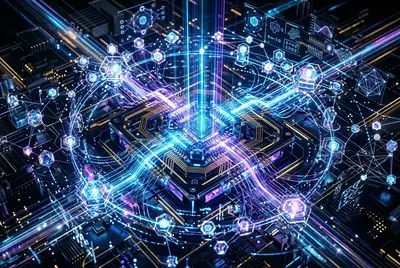
While the cosmic web doesn't run on silicon chips or quantum qubits in the way our human computers do, its vast interconnectedness, dynamic evolution, and information processing capabilities offer a compelling new perspective. It’s a testament to the idea that computation isn't just a human invention, but potentially a fundamental property of the universe itself. The fate of the cosmos might not be written in stone, but rather, is continuously being computed by its grandest, most beautiful architecture. We are all, in a sense, tiny bits of data in this grand, cosmic calculation.
Frequently Asked Questions
The cosmic web is the largest known structure in the universe, a vast, interconnected network of galaxy clusters, filaments, and voids, primarily structured by dark matter. Galaxies gather in clusters and are linked by long threads (filaments), with huge empty spaces (voids) in between.
The hypothesis suggests that the cosmic web, with its continuous gravitational interactions and information flow across vast scales, functions as a natural, distributed information processing system. Its dynamic evolution according to physical laws can be seen as a form of computation, similar to how complex systems process inputs to produce outputs.
Dark matter is the primary architectural component of the cosmic web. It provides the gravitational scaffolding for the filaments and clusters, drawing in ordinary matter (gas and galaxies) to form the visible structures we observe. Without dark matter, the cosmic web would likely not exist in its current form.
This is a theoretical concept. The idea isn't that the cosmic web 'decides' the fate, but rather that the universe's evolution, governed by physical laws and the interactions within this structure, constitutes a continuous 'computation' of its own future state. It emphasizes a deterministic, information-theoretic view of cosmology.
Scientists primarily use large-scale cosmological simulations run on supercomputers. These simulations model the interactions of dark matter, dark energy, and ordinary matter over cosmic timescales, allowing researchers to observe how the cosmic web forms and evolves, and to infer its potential information processing capabilities.
Verified Expert
Alex Rivers
A professional researcher since age twelve, I delve into mysteries and ignite curiosity by presenting an array of compelling possibilities. I will heighten your curiosity, but by the end, you will possess profound knowledge.
Leave a Reply
Comments (0)
No approved comments yet. Be the first to share your thoughts!
 Join Us
 Unknown Author


















Leave a Reply
Comments (0)