


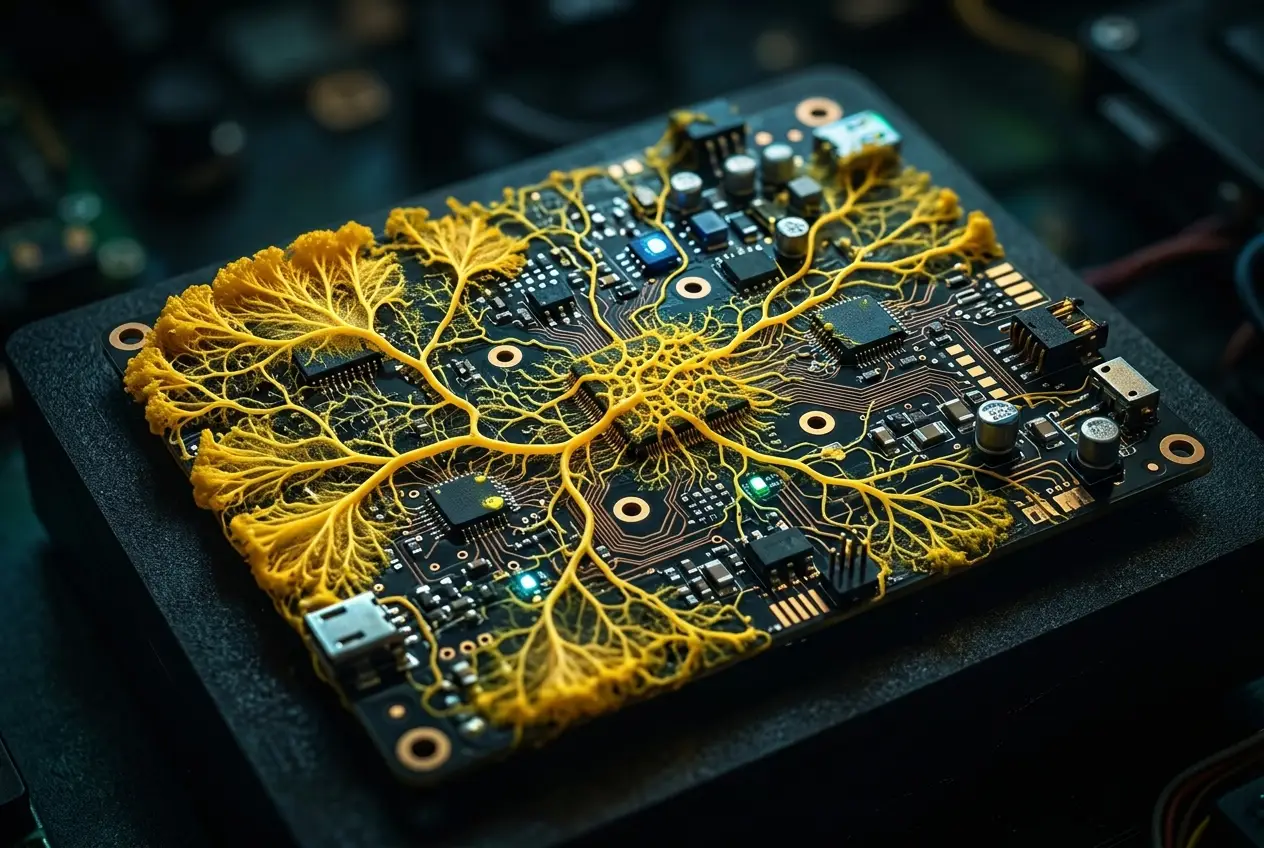
I recently stumbled upon a documentary segment that genuinely blew my mind. It wasn't about quantum physics or deep space exploration, but something far more humble and, frankly, gooey: slime molds. Specifically, a single-celled organism called Physarum polycephalum. We usually think of computing as silicon chips and complex algorithms, but what if nature itself holds the blueprint for ultra-efficient, unconventional computers? What if a brainless blob could outperform our best routing algorithms? I had to dive deeper into this fascinating mystery, and what I found completely redefines our understanding of intelligence and technology.
For centuries, we’ve categorized slime molds as fungi, then protozoa. Now, they sit in their own quirky corner of the biological kingdom. Physarum polycephalum is essentially one giant cell containing millions of nuclei, capable of growing to impressive sizes. What makes it truly astonishing is its seemingly intelligent behavior. Without a central nervous system, without a brain, it navigates mazes, finds the shortest path between food sources, and even 'remembers' where it's been. This isn't just a biological curiosity; it's a living, breathing, problem-solving machine that scientists are increasingly looking to as a model for bio-inspired computing.
The Intelligent Blob: Slime Molds as Natural Problem Solvers
Imagine placing a food source (like oats) in two different locations within a petri dish, connected by a network of possible paths. A slime mold, starting from a central point, will spread out, exploring all avenues. But then, something incredible happens: it reinforces the most efficient paths to the food, effectively "solving" the maze by pruning redundant connections. It can even find the optimal connection network for multiple food sources, creating structures eerily similar to human-designed transportation grids or internet topologies.
One of the most famous demonstrations of this ability involved replicating the Tokyo railway system. Researchers placed oat flakes at locations corresponding to major cities around Tokyo, and a slime mold successfully grew a network of tubes that mirrored the efficiency and fault tolerance of the actual rail system. This wasn't a coincidence; the slime mold was optimizing its nutrient transport, and in doing so, it was performing a complex computational task that our algorithms often struggle with. This phenomenon is a prime example of emergent intelligence – complex, sophisticated behavior arising from simple, localized interactions.
Beyond Silicon: Why Unconventional Computing Matters
The computational power of our silicon-based computers is phenomenal, but it comes with limitations. They consume vast amounts of energy, generate significant heat, and face physical limits in miniaturization. This is where unconventional computing, especially bio-inspired approaches, steps in. Slime molds offer a paradigm shift.
- Energy Efficiency: A slime mold operates on minimal energy, essentially just nutrients. Compared to the power-hungry supercomputers, this is a game-changer.
- Self-Organization: They don't need to be programmed in the traditional sense. Their "intelligence" is inherent in their growth dynamics and interaction with their environment. This hints at self-repairing and self-optimizing systems.
- Parallel Processing: Being a single, vast cell, all parts of the slime mold are interacting and "computing" simultaneously, offering a highly parallel processing capability.
- Adaptability: They can adapt to changing conditions, finding new paths if old ones are blocked or food sources move.
These attributes are incredibly appealing for solving problems that current computers find challenging, such as complex network optimization, logistics, and even medical diagnostics. Imagine a self-organizing sensor network that adapts its layout based on environmental changes, much like how a slime mold adapts its structure to find food.
"The computational power of Physarum polycephalum, though operating on a completely different principle than electronic computers, demonstrates an incredible efficiency in solving certain combinatorial optimization problems," notes Dr. Andrew Adamatzky, a leading researcher in unconventional computing at the University of the West of England. His work, detailed on Wikipedia's page about Physarum machines (opens in a new tab), has been instrumental in bringing slime mold computing into the academic spotlight.
How Does a Brainless Organism "Compute"?
The secret lies in the slime mold's plasmodium, the vegetative stage where it exists as a network of tubes. When it encounters a food source, the tubes leading to it thicken and strengthen, while those not leading to food thin out and eventually retract. This physical change is its form of "computation." It's a dynamic, analog process.
Think of it like this: each tube segment can be seen as a resistor, and the flow of cytoplasm as current. The slime mold is constantly adjusting these "resistors" to minimize the total "energy cost" of finding nutrients. This bio-physical computation allows it to explore numerous possibilities simultaneously and arrive at optimal solutions through a process akin to natural selection at a micro-level. It's a form of analogue computing where the physical structure itself embodies the solution. For more on how biological systems can perform computations, you might be interested in our earlier blog post about whether living organisms can compute.
Current Research and Future Potential
Scientists are actively exploring ways to harness slime mold intelligence.
- Slime Mold Robots: Researchers are designing "physarum-inspired robots" that mimic the mold's growth patterns and decision-making for tasks like pathfinding or collective exploration.
- Biocomputers: Efforts are underway to integrate slime molds into actual computing devices. Imagine a hybrid system where a slime mold component handles complex optimization tasks, feeding its solutions to a conventional electronic processor. Projects like this are pushing the boundaries of what we consider a "computer."
- Algorithm Development: Even if we don't use the slime mold itself, studying its problem-solving strategies can inspire new, more efficient algorithms for our silicon-based systems. This biomimicry is a powerful tool in computer science.
- Chemical Computing: The slime mold's ability to react to chemical gradients and physically reconfigure itself opens doors for chemical computing, where information is processed through chemical reactions and physical changes rather than electron flow.
Indeed, the capabilities of these organisms go beyond simple maze-solving. They have been shown to anticipate periodic events, forming rudimentary biological "memory," a concept often explored in the field of quantum biology. This ability to adapt and learn from their environment without a brain is a profound area of study, challenging our very definition of intelligence.
Challenges and Ethical Considerations
Of course, using living organisms as computers isn't without its hurdles.
- Scalability: How do you scale a slime mold computer to handle problems of immense complexity? Controlling and directing its growth for specific, large-scale tasks remains a significant challenge.
- Reliability: Biological systems are inherently variable and susceptible to environmental changes. Ensuring consistent, repeatable results is crucial for any computing platform.
- Interface: How do we effectively interface these biological "processors" with our electronic systems? Developing efficient input/output mechanisms is key.
- Longevity: Slime molds have a natural lifecycle. Maintaining them for extended computational tasks requires careful environmental control.
As we delve deeper into bio-integrated technology, ethical questions naturally arise. What are the implications of creating hybrid bio-electronic systems? Are we venturing into uncharted territory where the lines between life and machine blur? These are questions we must grapple with as we push the frontiers of what's possible. Our exploration into living systems for technology also touches upon how information might be stored in unconventional ways, a topic discussed in our piece on whether memory metals store hidden information.
A Glimpse into Tomorrow's Tech
The idea of a blob of goo acting as a computer might seem like science fiction, but the reality is that Physarum polycephalum is already demonstrating capabilities that rival, and in some cases surpass, conventional algorithms for specific tasks. It forces us to reconsider what intelligence truly is and where computation can occur. From optimizing city planning to developing more resilient network infrastructures, the humble slime mold could be an unexpected, yet profound, player in the future of computing.
I find it inspiring that some of the most elegant solutions to complex problems might not come from ever more powerful microchips, but from the simple, self-organizing principles observed in nature. The future of computing might just be more alive than we ever imagined.
References:






Conversation0
No comments yet. Be the first to share a thought — the best questions often become new stories.