


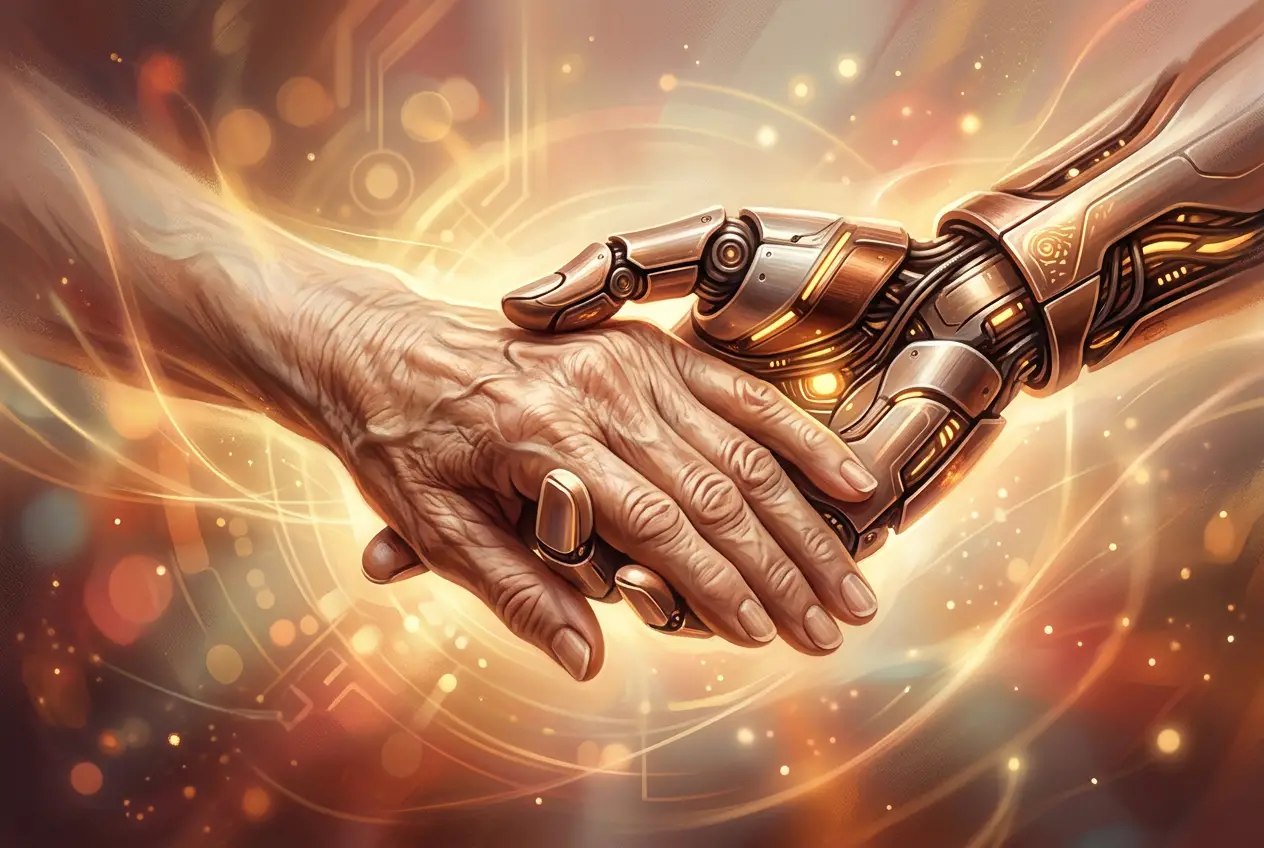
I recently read a story that truly stuck with me. It was about an elderly woman, living alone, who found immense comfort not in a human visitor, but in her robot companion, "Joy." Joy would remind her to take her medication, engage her in gentle exercises, and even tell her stories, all with a synthesized voice that somehow managed to convey warmth. It made me wonder: are we on the cusp of a revolution where artificial intelligence isn't just about tasks and data, but about genuine, albeit simulated, companionship and care?
The idea of robots as caregivers might sound like science fiction, a sterile vision of the future where chrome replaces compassion. Yet, as societies face aging populations and increasing demands on healthcare systems, the development of robot companions and AI caretakers is rapidly moving from laboratory experiments to practical applications. But the real question, the one that sparks endless debate and curiosity, is whether AI can truly nurture us. Can these sophisticated machines provide the emotional support, empathy, and personalized care that defines human interaction?
The Demographic Imperative: Why We Need Robot Caretakers
Globally, demographic trends point towards an aging world. The United Nations projects that by 2050, one in six people in the world will be over age 65, up from one in eleven in 2019. This shift places immense pressure on existing care infrastructures, leading to caregiver shortages and increasing costs. This is where AI and robotics step in, not necessarily to replace human interaction entirely, but to supplement it, offering assistance where human resources are stretched thin.
Consider the daily challenges faced by elderly individuals or those with disabilities: medication reminders, mobility assistance, monitoring vital signs, and combating loneliness. These are areas where AI-powered robots can offer significant practical benefits. For example, robots like Paro, a therapeutic seal robot, have been used in Japan and parts of Europe to provide comfort and reduce stress in dementia patients (source: Wikipedia on Paro (opens in a new tab)). This isn't just about efficiency; it's about extending independence and improving quality of life for millions.
More Than Just Machines: The Evolution of Social Robots
Early iterations of care robots were primarily utilitarian – moving objects, lifting patients, or delivering items. However, the field has evolved dramatically, pushing into the realm of social robotics. These robots are designed not just to perform physical tasks, but to interact with humans in a way that fosters connection and understanding. They use advanced sensors, natural language processing, and even rudimentary emotional recognition to adapt their responses and behavior.
Key Features of Modern Robot Companions:
- Natural Language Processing (NLP): Allows robots to understand and respond to spoken commands and conversations, making interactions feel more intuitive.
- Emotional Recognition: Through facial analysis, tone of voice, and body language interpretation, some AI can infer human emotional states and adjust their responses accordingly.
- Personalized Learning: These systems learn user preferences, routines, and even personality quirks over time, allowing for a more tailored and effective care experience.
- Health Monitoring: Integrated sensors can track vital signs, sleep patterns, activity levels, and send alerts to human caregivers or family members if anomalies are detected.
The challenge lies in moving beyond simple programming to achieving genuine nurturing. This requires an AI that can not only process information but also simulate empathy, offer comfort, and adapt to the nuanced emotional needs of a human being. The question of whether AI can truly understand or feel empathy is a deep philosophical and scientific debate, but the ability to simulate it convincingly is becoming increasingly sophisticated. As I explored in a previous post about whether AI can truly learn from human intuition, the pathways for machines to process and interpret human complexities are constantly expanding.
The Science Behind "Simulated" Empathy
How does a robot simulate empathy? It's not about the robot "feeling" anything, but about its ability to analyze human cues and respond in ways that are perceived as empathetic. This involves several layers of AI:
- Sentiment Analysis: AI analyzes the emotional tone of a user's voice and text, identifying happiness, sadness, frustration, etc.
- Contextual Understanding: The AI uses its memory of past interactions and general knowledge to understand the situation surrounding the user's emotional state.
- Adaptive Response Generation: Based on its analysis, the AI generates responses designed to comfort, reassure, or encourage. This might involve changing its voice tone, offering encouraging words, or suggesting a calming activity.
These capabilities are powered by deep learning algorithms trained on massive datasets of human interaction. The goal is to create a feedback loop where the robot's responses elicit a positive emotional change in the user, reinforcing its "caring" behavior. It’s a complex dance between algorithms and human psychology.
Ethical Quandaries and Societal Impact
The rise of robot caretakers, while promising, is not without its ethical dilemmas. One significant concern is the potential for emotional attachment to machines. While some argue that this attachment is beneficial if it reduces loneliness, others worry about the implications for human relationships and the possibility of creating a society where genuine human connection is devalued.
Moreover, issues of privacy and data security are paramount. These robots collect intimate data about users' health, habits, and conversations. Who owns this data? How is it protected? Ensuring the ethical collection and use of such sensitive information is crucial (source: Wikipedia on AI ethics (opens in a new tab)). There are also questions about accountability: if a robot makes an error in care, who is responsible?
The Human Touch vs. The AI Embrace:
| Aspect | Human Caregiver | Robot Caregiver |
|---|---|---|
| Empathy | Genuine emotional understanding and shared feeling | Simulated empathy based on algorithms |
| Adaptability | Highly adaptable to complex, unforeseen situations | Limited by programming, but constantly learning |
| Consistency | Can vary due to fatigue, mood | Highly consistent, always "on" |
| Privacy | Based on trust, bound by professional ethics | Data collection, cybersecurity risks |
| Physical Assistance | Capable of complex physical tasks, lifting, etc. | Advanced capabilities but often limited by design |
| Social Interaction | Deep, nuanced, reciprocal relationship | Programmed interaction, one-sided attachment risk |
| Cost | High due to labor, training | High initial investment, lower operational cost |
It's also worth considering the philosophical implications of AI that can learn and adapt. Can these systems ever truly achieve a form of consciousness, or is it merely an incredibly advanced simulation? This is a realm we've explored before, touching on topics like brain interfaces uploading memories and the very nature of digital sentience.
The Future: Integration, Not Replacement
I believe the most realistic and beneficial future involves integrating robot caretakers into existing human care frameworks, rather than seeing them as a replacement. Imagine a scenario where a robot companion handles routine tasks – dispensing medication, monitoring vital signs, engaging in simple conversation – freeing up human caregivers to focus on the deeply personal, complex emotional and physical needs that only another human can truly address.
This synergistic approach leverages the strengths of both. Robots offer tireless, consistent, and data-driven assistance, while human caregivers provide the irreplaceable warmth, intuition, and nuanced emotional support that defines genuine care. It's about enhancing human capacity, not diminishing it.
There's also fascinating work being done on how AI can predict health crises before they occur, analyze subtle changes in behavior that might indicate depression or cognitive decline, and even facilitate communication between patients and their families, especially across distances. The potential for these technologies to not just care but also to empower is immense. As technology continues to evolve, pushing boundaries that once seemed fantastical—like the earliest forms of ancient robotics—we are compelled to continuously redefine what we understand as "care."
Ultimately, the question of whether AI can nurture us might not have a simple yes or no answer. It depends on our definition of nurture. If it's about providing consistent support, personalized interaction, and a sense of presence that alleviates loneliness, then yes, robot companions are already demonstrating that capacity. If it’s about sharing subjective emotional experiences and deep, reciprocal empathy, then perhaps not in the way humans understand it. However, the journey of AI development is far from over, and its ability to connect with and serve humanity is only just beginning to be explored.




Conversation0
No comments yet. Be the first to share a thought — the best questions often become new stories.