



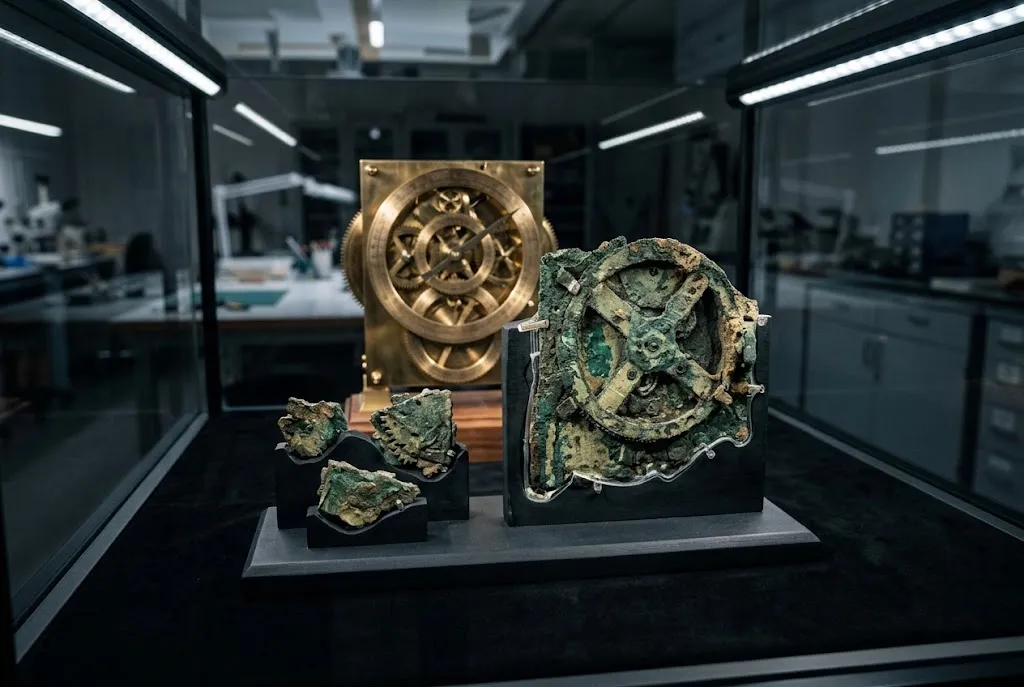
I remember a sense of profound wonder when I first learned about the Antikythera Mechanism. It wasn't in some dusty academic text, but rather through a documentary that painted a vivid picture of its discovery. Imagine, if you will, the year 1901. A group of sponge divers, battling a fierce storm off the coast of the small Greek island of Antikythera, sought refuge. While waiting out the gale, one diver, Elias Stadiatis, ventured into the depths. What he found wasn't just ancient amphorae or statues, but something far more enigmatic: a corroded mass of bronze and wood that would rewrite our understanding of ancient technology.
This wasn't just another shipwreck discovery; it was the unveiling of what many consider the world's first analog computer. For centuries, historians believed that such intricate mechanical devices only emerged during the Renaissance. Yet, here was evidence suggesting that more than 2,000 years ago, ancient Greek minds had already conceived and constructed a device capable of astronomical prediction with astonishing accuracy. The sheer complexity of it left me, and countless others, speechless. How could something so advanced exist so far back in history?
A Glimpse into a Lost World of Innovation
The Antikythera Mechanism, initially dismissed as an encrusted rock, began to reveal its secrets over decades of painstaking research. It wasn't until the 1950s and 60s, with advanced imaging techniques like X-rays, that researchers truly started to comprehend its internal workings. What emerged was a masterpiece of ancient engineering: a hand-powered orrery, a calendar, and a celestial predictor all rolled into one. It was designed to calculate and display the precise positions of the sun, moon, and perhaps even the five known planets (Mercury, Venus, Mars, Jupiter, and Saturn) against the backdrop of the zodiac, predict eclipses, and track important ancient Greek athletic events like the Olympic Games.
Its discovery challenged long-held assumptions about the capabilities of ancient civilizations. We often think of ancient Greece for its philosophy, democracy, and architecture, but rarely for its advanced mechanical engineering. Yet, the Antikythera Mechanism stands as a testament to a lost tradition of scientific and technological prowess that predates its supposed re-emergence by over a millennium. It suggests that there might have been an entire lineage of sophisticated mechanical devices that simply didn't survive the ravages of time, leaving this sole artifact as a ghost from a forgotten era.
The Mechanism's Mind-Boggling Complexity
To appreciate the genius behind the Antikythera, one needs to understand its intricate design. The device consists of at least 37 precisely machined bronze gears, some interlocking with a remarkable level of sophistication. The smallest gear is barely a millimeter thick, demonstrating incredible skill in metalworking. These gears were arranged in a differential gear system, a concept often attributed to 16th-century horologists. This system allowed for complex astronomical calculations, such as the anomalies in the moon's motion (its elliptical orbit), which weren't fully understood in the West until Kepler's laws in the 17th century.
The front dial displayed the Greek zodiac and a 365-day Egyptian calendar, while the back featured two larger spiral dials. One spiral represented the Metonic cycle, a 19-year period after which the phases of the moon recur on the same days of the year. The other tracked the Callippic cycle, a four-cycle adjustment to the Metonic cycle for even greater accuracy. There were also indicators for predicting lunar and solar eclipses, showing when they would occur and even their type. This level of astronomical detail and mechanical foresight is simply breathtaking. For a deeper dive into its construction, Wikipedia offers an extensive overview of the Antikythera Mechanism's design and function, available at https://en.wikipedia.org/wiki/Antikythera_mechanism (opens in a new tab).
Who Built Such a Device?
The identity of the Antikythera Mechanism's creator remains one of its greatest mysteries. Scientific consensus points towards a Greek origin, likely from the island of Rhodes, which was a hub of astronomical and mechanical innovation during the Hellenistic period. Scholars like Archimedes, Hipparchus, and Posidonius are often cited as potential intellectual architects or influences. Hipparchus, in particular, was a renowned astronomer who made significant contributions to the understanding of celestial mechanics and lunar theory, aligning perfectly with the device's functions.
However, the question isn't just who, but how? How was such precise gear cutting achieved without modern tools? The uniformity and accuracy of the teeth suggest a standardization of manufacturing that feels remarkably modern. It implies not just a single genius, but a skilled workshop with established techniques and tools, perhaps even an early form of mass production for specific components. This raises fascinating questions about the broader technological landscape of ancient Greece, hinting at advancements we may only be beginning to understand. The idea of "impossible artifacts" from ancient times isn't unique to the Antikythera; many discoveries challenge our historical narratives, just like the discussions surrounding artifacts potentially hinting at lost ancient tech.
Its Purpose and Implications
While its primary function was likely educational and demonstrative – a sophisticated teaching tool for astronomers and philosophers – it also served as a testament to the predictive power of Greek mathematics and astronomy. It allowed its users to visualize complex celestial motions and cycles, providing a tangible model of the cosmos. In an era where understanding the heavens was crucial for navigation, agriculture, and religious observances, such a device would have been invaluable.
The Antikythera Mechanism implies a level of scientific abstraction and engineering application that we hadn't attributed to antiquity. It's a stark reminder that history is not a linear progression of invention but rather a series of peaks and valleys, with periods of incredible innovation often followed by dark ages where knowledge is lost. The fall of empires, natural disasters, and the simple decay of organic materials mean that much of ancient human achievement may be forever hidden from us. This mechanism is a rare exception, a fragment that survived to tell a much larger story.
Some scholars even suggest that the Antikythera Mechanism could represent a lineage of similar devices, possibly even more advanced, that have simply not been found. If this one survived, how many others succumbed to time, rust, and seismic activity? This echoes the mysteries surrounding other feats of ancient engineering, such as the extraordinary durability of ancient geopolymer concrete used in pyramids, which suggests a forgotten mastery of materials science.
Modern Rediscoveries and Future Potential
Recent advancements in 3D imaging, computer modeling, and X-ray microtomography have allowed researchers to peel back more layers of the mechanism's secrets without physically damaging it. These technologies have helped reconstruct its original appearance and even simulate its functions with astonishing accuracy. We've learned that it was housed in a wooden casing, about the size of a shoebox, covered in inscriptions that acted as an instruction manual or a scientific treatise. The decipherment of these inscriptions is an ongoing effort, revealing even more about the astronomical theories it embodied.
The work on the Antikythera Mechanism continues, with new discoveries still being made. Each new piece of information reinforces the idea that the ancient Greeks possessed an understanding of the cosmos and a capacity for precision engineering that was far beyond what conventional history books often portray. It forces us to reconsider the timeline of technological development and wonder what other scientific marvels lie hidden beneath the waves or buried under centuries of earth. Even the purpose of ancient alignments used to track the cosmos can be seen in a new light when we understand the sophisticated tools that might have accompanied their observations.
This incredible artifact serves as a powerful reminder that curiosity, ingenuity, and the pursuit of knowledge are timeless human traits. The Antikythera Mechanism is not just an ancient artifact; it's a profound connection to the brilliant minds of antiquity, a cosmic computer that continues to inspire awe and fuel our own curiosity about the limits of human potential.
Conclusion: A Legacy of Ingenuity
The Antikythera Mechanism is more than just a piece of ancient technology; it's a philosophical statement. It tells us that even 2,000 years ago, humans were striving to understand the universe around them, to model its complexities, and to harness that understanding for practical and intellectual pursuits. It challenges us to look beyond simplistic narratives of historical progress and to appreciate the peaks of innovation that existed in seemingly "primitive" times. As we continue to uncover its remaining secrets, the Antikythera Mechanism stands as a beacon of lost knowledge, constantly reminding us that the past is far more complex and fascinating than we often imagine.





Conversation0
No comments yet. Be the first to share a thought — the best questions often become new stories.