


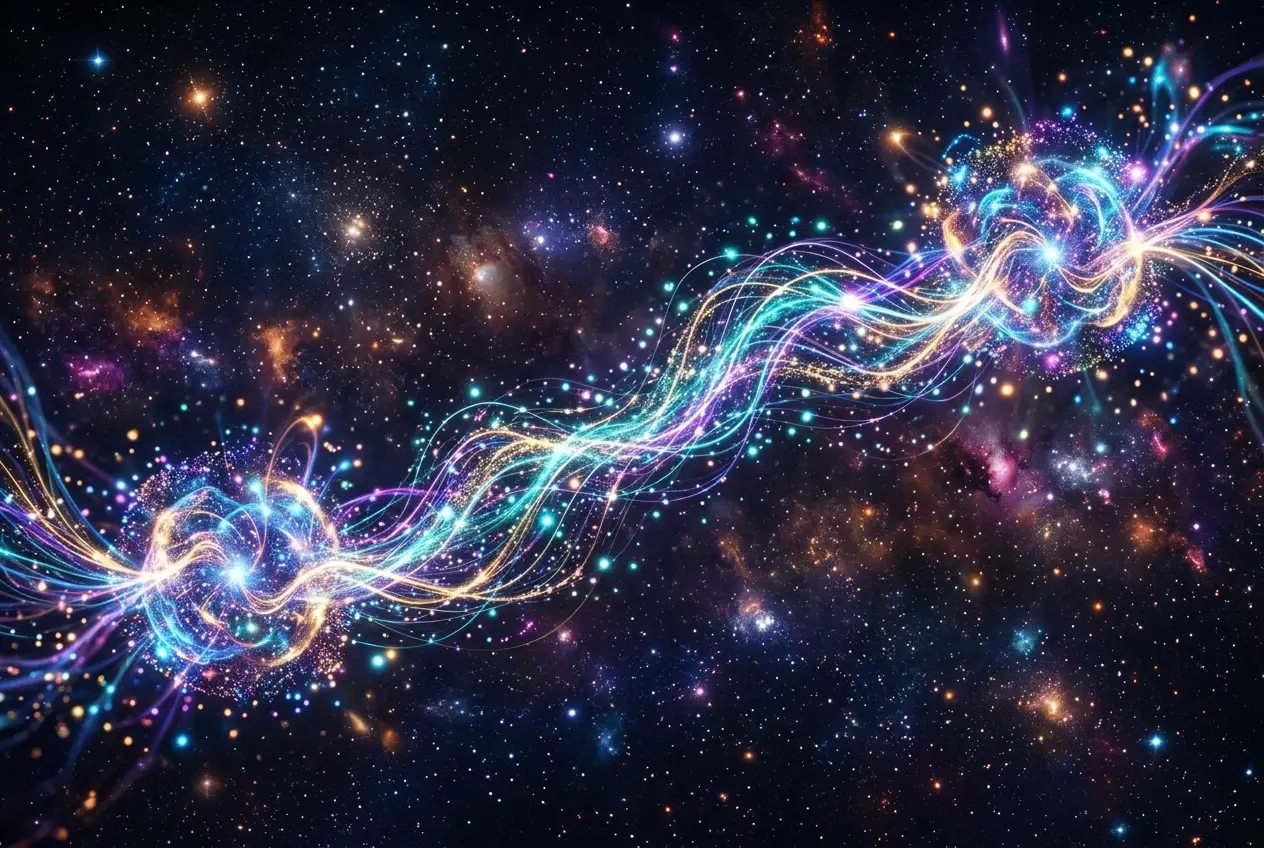
I remember watching Star Trek as a kid, utterly captivated by the idea of 'beaming' people across vast distances. The transporter effect, the shimmering light, the instantaneous relocation – it felt like the ultimate science fiction fantasy. But what if I told you that the core concept behind this fantastical technology isn't just fiction anymore? It's real, at least in a limited, quantum sense. We're talking about quantum teleportation, a mind-bending phenomenon that's stretching the very fabric of our understanding of reality and prompting us to ask: Could Quantum Teleportation Send Matter Across Space?
No, we’re not quite at the point where Captain Kirk can dematerialize from the Enterprise and reappear on an alien planet. But the science behind quantum teleportation is undeniably real and profoundly exciting. It’s a field where the bizarre rules of the subatomic world open doors to possibilities that were once confined to the pages of sci-fi novels.
Unpacking the Quantum Realm: More Than Just Small
Before we dive into the mechanics of quantum teleportation, let's briefly grasp what makes the quantum world so different. Unlike our everyday "classical" world, where objects have definite properties (like a ball being in one place at one time), particles at the quantum level behave very strangely. They can exist in multiple states simultaneously (superposition) and become intrinsically linked, even when separated by vast distances – a phenomenon Einstein famously called "spooky action at a distance." This "spooky action" is what we call quantum entanglement.
Quantum entanglement is the bedrock of quantum teleportation. When two particles become entangled, their fates are intertwined. If you measure a property of one entangled particle, you instantaneously know the corresponding property of the other, no matter how far apart they are. For a deeper dive into this bizarre connection, you might want to read our blog on how-does-quantum-entanglement-defy-space-time-5424.
What Exactly Is Quantum Teleportation?
The term "teleportation" can be misleading. In science fiction, it implies moving an object from one location to another. In quantum mechanics, it's not about physically moving particles. Instead, quantum teleportation is the transfer of quantum information from one location to another, without physically moving the particle itself.
Imagine you have a particle, let's call it particle A, with a specific quantum state (e.g., its spin or polarization). The goal of quantum teleportation is to recreate that exact quantum state on another distant particle, particle C, without particle A ever traveling to C's location.
Here’s a simplified breakdown of how it works:
- Entangled Pair: You need an entangled pair of particles, B and C, which are shared between two locations (let’s call them Alice’s lab and Bob’s lab). Alice has particle B, Bob has particle C.
- The Mystery Particle: Alice also has the particle A, whose quantum state she wants to teleport to Bob.
- Joint Measurement: Alice performs a special joint measurement on her particle A and her entangled particle B. This measurement effectively "scrambles" the original state of particle A, making it lose its identity, but it collapses the entangled state of B and C in a specific way.
- Classical Communication: The result of Alice’s measurement is then sent to Bob via a classical communication channel (like a radio signal or email). This is a crucial step; quantum teleportation is not faster than light. The information about the measurement result is classical information, which always travels at or below the speed of light.
- Reconstruction: Bob receives Alice’s classical information. Using this information and his entangled particle C, he performs a specific operation on C. This operation transforms particle C into an exact replica of the original quantum state of particle A.
Crucially, the original particle A is destroyed in the process (or rather, its quantum state is irrevocably altered). You can't just copy quantum information; you can only transfer it. This is due to the no-cloning theorem in quantum mechanics, which states that an arbitrary unknown quantum state cannot be perfectly copied.
Milestones and Achievements
The concept of quantum teleportation was first proposed theoretically in 1993. Since then, scientists have made incredible progress:
- 1997: The first experimental quantum teleportation was demonstrated by two independent teams, one led by Anton Zeilinger at the University of Innsbruck and another by Francesco De Martini at the University of Rome. They teleported the quantum state of a photon.
- Early 2000s: Teleportation was achieved with larger particles, like atoms.
- 2012: Quantum teleportation was successfully demonstrated between distant optical fiber links, a crucial step for quantum communication networks.
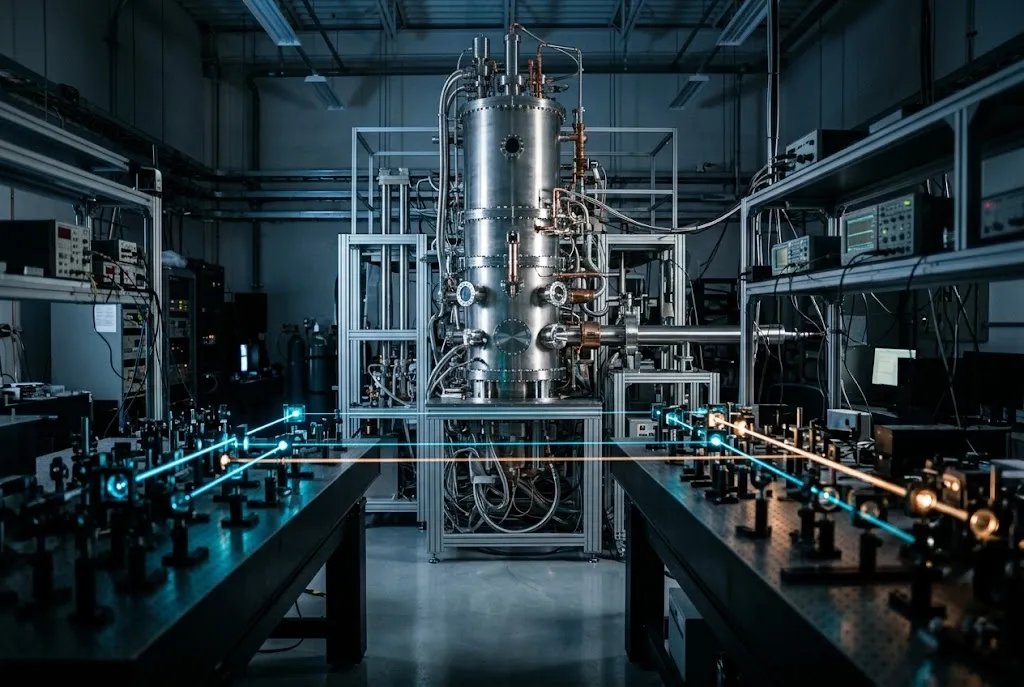
- 2017: Chinese scientists achieved quantum teleportation over a record-breaking 1,200 kilometers (745 miles) between a ground station and a satellite (Micius satellite). This proved the viability of quantum communication in space.
- 2020s: Experiments are now exploring teleportation in more complex systems, including within quantum processors. The implications for quantum computing are significant; for example, you can learn more about how quantum computing is revolutionizing various fields in our blog: can-quantum-computers-break-every-encryption-1438.
These achievements, though primarily involving photons and electrons, are monumental. They confirm the validity of quantum mechanics and pave the way for a future where quantum communication and computing are commonplace. For more detailed information, I always recommend exploring resources like the Wikipedia article on Quantum Teleportation (opens in a new tab).
The "Matter Across Space" Conundrum
So, if we can teleport the quantum state of a photon, why can't we teleport a human? The jump from a single photon to a macroscopic object like a person is gargantuan, primarily due to several immense challenges:
1. The Sheer Number of Particles
A single photon has a relatively simple quantum state. A human being, on the other hand, is an incredibly complex arrangement of trillions of atoms, each with its own quantum state, interacting in countless ways. To teleport a person, you would theoretically need to precisely measure and transfer the quantum state of every single particle in their body – a feat currently beyond our wildest capabilities.
2. Maintaining Coherence
Quantum states are incredibly fragile. They are highly susceptible to decoherence, which means they lose their quantum properties (like superposition and entanglement) when they interact with their environment. The warmer and larger an object, the faster it decoheres. Keeping a complex system like a human body in a coherent quantum state long enough to perform measurements and reconstruction is practically impossible with current technology.
3. The Measurement Problem
To extract the quantum information of a particle, you have to measure it. As soon as you measure a quantum state, it collapses from a superposition into a definite state. For a person, this would mean the destruction of the original body’s exact quantum configuration during the measurement process. And as mentioned, the classical information about these measurements still needs to be sent, making it impossible to transmit faster than light. This concept is extensively discussed in the Wikipedia article on the Measurement Problem (opens in a new tab).
4. The Data Bandwidth Challenge
Even if we could measure every particle in a human, transmitting that classical information would require an astronomical amount of bandwidth. Think about the amount of data in a single high-definition video, then multiply that by the complexity of every atom in a living, breathing person. It’s an unimaginably vast amount of information.
Future Prospects: Is Star Trek Teleportation Ever Possible?
The scientific consensus today is that teleporting macroscopic objects, especially living beings, in the Star Trek sense, is impossible due to the fundamental laws of physics as we understand them. The no-cloning theorem and the challenges of decoherence, measurement, and classical information transfer present formidable barriers.
However, the field of quantum mechanics is still relatively young, and there are theories that push the boundaries of our understanding. Some physicists explore ideas like emergent properties, where complexity itself might behave differently, or new interpretations of quantum gravity. But these remain highly speculative.
The Realistic Future: Quantum Internet and Communication
While human teleportation remains firmly in the realm of fiction, the actual applications of quantum teleportation are incredibly promising for technology.
1. Quantum Internet: The ability to teleport quantum states is a cornerstone of building a global quantum internet. This network would use entangled particles to transmit information with unprecedented security, resistant to hacking.
2. Quantum Cryptography: Quantum teleportation is central to quantum key distribution (QKD), a method for securely exchanging encryption keys. Because any attempt to intercept the key would disturb its quantum state, QKD offers unparalleled security.
3. Quantum Computing Enhancements: Teleportation could be used to transfer quantum information between different parts of a quantum computer, or even between different quantum processors, enabling more powerful and distributed quantum computations.
4. Fundamental Science: Continued research into quantum teleportation helps us better understand the fundamental nature of reality, space-time, and information itself. Each experiment pushes the boundaries of our knowledge. You can find more details on how classical information is handled in computing and communication at Wikipedia's page on Classical Information (opens in a new tab).
Conclusion: A Journey, Not a Destination
So, while "beaming" ourselves to distant planets might remain a cherished dream of science fiction, the reality of quantum teleportation is no less astounding. It’s a testament to the mind-bending nature of the quantum world, showing us that reality is far stranger and more fascinating than we often imagine. We are not just exploring the universe; we are exploring the very rules that govern its existence. The journey of understanding quantum mechanics is a continuous quest, promising revolutionary technologies and a deeper comprehension of the cosmos, even if it doesn't lead to instantaneous space travel for humans. The universe, it seems, still prefers the scenic route.



Conversation0
No comments yet. Be the first to share a thought — the best questions often become new stories.