


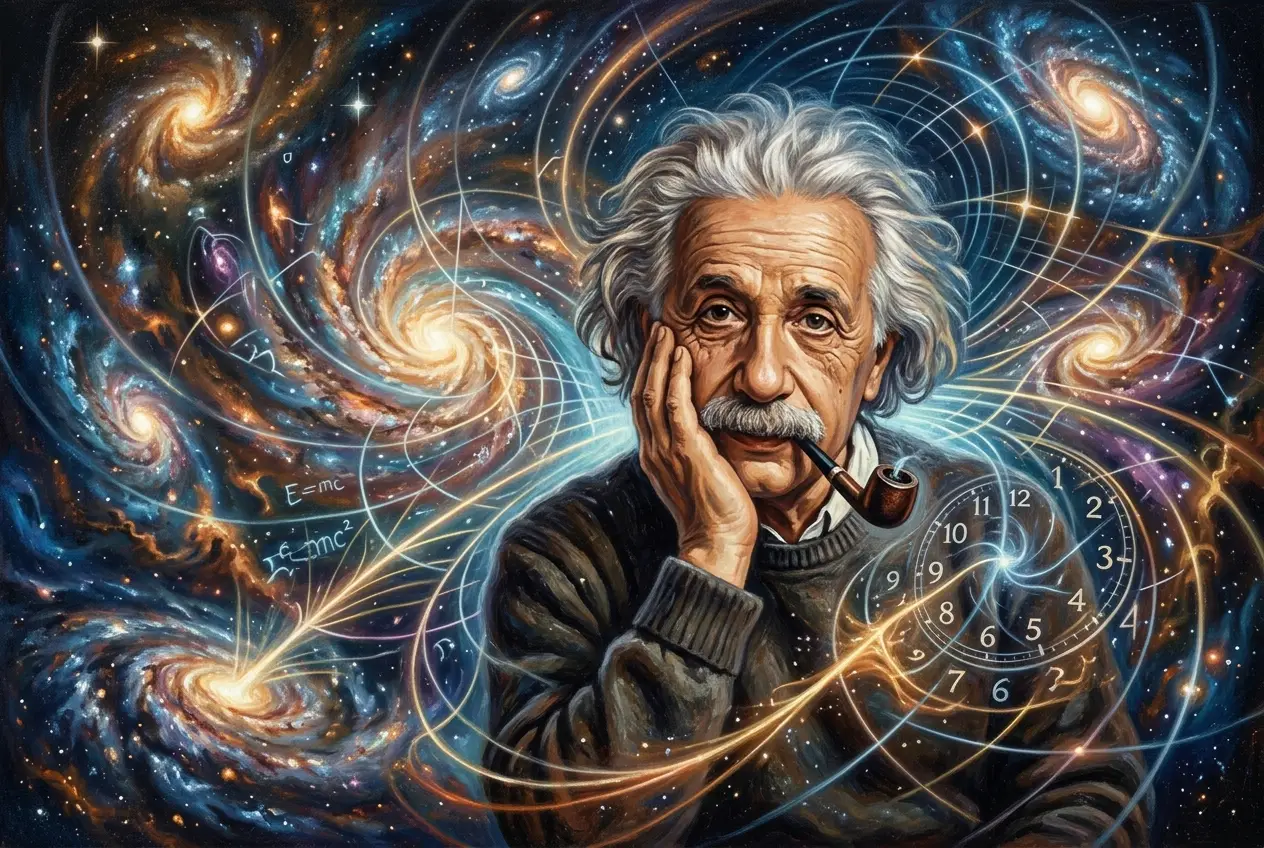
I've embarked on a fascinating journey, one that delves deep into the life and mind of perhaps the most iconic scientist in human history: Albert Einstein. This isn't just a brief overview; this is a comprehensive, epic exploration of a man whose ideas reshaped our understanding of the universe, a man whose name became synonymous with genius. Prepare yourself, for this is going to be a very long blog, meticulously detailing the trials, triumphs, and profound insights of a truly extraordinary individual.
The Early Sparks of a Rebel Mind (1879-1896)
Albert Einstein was born on March 14, 1879, in Ulm, Germany, to Hermann Einstein, a salesman and engineer, and Pauline Koch. His early life, I discovered, was not exactly indicative of the prodigy he would become. In fact, many biographers note that he was a late talker, which initially worried his parents. I can only imagine their concern, contrasting sharply with the global impact their son would eventually have.
Growing up, I've learned, Einstein displayed a profound sense of wonder, a trait that would define his entire career. A pivotal moment, often recounted, occurred when he was five years old. His father showed him a pocket compass, and the invisible forces guiding the needle utterly captivated young Albert. He later recalled this as a profound experience, suggesting that "something deeply hidden had to be behind things." This simple compass, I believe, planted the first seed of his lifelong quest to understand the fundamental laws of nature.
His formal education was a mixed bag. He attended a Catholic elementary school, and later, the Luitpold Gymnasium (now the Albert-Einstein-Gymnasium) in Munich. Here, I found a stark contrast to his later brilliance. He often chafed under the rigid, authoritarian Prussian school system, which he found stifling and dull. Rote memorization and strict discipline were antithetical to his inquisitive, independent spirit. He once famously remarked, "The greatest joy of all is to think and feel," a sentiment that was rarely encouraged in his classrooms.
Despite his struggles with the traditional system, certain subjects ignited his intellect. Mathematics, physics, and philosophy were his true passions. His uncle, Jakob Einstein, introduced him to algebra, and Max Talmud, a medical student who occasionally dined with the Einstein family, became a mentor, recommending books on popular science and philosophy, including works by Immanuel Kant and Euclid's Elements. I can almost picture the young Albert, poring over these texts, absorbing complex ideas far beyond his years. This self-driven learning, rather than formal schooling, became the bedrock of his intellectual development.
By the age of 16, Einstein was already grappling with profound philosophical questions. I was particularly struck by his thought experiment: What would the world look like if I rode on a beam of light? This simple yet revolutionary query laid the groundwork for his later work on special relativity, demonstrating his unique ability to visualize complex physical phenomena.
Switzerland, The Patent Office, and the Annus Mirabilis (1896-1905)
Disillusioned with the German school system and wishing to avoid military service, Einstein renounced his German citizenship in 1896 and moved to Switzerland. He applied to the Swiss Federal Polytechnic School (Eidgenössische Polytechnische Schule, now ETH Zurich) but failed the entrance exam initially, specifically in non-science subjects. He completed his secondary education at Argovian Cantonal School in Aarau, Switzerland, where he thrived in a more liberal environment. He reapplied to the Polytechnic the following year and was accepted into the mathematics and physics teaching diploma program.
During his time at ETH Zurich (1896-1900), he found some professors inspiring, but others, he felt, hindered his independent thought. He often skipped lectures to study physics on his own, devouring the works of Kirchhoff, Helmholtz, and Lorentz. He befriended Michele Besso, a fellow student who became a lifelong confidant and intellectual sounding board. I often wonder how many groundbreaking ideas were first whispered between these two friends over coffee.
After graduating in 1900, Einstein faced a challenging period. He couldn't immediately find an academic position, despite his qualifications. This was, I believe, a testament to his unconventional approach; he wasn't always seen as a "team player" in traditional academia. After two years of struggling, he secured a position as a patent clerk at the Swiss Patent Office in Bern in 1902, thanks to a friend's father.
This job, ironically, proved to be a blessing in disguise. While evaluating patent applications for electromagnetic devices, Einstein gained a practical understanding of technology and a rigorous approach to analyzing physical concepts. The work was demanding but left him ample time to pursue his own scientific inquiries in his spare moments. This was his "thinking laboratory," a place where his most revolutionary ideas would germinate.
Then came 1905, a year that would forever be known as Einstein's Annus Mirabilis (Miracle Year). In this single year, he published four seminal papers in the prestigious journal Annalen der Physik, each of which independently revolutionized a branch of physics:
- The Photoelectric Effect: "On a Heuristic Point of View Concerning the Production and Transformation of Light." This paper proposed that light, despite being understood as a wave, also behaves as discrete packets of energy called "quanta" (later photons). This contradicted classical physics and contributed significantly to the development of quantum theory. For this work, I'm reminded, he would eventually receive the Nobel Prize in Physics in 1921. You can read more about the photoelectric effect on Wikipedia (opens in a new tab).
- Brownian Motion: "On the Movement of Small Particles Suspended in a Stationary Liquid Demanded by the Molecular Kinetic Theory of Heat." This paper provided empirical evidence for the existence of atoms and molecules by explaining the seemingly random movement of particles in a fluid. This was a crucial step in convincing the scientific community about the reality of atoms.
- Special Relativity (Part 1): "On the Electrodynamics of Moving Bodies." This groundbreaking paper introduced his theory of special relativity, positing that the laws of physics are the same for all non-accelerating observers, and that the speed of light in a vacuum is the same for all observers, regardless of the motion of the light source. This led to radical conclusions about the nature of space and time, demonstrating their relativity.
- Special Relativity (Part 2) & Mass-Energy Equivalence: "Does the Inertia of a Body Depend Upon Its Energy Content?" This paper was a follow-up to his special relativity theory, introducing the most famous equation in physics: E=mc². It showed that mass and energy are interchangeable and equivalent, laying the foundation for nuclear physics and the atomic age.
I find it almost unbelievable that one person could produce such a volume of revolutionary work in a single year, all while holding down a full-time job. It speaks volumes about his focus, his profound intuition, and his unwavering dedication to unraveling the universe's secrets.
From Obscurity to Academic Prominence (1905-1915)
Despite the revolutionary nature of his 1905 papers, it took some time for the broader scientific community to fully grasp their implications. Initially, Einstein remained largely unknown outside a small circle of physicists. I've often thought about the sheer mental fortitude it must have taken to continue pushing boundaries when your most profound ideas are met with skepticism or indifference.
However, the quality of his work eventually shone through. In 1908, he became a Privatdozent (an unpaid lecturer) at the University of Bern. This was his first step back into academia. The following year, I learned, he finally left the patent office to accept a position as associate professor of theoretical physics at the University of Zurich. This marked the true beginning of his academic career.
During these years, Einstein continued to refine his ideas and delve deeper into the implications of relativity. He moved through various prestigious academic posts: a full professorship at the Karl-Ferdinand University in Prague (1911), then back to ETH Zurich as a professor (1912), and finally, in 1914, he accepted a coveted position at the Prussian Academy of Sciences in Berlin, which also made him director of the Kaiser Wilhelm Institute for Physics. This move placed him at the heart of the German scientific establishment, a hub of intellectual activity.
His work during this period was increasingly focused on extending his special theory of relativity to include gravity. He realized that special relativity, which dealt only with uniform motion, couldn't fully explain phenomena involving acceleration or gravity. This challenge led him to the monumental task of developing the General Theory of Relativity.
The Grand Design: General Relativity (1915)
The development of the General Theory of Relativity was a painstaking, decade-long intellectual struggle. I often reflect on the sheer scale of this undertaking; it was not merely an adjustment to existing physics, but a complete reimagining of gravity itself. Einstein sought to describe gravity not as a force acting between masses, but as a curvature of spacetime caused by the presence of mass and energy.
Imagine, if you will, a bowling ball placed on a stretched rubber sheet. The bowling ball creates a dip or a curve in the sheet. If you then roll a marble near the bowling ball, the marble will curve towards it, not because the bowling ball is "pulling" it, but because it's following the curvature of the sheet. This, in essence, is how Einstein envisioned gravity.
The mathematical framework for general relativity was incredibly complex, requiring advanced concepts from differential geometry, which Einstein had to learn with the help of his friend, mathematician Marcel Grossmann. It involved tensor calculus and intricate equations that described how mass and energy dictate the geometry of spacetime, and how this geometry, in turn, dictates the motion of objects.
On November 25, 1915, Einstein finally presented his field equations of general relativity to the Prussian Academy of Sciences. These equations, I believe, are among the most beautiful and profound ever conceived, elegantly linking the distribution of matter and energy to the curvature of spacetime.
Rμν - ½Rgμν + Λgμν = (8πG/c4)Tμν
This equation, often simplified by removing the cosmological constant (Λ), states that the spacetime curvature (left side) is equivalent to the distribution of mass and energy (right side).
The implications of general relativity were staggering:
- Gravitational Lensing: Light from distant stars or galaxies should be bent as it passes near massive objects.
- Precession of Mercury's Perihelion: General relativity accurately explained a small anomaly in Mercury's orbit that Newton's theory could not.
- Gravitational Redshift: Light emitted from a strong gravitational field should be shifted to longer wavelengths (redder).
- Gravitational Waves: Ripples in spacetime, predicted to be generated by accelerating masses, though these would not be directly detected until a century later.
The Eclipse Experiment and Global Fame (1919)
While general relativity was a theoretical masterpiece, experimental verification was crucial. The critical test came in 1919, during a total solar eclipse. Sir Arthur Eddington, a British astronomer, led expeditions to Príncipe Island off the coast of Africa and Sobral in Brazil to observe stars whose light would pass close to the Sun. According to Einstein's theory, the Sun's gravity should bend the starlight, causing the stars to appear slightly shifted from their actual positions.
The results, announced on November 6, 1919, were sensational. Eddington's observations confirmed Einstein's predictions. Suddenly, Einstein, a German scientist in a post-World War I era, became a global celebrity. His name was plastered across newspapers worldwide, proclaiming a revolution in physics. I can only imagine the sheer disbelief and excitement in the scientific community and the general public alike. "Lights all askew in the heavens! Men of science more or less agog," blared a headline in The New York Times.
This recognition, however, came with its own set of challenges. Einstein became a public figure, constantly hounded by media, revered by some, and scrutinized by others. He was now a symbol of intellectual prowess, a reluctant prophet of a new cosmic order. For more on the Eddington experiment, you can consult its Wikipedia page (opens in a new tab).
Personal Life Amidst Scientific Revolution
Einstein's personal life was as complex and multifaceted as his scientific theories. He married Mileva Marić, a Serbian physics student and his former classmate at ETH Zurich, in 1903. Mileva was a brilliant mind in her own right, and there is ongoing debate among historians about the extent of her contributions to Einstein's early work. They had three children: a daughter, Lieserl (born in 1902, whose fate remains largely unknown), and two sons, Hans Albert (born 1904) and Eduard (born 1910).
Their marriage, I regret to say, was fraught with difficulties. The intense intellectual demands of Einstein's work, combined with personal struggles and Mileva's own unfulfilled scientific ambitions, led to increasing strain. They eventually divorced in 1919.
Soon after, in 1919, Einstein married his cousin, Elsa Löwenthal. Elsa provided him with a stable and supportive home life, shielding him from the demands of his newfound fame. Their relationship, while perhaps less intellectually intense than his first marriage, provided him with a sanctuary that allowed him to continue his profound work.
His relationship with his sons was also complex. Hans Albert followed in his footsteps to some extent, becoming a distinguished professor of hydraulic engineering. Eduard, however, suffered from schizophrenia and spent much of his adult life in institutions. I find this aspect of Einstein's life particularly poignant, a reminder that even the greatest minds face deeply human struggles.
A Glimpse into Einstein's Family and Early Career
| Year | Event | Scientific Contribution / Personal Milestone |
|---|---|---|
| 1879 | Born in Ulm, Germany | - |
| 1896 | Renounces German citizenship | Begins studies at ETH Zurich |
| 1900 | Graduates from ETH Zurich | - |
| 1902 | Joins Swiss Patent Office, Bern | Begins independent research |
| 1903 | Marries Mileva Marić | - |
| 1905 | Annus Mirabilis | Photoelectric Effect, Brownian Motion, Special Relativity, E=mc² |
| 1908 | Privatdozent, University of Bern | - |
| 1909 | Associate Professor, University of Zurich | Leaves Patent Office |
| 1914 | Moves to Berlin | Director of Kaiser Wilhelm Institute for Physics |
| 1915 | Completes General Relativity | Field equations published |
| 1919 | Divorce from Mileva; Marries Elsa Löwenthal | Eddington confirms General Relativity; G |
The Quantum Debate and the Quest for Unification (1920s-1930s)
While general relativity solidified Einstein's place in history, his relationship with quantum mechanics, a field he helped pioneer with his work on the photoelectric effect, became increasingly contentious. As quantum theory evolved, particularly with the development of the Copenhagen interpretation by Niels Bohr and others, Einstein grew uncomfortable with its probabilistic nature and the concept of inherent randomness at the subatomic level.
He famously declared, "God does not play dice with the universe." This quote, I believe, encapsulates his philosophical conviction that there must be a deeper, deterministic reality underlying quantum phenomena. He spent much of his later life engaging in debates with Bohr, attempting to find flaws in quantum mechanics through a series of ingenious thought experiments. While these debates often failed to disprove quantum theory, they significantly helped to refine its understanding.
In 1921, Einstein was awarded the Nobel Prize in Physics, not for relativity (which was still considered controversial by some members of the Nobel committee), but for his explanation of the photoelectric effect and "for his services to Theoretical Physics." This, I feel, underscores the revolutionary nature of his early quantum work.
During the 1920s and 1930s, Einstein increasingly dedicated himself to the pursuit of a unified field theory. He sought to create a single theoretical framework that would unite all the fundamental forces of nature – gravity and electromagnetism initially, and later, the strong and weak nuclear forces. This became his holy grail, an intellectual quest that consumed his final decades. He believed that the universe must be described by elegant, deterministic laws, and that quantum mechanics was an incomplete description.
His efforts, while unsuccessful in his lifetime, inspired generations of physicists to pursue similar paths, leading to the development of the Standard Model of particle physics and ongoing research into theories like string theory and quantum gravity. I often reflect on the audacity of his ambition, to try and encompass all of nature's laws within a single, beautiful equation.
The Rise of Nazism and Exile to America (1933)
The political climate in Germany deteriorated rapidly in the early 1930s. As a prominent Jew, a pacifist, and a liberal, Einstein became a target of the burgeoning Nazi regime. His theories, particularly relativity, were denounced as "Jewish physics" and attempts were made to discredit his work. I find this period to be one of the darkest chapters in modern scientific history, where ideology sought to suppress truth.
In 1933, while on a visit to the United States, Einstein learned that Adolf Hitler had come to power in Germany. He made the momentous decision not to return. He was offered a position at the newly established Institute for Advanced Study in Princeton, New Jersey, and accepted it, making America his new home.
His departure from Germany was a profound loss for European science and a stark symbol of the intellectual exodus caused by Nazism. He was stripped of his German citizenship and his property was confiscated. I think about the courage it must have taken to leave everything behind, but also the clarity of vision to recognize the grave danger.
Princeton Years and World War II (1933-1945)
In Princeton, Einstein continued his research at the Institute for Advanced Study, focusing primarily on his unified field theory. He enjoyed the intellectual freedom and the collegial atmosphere, often taking long walks with other eminent scientists and scholars. He quickly became a beloved, if somewhat eccentric, figure on the Princeton campus. His disheveled hair and thoughtful demeanor became iconic.
The looming threat of World War II, however, brought a new dimension to his life. Though a lifelong pacifist, the prospect of Nazi Germany developing atomic weapons deeply concerned him. In 1939, at the urging of fellow physicists Leo Szilard and Eugene Wigner, Einstein signed a letter to President Franklin D. Roosevelt, alerting him to the possibility of an atomic bomb and suggesting that the U.S. pursue its own nuclear research.
This letter, known as the Einstein-Szilard letter, is often credited with initiating the Manhattan Project, the top-secret American effort to develop the atomic bomb. I've often grappled with the irony of a dedicated pacifist playing such a pivotal role in the development of the most destructive weapon ever created. After the war, Einstein expressed profound regret about his role, stating, "I made one great mistake in my life... when I signed the letter to President Roosevelt recommending that atom bombs be made."
He remained a fervent advocate for nuclear disarmament and world peace for the rest of his life, becoming a prominent voice against the proliferation of nuclear weapons. His moral conscience, I believe, was as powerful as his intellect.
Post-War Activism and the Search for a Unified Theory (1945-1955)
After World War II, Einstein remained a prominent figure, not only in science but also in social and political spheres. He became an outspoken advocate for civil rights, supporting the nascent American civil rights movement. He was also a strong proponent of world government and international cooperation, believing that such structures were necessary to prevent future conflicts and the existential threat of nuclear war. I find his unwavering commitment to justice and peace deeply inspiring.
His scientific work in these later years continued to be dominated by the pursuit of a unified field theory. Despite the successes of quantum electrodynamics and the emerging understanding of the strong and weak forces, Einstein remained convinced that a geometric theory, similar to general relativity, could unify all interactions. However, his approach often diverged from the mainstream of physics, which was increasingly embracing quantum field theory.
He often worked in relative isolation on this problem, sometimes to the bewilderment of his colleagues. "I have no special talents," he once said. "I am only passionately curious." This curiosity, I've observed, was his driving force, pushing him to challenge conventional wisdom and search for deeper truths.
His final years were marked by a blend of continued intellectual intensity and a growing awareness of his legacy. He passed away on April 18, 1955, at the age of 76, at Princeton Hospital, due to a ruptured abdominal aortic aneurysm. His last words, spoken in German, were reportedly lost because the attending nurse did not understand the language. He had been working on a unified field theory until his very last moments.
The Legacy of a Titan
Albert Einstein's legacy is immeasurable. He didn't just contribute to physics; he fundamentally changed how we perceive reality. His theories of relativity shattered classical notions of absolute space and time, revealing a dynamic, interconnected cosmos. E=mc² became the equation heard around the world, forever linking mass and energy. His work on the photoelectric effect helped launch the quantum revolution, despite his later reservations.
Beyond his scientific contributions, Einstein's persona – the wise, disheveled genius with a twinkle in his eye – captured the public imagination. He became an icon of intellect, curiosity, and humanity. His quotes are ubiquitous, inspiring generations to think critically, challenge assumptions, and pursue knowledge with passion.
I've learned that his impact extends far beyond the realm of theoretical physics. His work laid the foundation for numerous technological advancements, from nuclear power and GPS to lasers and photoelectric cells. The very fabric of our modern technological world, I believe, is woven with threads of Einstein's genius.
His philosophical stance, his pacifism, and his activism for civil rights continue to resonate. He used his immense platform to advocate for a better world, demonstrating that the pursuit of scientific truth is intrinsically linked to ethical responsibility. You might be interested in a previous blog we wrote about The Baghdad Battery: Could Ancient Civilizations Harness Electricity? which explores how historical tech often sparks similar questions of innovation.
Einstein's Enduring Mystique: Unfinished Business
Despite his incredible achievements, Einstein left behind unfinished business, most notably his quest for a unified field theory. This grand challenge remains one of the holy grails of modern physics. Today, physicists continue to grapple with reconciling general relativity (which describes gravity and the large-scale structure of the universe) with quantum mechanics (which describes the other fundamental forces at the subatomic level). Theories like string theory, loop quantum gravity, and other approaches are direct descendants of Einstein's ambitious vision.
His insights continue to guide contemporary research in astrophysics, cosmology, and quantum physics. Gravitational wave observatories like LIGO, for example, directly confirm predictions made by his general relativity a century ago. The search for dark matter and dark energy, the mysterious components that dominate our universe, is deeply rooted in the relativistic framework he established. If you're fascinated by cosmic mysteries, you might enjoy our article on Do Ghost Galaxies Haunt Our Cosmic Voids?.
I often wonder what Einstein would make of today's scientific landscape. Would he be thrilled by the detection of gravitational waves or the images from the James Webb Space Telescope? Would he find new avenues for his unified field theory in the complexities of quantum gravity? His legacy is not just a collection of completed theories, but a testament to the power of relentless inquiry and the courage to question the very foundations of reality.
As I reflect on the entirety of Albert Einstein's life, I see a figure of immense complexity: a solitary thinker who yearned for connection, a fierce individualist who cared deeply about humanity, and a revolutionary scientist whose greatest insights came from simple thought experiments. He was a man who, with a compass and a beam of light, started a journey that truly rewrote reality.



Conversation0
No comments yet. Be the first to share a thought — the best questions often become new stories.