


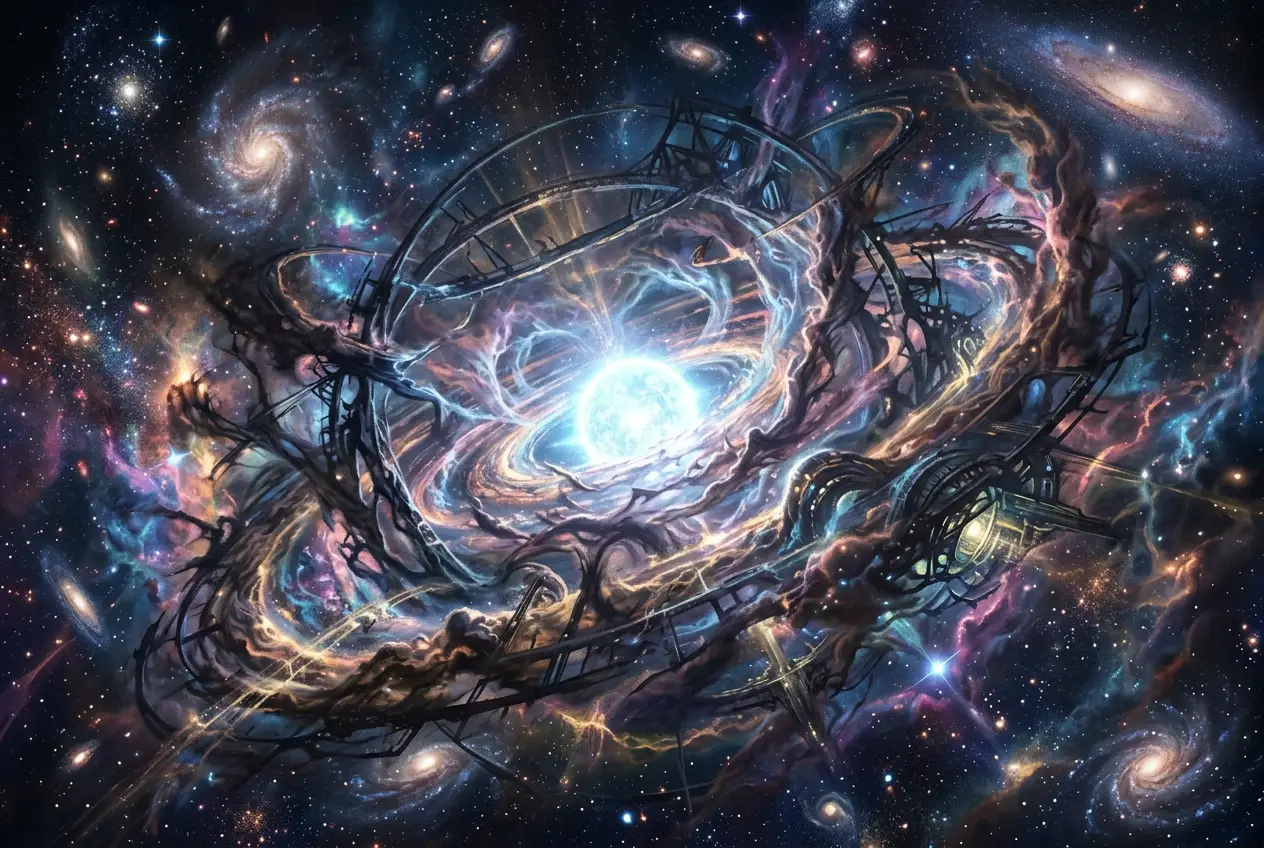
I remember the first time I heard about Tabby's Star. It wasn't through a scientific journal, but a late-night podcast discussing cosmic mysteries. The speaker described a star so baffling, so utterly unconventional, that it had astronomers scratching their heads and the public buzzing with a tantalizing possibility: alien megastructures. My imagination immediately soared. Was this it? Had we found definitive proof of advanced extraterrestrial intelligence manipulating stars on a galactic scale?
The story of Tabby's Star, officially known as KIC 8462852, is a quintessential tale of scientific discovery meeting cosmic enigma. It’s a narrative that blends rigorous data analysis with thrilling speculation, reminding us just how much we still don't understand about the universe, and how a single anomaly can push the boundaries of our knowledge.
The Star That Wouldn't Behave
In 2015, Tabetha Boyajian, an astronomer at Louisiana State University, along with a team of citizen scientists from the Planet Hunters project, published a paper detailing the bizarre behavior of KIC 8462852. This was no ordinary star. Discovered by NASA’s Kepler Space Telescope, which was designed to find exoplanets by detecting slight dips in a star’s brightness as planets pass in front of them, Tabby’s Star was doing something far stranger.
Kepler had observed KIC 8462852 over four years, and the data showed highly erratic and unprecedented dimming events. Instead of the regular, shallow dips caused by orbiting planets (which typically block 0.5% to 1% of a star's light), Tabby’s Star exhibited deep, irregular, and prolonged dimming episodes, sometimes blocking up to 22% of its light. Imagine trying to peer through a window that’s suddenly covered by a massive, chaotic, and non-uniform curtain – that’s what astronomers were seeing.
What made this particularly baffling was the asymmetry and aperiodicity of the dips. Planetary transits are symmetrical and occur at regular intervals. KIC 8462852’s dips were anything but. They varied in depth, duration, and seemed to occur randomly. This wasn't a planet. It wasn't even a large group of planets. This was something entirely new, something that defied conventional astrophysical explanations.
Ruling Out the Usual Suspects
When faced with an anomaly, scientists first try to explain it with known phenomena. The team meticulously worked through every plausible natural explanation:
- Giant Planets or Brown Dwarfs: These would cause regular, deep dips, not the chaotic pattern observed. Ruled out.
- Stellar Flares or Spots: These usually cause brightening or shallow dips, not prolonged obscuration. Ruled out.
- Dust Clouds from a Catastrophic Collision: While a massive collision of rocky bodies could produce a lot of dust, the expected infrared emission from such warm dust wasn't detected to the extent that it would cause such dimming. Furthermore, the longevity and irregularity of the dimming events didn’t fit a simple, one-off collision model.
- Swarm of Comets: This was one of the stronger initial natural hypotheses. A family of large comets, perhaps perturbed by another star, could theoretically pass in front of KIC 8462852, blocking its light. However, the sheer number and size of comets required to produce such deep and prolonged dimming would be unprecedented. Furthermore, subsequent analysis of the star's historical light data, stretching back to the 19th century, revealed a long-term, gradual dimming trend that couldn't be explained by comets alone. You can learn more about the Kepler mission and its incredible discoveries on its Wikipedia page (opens in a new tab).
The "Alien Megastructure" Hypothesis: A Spark of Speculation
With natural explanations struggling to account for all the observed phenomena, astronomer Jason Wright and his colleagues put forth a truly audacious hypothesis: an alien megastructure. Specifically, they suggested the dimming could be caused by components of a Dyson swarm – a theoretical construct built by an advanced civilization to harness a star's energy.
A Dyson sphere (or more practically, a Dyson swarm of collectors) is a hypothetical megastructure that completely encompasses a star to capture its energy. The idea was first proposed by physicist Freeman Dyson in 1960. While a complete sphere would be incredibly difficult to build, a swarm of individual structures (like solar panels or habitats) orbiting the star would be more feasible. If such a swarm were under construction or partially complete, it could explain the irregular, deep dips in light. The lack of excess infrared radiation (which would be expected from waste heat if a complete sphere were being built) was a significant counter-argument, but a partial or incomplete swarm might not radiate enough to be easily detectable. For a deeper dive into this fascinating concept, visit the Dyson sphere Wikipedia page (opens in a new tab).
The idea, though speculative, wasn't baseless. It emerged because every known natural explanation had significant shortcomings. This hypothesis triggered a massive wave of public and scientific interest, breathing new life into the search for extraterrestrial intelligence (SETI). It also reminded me of other historical mysteries, like the complex mechanisms of the Antikythera Mechanism, prompting me to wonder: could ancient civilizations here have possessed advanced understanding that still baffles us today? It makes me think about how we interpret unexplained technology, whether it's an ancient cosmic computer or something else, like the unexplained anomalies on our own moon, as discussed in our blog, Mysteries on the Moon: Are Anomalies Unexplained Tech?.
Diving Deeper: New Data, Refined Theories
The alien megastructure theory, while thrilling, spurred further, more detailed scientific investigation. Astronomers turned other powerful telescopes towards KIC 8462852.
-
Multi-wavelength Observations: Telescopes like NASA’s Spitzer Space Telescope (infrared) and Swift Gamma-Ray Burst Explorer (ultraviolet and X-ray) were used to observe the star. Crucially, these observations during subsequent dimming events in 2017 showed that the star was dimming more significantly in blue light than in red light. This is a tell-tale sign of dust. Smaller dust particles scatter blue light more effectively than red light, while larger, opaque objects block all wavelengths equally. This differential dimming strongly supports a scenario where the obscuring material is fine dust.
-
Long-Term Dimming: Independent analysis of historical photographic plates from the Harvard College Observatory, dating back to the 1890s, revealed that Tabby’s Star had been steadily dimming over the past century, losing about 16% of its brightness. This long-term dimming, combined with the rapid, short-term dips, suggests a complex and ongoing process, perhaps involving multiple factors.
The Current Leading Natural Hypothesis: Dust, Dust, and More Dust
Today, the scientific consensus largely leans towards natural explanations involving dust. However, it’s not just any dust. The leading theories propose complex scenarios:
- Fragmented Comets or Exomoons: A large, massive comet or even an exomoon could have fragmented relatively recently, creating a vast cloud of dust and debris that orbits the star. The fragments and dust clouds would evolve over time, leading to irregular dimming events. The long-term dimming could be due to a gradual dispersion of this dust.
- Ringed Planet Breaking Up: Another intriguing idea is that a large, ringed planet or even a debris disk from a planet that was tidally disrupted (pulled apart by the star's gravity) could be the source of the obscuring dust.
- Variable Star with Circumstellar Dust: While not a "normal" variable star, it's possible KIC 8462852 has some intrinsic variability coupled with a substantial, evolving circumstellar dust cloud.
The current understanding, primarily driven by the multi-wavelength observations, suggests that while the obscuring material is likely dust, the source and behavior of this dust are still not fully understood. It’s an unusual star with an unusual environment, challenging our models of stellar evolution and planetary systems.
Why Tabby's Star Still Matters
Even if Tabby's Star doesn't turn out to be home to an alien megastructure, its story is incredibly important.
- Pushes Scientific Inquiry: It demonstrates the scientific process at its best – an anomaly is observed, hypotheses are formed, data is collected, theories are refined or discarded. It challenges us to look beyond conventional explanations.
- Inspires Curiosity: The public fascination with Tabby's Star highlights humanity's innate curiosity about the universe and our place in it. It reminds us that there are still profound mysteries waiting to be unraveled.
- Refines Our Understanding of Exoplanets and Stellar Systems: Studying such an extreme case helps astronomers better understand the diversity of star systems, the dynamics of dust and debris around stars, and potentially even new types of astronomical phenomena. It also makes us consider the sheer diversity of celestial bodies, much like the exotic nature of black holes and their potential as ultimate quantum computers, a topic explored in our blog, Black Holes: Nature's Ultimate Quantum Computers?.
The mystery of KIC 8462852 continues. While the alien megastructure theory has largely faded from the forefront of scientific discussion, the star remains one of the most intriguing objects in our galaxy. It stands as a testament to the fact that the cosmos is full of surprises, and that even when our initial, most exciting hypotheses don't pan out, the journey of discovery itself is profoundly rewarding. Perhaps one day, we'll encounter another such enigma, and this time, the evidence will undeniably point to something... other. But until then, the universe continues to amaze us with its natural, baffling wonders.
The Ongoing Search
Astronomers continue to monitor Tabby's Star. As technology advances and more powerful telescopes come online, we will undoubtedly gather more data that might finally resolve this cosmic riddle. Perhaps future observations will reveal new insights into the evolution of dust clouds around stars, or perhaps, just perhaps, they will uncover a signature that makes us reconsider the initial, thrilling proposition. One thing is for sure: the universe keeps its secrets close, but human curiosity is a relentless force.
In Conclusion
Tabby's Star, KIC 8462852, is more than just an astronomical curiosity; it's a symbol of the unknown that still permeates our universe. It challenges our assumptions, fuels our imagination, and pushes the boundaries of scientific inquiry. While the current evidence points towards complex natural phenomena, the initial "alien megastructure" hypothesis captured the world's attention and reminded us of the tantalizing possibility of intelligent life beyond Earth. As we continue to gaze at the stars, anomalies like Tabby's Star will always serve as powerful reminders that the universe is far stranger, and more wonderful, than we can possibly imagine. The pursuit of understanding these anomalies is what drives science forward, sparking awe and wonder with every new discovery.


Conversation0
No comments yet. Be the first to share a thought — the best questions often become new stories.